Coverage now opens on a verdict stage, with the sweep playing live
The coverage grid used to hand you a grid and leave you to interpret it. It now states the verdict in one sentence, counts the figures up beneath it, and plays the sweep in a fullscreen theatre while it runs.
Here is the question that ends meetings badly. A vendor proposes a renewal uplift, your CFO asks whether anything in the estate stops them, and nobody in the room can answer. Not because the answer is hard, but because it lives in forty separate PDFs, three of which are scans, and the last person who read them left in March. So the answer becomes we think so, and we think so is a negotiating position worth nothing. We wrote about the shape of this problem when the grid first shipped, in the must-have coverage grid. This post is about what we changed in how it opens.
The named problem: a grid is evidence, not an answer
The original coverage screen worked. You picked a protection, it swept every agreement, and it returned a grid of present, absent, and weak. Buyers used it. But we watched how they used it, and the pattern was consistent: they opened the grid, scanned for red, and then spent eleven minutes rebuilding a sentence in their head that the system already knew. The grid told them what was in each cell. It did not tell them what the estate said.
That gap matters because coverage work is almost never done for its own sake. It is done ninety minutes before a call, or the morning a renewal notice lands, or in the hour after the CFO asks a question in a steering meeting. In all three cases the buyer needs a headline first and the evidence second. A grid inverts that order. It hands you the evidence and asks you to write the headline yourself, under time pressure, from twelve columns of cell states.
So coverage now opens the way Second Opinion opens. A navy stage states the verdict in one sentence. The figures count up beneath it: agreements swept, protections checked, gaps found, weak language flagged. You read the sentence in two seconds, and then you decide whether you need the detail.
The verdict stage, and what it is allowed to say
The sentence is written to be usable out loud. Not coverage analysis complete, which tells you nothing, but something a buyer can repeat to a CFO without editing it. As an illustration of the form: nine of your twenty largest agreements carry no cap on renewal uplift, and four of those renew inside the next two quarters. That is a sentence with a subject, a number, and a deadline in it. It is the thing you were going to write anyway.
The counters underneath exist to make the verdict auditable at a glance. If the stage says nine gaps and the counter says twenty agreements swept, you know the denominator. If the swept figure is lower than your estate, you know immediately that something did not parse and you should look at the exclusions before you quote the number in a meeting. We would rather you catch that in the first four seconds than in front of the vendor.
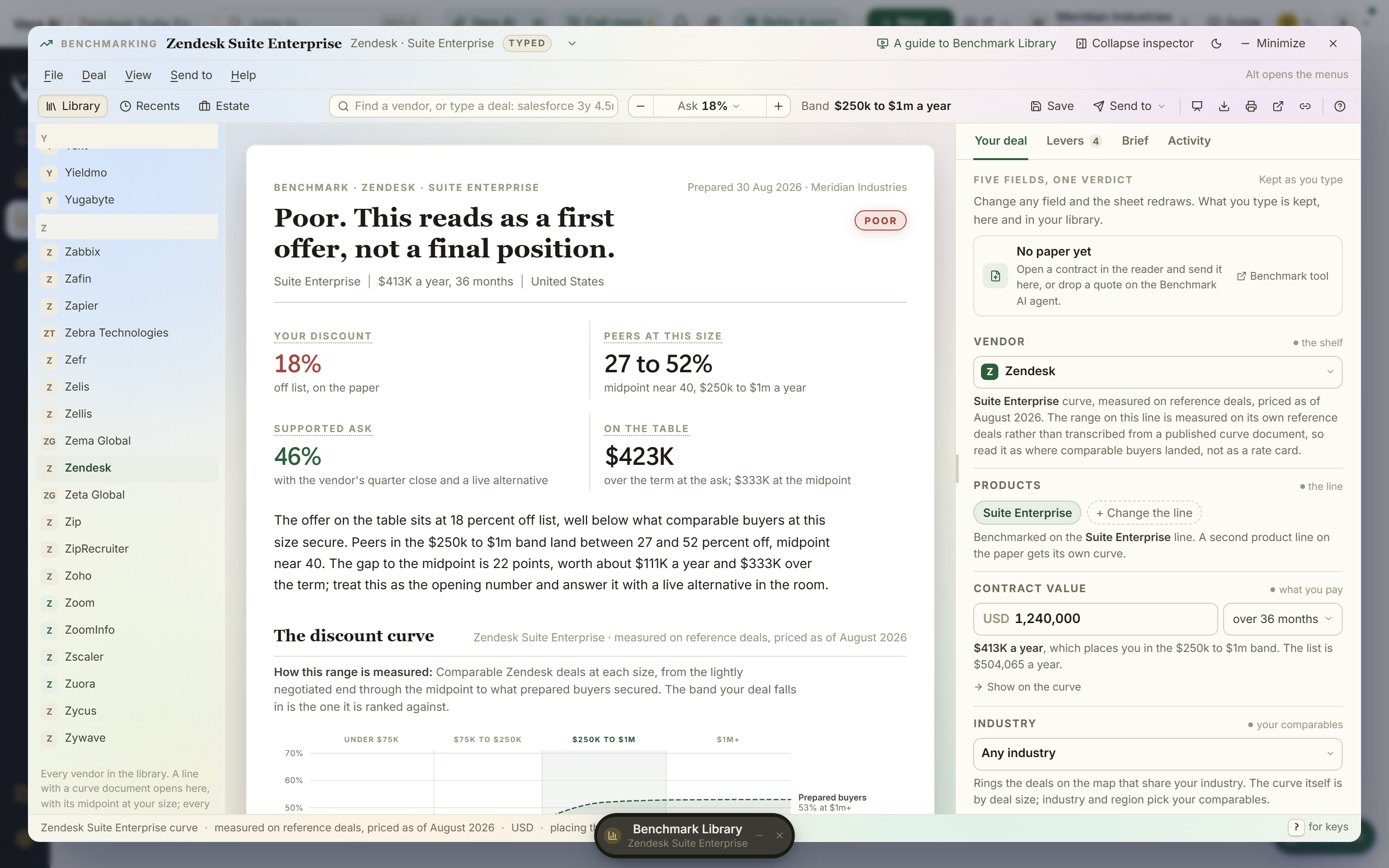
The theatre: watching the sweep instead of watching a spinner
Press Run coverage check and the screen raises a fullscreen theatre. The sweep plays live. Position lines tick in as each agreement is read, a gold arc tracks the real batches moving through the queue, and the completion line types itself when the verdicts land. This is the same treatment we gave contract analysis in the Workup Theatre, and the reasoning is the same.
The honest reason is not aesthetics. It is trust. A coverage sweep across a real estate takes minutes, not seconds, because it is reading whole documents rather than pattern matching on filenames. A progress bar that sits at sixty per cent for ninety seconds teaches a buyer to distrust the output. An arc that tracks actual batch completion, with position lines appearing as each agreement resolves, teaches the opposite. You can see the work happening, so you can see which agreement was in flight when something looked wrong.
There is a practical side effect. The theatre is watchable in front of other people. Several buyers now run the sweep live at the start of an internal renewal review rather than pre-baking a slide. The room watches the estate get read, the verdict lands, and the discussion starts from a shared number instead of from someone's memory of a spreadsheet. That is the same argument we made in present the benchmark, do not just forward it.
Three tabs, each doing one job
Underneath the stage, the work lives in three tabs, and the split is deliberate. The board is the working surface. Pick a protection, read the finding per agreement, and expand any row to see the exact clause quoted from the document, with the language that produced the verdict shown rather than summarised. That expansion is the part buyers use most, because absent and weak are very different problems and only the clause text tells you which one you have.
By protection is the ranked read, weakest first. This is the view for the question nobody asks precisely, which is where should I spend my negotiating leverage this quarter. If your uplift caps are strong across the estate but your audit and termination for convenience language is thin in eleven agreements, the ranking says so without you having to compute it. The report is the white paper, written in one press, in the form we describe in why AI reports beat AI answers. It is a document you can send, not a chat transcript you have to translate.
Every agreement on every tab links straight to its contract record. That is the small change with the largest effect on how the screen gets used. A finding without a route back to the source document is an assertion. A finding that opens the executed paper in one click is evidence. You can run the sweep, land on a gap, open the agreement, and read the surrounding section before you say anything out loud. Coverage lives at /contracts/coverage.
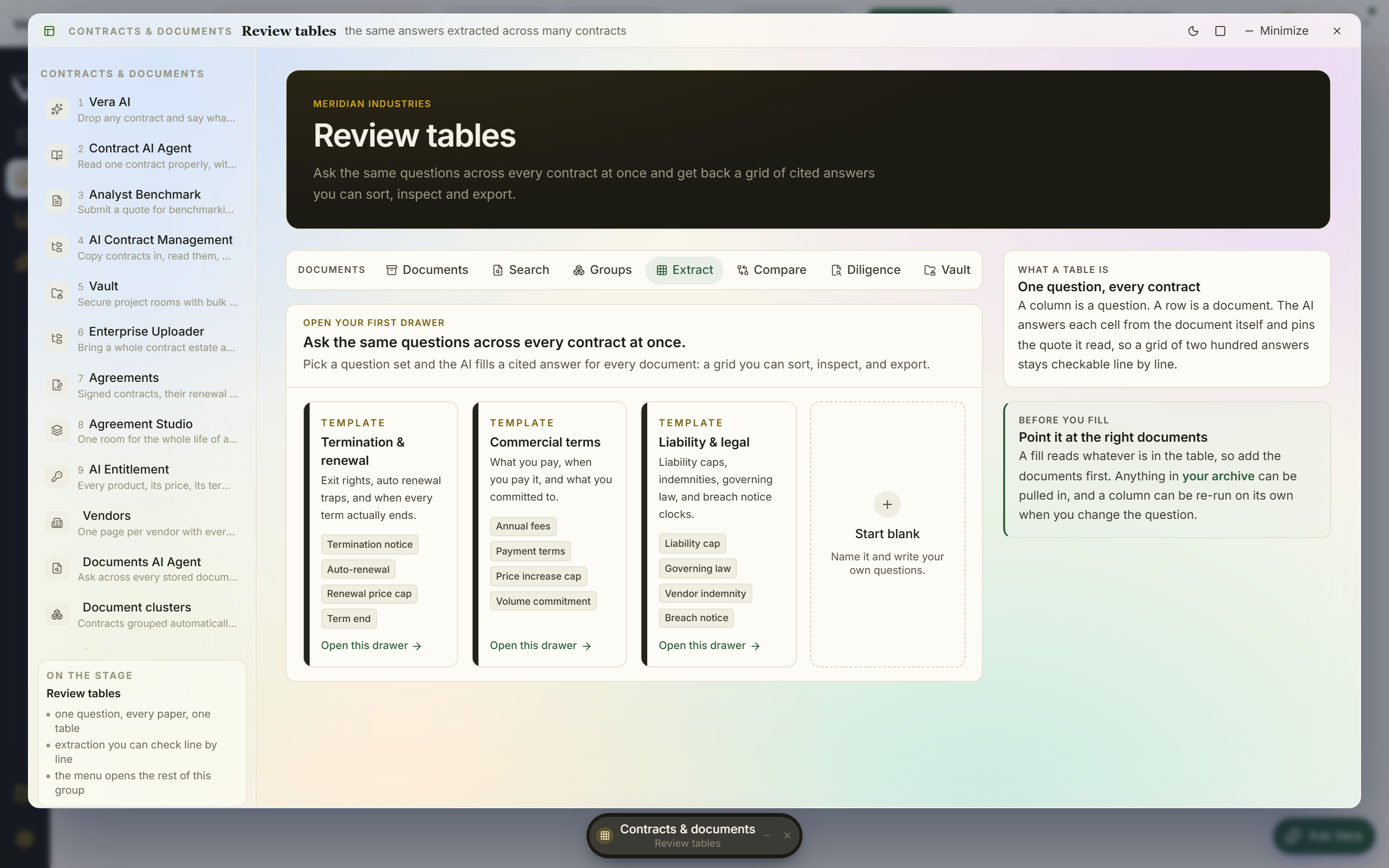
Honest limits, stated plainly
Coverage tells you whether a protection is present in the documents you have loaded, and how it is worded. It does not tell you whether that wording is enforceable in your jurisdiction, and it is not legal advice. A cap on uplift can be present, clearly drafted, and still weaker in practice than a well drafted termination right sitting elsewhere in the same agreement. Read the verdict as a map of exposure, then take the material items to counsel.
It is only as complete as the estate you have uploaded. If the master agreement is in the system but the negotiated side letter is in someone's inbox, the sweep will call the protection absent when it exists. That is not a false positive so much as a filing problem, and it is the single most common cause of a verdict a buyer disputes. Scanned documents and poor quality OCR degrade the read, and heavily amended agreements where three order forms modify one master will sometimes attribute a clause to the wrong layer. Both cases are why the board quotes the clause rather than just colouring a cell. When the quote looks wrong, open the contract record and check.
The verdict sentence is a compression, and compression loses things. One sentence cannot carry the difference between a gap in a 40,000 a year agreement and a gap in your largest platform contract. The stage gives you the headline, the board gives you the weighting, and you still have to apply judgement about which gaps are worth the political cost of reopening. Nor does coverage negotiate. Knowing that nine agreements lack an uplift cap is the beginning of the work described in the auto-renewal clause, not the end of it.
Finally, the report is a draft you own. It is written in one press, it cites the clauses it relies on, and it is deliberately structured for a finance audience. It is not a filed position. Read it before you send it, cut the sections that do not apply to your estate, and put your name on the version that goes out. The point of the verdict stage is not that the system decides for you. It is that you spend your twelve minutes deciding, rather than your fourteen hours reading.
Fredrik has spent more than twenty years in enterprise software, with time at Oracle, IBM, SAP, and Salesforce before moving to the buy side. He structured and priced the kind of large agreements most buyers only see once or twice in a career, which taught him where the leverage sits and how far a vendor will actually move. He started VendorBenchmark to hand that knowledge to every sourcing team.