The Deal File: your negotiation as one case file (preview)
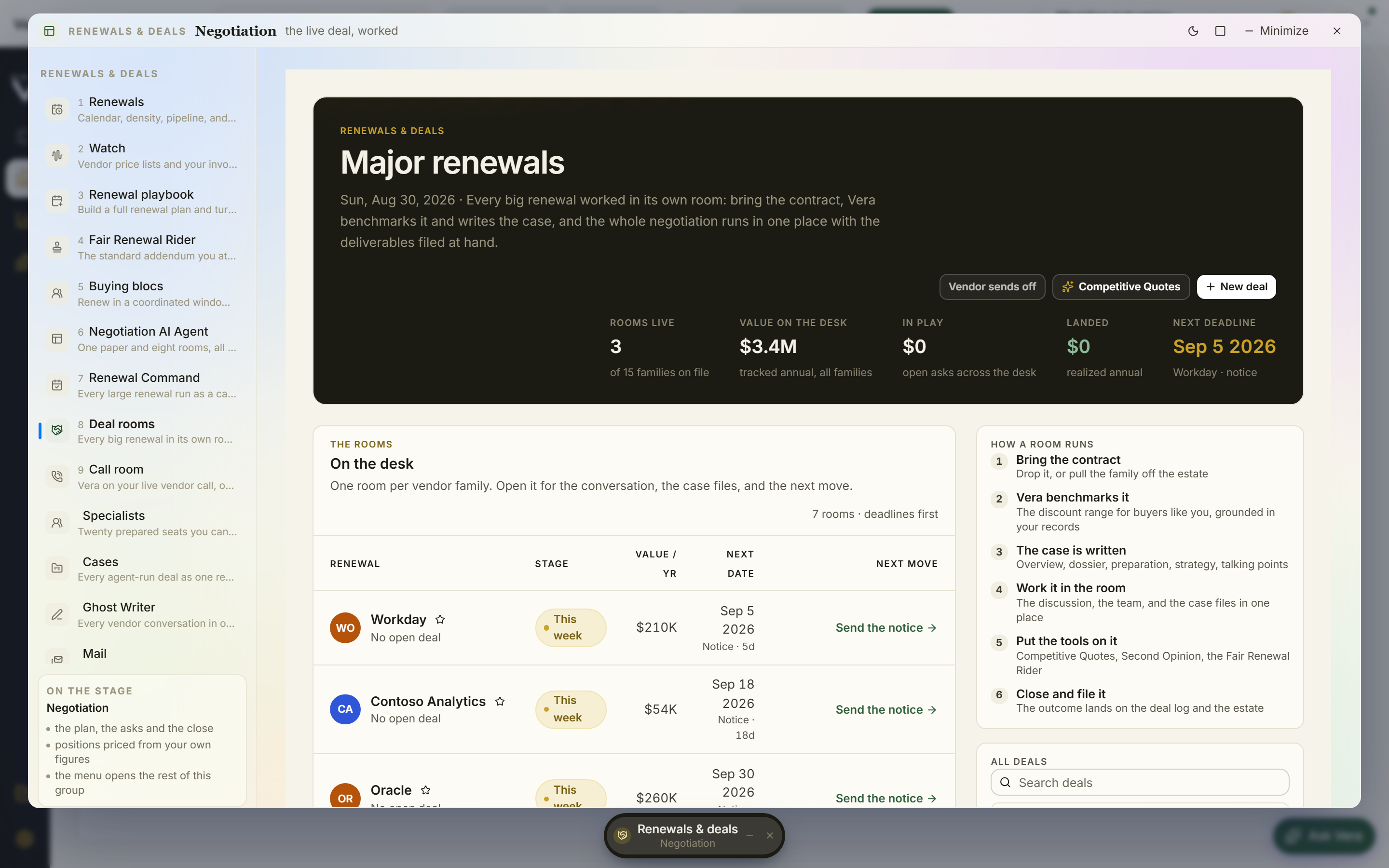
A renewal is one job that usually lives in eleven places. The Deal File renders the whole negotiation as a single case file, with a what-if desk that reprices every page as you move scope, term and ambition.
Call it the scatter tax. A single renewal negotiation is one job with one outcome, and it almost never lives in one place. The benchmark sits in a report you exported in March. The leverage assessment is a conversation you had with the application owner and never wrote down. The counter offer letter is a draft in your sent folder. The line by line pricing is a spreadsheet with three tabs and one broken formula. The redline is a Word file with tracked changes from two people. The approval chain is an email thread. Every time you pick the negotiation back up, you spend the first twenty minutes rebuilding your own position from fragments before you can do any new thinking.
That reassembly cost is invisible on any budget line, which is exactly why it never gets fixed. So we fixed it in the product. The Deal File is a new workspace that renders an entire negotiation the way Second Opinion renders a verdict: one dark stage, six executive brief pages, one file. You can open the preview at /deal-file. It runs on an anonymized sample renewal so you can work the whole thing end to end without touching your own contract data.
Six pages, one stage, one file
The file opens on a dark stage with six pages you can move between in one click. Each page is written as an executive brief rather than a tool panel, because the artefact a buyer actually needs at the end of a negotiation is a document someone else can read without you in the room.
The benchmark brief states where the deal sits against the peer band, in plain sentences, with the distance from median expressed as a number rather than a colour. The research dossier is a leverage checklist that scores as you tick it, so the difference between a strong position and a weak one becomes arithmetic instead of a feeling. The drafting pack holds five letters covering the standard sequence of a renewal conversation, from the opening information request through to the close. The comparison prices every line item with a strike button, so removing a module updates the total immediately and visibly. The redline marks up six clauses with a buyer side position for each. The mandate closes the file for sign-off, summarising what you are asking for, what you will concede, and where you walk.
None of these six artefacts is new in concept. Procurement teams have been producing all of them for decades, badly, in six unconnected file formats. What is new is that they are one object. Change the ambition on the benchmark page and the mandate page already knows. This is the same principle behind the Negotiation Dossier, applied to the full arc of the deal rather than a single counter offer.
The what-if desk reprices all six pages at once
Pinned to the right of the stage is the what-if desk. It carries three controls: scope, term and ambition. Move any of them and all six pages recompute together. Drop two modules from scope and the comparison total falls, the benchmark brief restates your new position against the peer band, the redline drops the clauses that only applied to those modules, and the mandate rewrites the ask. Push the term from one year to three and the ambition slider becomes more expensive to hold, because you are trading flexibility for discount and the file says so on the page rather than in your head.
This matters because most negotiation preparation collapses at exactly the moment the vendor changes one variable. You built a position around a three year term, the vendor comes back with a two year structure and a different bundle, and the entire spreadsheet is stale. The what-if desk is designed for that moment. You are not rebuilding an analysis, you are moving a control and reading the consequence. It is worth pairing this with what we wrote about the co-term trap, because term alignment is the single variable buyers most often move without pricing what it costs them in leverage.
The file autosaves in your browser. Close the tab in the middle of the redline page with the ambition set high and two line items struck, and it reopens exactly where you stood. That is a small engineering detail with a large behavioural effect: a negotiation you can put down and pick up without loss is a negotiation you will actually work in short bursts between meetings, which is how procurement work really happens.
Where it sits in the week
The Deal File is not a replacement for the benchmark hub, the contract record or the renewal calendar. It is the working surface between them. The sequence we expect is straightforward. The renewal calendar tells you which deal is live. The benchmark tells you where the current pricing sits against comparable transactions. The Deal File is where you turn that into a position, a set of letters, a marked up paper and a mandate. Then the mandate leaves the file and enters the sign-off chain, where each approver gets a brief written for their question rather than a forwarded thread.
One practical note on sequencing. Work the research dossier before the comparison, not after. Buyers habitually start with pricing because pricing feels like the negotiation. It is not. The leverage score determines how much of the pricing ask you can credibly hold, and if you set ambition before you have scored leverage, you will either underclaim or write a mandate you cannot defend when the CFO asks why you think the vendor will move.
What changes for a procurement buyer
Honest limits of the preview
This is a preview, and it is worth being precise about what that means so nobody builds a quarter end process on it yet. First, it runs on an anonymized sample renewal. You cannot load your own contract, your own quote or your own benchmark into it in this release. It is a working demonstration of the model, not a live case file for a deal you are closing next Friday.
Second, autosave is local to your browser. That is a deliberate choice for a preview, because it means nothing you type leaves the machine, but it also means the file is not shared, not synced across devices and not backed up. Clear your site data and the state is gone. Do not treat it as a system of record.
Third, it is single user. There are no comments, no assignments, no version history and no routing. The mandate page closes the file for sign-off in the sense that it produces the document, not in the sense that it moves the document through an approval chain. That routing exists elsewhere in the platform and the two will be joined, but not in this build.
Fourth, the artefacts are bounded on purpose. Five letters, six clauses, one comparison table. Real negotiations run longer than that. The redline covers the six clauses that move most often in software renewals, not a complete master agreement markup, and the drafting pack is a spine you extend rather than a complete correspondence library. Fifth, the leverage score is a structured self assessment. It reflects the facts you tick, and it will happily produce a strong score from optimistic inputs. It is a discipline device, not an independent measurement of your position.
Finally, one framing point. A case file is a tool for one deal at a time, and one deal at a time is not how leverage compounds. If your portfolio has thirty renewals inside two quarters, the Deal File will make each of them sharper but it will not tell you which order to fight them in. That remains a portfolio question, and it is answered upstream of this workspace. Use the Deal File for the deals where the position is genuinely contested and the outcome is worth the forty minutes. For the rest, the standing benchmark and a clean rider will usually do the job.
Morten brings two decades of enterprise and software procurement, with stints across Oracle, IBM, SAP, and Salesforce shaping how he reads a deal. He has led sourcing through hundreds of renewals, from mid market order forms to nine figure global agreements, and learned that the buyers who win are the ones who walk in knowing the market. He built VendorBenchmark to make that pattern recognition repeatable.