Ask for a file, get the file
The document pane was always the home for a brief you revise line by line. The new file lane is for when you want the finished artefact itself, formulas and slides intact.
Here is a workflow most procurement teams recognise, because it eats an afternoon almost every week. You ask an analyst, human or otherwise, for the numbers. You get the numbers back as a tidy answer in a chat window or an email. Then the real work starts. You retype that answer into a spreadsheet so it carries formulas, you paste it into a Word template so it carries your firm's letterhead, or you rebuild it as slides because the sourcing committee only reads decks. The answer was correct. The artefact did not exist yet, and building the artefact was your job. That gap is what we just closed.
The named problem: the answer was never the deliverable
A benchmark you can read is not the same thing as a workbook you can hand to your CFO. For years the honest limit of conversational tools was that they returned text, and text is where the friction lived. You would ask Vera for a percentile comparison across three quotes, she would answer with cited figures, and you would then spend twenty minutes turning that answer into an Excel file with live formulas so finance could stress the discount themselves. The intelligence arrived instantly. The file arrived by hand, built by you, at the end of the day.
We already handle the reading side well. Our research papers now read as styled pages rather than embedded blobs, and the document pane is the right home for a brief you intend to revise line by line in conversation. What was missing was the other lane. Sometimes you do not want to revise anything. You want the file itself, dressed, named, and downloadable, so you can attach it to an email and move on.
What actually happens when you ask
Ask for a Word document, an Excel workbook, a slide deck, or a PDF, and Vera writes it in a sandboxed workspace using the same document machinery Claude uses on claude.ai. This is not a screenshot of a table dressed up to look like a file. A workbook carries real formulas that recalculate when someone changes a cell. A deck carries real slides your committee can edit. The file lands on the answer as a download card, in your firm's dress, named to a sensible convention rather than "export final v3", and it persists. Reopen the conversation tomorrow and the file is still attached where you left it.
Because the file is generated in a sandbox rather than pulled from your estate, tenant isolation holds the way it does everywhere else in the platform. The workspace that builds your file cannot see another buyer's data, and the file is yours the moment it lands. If you want to see where that same discipline shows up across the product, our Archive now works like a real file manager, so a file Vera builds and a file you upload live under the same rules.
Two lanes, and using both is fine
The distinction worth keeping in your head is between the document pane and the file lane, because they solve different problems. The document pane stays the home for a brief you will revise line by line inside the conversation, the negotiation memo you shape sentence by sentence with Vera before a call. The file lane is for when you want the artefact itself, finished and portable. Asking for both in one breath is fine. You can revise a position paper in the pane, then ask for the accompanying pricing workbook as a downloadable Excel file, and get both from the same thread.
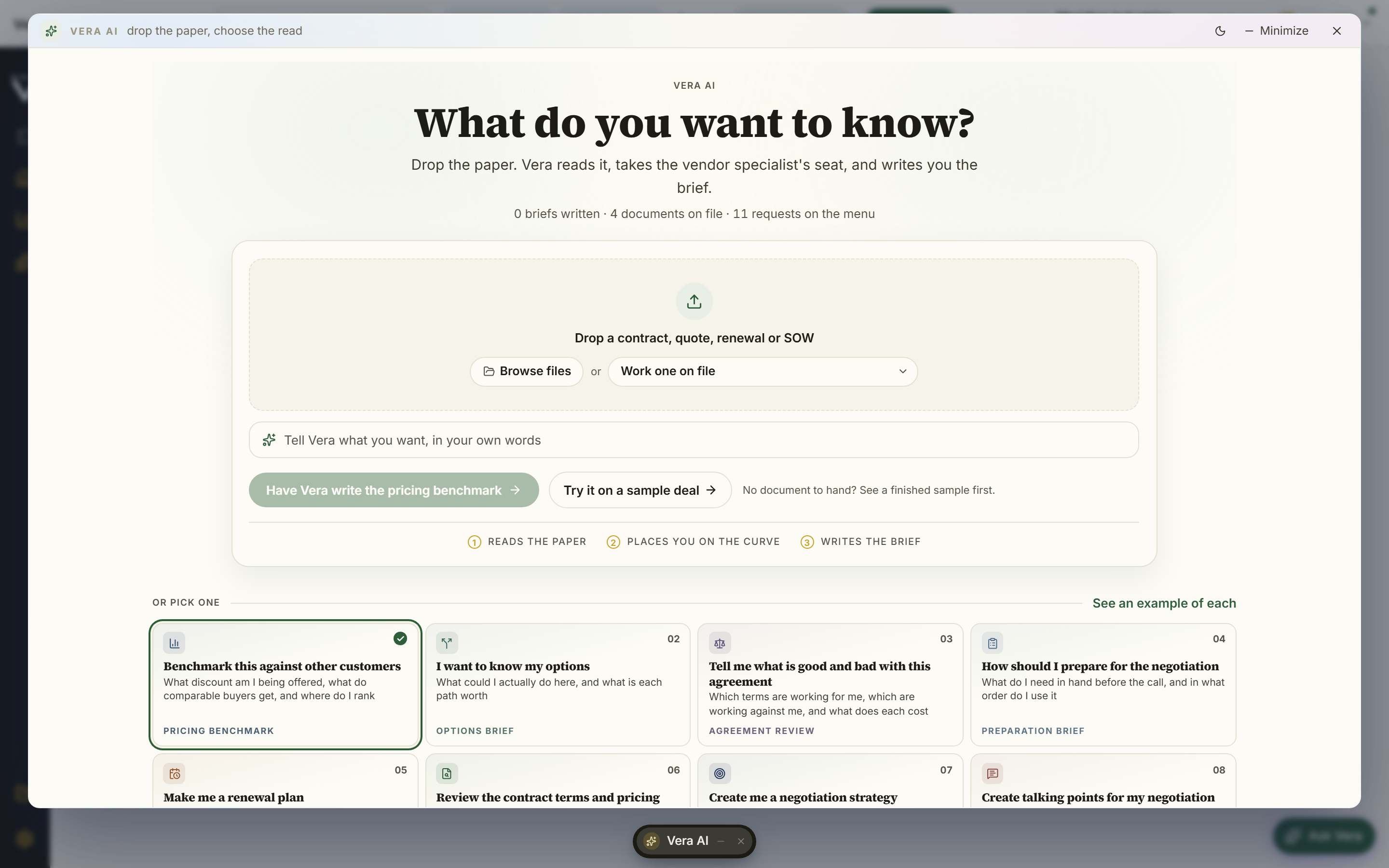
This maps cleanly onto how negotiation work already runs here. You might talk a position through with Vera before the call, hold the argument in the document pane, and then, once the shape is settled, ask her to hand you the deck the committee expects. The file lane is not a replacement for the analysis. It is the last step of the analysis that you used to do yourself.
Where it fits the buying week
Think about the moments where a file, not a chat message, is the thing standing between you and the next step. A sourcing committee that only reads slides. A finance partner who wants to stress your discount assumptions in a live spreadsheet, not trust a static number. A vendor who needs a formal PDF response on letterhead rather than an inline paragraph. Each of those used to force a handoff from thinking to formatting. Now the format is part of the ask. For a worked example of the analysis this sits on top of, our Quote Face-Off takes three confusing quotes and returns one benchmarked board, and that board is exactly the sort of thing you now export as a workbook in one line.
The honest limits
Be clear-eyed about what this does and does not do. It builds files, it does not sign off on them. A workbook Vera generates carries real formulas, but you are still the analyst who checks that the discount logic matches your intent before it goes to finance. The file lane produces a clean first artefact, not a final approved one, and for anything binding you should read it the same way you would read a draft from a junior analyst.
It is also not the right tool for a document you intend to argue over word by word. That work belongs in the document pane, where the revision loop lives. If you ask for a PDF and then decide you want to change three sentences, you are better off shaping it in the pane first and generating the file once you are settled, rather than regenerating the whole file for each edit. And while the file dress follows your firm's template, deeply bespoke formatting, a specific corporate deck master with animation, may still need a final pass in the native application. The point of the feature is to remove the ninety percent of formatting that is rote, not to promise the last ten percent that is judgement.
Within those limits, the change is simple and it is the one buyers asked for most. Ask for a file, get the file. The analysis was always here. Now the deliverable is too, and you can see both lanes working together the moment you open Vera's chat.
Want to be updated when major licensing and pricing changes land? One analyst brief a week: the price rises, metric changes and audit campaigns that move software costs. Work email only.
Morten brings two decades of enterprise and software procurement, with stints across Oracle, IBM, SAP, and Salesforce shaping how he reads a deal. He has led sourcing through hundreds of renewals, from mid market order forms to nine figure global agreements, and learned that the buyers who win are the ones who walk in knowing the market. He built VendorBenchmark to make that pattern recognition repeatable.