The Desk now opens on the morning brief
A navy stage states the book in figures, the landing paper is the queue of what actually needs a person today, and the console underneath is unchanged.
Every procurement tool ships with a landing screen, and most of them land you on inventory. Tiles, counts, a chart of spend by category, a list of suppliers sorted alphabetically because nobody could agree on a better order. None of that tells you what to do before lunch. This update changes the first screen of the Desk. It now opens the way Second Opinion opens: a navy stage that states the book in figures, then the desk file, then the console. The landing paper is a morning brief of everything waiting on a person, ranked, each line with one press that lands you on the right supplier and the right station.
The cold open
Name the problem properly and it stops feeling like a personal failing. Call it the cold open. You sit down, you open the platform, and the first twenty minutes go to reconstructing state that the system already holds. Which counters came back overnight. Which approval is stuck and with whom. Which notice window closes this week. Which draft has been sitting there fully written, waiting only for someone to decide who receives it. The information exists. It is simply distributed across six screens, and the act of assembling it is unpaid work you repeat every morning.
The cold open scales badly. One buyer covering fifteen suppliers can hold the state in their head. A team covering three hundred cannot, which is the argument we made in the renewal calendar problem. Past a certain book size, the failure mode is never a bad decision. It is a decision nobody made, because the item that needed it was on page four of a list sorted by supplier name. Auto renewals do not fire because a buyer chose to let them fire. They fire because the window opened on a Tuesday when three other things were louder.
The stage states the book in figures
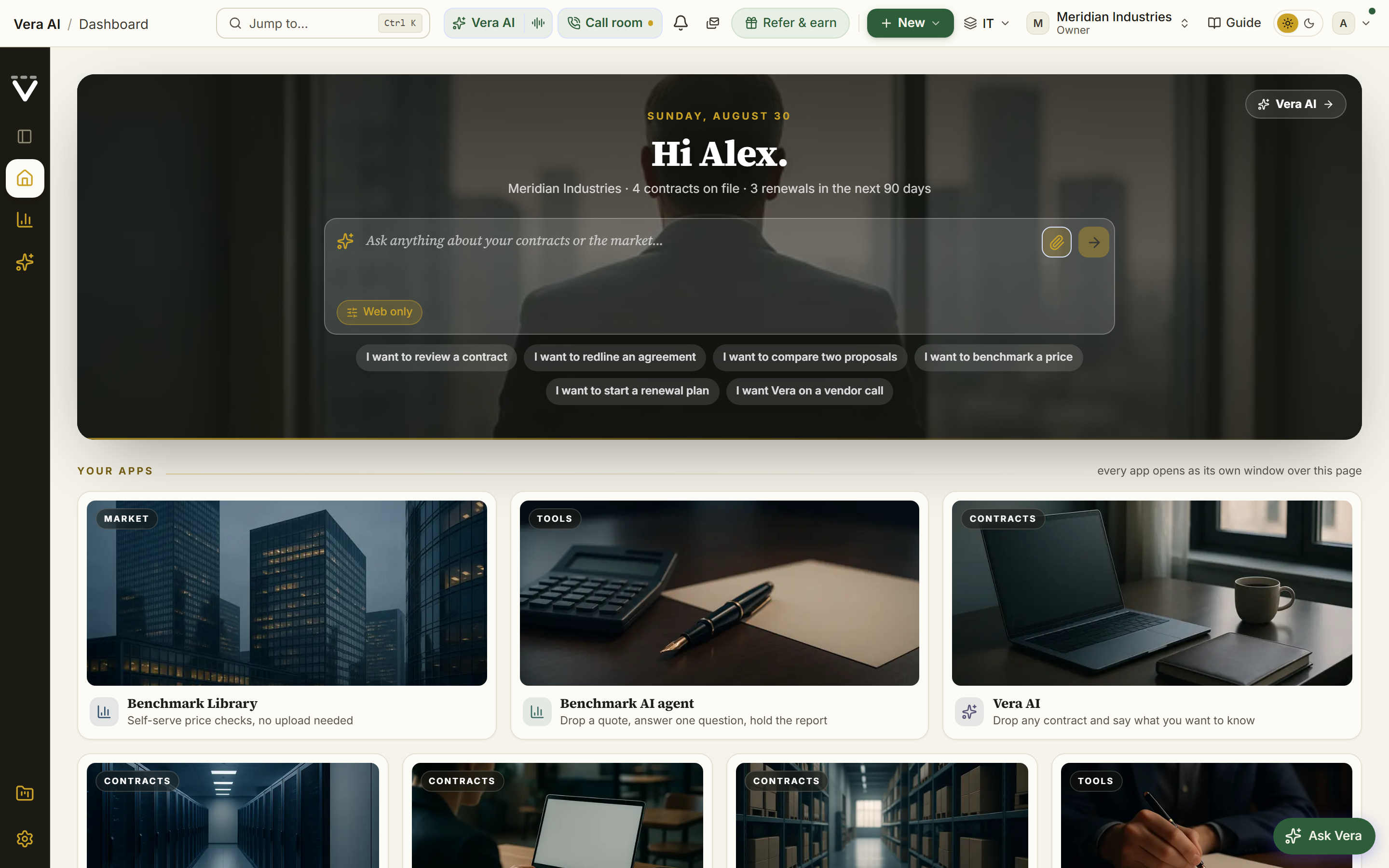
The Desk now opens on a navy stage. It is not a hero banner. It is a statement of the book in figures: how many agreements are live, what they are worth annually, how many carry a deadline inside the next seven days, how many sit in an active negotiation, how many are being scored against market. Illustratively, a mid market estate might read as one hundred and forty live agreements, eleven inside a week, four in open negotiation. Your numbers will differ. The point is that the first thing the screen does is state the size and shape of what you are responsible for, in one line, before it asks anything of you.
Under the stage sits the desk file, and under that the console. The order matters. Figures orient you, the file gives you the papers in the order a working analyst would stack them, the console does the work. Nothing in the console changed, which is the second half of this release and the part experienced users will care about most.
The morning brief is the landing paper
The brief is one list, in priority order, of everything waiting on a person. Six queues feed it. Deadlines inside a week, meaning any notice date, response date, or expiry that lands within seven days. Counters to approve, where a supplier has moved and the position needs a human yes or no. Drafts that only need a recipient, which are complete messages sitting one field short of being sendable. Mandates about to lapse, where the authority a stakeholder gave you has a shelf life and it is nearly up. Windows open with no authority, where the clock is running and nobody has been given the right to act. Leaking closes, where a deal is drifting past its landing zone and the concession pattern says it will keep drifting.
Two of those queues are worth dwelling on. Windows open with no authority is the direct answer to the failure described in the auto renewal clause. It is not enough to know a notice period exists. Someone has to be allowed to send the notice, and the brief surfaces the gap between the open window and the missing mandate as a single line. Counters to approve connects to the machinery in the deal sign off chain, where each approver gets a brief written for their seat rather than a forwarded thread.
Every line has one press. That press does not open a summary of the supplier. It lands the console on the correct supplier at the correct station, with the relevant papers already loaded. If the line is a counter, you arrive in the negotiation station with the concession history in view. If the line is a draft, you arrive where the draft is, with the recipient field waiting. The brief is a router, not a report.
The desk file leads with the brief and the book
The desk file grew two new papers and they sit at the front. First the brief, which is the same list you land on. Second the book, which is every agreement you hold ranked by leverage rather than by value or date. Leverage ranking is a composite view of where you stand: distance from benchmarked market, term structure, switching exposure, concession history, and how much time you have before the counterparty stops caring. A large agreement where you have no time and no alternative ranks below a smaller one where you have both.
The supplier case papers, the per vendor dossiers you already used, now sit behind those two. That ordering is deliberate. Case papers answer the question you already asked. The brief and the book answer the question of which question to ask. On open, the file lands on the brief, so the default state of the Desk is the work rather than the archive. If you want the old behaviour, the case papers are one press away and unchanged.
What did not move, and what this will not do
First, the reassurance. The console below the file is unchanged. Same signatures, same guardian, same records. Nothing about permissions, audit trail, or approval routing was altered by this release. If your team has trained on the console, that training holds. This is a new front door on the same building.
Now the limits, plainly. The brief only knows what the platform holds. If a contract was never loaded, its notice window does not exist as far as the queue is concerned, and no landing screen fixes a coverage gap. Teams with a partially loaded estate will get a confident looking brief that is quietly incomplete, which is arguably worse than an empty one. Load coverage first, then trust the ordering.
The priority ordering is a heuristic, not a judgement. It weights time to lapse and estimated leakage. It does not know that your CFO has asked for the analytics renewal to be settled this week regardless, or that a category owner is on leave. It will sometimes rank a small leaking close above a large strategic negotiation, and you should override it without hesitation. Leverage ranking on the book is a model of position, not a promise of outcome. It tells you where room probably exists. Whether you get it depends on the conversation.
The brief also refreshes on the cadence of the background work behind it, so a counter that arrives four minutes before you open the Desk may not be on the list yet. And it does not send anything. Drafts wait on a recipient because a person should choose the recipient. Nothing in this release moves the platform toward acting without a named human pressing something.
Finally, this is a change to sequencing, not to capability. It will not find savings that were not already discoverable. What it will do is make the discoverable ones harder to walk past, which for most teams is the binding constraint. If you want to see how the new landing behaves against your own book, open the Desk and read the first screen. If it is empty, that is a coverage answer, and it is a useful one.
Fredrik has spent more than twenty years in enterprise software, with time at Oracle, IBM, SAP, and Salesforce before moving to the buy side. He structured and priced the kind of large agreements most buyers only see once or twice in a career, which taught him where the leverage sits and how far a vendor will actually move. He started VendorBenchmark to hand that knowledge to every sourcing team.