01 · Contracts & renewals
This is the paper-trail heart of the platform: where you upload vendor quotes for expert benchmarking, keep your signed agreements, and watch every expiry, notice deadline, and price-list change so none of them catches you out. It is also where you work a live deal to a close, from setting a mandate through to signature. If a screen touches a contract, a vendor, or a renewal date, it lives in this chapter.
Analyst Benchmark
The related records strip states whether this vendor's signed agreement is on the ledger; when none exists it says so and offers to add one so the notice date is tracked.
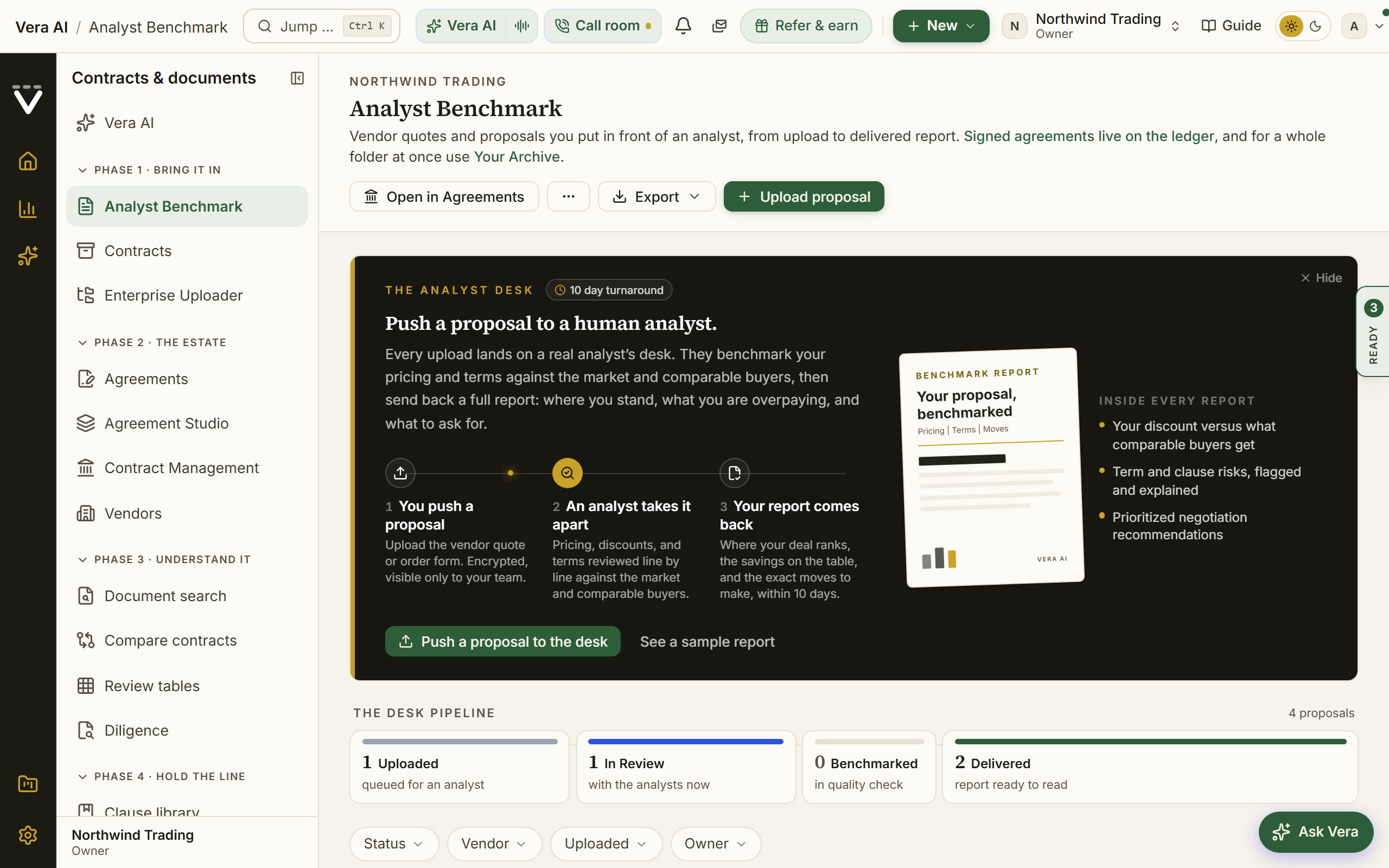
Analyst Benchmark holds the vendor quotes and offers you put in front of an analyst, from upload to delivered report. Signed paper lives on the agreement ledger, and a whole folder at once goes to Contracts, which the empty state now links directly.
Since August 2026 it opens as a Fluent window with its own menu: the rail inside lists the rest of Contracts & documents, so you can move between them without going back out, and the entry you are standing on is marked. Escape closes the window.
Vendor quotes and contracts you have submitted for benchmarking. Each one moves along a path: Uploaded, In review, Benchmarked, then Delivered when your report is ready.
*In plain words: the tracker for everything you sent to the analysts, and the door to each finished report.*
When to reach for this
- "Where is my benchmark?" answered by the status pill and the expected delivery date.
- The report landed and you want to read it: the Report tab is on the proposal's own page.
- A quote deserves the expert treatment rather than an instant read.
On the screen
- Status pills — where each proposal sits in the review pipeline. Every step talks to you: an alert and an email when an analyst picks the proposal up (with the expected delivery date), when the benchmark is built and moves into final quality review, and when the report is delivered. If a benchmark ever slips past the promised turnaround, you get one proactive email owning the miss with a revised delivery date. Tune these under Settings › Notifications (Benchmark status updates and Report delivered).
- Proposal page — open a row to see its status path, the files you attached, and, once delivered, the benchmark report. While a proposal is anywhere before Delivered, the page refreshes itself within half a minute of a status change, so you never need to reload; delivery announces itself with a toast that opens the Report tab.
- Indexed for Vera — each file on the proposal page states whether Vera can read it yet. A readable file indexes itself within minutes of upload; a scanned PDF shows Being transcribed while its pages are read image by image, then flips to indexed for Vera, and the uploader gets an in-app note the moment it becomes readable (Uploads finished processing under Settings › Notifications). Until a document is indexed, Vera cannot read, search, or cite it.
- Benchmark request card — an upload normally enters the analyst queue by itself. When your plan's benchmark allowance is used up it cannot, and the proposal page says so plainly: the card states your usage (for example 4 of 4 requests this month) and resolves it in place. An organization owner adds a benchmark credit ($5,000 for one full analyst benchmark, billed by invoice, no card) in a dialog; the request lands on our desk as a support ticket, our team confirms and invoices it, and the credit is added to your account. A teammate who is not an owner asks their owner in one click; the owner gets the request with a link back to the proposal. While a credit request is in flight the card shows it, with a link to follow the ticket under Support.
- AI review — on a proposal page you can run an AI redline scan of the vendor PDF that flags risky clauses with quotes from the document.
- Filters and views — the facet row narrows the list by status, vendor, recency, tag, or owner, and the pipeline band's segments are the same filters one click big. A combination you keep returning to saves as a named chip in the Views row beside the facets; see Saved views.
How to use it
- Upload a proposal: vendor, contract type, your question, and the files (PDF or DOCX).
- Open a proposal to track its status, or wait for the emails; every stage change reaches you either way.
- Read the report once it is delivered.
- About 30 days after delivery, answer the What happened? question, from the one-touch email or the card on the Report tab. A won reduction, with its annual figure, lands in your realized savings on Portfolio; if the contract has no stored annual value the card asks for the pre-reduction baseline so the saving can be reconciled against invoices.
If something looks wrong
- The proposal reads Saved, not queued: your plan's benchmark allowance is used up, and the page resolves it in place with a benchmark credit; see the card described above.
- The status emails never arrive: check the Benchmark status updates toggle under Notifications and Troubleshooting.
Related: Upload a proposal · Delivered reports
Upload a proposal
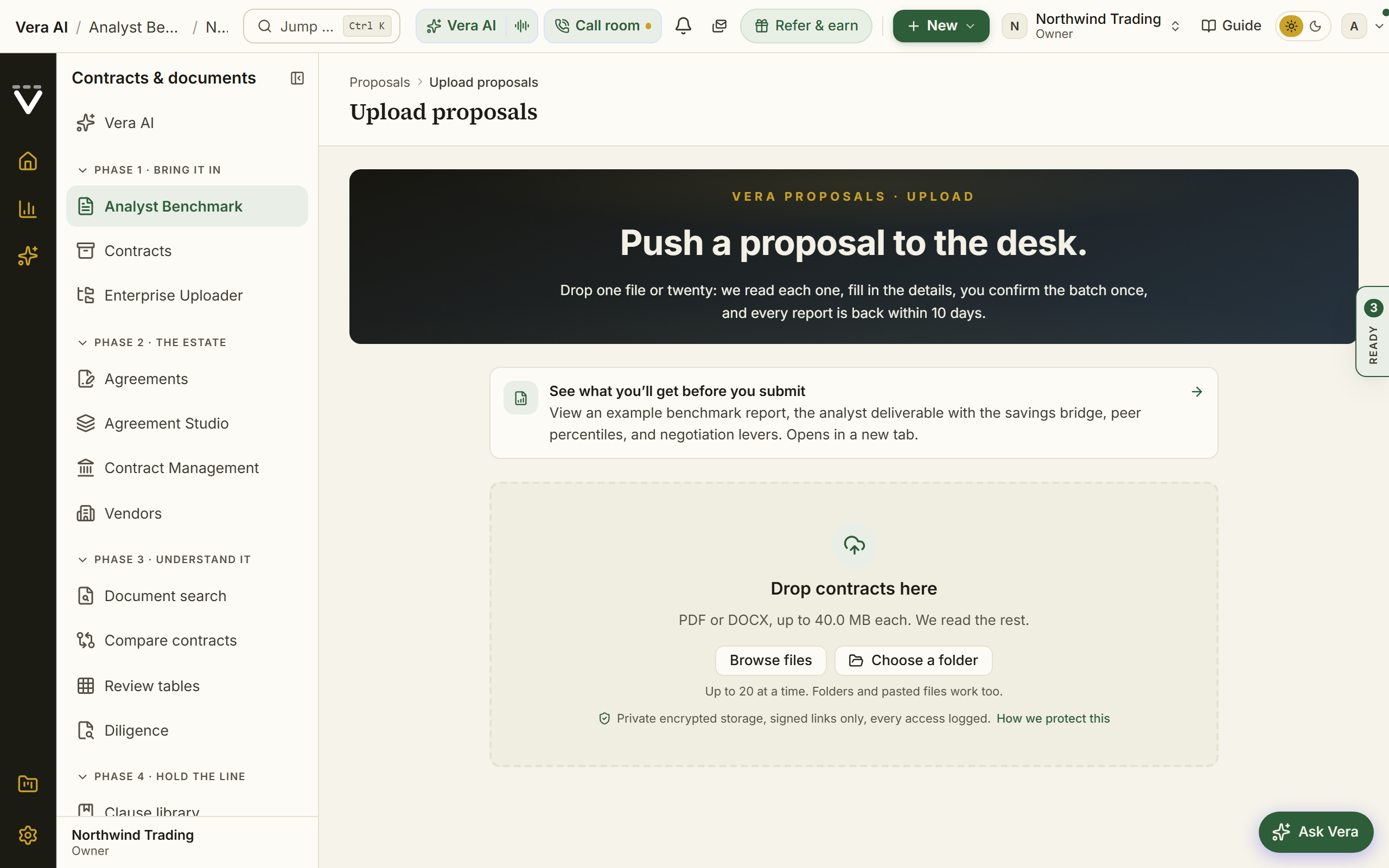
One drop zone sends vendor quotes and contracts to our analysts for benchmarking. Drop one file or twenty; each document is read as it lands, its details fill in as editable chips, and you confirm the whole batch once. You will be emailed when each report is ready.
*In plain words: drop the paper, check the chips, confirm once.*
A worked example. Drop a renewal quote like the sample Contoso Analytics one and watch the chips fill: vendor Contoso Analytics, 120 seats, $450 per seat, $54,000 annual value, the term dates, and, tellingly, no uplift cap, because the quote names none. A missing or low-confidence value shades gold or red; that is your cue to check the paper, and the benchmark focus box is where you tell the analysts what you actually want answered ("the quote carries no uplift cap; what does that cost us?").
On the screen
- The drop zone — drop PDF or DOCX files, browse, choose a whole folder, or paste files from the clipboard. Every file is verified by its contents (not just its name) the moment it lands, and stored privately: your organization and our analysts only.
- File cards and chips — vendor, title, category, annual value, currency, seats, term dates, and uplift cap fill in per file, shaded by how confident the read is: plain for high confidence, gold for worth a glance, red for please check, blue for values you set yourself. Click any chip to correct it; the AI pass never overwrites your edits.
- Discount band — once the vendor is known, the card shows the discount band buyers like you land with that vendor at your deal size, with sample sizes, so you know the stakes before you submit.
- Notes and benchmark focus — optional per file: notes for our analysts and what you want benchmarked, with a one-click starter template matched to the proposal category.
How to use it
- Drop your files (up to 20 at a time). Each card starts reading immediately: rules first, then an AI pass that upgrades anything you have not edited.
- Check the chips, correct anything gold or red, and add your benchmark focus.
- Confirm once (Ctrl+Enter also works). A batch shows a progress bar while it submits, and each card ends as Queued with a link to its proposal page.
- Track progress afterwards on the Analyst Benchmark list.
Tips
- Files are limited to PDF and DOCX and capped at 40 MB each. Files upload straight from your browser to storage.
- Your edits survive a stray navigation: chip corrections, notes, and the benchmark focus are restored when you re-add the same files in the same browser session.
- If your plan's benchmark allowance is used up, the upload still lands but ends as Saved, not queued instead of Queued. Open the proposal page to fix it in place; see Analyst Benchmark below.
Related: Analyst Benchmark
Contracts
*In plain words: drop your whole contract folder and get back a filed, judged estate.*
This screen was called Your Archive, then Contracts, and it lived at /archive. In August 2026 it folded into the Contract Management Portal, so the estate has one door rather than two. Everything it did is still here, one room along:
| What you came for | Where it is now |
|---|---|
| The vendor ledger, your agreements, the renewals | Contract Management Portal › Contracts |
| The review queue and the read log | Contract Management Portal › Index |
| The file explorer and Add documents | Contract Management Portal › Files |
| The estate benchmark | Contract Management Portal › Market |
| The post-scan money moves | The What next close at the foot of every room |
| The intake brief | The What next close, or the link in your scan notification |
Old links and bookmarks to /archive still work and land in the matching room.
Full documentation: The Contract Management Portal in Chapter 18, with a section for each of the five rooms.
Related: The Contract Management Portal, Market: where every agreement stands, Renewal calendar
Compare contracts
A saved comparison says when the paper moved: on the contract record and on your Comparisons shelf it shows the date it ran and names the compared document that has a newer version since, with a Compare again link that reopens this desk with the same two contracts selected. Nothing re-runs on its own.
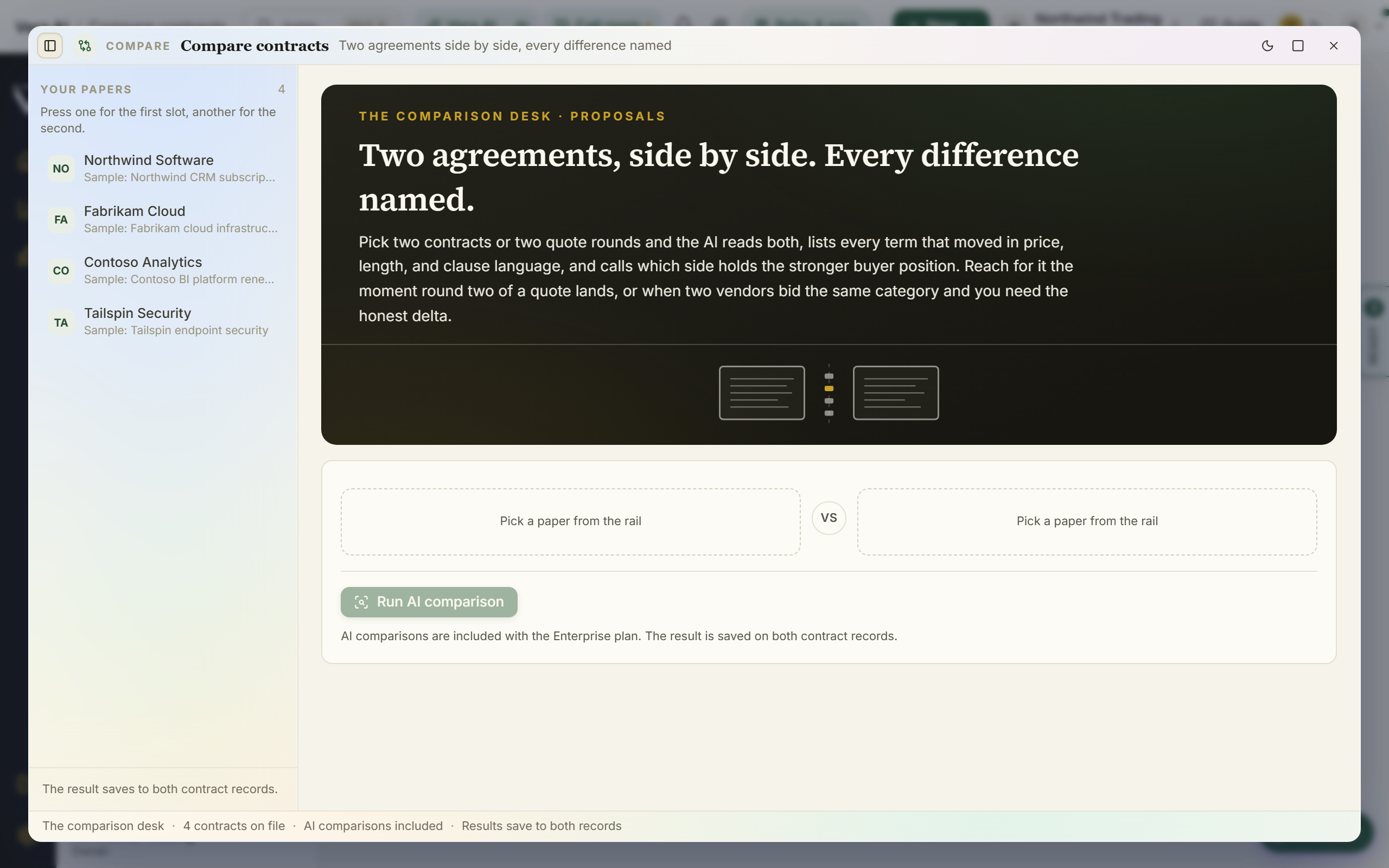
Side-by-side document comparison with an AI difference scan, in its own window. Opening Compare contracts from anywhere, the contracts header, a record's compare card, the drop chooser, lands you straight in a Mica window rather than a workspace page: the titlebar carries a rail toggle, the theme switch, Maximize, and Close (which returns you to Home), a frosted papers rail sits on the left, and the desk renders on a solid pane. The result opens with a verdict band (terms compared, which side is stronger where, watch-outs), then one card per term showing both sides' language with the stronger position highlighted, a Your options card laying out your next steps, and an amber watch-out panel closing the read.
On the screen
- The papers rail — every contract on file, on the frosted panel. Press one for the first slot and another for the second; press an assigned paper to clear it, and with both slots held a third press swaps the second paper. On phones, and whenever you hide the rail, the two dropdowns in the picker carry the same choosing, and the slot cards under them always name what is on the desk.
- The window foot — the desk's own status line: how many contracts are on file, the comparisons left on your plan, and where results save.
- Document panes — the two documents side by side.
- A paper sent from the chat — dropping a contract onto any screen and choosing Compare it with another contract lands here. This desk holds contracts rather than files, so the paper is filed to your contracts on the way in, the page says so while it happens, and the desk then opens with it already picked on the left; you choose the side to hold it against. It is the only one of the chooser's answers that adds a record, and the button says so before you press it. Filing this way spends no benchmark from your allowance and puts no renewal on your calendar, and the vendor and contract type fill themselves in from the document. If it is the only contract you have, the desk says the paper is filed and waiting rather than telling you to upload two.
- Difference scan — the AI's read of what changed and what it means commercially.
- Your options — two to four concrete next steps drawn from the scan, numbered, with exactly one marked Recommended, so the read ends in a decision rather than a table. The same block appears on the compare card each contract's record page keeps, told from that contract's own perspective.
- Saved automatically — every completed scan files itself on both contract records and on the Comparisons shelf of your Saved page; the green note under the result confirms it.
- What next — a finished comparison closes with a What next panel: seed a case or a renewal playbook on the weaker contract, put an Ask Vera question on the sharpest difference, or copy the verdict for a chat thread.
How to use it
- Press two papers in the rail, or pick them in the dropdowns, and run the scan. While it reads, a progress bar counts toward done and names each step as it happens; a full read usually lands inside a minute.
- Read the verdict and pick from Your options. There is no save step: the finished scan is already on both contract records and on the Comparisons shelf of your Saved page, so you can reopen the pair any time.
Tips
- Use this to check a renewal quote against last year's paper, or a redlined draft against the version you sent. For a year-over-year read on the same vendor, see the Time machine tool.
Related: Saved
Vendors
Since August 2026 it opens as a Fluent window with its own menu: the rail inside lists the rest of Contracts & documents, so you move between them without going back out, and Escape closes the window.
Every vendor across your proposals and agreements, one page per vendor, so you can see your whole relationship in one place.
*In plain words: the whole relationship with one vendor, on one page.*
When to reach for this
- Before any vendor conversation: contracts, benchmarks, market intel, and notes in one read.
- Taking over a colleague's book: this page per vendor is most of the handover (the recipe).
- Opening the case file when the meeting deserves the full executive-brief treatment.
On the screen
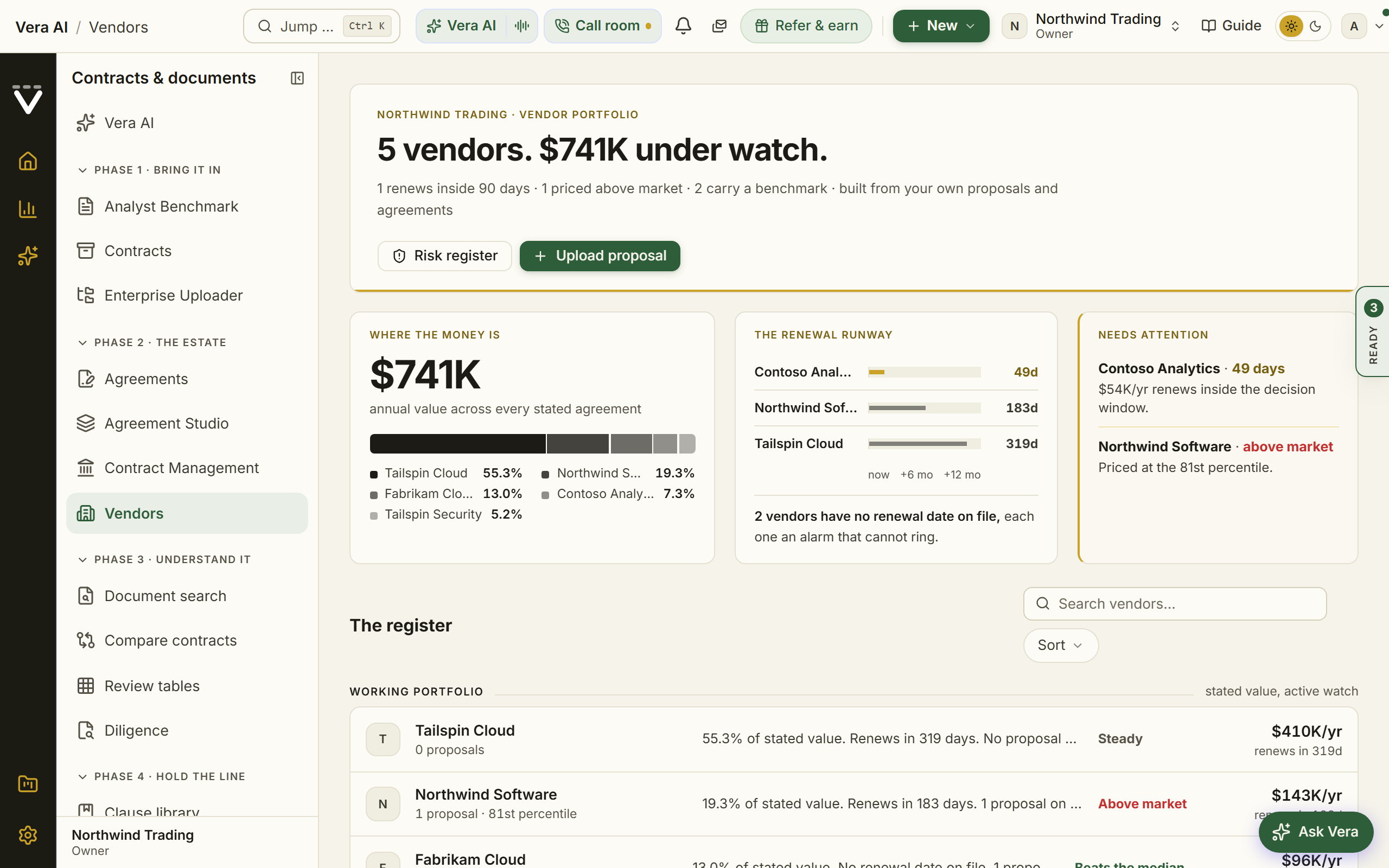
- Your position — the masthead states the estate in one sentence under a gold rule: how many vendors you hold, their stated annual value, how many renew inside 90 days, and how many are priced above the market median.
- The briefing band — three reads before the rows. Where the money is draws your spend concentration as one bar across the top five vendors, with the share each holds. The renewal runway plots every tracked renewal across the next twelve months, soonest first, and counts the vendors with no renewal date on file. Needs attention names up to four profiles worth opening today, each with the reason: renewing inside the window, priced above market, or carrying proposals with no stated value.
- The register — vendors grouped by the role they play in your estate: anchor vendors (the top five by stated value), the working portfolio, and the profiles with no stated value. Each row carries the vendor, a one line position statement, a verdict in plain colors, the annual value, and the renewal countdown. Choosing a sort (spend, renewal urgency, recently active) flattens the groups into one ranked list.
- Vendor page — open a vendor for its contracts, benchmarks, market intel, and notes.
- Open the case — a navy band under the related records opens the vendor as a case file: a full screen file of numbered executive brief documents in a grouped left rail, paged with the arrow keys or the rail, with a read meter tracking your progress and Esc to close. Up to six documents build from what the vendor's record holds: your agreements ledger, the pricing band at your deal size, the vendor's terms and conduct intel, a negotiation angles brief fitted to your footprint, and a closing What now sheet whose every move runs on your live records. Drafts open in your own inbox, copies go to your clipboard, and nothing ever sends from a case. Several records across the platform open the same way; each section below says what its case holds.
How to use it
- Open a vendor to see everything you have with them.
- Run an instant benchmark for a vendor from here.
Watch
The watchtower opens as its own window with six rooms on the number keys, and one search that crosses all of them.
- The tower — every published change on a vendor you actually hold, priced at your own seat counts, over a strip showing a year of the whole tracked market.
- The change — one move argued in full: the before and after prices, what changed and why, what to do about it, and a lever that prices the move on any seat count you set.
- Your bill — what you are billed against what you are entitled to against what the market pays, checked daily, ranked by what each finding costs a month.
- The price book — which published lists are watched, how often, and what is still waiting on an analyst read before it reaches you.
- The market — the same watch on vendors outside your estate, where a repricing shows up before it reaches your renewal, plus the email opt-in and the vendor follow picker.
- The record — one vendor's whole published history as a seismograph and a table.
Three pages sit beneath the window for the work that needs a form: the leak board, the price list check, and the archive by vendor. The old addresses (/vendors/watch for Terms watch, /spend/watch for Billing watch) redirect, so old links, bookmarks, and emails keep working.
The tower room carries the same navy band it always did: Open the workroom raises the watchtower file, a four document case that reads the whole tower for the last 90 days. The watch brief states the period in tiles and one narrative, the change ledger lists every change on your vendors with both published prices and your exposure, On your paper folds the period per vendor with the renewal windows to act, and What now carries the stakeholder memo, the copy moves, and the rooms. ⚡ What now and ✦ Ask Vera, grounded on the file, ride beside every paper.
Terms watch
Every change to a tracked vendor's published price list, diffed on each refresh and priced at your own seat counts. This is the vendor side of the watch: what a vendor moved, and what that move would cost you at renewal. Every change is kept, so you can read a vendor's full price history any time.
*In plain words: when a vendor moves its published prices, you find out, priced at your own seat counts.*
When to reach for this
- Setting up the watch on your top vendors, once, in the week the estate lands.
- A renewal is inside a year: the vendor's recent moves are your negotiation file.
- A price rise just landed mid-term: the change's case file carries the response play.
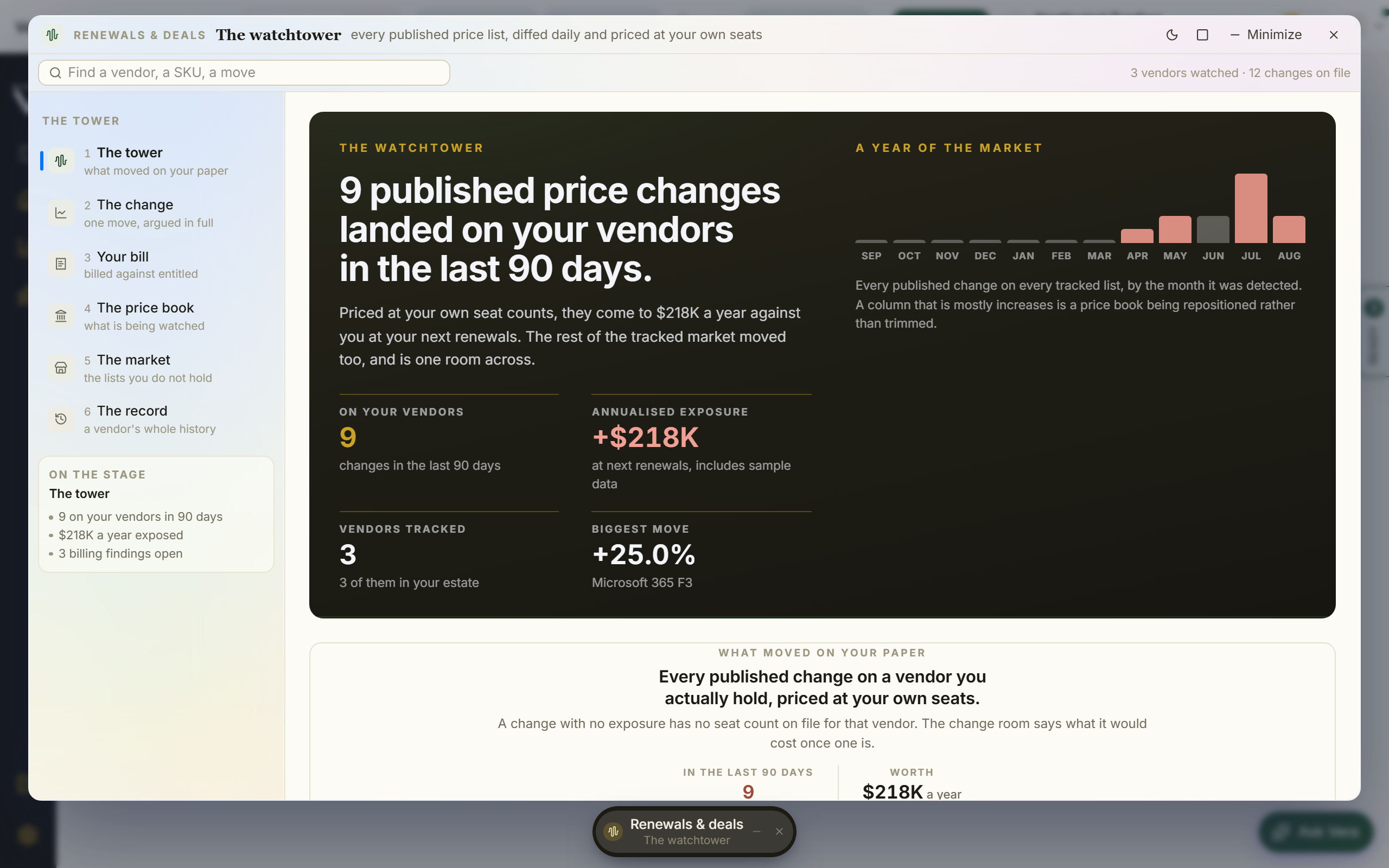
Your position sits in the masthead: price changes on your vendors in the last 90 days, vendors tracked and how many are in your estate, your annualized exposure at the next renewals, and the biggest single move in the window. The vendor follow switch and the other standing watches sit in the column beside the strips.
On the screen
- The watchtower workroom — the navy band above the floor opens the watchtower file described at the top of this section: the whole period across Terms, Billing, and the check, as four executive papers with the moves and Ask Vera docked beside them.
- The floor toolbar — one instrument row over the strips: scope the board to your vendors, the tracked market, or both; cut it to increases, decreases, new SKUs, or retirements; and read the last 90 days or the full year. The count at the right restates what the filter left, so a narrowed board never reads as a quiet market.
- Email me when price lists change — a switch in the side column turns on the price-change digest; nothing is sent until you turn it on, and every email carries a one-click unsubscribe that turns off only this email. Below it, one chip per vendor company (Microsoft covers Microsoft 365, Azure, and Dynamics 365 in a single chip; Oracle and Google merge the same way): pick the vendors you care about, or choose All tracked vendors to hear about every tracked change. The list here and on the Price list check tab are the same roster, so the two tabs always agree.
- Your vendors — a seismograph strip per vendor you hold: increases strike upward in brick, decreases downward in green, new SKUs in gold.
- Open the change workroom — selecting a change shows a second navy band under the diff panel; it opens that one change as a five document workroom: the cover sheet, the change itself with both published list entries side by side, an impact brief priced at your own seat counts, a response sheet weighing the grandfathering, renewal, and acceptance options, and a What now sheet. ⚡ What now drafts five letters from the change itself, the grandfathering request, the claim on a new list price, a clarification request on a new SKU, a continuity request on a retired SKU, and the internal note to stakeholders, then copies the change summary or the one line version and opens your renewals or the full price history. Both published prices are quoted rather than derived. ✦ Ask Vera answers from this change and your own exposure to it; if you do not hold the vendor, the room says so and treats the move as market intelligence rather than exposure.
- Market watch — tracked vendors outside your estate. Changes here are context, not exposure, because nothing below touches a contract you hold.
- Also watching for you — cross-links to the Billing tab and to standing answers that changed.
How to use it
- Read your vendors first: any strip with a recent brick strike is a price rise heading for a renewal you hold.
- Use the switch to have price-list changes emailed to you, and follow the vendors you want to hear about.
- Open a change to see the old and new price, the delta, and what it costs at your seat counts.
- Switch to the Billing tab to see whether your invoices already reflect a move.
If something looks wrong
- The digest emails are not arriving: the switch here is the source of truth, and nothing sends until it is on; Troubleshooting covers the delivery cases.
- Your vendor's strip is missing: following is per vendor company, so check the chip roster on the Price list check tab, and request the vendor from its card if it is not tracked yet.
Related: Archive by vendor · Billing watch · Research Agent
Terms watch archive by vendor
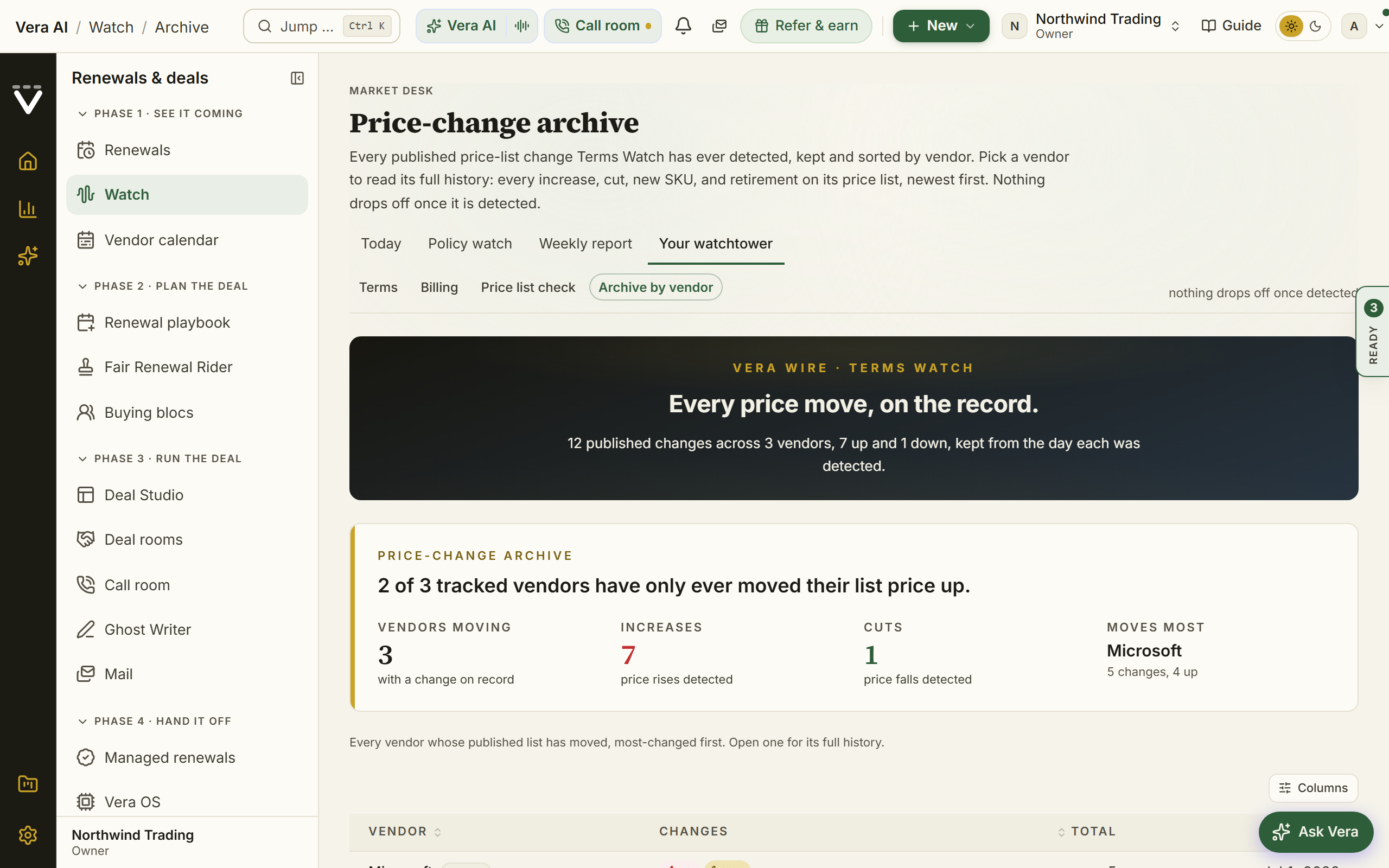
Every published price-list change Terms Watch has ever detected, kept and re-sorted by vendor. It opens with the read: how many vendors have moved, increases against cuts, and which vendor moves its list most. The index lists every vendor whose price list has moved, with how many changes it has, a breakdown of increases, cuts, new SKUs, and retirements, and when it last moved. Open a vendor to read its full history, newest first: each change shows the old and new price, the delta, and the grounded analyst note (what changed, why it likely changed, and the one action to take before renewal).
How to use it
- Press Archive by vendor in the watchtower's pill row, from any of its rooms.
- Scan the index (most-changed vendors first) or find the vendor you are about to renew.
- Open the vendor to read its full price history and the note attached to each change.
Billing watch
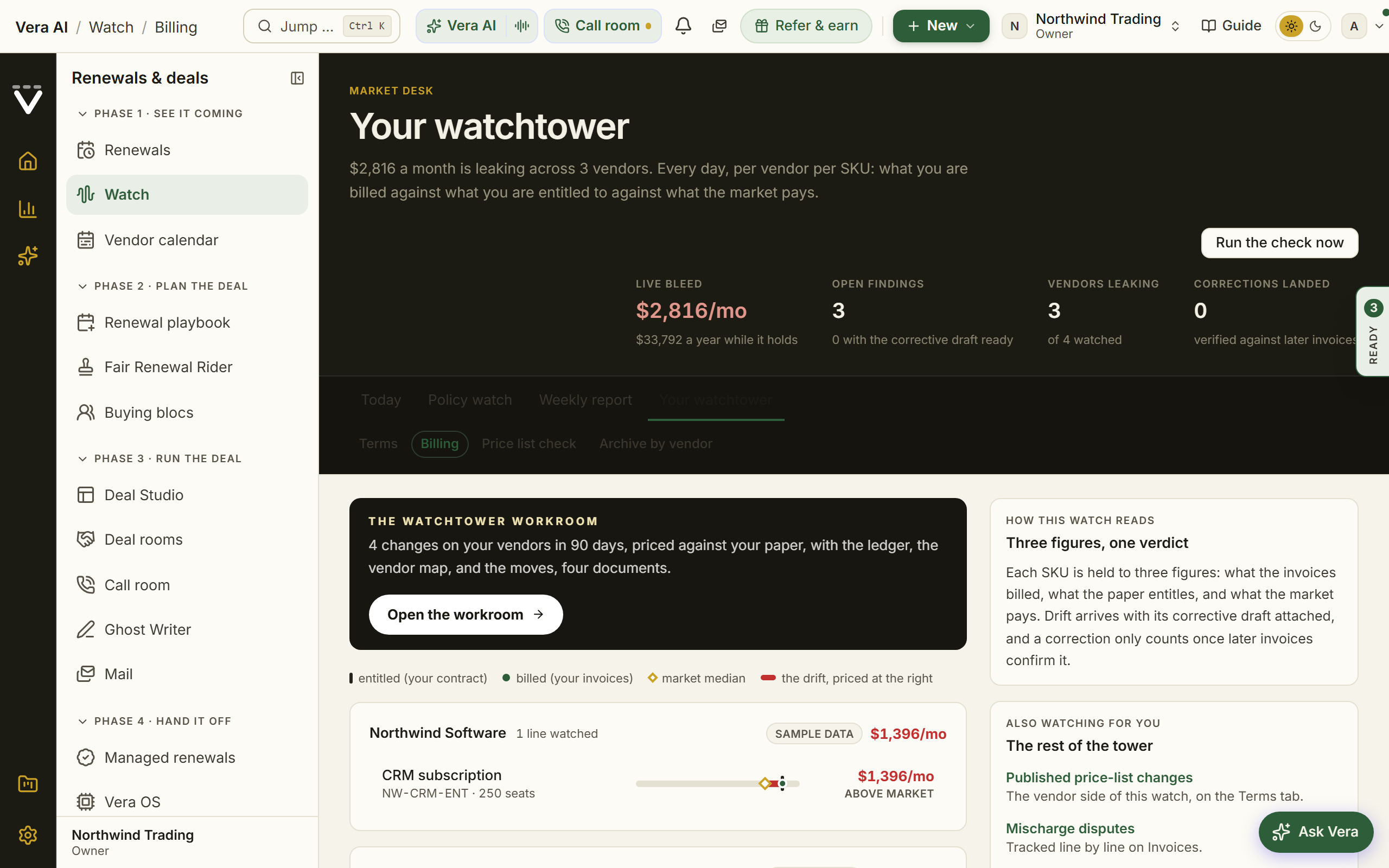
Every day, per vendor per SKU: what you are billed against what you are entitled to against what the market pays. Drift arrives with its corrective draft attached, and a correction only counts once later invoices confirm it. This is the customer side of the same seismograph as the Terms tab.
On the screen
- The masthead — the headline number lives in the navy masthead: how much a month is leaking, across how many vendors, with live bleed, open findings, vendors leaking, and corrections landed. Recompute sits beside it.
- The watchtower workroom — the navy band above the board opens the shared watchtower file (see the top of this section), which reads the billing drift beside the period's price-list changes.
- Leak board — a row per leaking vendor with the SKUs where billed, entitled, and market prices disagree.
- The side column — how the watch reads (billed against entitled against market), entitlements waiting for your confirmation, and the rest of the tower: the Terms tab, invoice disputes, proven corrections, and standing answers that changed.
How to use it
- Read the verdict band for the live monthly bleed.
- Open a leaking vendor to see the SKU-level findings and the corrective draft attached to each.
- If the board is empty, confirm entitlements from a contract or connect a license source so the daily check has something to price against.
Tips
- An approved correction is proven or disproven against later invoices, and the verified saving lands in realized savings on Portfolio; mischarge disputes are tracked on Invoices.
Related: Terms watch
Price list check
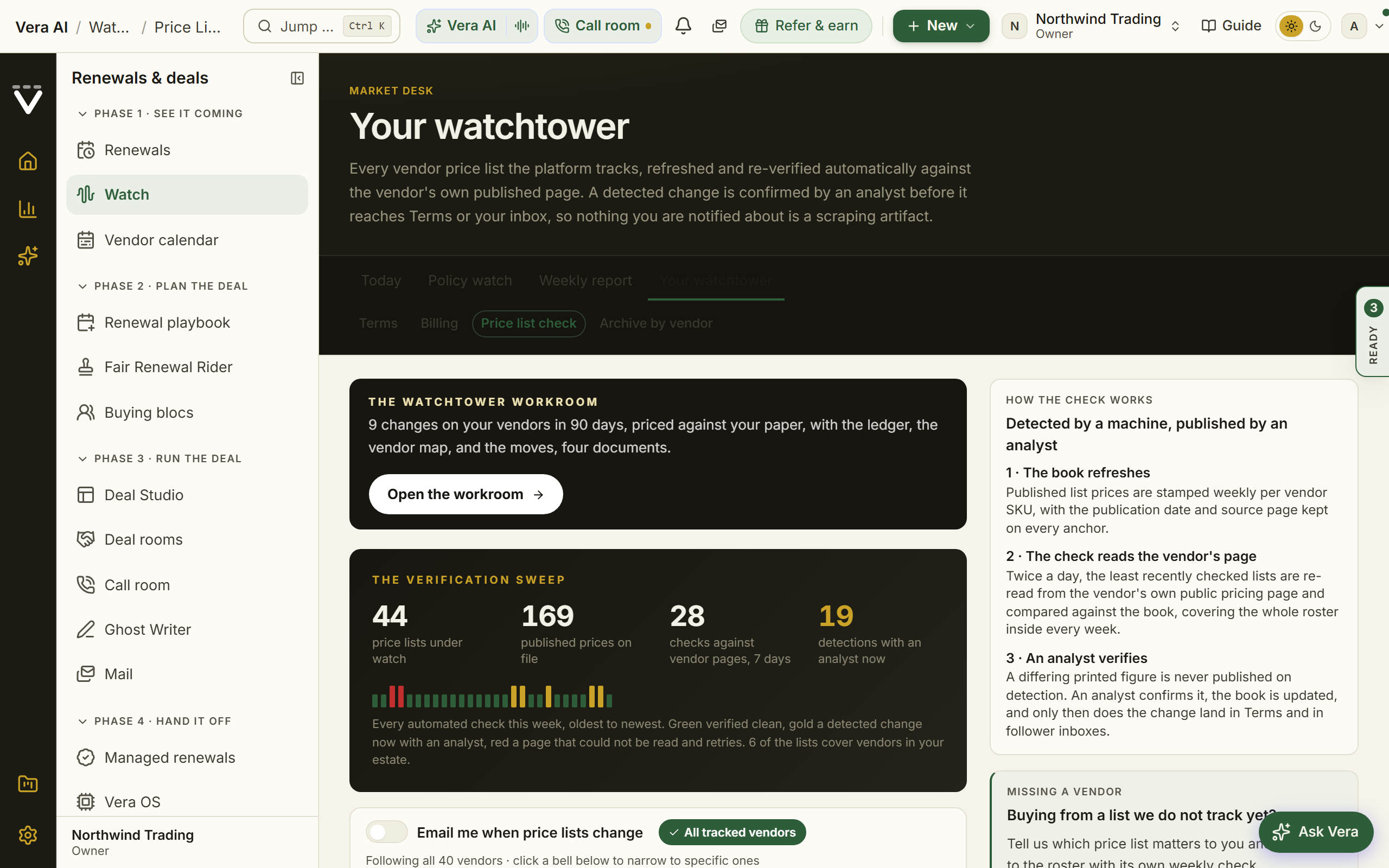
The verification machine on one screen. The book of published list prices refreshes weekly, an automated check re-reads each vendor's own public pricing page and compares it against the anchors on file, walking the whole roster inside every week, and an analyst confirms any detected change before it is published to the Terms tab. This tab shows all of it live, and doubles as the place you choose what you are notified about.
On the screen
- The watchtower workroom — the navy band above the desk opens the shared watchtower file (see the top of this section).
- The sweep band — the dark panel at the top of the desk states the live numbers: price lists under watch, published prices on file, checks against vendor pages in the last 7 days, and detections currently with an analyst. Beneath them, a heartbeat marks every automated check this week: green verified clean, gold a detected change, red a page that could not be read and retries.
- Notification bar — the email switch, the All tracked vendors chip, and your follow count. The roster below is the picker: the bell on each row follows or unfollows that vendor and saves instantly, no separate save step. Following is one chip per vendor company, so all the Microsoft lists ride one follow.
- Latest verified changes — the most recent analyst-confirmed changes with their deltas, linking to the Terms tab where each is priced at your seat counts.
- Search and lenses — find a vendor by name, or cut the roster to your vendors, lists with changes, stale prices, or lists needing attention.
- The roster — grouped by category, a row per price list: the vendors it covers, how many SKUs are on file, a freshness bar for the published prices, the list's recent check history, and the latest result. A gold dot marks vendors in your estate.
- The drawer — open any row for the full detail: every anchor's list price, unit, publication date, and confidence, a price-history trend per SKU, the latest check's verdict for each anchor (matches the page, change detected, or not printed publicly) with a link to the vendor's own pricing page.
- The side column — how the check works in three steps (the book refreshes, the check reads the vendor's page, an analyst verifies), and Request a vendor: buying from someone we do not track? Ask and the list joins the roster with its own weekly check.
How to use it
- Read the sweep band: if detections sit with an analyst, a price move may be coming to Terms soon.
- Turn on the email switch, then either keep All tracked vendors or click bells to follow just the vendors you hold.
- Use the Your vendors lens to confirm your estate is covered; anything green was recently re-verified against the vendor's own page.
- Open a row before a renewal to read the vendor's current anchors and their history, straight from the book our analysts maintain.
Related: Terms watch · Archive by vendor
Research Agent
The Research Agent opens as its own application window, not as a page inside the Market Desk. Every door leads to the same window: the rail entry, the desk tab, a link in an email, a typed address. Closing it returns you to Home.
Every Monday the agent researches the week's enterprise software news for pricing and licensing changes, anything that moves costs or negotiating position, and files this wire. It runs five sweeps in parallel, one per beat (price moves; licensing, packaging and product terms; audits, support and end of life; M&A and earnings; the regulatory and notice calendar), opens and reads the consequential articles in full rather than working from headlines, runs a completeness check that closes anything the sweeps missed, and remembers recent weeks so it reports what is new rather than repeating itself. It also reads the platform's own evidence, price list changes from Terms watch, price index moves and fresh research, alongside the web. Each item links to the article it came from, and an item whose figures were checked against the research and whose source link answered carries a green verified at source mark. Between briefings, a daily flash check watches for changes too big to wait for Monday; when one breaks, the item joins the current week's briefing the same day with an Added stamp naming the day it landed. A story that develops over several weeks reads as one thread: a continuing item notes which week of the story this is. It is short on quiet weeks and longer only when something major breaks; items on vendors you hold are marked throughout.
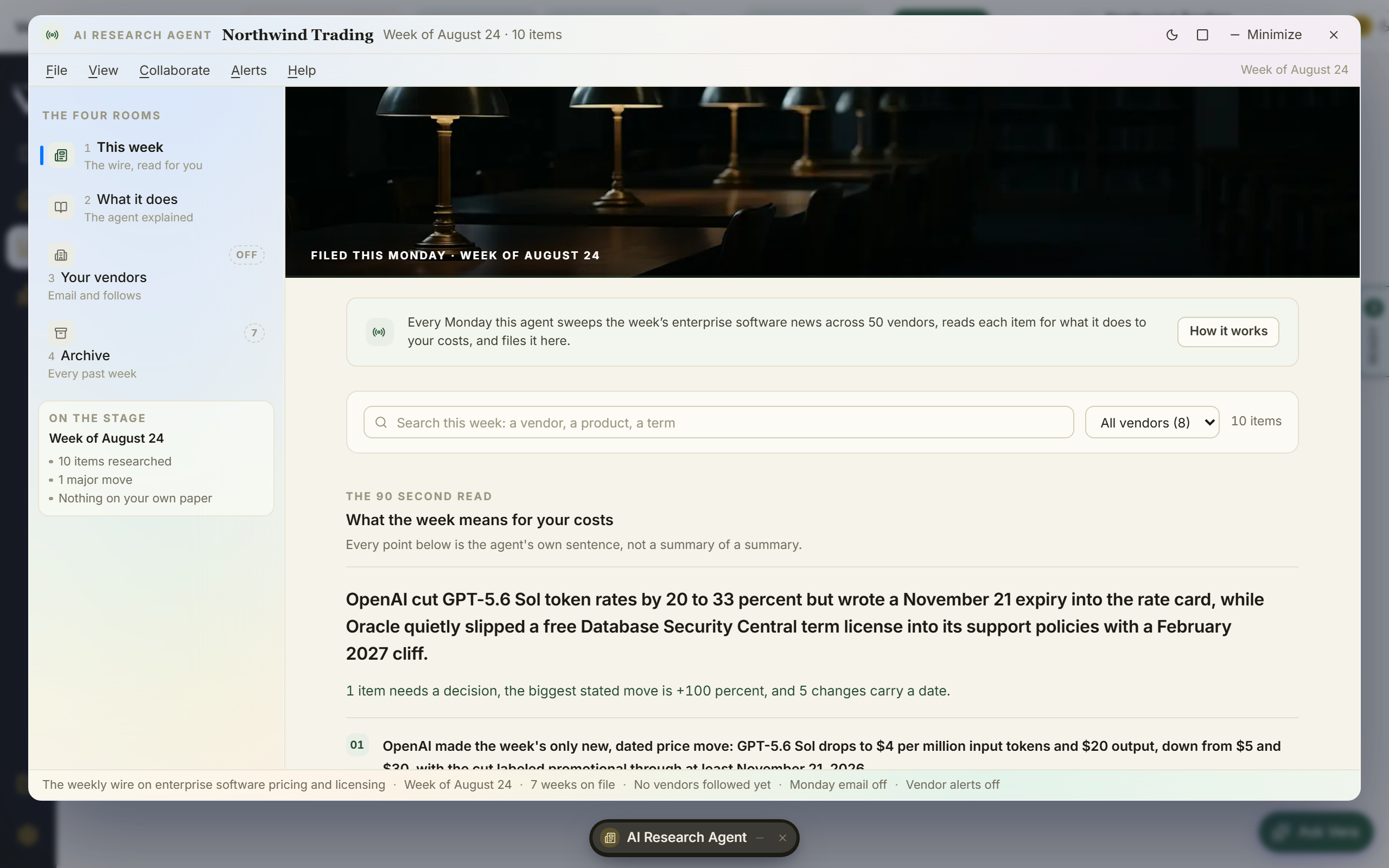
The menu row sits under the title bar: File, View, Collaborate, Alerts, Help, the way a desktop application carries them. Alt opens them, and every item prints its key beside it. Nothing lives only in a menu; each one is a second door to something the rooms already do.
- File — print this week, open it in a new tab, copy a link to it, open a past week, close the window.
- View — jump to any of the four rooms, search this week, show only the vendors you hold, clear the filter, maximize, dark mode.
- Collaborate — send this week to a colleague, copy a link, print or save as PDF.
- Alerts — what you are subscribed to, ticked, with a press opening room three where the switches live. A menu never changes a notification setting on its own.
- Help — what this agent does, the keyboard shortcuts, and what the agent is.
The four rooms sit in the rail on the left, and keys 1 to 4 move between them.
Room 1 · This week opens on the latest wire.
- The band — a photograph across the top of the room, captioned with the week you are reading and whether it was filed this Monday or opened From the archive. Under it a single row says what the agent is, with How it works opening room two and Send this week handing it to a colleague.
- The filter bar — sticks to the top of the room, so a long week never scrolls away from its own controls. A search field reads every item's vendor, headline, detail, what it means for you, and its source; a vendor list narrows to one vendor at a time; In your estate leaves only the vendors you hold paper with. The count on the right says how many of the week's items are showing. The ledger and both finding sections read the same filter, so what you count in one place is what you get in the other. A filter that matches nothing says so, and offers to clear itself or to search past weeks instead.
- The 90 second read — the week's finding in one sentence, then the stake in one line (how many items need a decision, how many land on paper you hold, the biggest stated move, and how many changes already carry a date), then the executive summary as a numbered list, one point per sentence. Nothing is dropped and nothing is re-summarised; the agent's own sentences are simply set as a list. The stake counts the whole week, not the filtered view.
- The ledger — every item as one row: vendor, what changed, the move as a percentage, when it takes effect, and your read. Rows are ordered by what they ask of you rather than by when they were published: Act this week first, then Watch, then For the file. The rank is worked out from the item's own figures, its effective date, and whether it lands on a vendor you hold, so it is the same for everyone reading the same week. Rows on vendors you hold carry a gold edge and a yours tag.
- The calendar — a strip of the week's dated changes in the order they land, drawn only for changes whose source stated an effective date.
- The findings — one card per item, split into pricing and licensing first, then product and market context, each section in the same rank order as the ledger. The conclusion leads: the card opens with its rank, its type and its estate mark, then the headline, then a before and after bar wherever the source stated both prices, then What you should know about it as a numbered list, and only then The detail as bullets, the evidence behind the read. The source line at the foot links the article the agent actually read.
- What to do this week — the week's moves, numbered, first one first.
- Bottom line — the call in one sentence, with the reasoning as points under it.
Room 2 · What it does explains the agent itself.
- The pipeline — the Monday pass drawn as five stages: sweep, read, verify, match, file.
- What it is looking for — the six signals as a checklist. Anything failing all six is left out.
- What lands on your desk, and when — a table of every output, where it appears and on what cadence.
- What it will not do — the limits, numbered and stated plainly: it never invents a figure, it reads public reporting rather than your contracts, and it is short on quiet weeks.
Room 3 · Your vendors is where the weekly email, the follow list, and the per vendor alert live. It saves in three steps and one press.
- Step one, the Monday email — a switch, off by default. Nothing is sent until you turn it on, and every email carries a one click unsubscribe that turns off only this email.
- Step two, the follow list — a search field over the 50 researched vendors, so you find your own stack by typing rather than by reading every name. Searching narrows what is shown and never changes what you follow. On your own paper lifts the vendors the agent found on contracts in this workspace to the top, followable in one press. Below it, eight groups sort the rest into the buying conversations they belong to (platform and ERP, cloud and infrastructure, data center and virtualization, data and analytics, security and identity, developer and AI, collaboration and content, business applications and services). Each group follows or clears as a set and counts how many of its vendors you follow.
- Step three, tell me when a vendor I follow moves — two switches, both off until you turn them on. Notify me in the workspace posts a notification the moment a week is filed carrying one of your vendors, naming the vendor and what changed, opening straight to that week. Email me as well sends the same alert to your inbox with a one click off link. This is not the Monday email: the briefing is the whole wire on a schedule, and this fires only when a vendor you follow actually moved. Follow no vendors and the alert has nothing to watch, which the room says rather than letting you switch on silence.
- The save bar — follows you down the list and says what is unsaved, then states what is on once it is saved. Every vendor is researched whether or not you follow it; following moves its items to the top of your briefing and your email, and decides what the alert watches.
Room 4 · Archive lists every week the agent has filed, newest first, with how many items it carried, how many were major, and how many landed on a vendor you hold, so you can tell at a glance whether a week is worth reopening. A search field reads the headlines and the dates once there is more than a fortnight on file. Pressing a week puts it on the stage in room one, marked From the archive. Browse by vendor opens the per vendor archive (see below).
Sending a week to a colleague. Send this week, on the row under the figures or in the Collaborate menu, opens a short sheet: pick somebody from your workspace, say what you want them to do, send. They get a real task on their desk dated a week out, a notification, and an email, each linking back to the same week you were reading. Only members of your own workspace are listed; the window does not mint a public link.
How to use it
- Read this week, starting with the rows and cards marked as in your estate.
- Narrow it when a week is busy: search a product name, or pick one vendor from the list, or press In your estate to see only your own paper.
- Press Your vendors, search for the vendors you hold, follow them, turn on the Monday email, and turn on the alert if you want to hear between briefings. Save.
- Send anything somebody else owns straight to them with Send this week.
- Open What it does if you want to know exactly what the agent reads and what it will not claim.
- Open a past week from Archive to catch up, or browse the archive by vendor to read one vendor's full history.
Tips
- The title bar carries its own light and dark switch, because the window covers the top bar's usual one. It flips the same account theme everywhere.
- Keys: 1 to 4 for the rooms, / to search this week, ? for the shortcut list, Alt for the menus, Esc to close.
- Your weekly emails arrive as one Monday brief: the vendor market wire (this report), renewals coming up, watchtower changes, and savings and wins in a single send. Turn any section off while keeping the rest under Settings › Notifications, where the per vendor alert also appears as Vendor wire alerts.
Related: Archive by vendor · Terms watch
Research Agent archive by vendor
Every weekly update the agent has ever filed, kept and re-sorted by vendor so nothing drops off. Updates that belong to the same developing story fold into one story card, newest week first, with a chip counting the weeks, so a saga fought over a quarter reads as one narrative. It opens with the read: how many vendors carry a major market-moving update, how many touch pricing, and which vendor the desk keeps writing about. The index lists every vendor the agent has covered, with how many updates it has and when it was last mentioned; a gold dot marks a vendor with a major update on record. Open a vendor to read its full history: every price move, licensing change, and market shift on it, newest first, each linking back to the week it ran in.
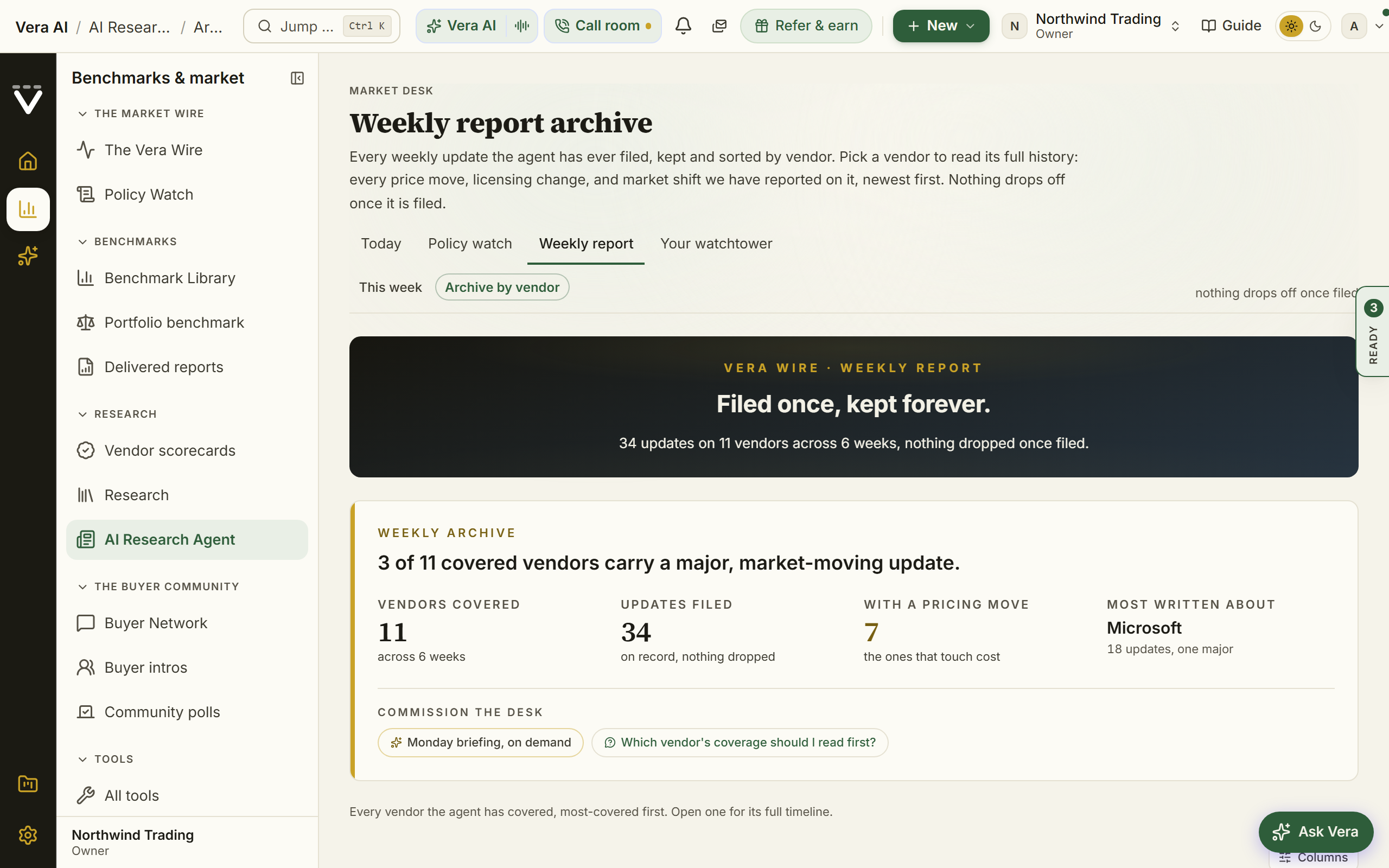
Commission the desk sits beside the archive: gold chips that turn what is on file into a written document rather than leaving you to act on a feed. A renewal strategy brief on the vendor the desk covers most, offered only where your workspace actually holds a contract for that vendor; a Monday briefing that states how many notice deadlines fall inside 45 days; and a closing question that opens Vera on the same subject. Each commission writes a full document to your Deliverables and keeps writing even if you close the dialog. The same rail rides the price watch archive, where the chips are the renewal strategy brief on the vendor with the most published price moves and talking points for the call on that vendor.
How to use it
- Open the Research Agent, go to the Archive room, and press Browse by vendor.
- Scan the index (most-covered vendors first) or find the vendor you are about to renew.
- Open the vendor to read its timeline, and click any Week of eyebrow to jump to the full weekly brief it came from.
- Press a Commission the desk chip to turn the coverage into a document you can forward.
Agreements
Since August 2026 it opens as a Fluent window with its own menu: the rail inside lists the rest of Contracts & documents, so you move between them without going back out, and Escape closes the window.
The ledger is signed paper only, one row per vendor. The full document estate is in Contracts, and a quote you want priced against the market goes to Analyst Benchmark.
Signed contracts you are tracking for spend and renewals, worked as a ledger and an inspector. The table groups every vendor folder by what binds you first; selecting a row opens that folder in full beside the table. Set the expiry and notice period once, and the platform watches the deadlines for you.
*In plain words: the ledger of what you signed, with the dates watched so windows never shut silently.*
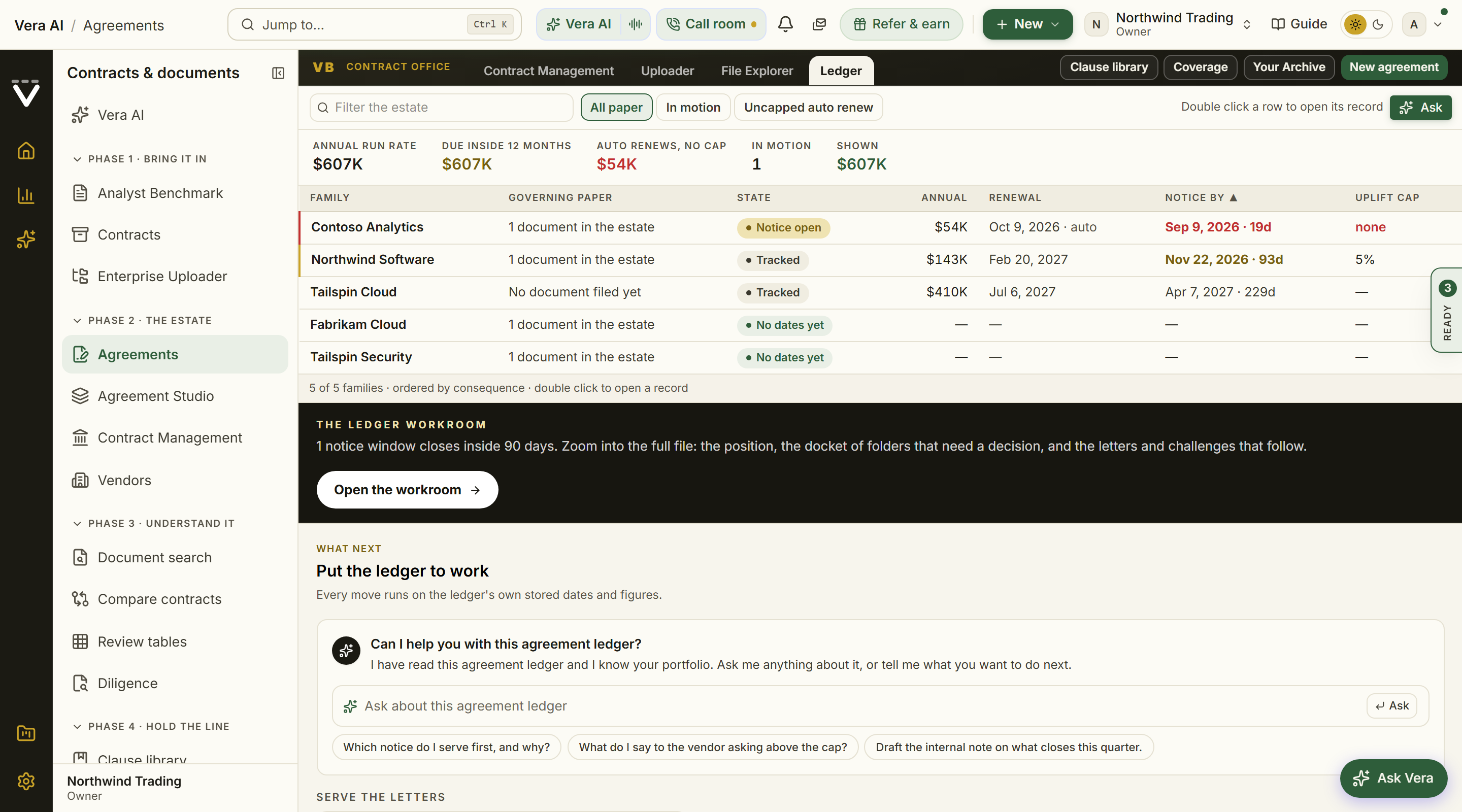
Inside the Contract Management Portal the ledger is one dense grid over the whole estate, the same table grammar as the Uploader's run. A filter and three lenses sit across the top, All paper, In motion (anything in a notice window or renewing) and Uncapped auto renew (the paper that renews itself with no ceiling on the increase). Beside them the figures: the annual run rate, what is due inside twelve months, what auto renews with no cap, how many agreements are in motion, and the value of what you are currently looking at, which moves as you filter. Then the table itself: the family, its governing paper, its state, the annual value, the renewal date, the notice by date and the uplift cap. Press a column heading to sort by family, by annual value or by consequence, and press it again to flip. A notice date inside thirty days wears a red edge and red text, one inside four months wears gold, and an auto renew with no cap reads none in red. A click selects a row, a double click opens that agreement's record, and Enter opens the selected row.
Uploading happens in the Enterprise Uploader, never here. The ledger reads your paper; the Uploader is the one door that takes it in, checks it, and keeps it staged until you sign it off.
When to reach for this
- Filing a newly signed contract, the day it is signed, while the dates are at hand.
- Checking what reaches renewal inside 90 days and what vendors are asking above your caps.
- Auditing inherited agreements for the two fields that matter: expiry and notice.
A worked example. The sample Northwind CRM agreement carries $142,800 a year, an expiry with a 60 day notice period, and a 7 percent uplift cap. The vendor's renewal proposal on file asks $162,792, a 14 percent increase, which is exactly the kind of gap the masthead's "asking above your caps" figure counts and Anomalies flags. One ledger row, set up once, is what makes that breach visible without anyone rereading the contract.
On the screen
- The Contract Management Portal frame — the ledger is a room of the one Contract Management Portal application: the navy titlebar carries the same four tabs as every room, Contract Management, Uploader, File Explorer and Ledger, with Clause library, Coverage, Your Archive and New agreement as doors on the right (the old left menu retired), and a status bar states the position: vendors, value under management, and how many sit in a notice window.
- The ledger — one row per vendor, grouped by urgency: notice window open, past renewal, renews inside 90 days, later this cycle, and no date yet. Each group states its count and annual value, and the runway column shows how much of the final year has run with the notice deadline ticked on it.
- The inspector — select a row and the panel beside the table works that folder in full: the term drawn as a timeline, the editable terms, the uplift verdict against your cap, and up to five documents. On a narrow screen it stacks under the table. Days remaining are counted on your organization timezone's calendar day, the same one deadlines and alerts use, which owners set under Renewals.
- Chips, search and views — filter to the notice windows, the next 90 days, past renewals or undated folders in one press, search the ledger by vendor, or switch to the Runway tab to see every renewal drawn on a timeline. You can track up to forty vendor agreements.
- The workroom — a band above the ledger opens the case file: the position on a cover sheet, a docket of every folder that needs a decision and why, and a What now sheet of real moves drafted from your own folders: serve notice where the window is open, agree terms in writing where the deadline has passed, challenge proposals standing above their uplift caps, and benchmark the largest agreement with no renewal quote on file. Letters open as editable drafts and send from your own mail client.
- What next — the page closes with the same moves as a module, so the ledger never dead-ends.
How to use it
- Add an agreement with Add vendor or Add with AI: vendor, expiry date, notice period, and the signed files.
- Press the In notice chip and work the top row in the inspector: confirm the dates, enter the vendor's proposed price against your cap, and file the paper.
- Open the workroom's What now sheet and run the top move; the notice letter is usually it.
- See them sorted by deadline on Renewals.
If something looks wrong
- An agreement never alerts: check it carries both an expiry date and a notice period; without both there is no window to watch. And remember the alerts themselves are opt-in under Notifications.
- You are out of room: the ledger tracks up to 40 vendor agreements with 5 files each. Past that scale, the estate belongs in Contracts or Enterprise Uploader.
Related: Renewals
Deals
A deal is one negotiation held in one place: the papers on the table, what you are trying to win, the standing instructions you want followed, and how strictly a conversation inside it is bound to those papers.
*In plain words: the folder for a single negotiation, and the switch that stops Vera answering it from the rest of your estate.*
When to reach for this
- A renewal is coming and you want every question about it answered from that paper, not the whole workspace.
- Several people are working the same negotiation and the instructions should be written down once.
- You want a brief you can forward that says what the deal is, what is on the table, and where it stands.
On the screen
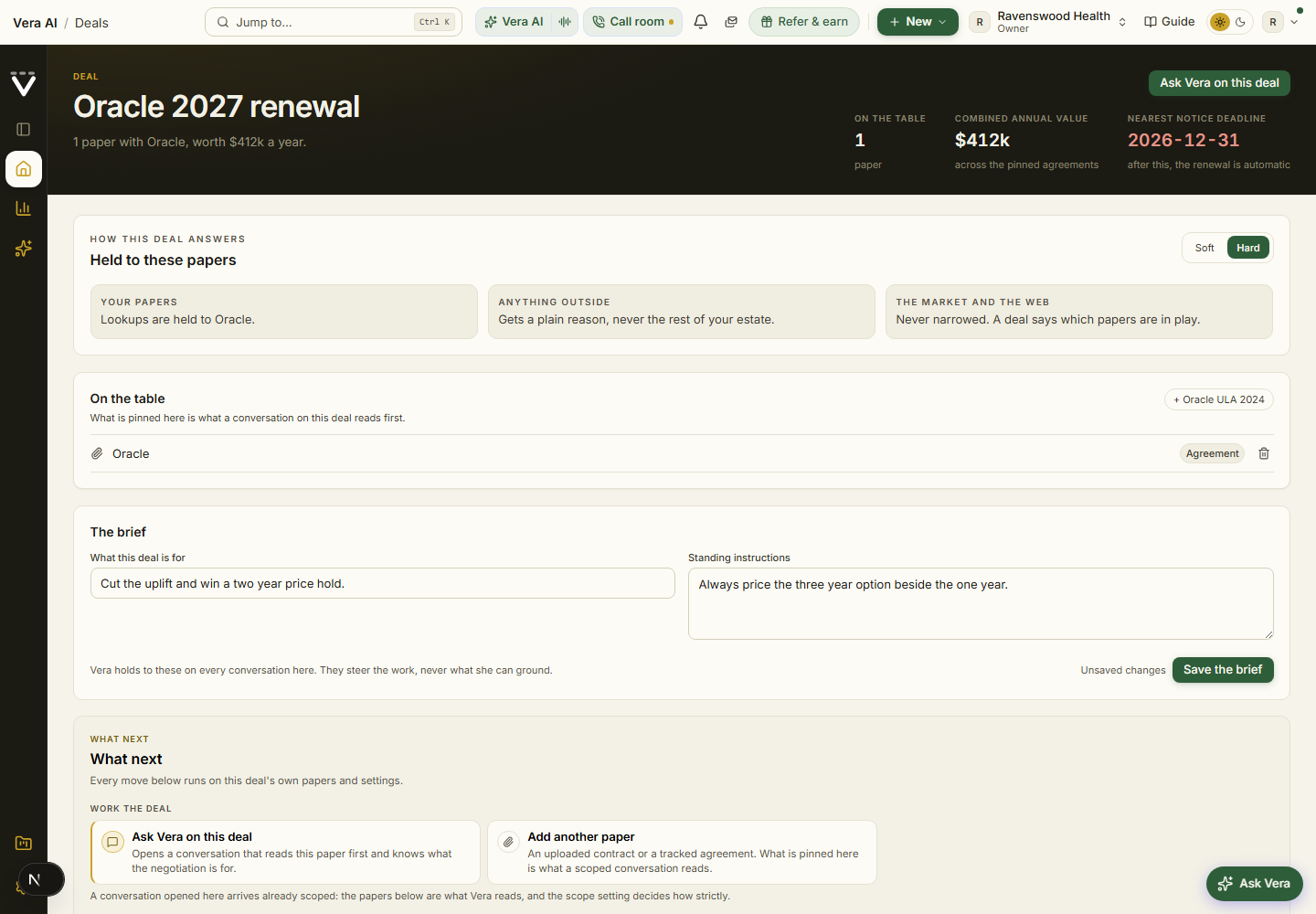
- The stake, at the top — how many papers are on the table, their combined annual value, and the nearest notice deadline. The deadline is the expiry pulled back by the notice window, which is the date that actually matters: after it the renewal is automatic whatever the expiry says. Only tracked agreements carry a value and a window, so a deal made of uploaded contracts alone reads Not on file rather than a confident zero.
- How this deal answers — the scope, as three short rows: what your papers do, what happens to anything outside them, and what stays untouched. Press Soft or Hard and the rows rewrite to the behaviour you just chose, before you have asked anything.
- Soft scope — the papers are the subject, so "the contract" and "this deal" mean them. Vera still looks wider when a question genuinely goes wider, a comparison against another vendor for instance, and says when she has.
- Hard scope — her lookups are held to the deal's vendors. A question that names nothing is narrowed to them and the answer says so, and one that names a vendor outside the deal gets a plain reason instead of an answer drawn from the rest of your estate. The market, the web and the research library are never narrowed: a deal says which of your papers are in play, not what the market is allowed to say. A deal with nothing pinned holds to nothing, and the page says so.
- On the table — the papers themselves. Add an uploaded contract or a tracked agreement from the chips beside the heading; the bin takes one off. What is pinned here is what a conversation on this deal reads first. Add a file under the list takes anything else the deal turns on, a pricing workbook, a photographed rate card, a text note: the file is kept with the deal, marked File in the list, and Vera reads it through her document search on every question scoped to this deal.
- The brief — what the negotiation is for, and the standing instructions Vera holds to on every conversation in the deal. They steer the work and never license stating a figure she cannot ground.
- Ask Vera on this deal — opens a conversation already carrying the deal, so the scope applies from the first question rather than after you explain it.
- What next — the moves this deal offers, including the brief you can copy and paste into a note.
How to use it
- Press New deal, name it after the negotiation, and say in one line what you are trying to win.
- Put the papers on the table: the agreement you are renewing, the proposal that arrived last week, or both.
- Write the standing instructions you would give a colleague working it, then Save the brief.
- Set the scope. Soft while you are still exploring, hard once the papers are the whole conversation.
- Press Ask Vera on this deal and work it. Every answer reads those papers first.
If something looks wrong
- The combined annual value reads Not on file: only tracked agreements carry one. Pin the agreement rather than the uploaded contract, or add the figure on the agreement itself.
- A hard scope is not narrowing anything: check that a paper is actually pinned. With nothing on the table there is nothing to hold to, and the page says so under the scope rows.
- Vera answers about a vendor you did not expect: the scope is soft. Switch it to hard and save.
Related: Agreements · Vera conversations
The agreement file
One agreement's whole record on one page: what it is worth, where it stands, every version it has been through, and every actor who touched it. It is the same page whether the agreement came from your ledger or from a proposal you uploaded. The Agreement Command console that used to list these files folded into the Contract Management Portal on 25 August 2026; the file itself is unchanged and every link to it still works.
*In plain words: everything known about one agreement, and the moves that follow from it.*
On the screen
- The read — the panel at the top right states where this file stands before any table does. It is the first thing to look at.
- Five panes under the header: Overview (the terms, the economics, the state), Documents (what is on file; on a contract backed record the file's name, the View button, a click or a double click opens the paper in the reader, the document analysis window described under the Enterprise Uploader in chapter 0: find, the figures the read lifted, marks on the paper, a question box, and the redline painted on the page), Redline (the marked-up paper and what changed), The watch (the rights you hold and duties you owe on this agreement), and Activity (one timeline every actor writes to, human and Vera alike, including a call about this agreement once you hang up).
- Team discussion — the Activity pane also carries the file's comment thread. Write a comment, mention a teammate with @ and only that person is notified, resolve a thread when it is settled. For a ledger agreement this is the same thread its renewal card shows, so one conversation follows the paper wherever the team reads it.
- The economics read — your discount, the peer range, and where this deal ranks, with the money at stake a year when a decode has priced the movable terms. When there is no market read yet it says so and offers the benchmark rather than inventing a figure.
- The benchmark report — one press composes the full verdict on a page and a half: your discount, what comparable customers at your size are offered, where the deal ranks with the gap priced, the discount curve with your deal placed on it, what protects you and what works against you, and a plain answer to whether you are overpaying. The report saves on the contract as a versioned record inside the platform, opens in its own window, and exports to Word in the same look or to Excel with live sensitivity formulas. Run it again after a renewal and the new version files on top of the old.
- What if they ask for more — the renewal lever, under the economics read. Move the uplift the vendor is asking for and the length of the term, and the cost of the next term moves with it, on your own annual figure. It opens on the forecast's own expected uplift so it agrees with the panel above it, and it shows what compounding actually costs: year two pays the uplift on year one's raised price. Where your paper caps the uplift, it prices what the cap is worth against the ask, so you know what the clause is protecting.
- Move the file — the states an agreement can go to next, for editors. A file moves forward one declared step at a time rather than by free text.
- Version chain — every version of this agreement in order, so a term you remember differently can be checked rather than argued.
- Doors — the surfaces that do the work: talk it through with Vera, the market answer, the ledger, the rights register, the runway, and the vendor page, everything you hold with that vendor on one page.
- The Reading Room — the Redline pane opens full screen: the counterparty's own language beside your position, clause by clause. Edit your language in place and the tracked change renders live as you type, their words struck, yours underlined, exactly what the Word file will carry. Accept, edit, or reject each finding (j and k walk the list), then one press composes the real tracked changes redline into their own DOCX and files it on the version chain under your name.
- The Decoder — on a proposal's file, three doors run Vera's decoder on the stored paper without leaving the room: the contract decode, the MSA Agent, and the SOW Agent. The run happens in the background and the result opens in its own window when it lands; a recent run is reused rather than paid for twice.
- Send it on — Vera drafts a follow up email from the file's own facts, for the vendor, your CFO, your CIO, or a colleague. Edit anything, then copy it or open it straight in your own mail app. Nothing ever sends from the platform.
- The Signing Desk — for records at the Executing station. Open the signing studio is the front door: the stored PDF opens full screen, you name up to ten signers in the order they must sign, drag signature, initials, date signed and text areas onto the pages (each area carries its signer's color), write the note that travels with the request, and send. Every signer receives a personal link and signs in the browser with no account: they type or draw a signature once, every area of theirs fills, text boxes ask for exactly what you labelled them, and out of turn they see who signs before them. Back on the desk, each signer shows their standing by name: sent, opened it but not signed, or signed with the date, so you can see exactly who is holding things up. A live envelope can be reminded (the slowest signer gets a fresh link), re-routed to a different person (the old link dies the moment you do), or voided with a reason that lands on the record; a signer who declines must say why, and the reason reaches you verbatim by email and on the activity trail. When the last signature lands, the areas are stamped into the PDF, a certificate of completion is appended (the chain in order, each signature's time and network address, and the document's fingerprint), the signed copy files on the version chain, the record moves into force, and the fully executed contract goes to every party by email. Orgs that sign on DocuSign or Adobe Acrobat Sign keep those rails on the same desk: connect either under Settings › Integrations and the quick send routes the same signers through the provider instead.
- What next — the close of the page. Every move there runs on this file's own record: decide what to do, work the paper, or see it in context. Copy the position puts the value and the notice deadline on your clipboard as one line for an email.
How to use it
- Read The read panel first, then the economics.
- Move the renewal lever to the uplift you expect to be asked for. That number is what you are negotiating against.
- Take the move that follows from it under What next, and file the state forward when the agreement genuinely moves.
Related: The Contract Management Portal · The call room · Rights register
The watch desk
Route: /agreements/watch · Who sees it: everyone · Reached from: Contract Management, the Watch tab, "Open the watch desk"
Both sides of your paper on one floor: the rights the contract gives you, and the duties it puts on you. Every row is quoted from the document it was read out of, so nothing appears here that cannot be pointed at in the paper.
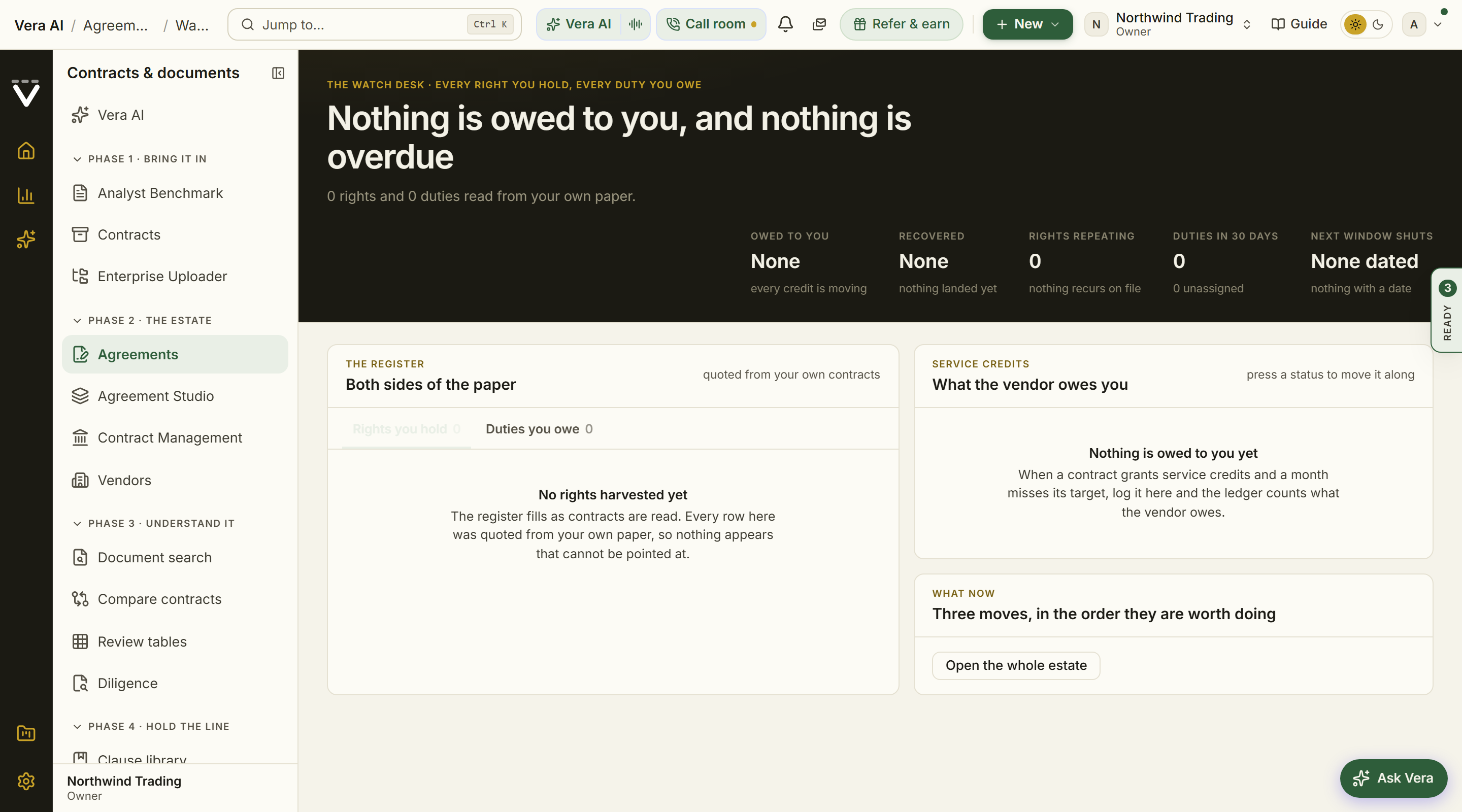
The desk above is shown on a workspace whose contracts have not been read for rights yet, which is what a new estate looks like. Once the register has run, the panels fill with the rows described below.
On the screen
- The headline states what you are owed, and whether any of it has been claimed.
- Five figures across the top: what is owed to you, what you have recovered, how many rights come round again, how many duties fall due inside 30 days, and when the next window shuts.
- The register, in two tabs. Rights you hold are the concessions you can exercise: a benchmark review, a true down, a price hold, service credits. Duties you owe are what the contract asks of you: a usage report, a true up notification, proof of insurance. Each row carries its deadline, who owns it, and the passage it was read from.
- Rights that repeat carry their schedule, for example "Every year, turn 3". The desk shows the turn you are on now rather than the first one, so a right your contract grants every year stays watched for the whole term instead of lapsing after one use.
- Service credits is the ledger of what a vendor owes you when it misses what it promised. Each credit moves from Owed to you, to Claimed, to Received, or to Not pursued if you decide to let it go.
How to use it
- Open Contract Management, choose the Watch tab, then press Open the watch desk.
- Read the rights first. A row showing days left is still open to you; a row marked late has passed.
- Press a credit's status to move it along the claim. The headline and the three totals move with it, so you can see what claiming is worth before you commit to it.
- Use the Claim button at the top right to move every outstanding credit at once.
Amounts are held in the currency each credit is owed in, and currencies are never added together: a credit is claimed in the currency the contract states it in.
Agreement Studio
One room for the whole life of an agreement. The estate board lists every agreement on your ledger with its renewal posture, and opening a row holds that agreement as six acts over the record the platform already keeps. Where the Agreements workbench edits the terms, the studio reads them as a story: what you signed, what you owe and own, when to act, whether the language still protects you, and whether the price is still right.
*In plain words: click an agreement and its whole situation reads left to right, with the letter you need already drafted.*
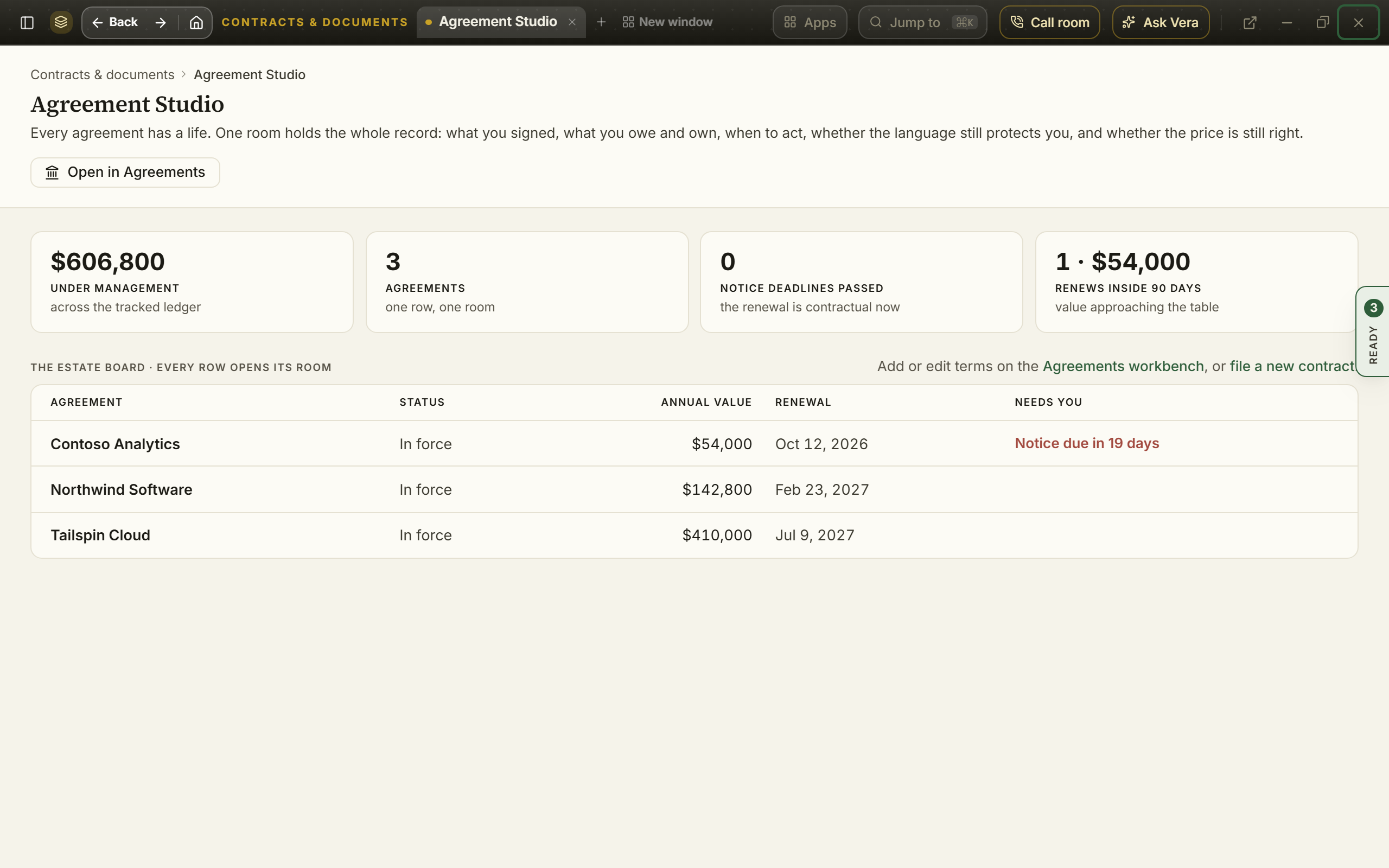
On the screen
- Pick up where you were — once you have opened files here, the studio greets you with the five agreements you last worked in, each with what it costs a year, when it renews, and anything needing you. One press reopens that file on all six acts. The five follow your account rather than your browser, so they are the same on any machine, and an agreement you have since deleted simply drops off the list. Open the estate board beside it goes to the whole ledger. A link that names an agreement goes straight there and asks nothing.
- The estate board — one row per agreement: state, annual value, renewal date, and what needs you, with passed notice deadlines and closing windows called out first. Clicking a row opens its room. It is the first thing you see before you have opened anything, and one press away afterwards.
- The empty board — before your first agreement the board offers the two ways to start. Add the first agreement opens the Agreements workbench with its vendor picker ready, and Load the sample portfolio fills the ledger with example agreements so you can walk a room before your own paper arrives. The sample offer appears only while your workspace has never loaded it; remove the sample from the dashboard once your own agreements are in.
- Act 1 · The paper — the signed terms on the ledger, the documents on file, and the doors to the workbench and the agreement file. Talk it through with Vera opens the call room as a conversation about this agreement: she arrives knowing its value, its term and its renewal clock without you setting anything up, and the room offers the conversations already held about this same paper so you can pick one back up rather than start again.
- Act 2 · The watch — the rights you hold and the duties you owe for this vendor, harvested from the contract text, each with its verbatim clause and window. Owners and statuses live on the Rights register.
- Act 3 · The clock — your posture in plain words: window open with the days left to act, or deadline passed. Both notice letters are drafted, the protective notice that keeps every option open, and the renewal terms letter for a deadline already missed. Copy either or open it in your email app; nothing sends from the room.
- Act 4 · The language — the decodes of this vendor's paper, each with its clause count, and the doors to run a new one.
- Act 5 · The money — the uplift check on the ledger's own figures, and the bridge that hands the renewal to the Negotiation Agent with the working deal carried across.
- The estate — where the file sits among the rest, and the moves.
How to use it
- Open the Agreement Studio and read the Needs you column. The row nearest its notice deadline is the one to open first.
- Walk the acts with the arrow keys. The clock act states your posture and holds the letter that fits it.
- Copy the letter, assign the watch items on the rights register, and take the renewal itself to the Negotiation Agent when the numbers need arguing.
Related: Agreements · Rights register · Negotiation Agent
Vera OS (beta)
Vera OS is the autonomous procurement companion: agents that work renewals and deals end to end under mandates you sign, grounded on your VendorBenchmark data. Opening Vera OS lands you directly on the Control Tower in your normal workspace, reading your own estate live; there is no separate landing page and no separate Vera OS menu. Because it runs as its own product alongside the platform, it is documented in full in the technical reference: Vera OS, the autonomous procurement companion.
Related: Renewals
Renewals
The renewal desk opens as its own window with eight rooms on the number keys. Every room argues the same book from the same reading of your agreements, so no two of them can disagree about a figure. Renewal alerts are opt-in: anyone who turned them on in their notification settings hears when a notice window opens.
*In plain words: every agreement on one clock, with the decision and the money on it.*
When to reach for this
- The Monday pass: what shuts next, and what it is worth (the desk routine).
- A renewal is close enough to decide: the case states the options rather than just the date.
- Planning a quarter: which weeks the team will be running six renewals at once, and which are quiet.
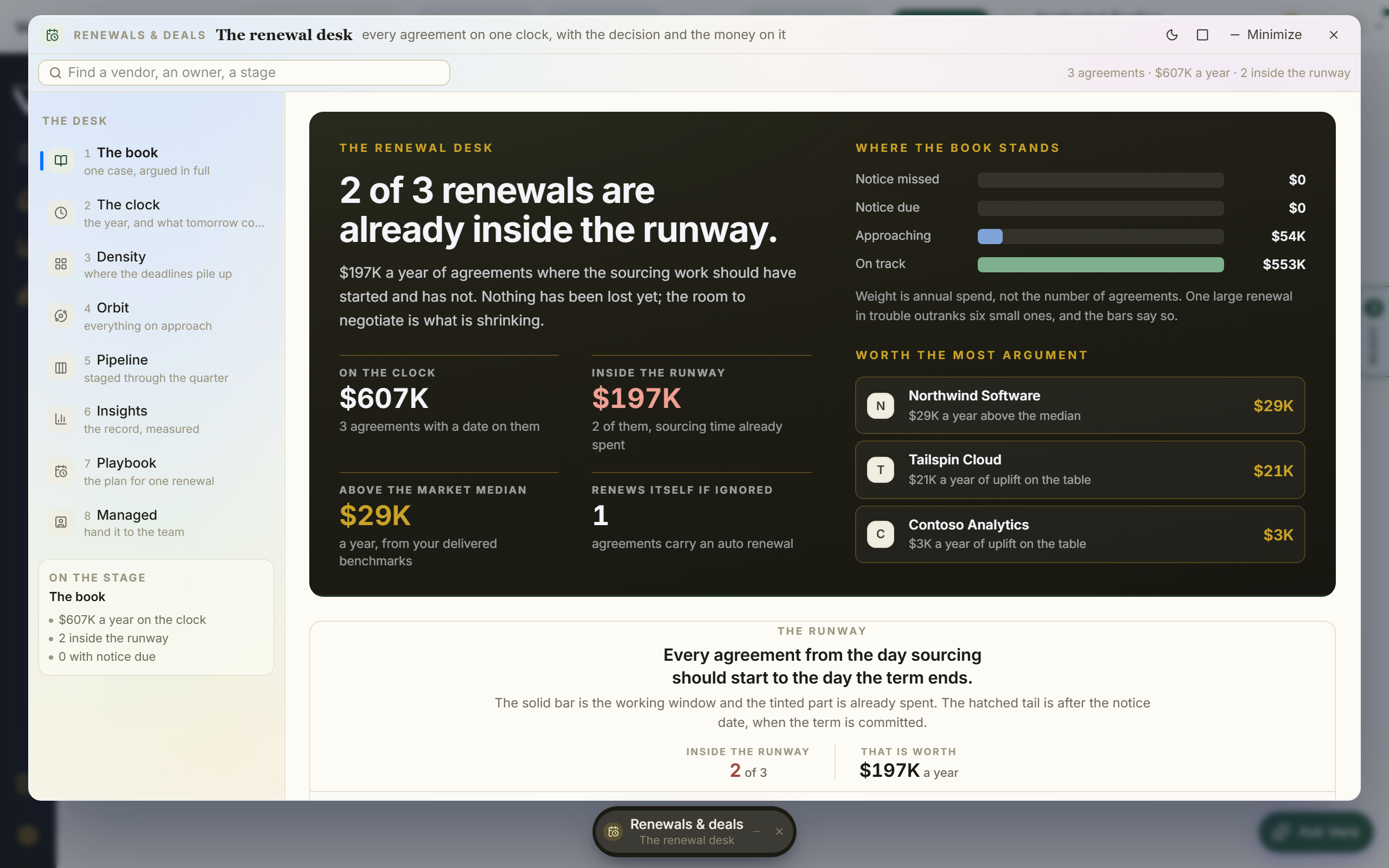
A worked example. On a book carrying a $2.4M agreement whose notice date passed fifty days ago, the desk opens with that fact rather than with a table: the term is committed for another year, and the money beside it is what a further three renewals are worth whose sourcing lead time has already been spent. Press 2, drag the date to the end of the quarter, and the reading re-derives: four terms committed rather than one, and the agreements that crossed in between are named. That is the desk's argument in two presses.
On the screen
- The rooms — eight, on the rail and on the number keys
1to8: the book, the clock, density, orbit, the pipeline, insights, the playbook and managed. One search at the top crosses all of them, so typing a vendor or an owner team narrows every room at once.Esccloses the desk. - The stage — the first thing the book room says is the stake: how many renewals are inside the runway their size warrants, how many have already passed a notice date, and what each is worth. Beside it, the book split by state, weighted by annual spend rather than by count, and the three agreements worth the most argument.
- The runway chart — one row per agreement, drawn from the day sourcing should start, through the notice deadline, to the end of the term, with today a fixed gold line down the whole chart. The solid bar is the working window and the tinted part of it is lead time already spent; the hatched tail is the stretch after the notice date, when the term is committed whatever you decide. A gold tick marks the vendor's own quarter close. Press a row to open its case.
- The case — the decision in one sentence, then the facts, then the argument composed from figures stored against the agreement rather than written for you. The uplift lever sets the opening position to whatever the vendor has actually put on the table, and the three outcomes move with it: renewing as offered, holding today's price, and pricing at the market median. The outcome marked the ask is only ever the one your delivered benchmark supports. Risk, the vendor's own clock and what the case is worth sit on the right, and the moves close it full width.
- The clock — every notice deadline and every term end on one axis, with a lever on today. Move it and the reading re-derives: what is committed by that date, what has notice due inside a fortnight, what is still fully open, and which agreements crossed in between. The curve below steps up at every notice date the lever passes, so a whole year of commitment reads as one line.
- Density — how many renewals your team is running at the same time, week by week. An agreement counts from the day sourcing should start until its notice deadline, which is the stretch where it takes real work, so the heavy weeks are visible months before they arrive.
- Orbit — everything on approach, sized by annual spend and coloured by readiness, with the ring showing how long you have. Beside it, the book ranked by money divided by time left, which is the order a desk with one afternoon should work in.
- The pipeline — every renewal by the work it is actually in. The arrows under each card move it on a stage, and a renewal sitting in Upcoming while its runway burns is what the board exists to expose.
- Insights — the alert gap first: your alert lead days measured against the sourcing runway each agreement's size warrants, and every renewal that is warned late named with the number of days. Then the forward book by quarter, the book by owner team, what your delivered benchmarks say each agreement is overpaying, and your closed record where there is one.
- The playbook — one renewal's plan, dated backwards from its notice date and the runway its size warrants, so the plan reads as a calendar rather than a checklist. Build the full plan opens the Renewal playbook.
- Managed — what handing a renewal to the Vera AI Team costs and what it is worth here, with the renewals ranked by what the handover would recover. Open managed renewals opens Managed renewals.
- The sample book — See the sample book on an empty desk fills it with fourteen worked example agreements, ten of them benchmarked, so you can see the desk working before your own agreements are on file. Countdowns are live. Nothing in it is your data and nothing in it is saved, alerted on or exported.
How to use it
- Read the stage. It states what is actually at stake in the book rather than describing the screen.
- Scan the runway chart for bars whose tinted part reaches the gold line: those are the renewals whose lead time has gone.
- Press a row to open its case, and check which outcome carries the ask.
- Work down What to do next, each one a link to where the move happens.
- Press
2and push the date forward to see what the next quarter commits before it arrives.
If something looks wrong
- The desk is empty: rows come from agreements carrying an expiry and a notice period, so an empty desk means missing dates, not a quiet year. See the sample book shows the desk working while you fix that.
- Above the market median reads
$0: no benchmark has been delivered for any agreement in the book, so the desk refuses to guess. An instant benchmark or an uploaded proposal is what turns it on. - An old bookmark to the calendar, density, orbit, pipeline or insights page still works: it lands in the room that replaced it.
Tips
- The number keys are faster than the rail once you know the rooms;
1always returns to the book. - The month grid, the capacity planner, Present mode and every alert setting stay on the Renewal calendar, one tab across. The desk answers what to do; the calendar plans the year.
Related: Renewal calendar · Renewal playbook · Major renewals · Renewal Command
Renewal Command
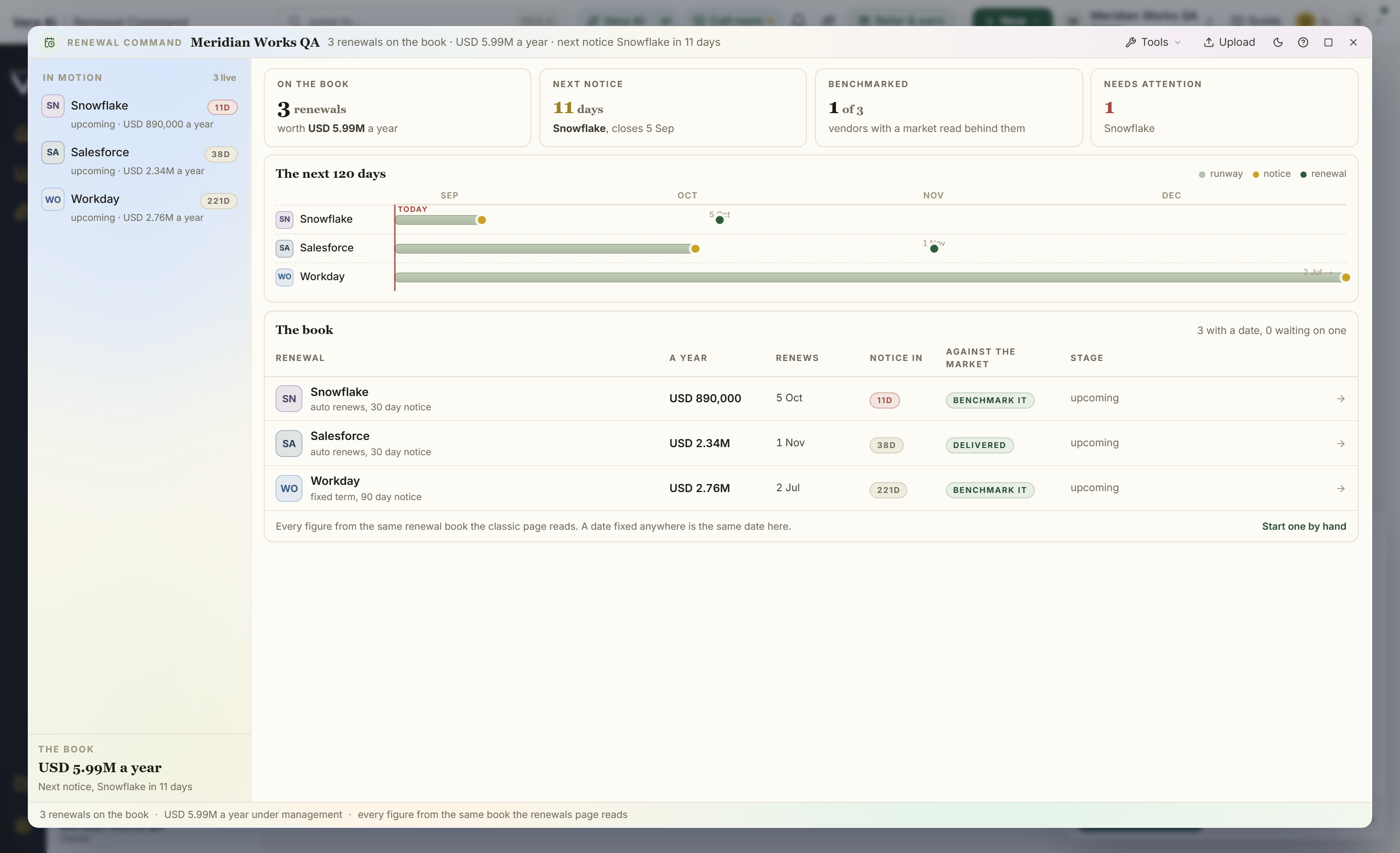
Every large renewal run as a case, in one window. Renewal Command opens as its own Fluent window over whatever page you are on. The desk shows the whole book: the stake in four tiles, a 120 day runway with every notice and renewal date flagged, and the queue as a dense table. Pressing any renewal turns the left rail into that case's nine rooms. Everything reads from the same renewal book as the classic Renewals page, so a date fixed in either place is the same date in both.
*In plain words: one window where a big renewal gets a plan, a team, a market read and a thread, without leaving the desk.*
When to reach for this
- A renewal is large enough to run as a project, with steps, owners and a deadline, rather than as a row on a list.
- You want the paper, the market read and the negotiation plan in one place before the first vendor call.
- You want a reminder a set number of days before the notice window closes, sent to you and nobody else.
A worked example. A Salesforce agreement at USD 2,340,000 a year renews on 31 October with a 30 day notice window. On the desk its lane shows the notice flag in gold at 1 October. Opening the case, the overview brief states the paper, the clock, the market and the standing in four labeled lines; room 7 lays a 20 step plan backwards from a signature date a week clear of notice; room 6 writes the ask on the case's own figures. Ticking steps moves the phase path on the overview, and the case thread in room 9 is the same conversation the renewals page shows for that agreement.
On the screen
- The desk — four stake tiles (on the book, next notice, benchmarked, needs attention), the 120 day runway, and the queue. Every row states the annual value, the renewal date, the days to notice, and the market standing when one is on file.
- The case rail — nine numbered rooms: Overview, The paper, The agreement, The benchmark, The research, The negotiation, The plan, The team, The room. The digits 1 to 9 switch rooms; Escape returns to the desk.
- Overview — the brief in labeled lines, the phase path, What now, the dates that matter, the play (renew as it stands, renegotiate, or test the market), and Be reminded.
- The plan — the project plan dated backwards from the signature deadline. Ticks are yours and persist per case; changing the play relays the dates and keeps your ticks.
- The benchmark — the three answers when a market read exists: where the deal stands, what the cohort pays, and what it is worth, plus the uplift lever priced on the case's own annual value. No read yet means an honest empty state and the door to request one.
- The room — the case thread, shared with the renewals page and the agreement record; @ mentions notify the colleague.
How to use it
- Open Renewal Command from Renewals & deals; it draws its own window over the page.
- Press the renewal with the nearest notice date, or its lane on the runway.
- Read the overview brief, then choose the play in The call to make.
- Open The plan and tick the kickoff steps; add a step to any phase with the dashed row.
- In The team, add colleagues as participants or FYI readers from the workspace roster.
- In The negotiation, press Write the plan and rehearse the talking points before the first call.
- Switch on a reminder in Be reminded; the note lands with you a set number of days before notice.
If something looks wrong
- The desk is empty: rows come from agreements carrying dates, exactly like the Renewals page. Upload a contract from the titlebar and it appears once read.
- The benchmark room shows an empty state: no market read has been delivered for that vendor yet. The door in the room requests one.
- Reminders are greyed: they arm once a contract is filed behind the renewal, because the reminder rides the contract record.
Tips
- The plan's step ticks are yours per case and survive closing the window; the dates always derive from the paper's own term end and notice window.
- The window closes back to Home; the case keeps everything.
Related: Renewals · Renewal playbook · Major renewals
Renewal calendar
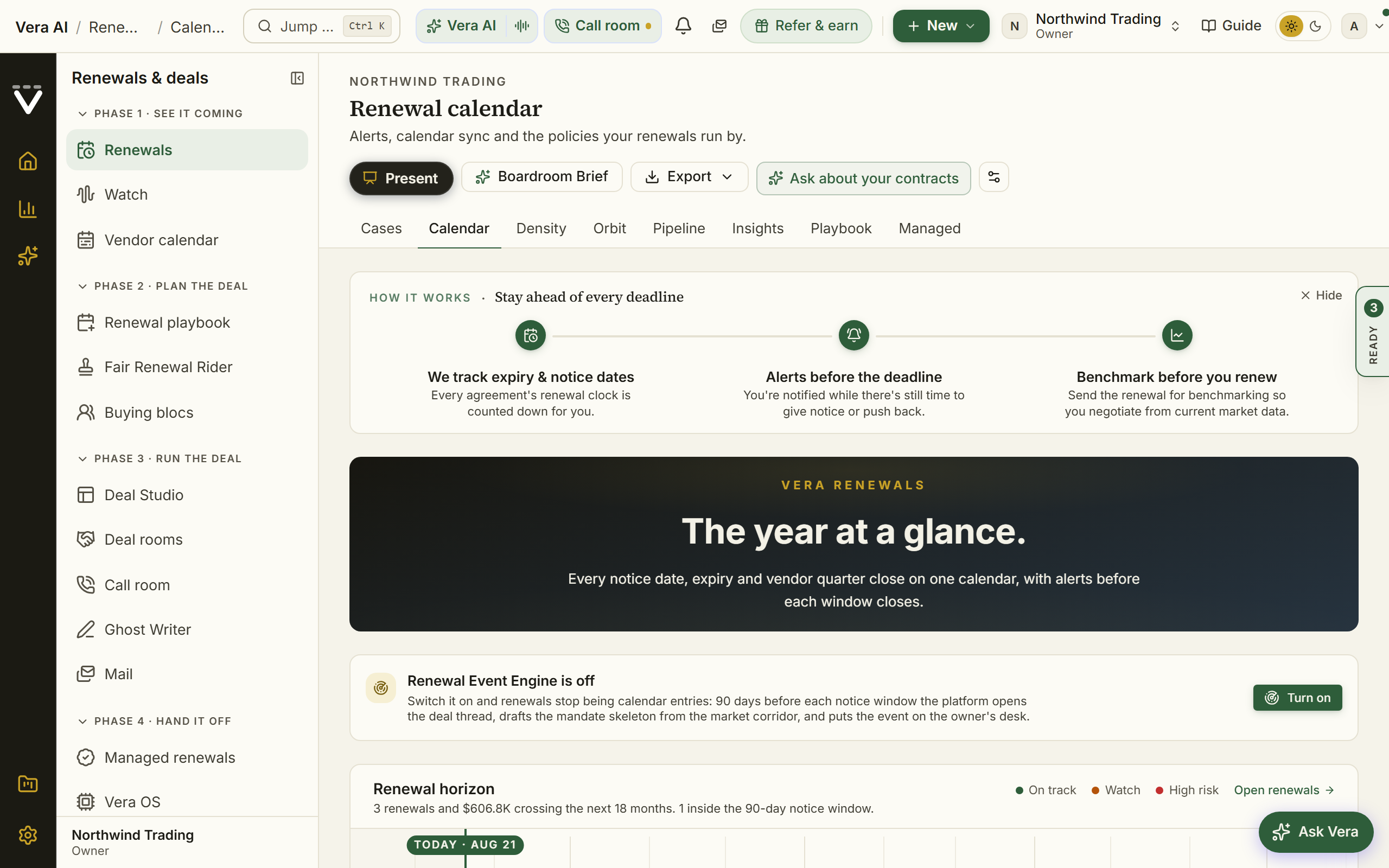
The year at a glance: every notice date, expiry and vendor quarter close. Planning a year of capacity and taking one decision are different jobs, so the calendar keeps its own tab beside the case desk.
*In plain words: the year's deadlines and the vendors' quarter ends on one grid, so timing stops being luck.*
When to reach for this
- The annual planning sit-down (the recipe): where the capacity crunch quarters are.
- Timing an ask: a vendor with a quarter to close has discount authority it lacks the week after.
- The QBR: Present mode walks the calendar as the session itself.
On the screen
- Renewal horizon — the same 18-month strip your dashboard shows: every dated deal sized by spend, colored by risk, and led by its notice deadline. One timeline everywhere, so the dashboard and this page always agree.
- Month grid — twelve months with deadlines, expiries and vendor fiscal quarter closes layered on the same days.
- Stat band and quarter planner — decisions due, renewals inside the sourcing runway, spend at risk, the next deadline, and the next four quarters with the value and ownership coverage of each.
- Present — runs the calendar as a full screen QBR session: the horizon and quarter planner open, each upcoming quarter follows deal by deal with notice-window renewals leading, and the decisions due close the show. Arrow keys move, N shows presenter notes, the print control leaves the walked screens behind as a packet, and a shared link carries the show.
- Get it managed — every renewal card carries a control to hand the renewal to a human team as an add-on engagement. If your workspace is served by a partner firm, the request goes straight to them; otherwise it goes to the Vera AI team. One live request per renewal.
- Calendar governance — folded shut at the foot: calendar sync, alert timing, vendor aliases, and the approval and SLA policies your renewals run by. The alert card states your own delivery plainly: whether renewal alerts reach you and on which channels, with a link to Settings › Notifications to manage delivery. Alerts stay off until you turn them on; the line only states where you stand.
How to use it
- Read the horizon for the shape of the year, then the quarter planner for where the capacity crunch is.
- Press a quarter to narrow the list below it.
- Subscribe your own calendar app from Calendar governance so the notice dates ride along with your diary.
Related: Renewals · Renewal playbook
Renewal playbook
Your answers are kept. Every answer and the step you were on are saved as you go, so closing the window or walking away no longer starts you over, and a contract you uploaded inside the wizard is remembered rather than left orphaned. Returning asks once whether to continue, resume one of your last five drafts, or start a new one; Start a new playbook sets the current one aside rather than deleting it.
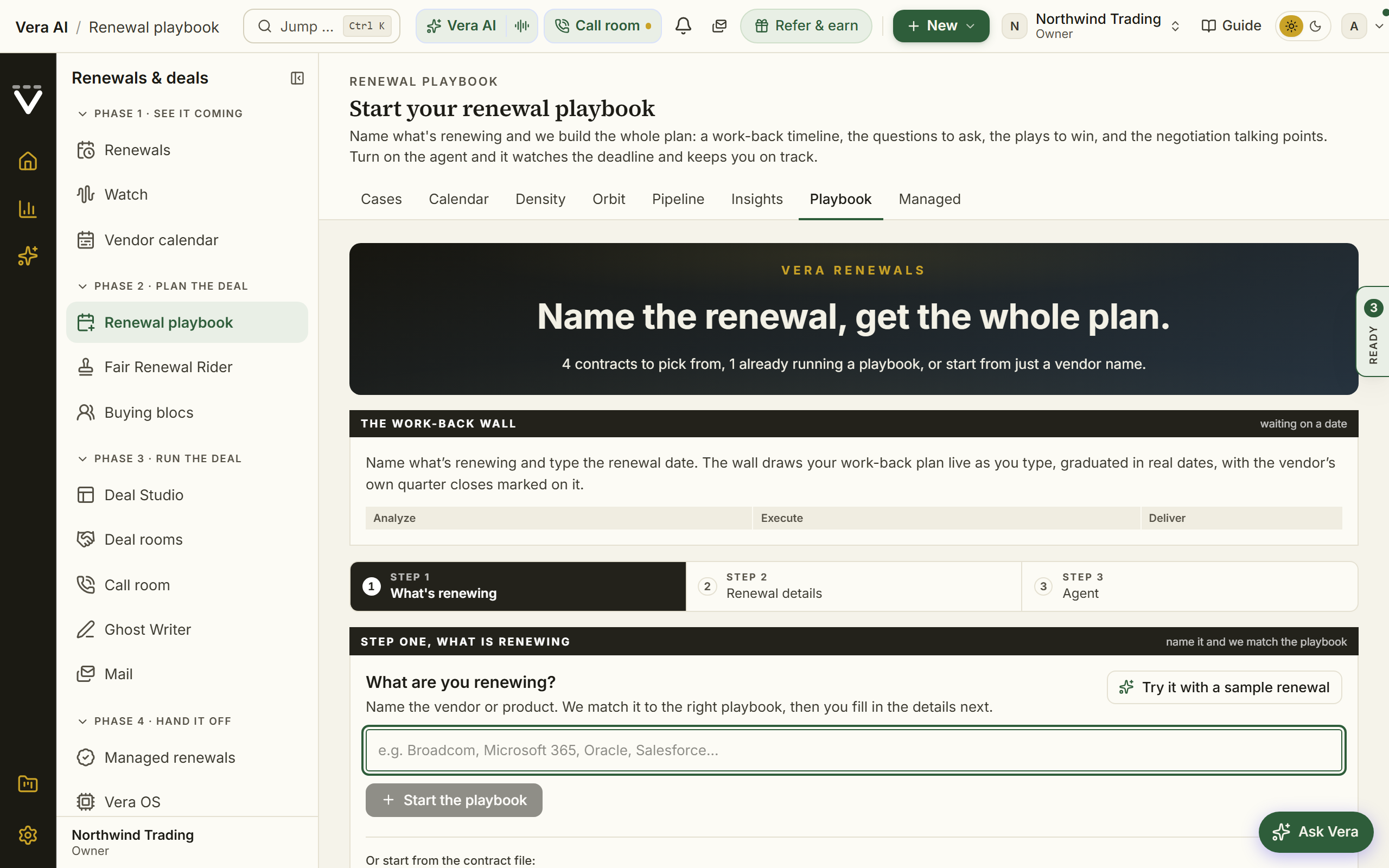
Name what is renewing and the platform builds the whole plan: a work-back timeline, the questions to ask, the plays to win, and the negotiation talking points. Turn on the agent and it watches the deadline and keeps you on track.
*In plain words: name the renewal and get the plan, worked backwards from the date.*
When to reach for this
- A renewal crossed into your working horizon and needs to become a plan, not an entry.
- You know the vendor but not the moves: the plays and talking points are the education.
- You want a deadline watched by something that never gets busy: the agent.
On the screen
- The work-back wall — the whole plan on one engraved scale, redrawing live as you type the date and the notice period below it. The three delivery phases are drawn to scale worked back from the notice deadline, the stretch after the notice date is hatched because that is time the contract is deciding rather than time you are working, and the graduations are real dates rather than a progress bar. It is the same instrument the Renewals case desk uses for a single agreement.
- Their calendar — the gold dashes on the wall are the vendor own fiscal quarter closes. Discount authority loosens as a seller chases a number, so a decision timed into one of those is worth more than the same decision a week later.
- The three steps — name what is renewing, fill in the renewal details, then choose who works it. A completed step stays pressable, so you can change an earlier answer without losing the ones after it.
- Wizard — pick an existing contract or just name the vendor and fill in the details. Contracts that already have a playbook offer "open" instead of starting a new one.
- The agent — turn it on and it tracks the deadline and prompts you at each step.
- Engage the vendor — the same two doors that close the Renewals case, at the foot of the playbook: Have Vera run it opens a case with this renewal attached, Track it yourself opens a negotiation thread prefilled with the vendor. If a case or a thread is already open on that vendor, one link to it replaces both.
How to use it
- Pick the contract that is renewing, or name the vendor and its details.
- Let the platform build the timeline, the discovery questions, the plays, and the talking points.
- Turn on the agent if you want it to watch the deadline for you.
- When the plan is built, pick a door under Engage the vendor to start the actual work.
Tips
- The step-by-step plan and the agent draw on your AI plan. Without one you still get the plan structure and the work-back timeline.
Related: Renewals · Managed renewals
Managed renewals
Hand over the calendar: you send a renewal to the Vera AI Team and they run it for you under mandates you approve. The only fee is 25% of savings verified against vendor invoices. Claimed figures never bill.
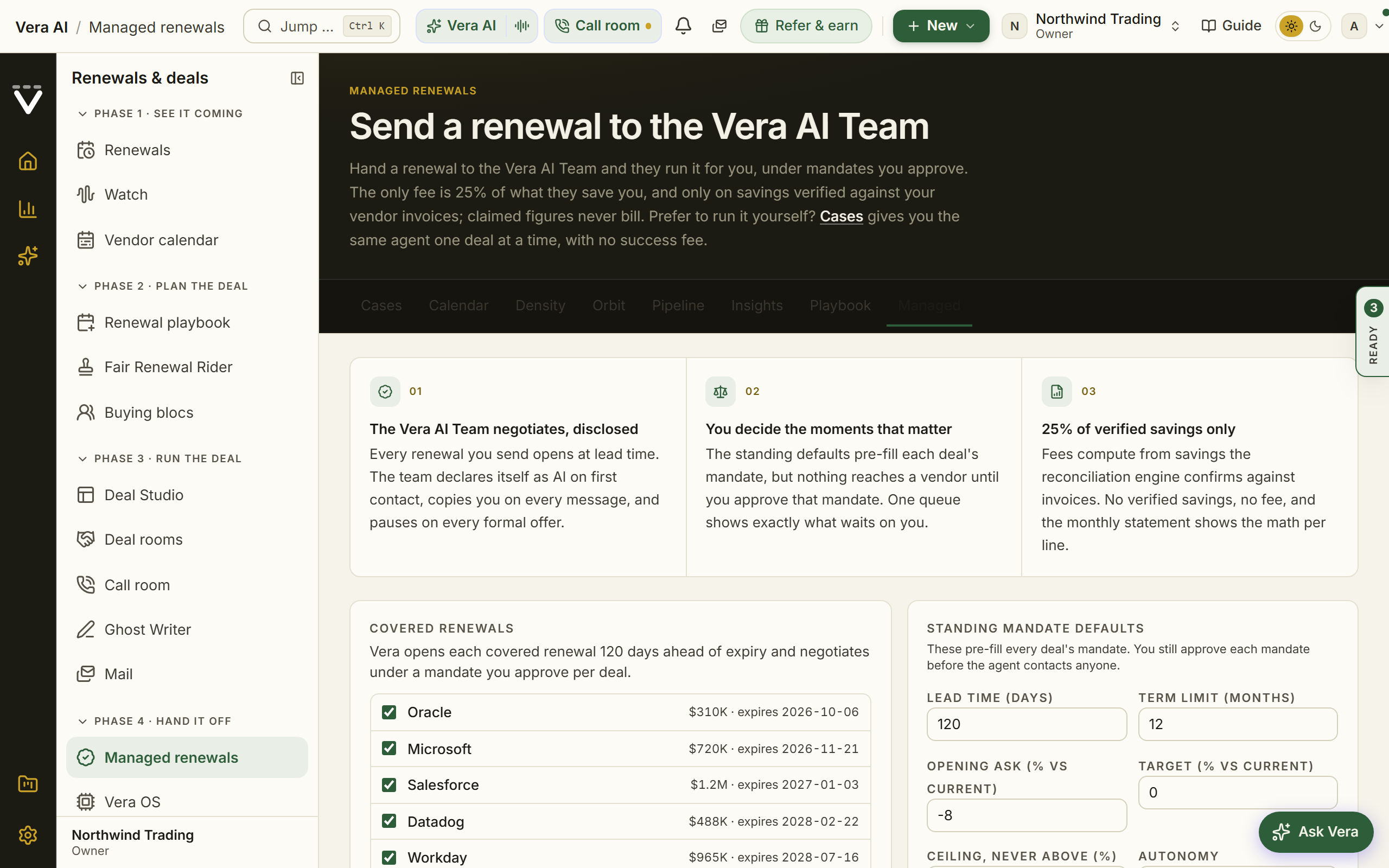
Your position sits in the masthead: savings banked and invoice-verified, fees paid and accrued, your net position, and how many decisions wait in the queue. The renewals tab strip rides the masthead's foot, so the program stays one press from the calendar and the pipeline.
On the screen
- The offer — before you enroll: three numbered cards (the Vera AI Team negotiates and discloses itself as an AI, you decide the moments that matter, the only fee is 25% of invoice-verified savings) above the activation form.
- The command queue — leads the enrolled desk: every interruption typed (a mandate, a formal offer, a counter, a bounced contact), aged in place and flagged when it has waited five days, each row opening the deal it waits on.
- The covered horizon — every covered renewal on one time axis across the next fourteen months, with the open window shaded and dots sized by contract value. Press a state in the legend to isolate its lanes, hover a lane for the readout, and a lane with an open run clicks through to it.
- The book of runs — every run grouped by what it needs (waiting on you, Vera working, preparing, settled), with days to expiry on each line.
- The fee ledger — every fee line paired with the verified saving and the invoice that confirms it, with the program totals in the footer.
- The pairing — in the column beside the work: savings banked against fees paid, always shown net, with how the fee works and the program as signed beneath it.
How to use it
- Read the offer and the fee terms.
- An owner activates the program, which signs a fee agreement and sets the standing mandate defaults.
- Approve each deal's mandate before anything reaches a vendor, and clear the command queue as Vera works; the horizon and the book of runs show everything else moving without you.
Tips
- Nothing reaches a vendor until you approve that deal's mandate, even with the standing defaults in place.
Related: Renewal playbook · Portfolio
Major renewals
Every big renewal worked in its own room. The rail row reads Deal rooms: this is the door for the deals you run yourself, beside Managed renewals for the ones you hand off. The page opens on the Major renewals hub: one room per vendor family, the live rooms in deadline order, and your largest contracts straight off the estate, top 5, 10, or 20 by tracked annual value. Opening a room lands on that family's workspace: where the offer stands answered from your records, the case discussion for your team, the case papers Vera writes, and the tools that fit the next move. Document one, The move, is assembled from your own records: the evidence with each line's source, the commercial picture as a verdict table, a ready draft where the move sends something, and every figure cited to the record it came from. The other papers (executive overview, vendor dossier, benchmark card, before you start, strategy, talking points) are written by Vera on request, at maximum effort, grounded only on what your workspace holds; anything not on file is named as missing, never invented. Families carrying a queued move keep the full case file one click away, the same reading room the rest of the platform uses, with the decide panel beside the papers. Approving a move files the decision and any draft to the deal log; nothing sends to a vendor without the owner-set send rules. Each negotiation remains a tracked thread from mandate to signature, so nothing agreed on a call gets lost.
*In plain words: the deal as a record: the mandate, every give and get, and what the vendor promised.*
When to reach for this
- The moment a renewal turns into a live conversation with the vendor.
- A vendor email needs decoding: paste it and the tactics analysis names the play and the counter.
- Post-signature: the commitments list is what you check the final paper against.
A worked example. Standing up the sample Northwind CRM deal, the mandate writes itself from the benchmark: the target is the market median seat price of $504 (worth $16,750 a year against the $571 on paper), the discount rebuild to 22 percent is the second ask, and the walk-away is where your alternatives stop being credible. With the mandate set before the first call, every later concession in the ledger is measured against something, which is the difference between negotiating and drifting.
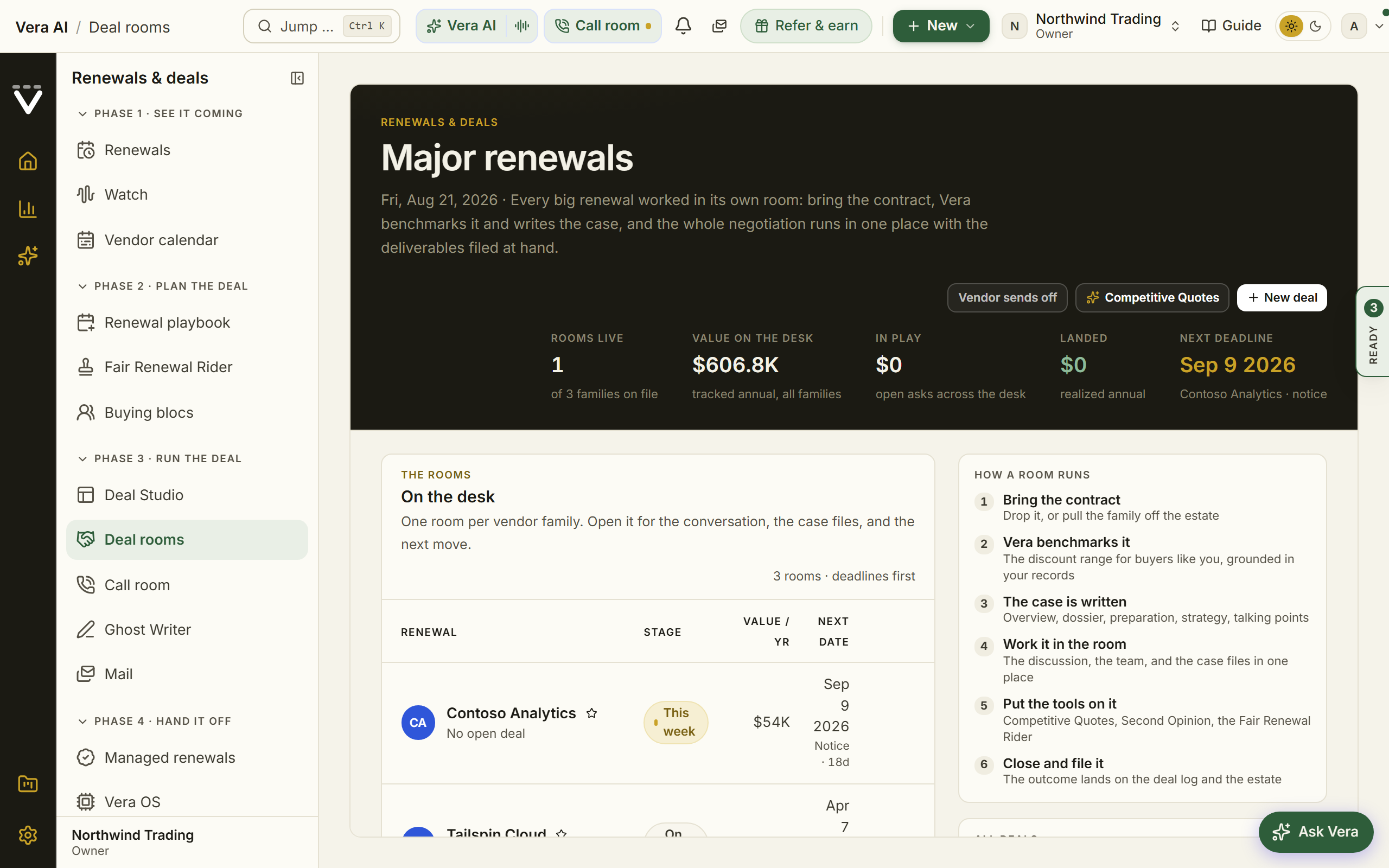
Starting one from a drafted email. Every vendor-facing draft in a workroom ends with one question: is this the start of a negotiation? Pressing Save it to the log saves that draft as your opening move on a tracked thread and puts the track on your dashboard, marked as waiting on the vendor. When they answer, open the track and paste their reply into the composer: Vera reads it against the whole thread and your signed mandate before naming the tactic, logging any concession, and drafting your response, so she is reading the conversation rather than one email. The prompt appears only on vendor-facing drafts, because an internal note to your CFO is not the opening of a negotiation. If a track is already open with that vendor the draft files onto it rather than starting a second one. Nothing sends from the platform either way: the draft still leaves from your own inbox, and the track records what you sent.
On the screen
- The hub — the masthead carries the desk's vitals (rooms live, value on the desk, money in play, landed savings, and the next deadline), with vendor sends, Competitive Quotes, and New deal beside them. On the desk lists every room with its stage, tracked value, next date, and next move, deadlines first: a family with a queued move shows the move itself as its next step, and entities of one vendor family share a single room with the money aggregated. Bring in your largest contracts ranks the estate's families by tracked annual value, top 5, 10, or 20, and every one opens as a room whether or not a deal thread exists yet. Beside the board: How a room runs, Your shelf of starred rooms, and the All deals directory with search, the closed pile one fold away, the Boardroom Brief, and New deal. A star on any row shelves that room, and every room has a link of its own, so the dashboard's Back to the room lands on the exact case.
- What next — the hub's close, under the board. Built from the desk's own figures rather than a fixed menu: take one deal into the Negotiation Agent, work the open asks with the money in play named, chase the commitments, open the vendor room or start a negotiation against the vendor you have most in play with, or ask Vera which of your negotiations is most at risk this week. It sits on the hub only; a renewal room carries its own moves already.
- The renewal room — one family's workspace on the light canvas. Where the offer stands answers the three questions from your records: the tracked annual value, the range comparable buyers land with its midpoint read live from the reference library, and the benchmark card that places you in it, one press to write when it does not exist yet. The communications room is the case discussion, on the record with presence, mentions, and resolve. The case files list the seven papers with one press to write or open each, the whole case exporting to PDF or Word, and the room names the tools that fit the next move: Competitive Quotes, Second Opinion, the Fair Renewal Rider, and Ghost writer, plus the library's own research on this vendor. On families with a queued move, the room states the move and Open the full case file raises the dark case stage described below.
- The case stage — the vendor's case file takes the whole screen: seven documents numbered in the left rail with a read meter, one paper on stage at a time, the arrow keys to page, Escape to step back to the lobby. Your brief to Vera, under the document list, takes one line, what are we negotiating and what to focus on, and every document she writes then stays on that topic, written as someone who has negotiated that vendor's licensing for 25 years.
- The Executive overview (document 1) — the case opens on one question: are you negotiating from a proposal or contract? Upload it, PDF or DOCX up to 30 MB, and Vera reads it end to end and writes a two to three page assessment: the deal at a glance with every commercial fact exactly as the paper prints it, the high level read of what the vendor is really selling, the market position, a verdict table of the terms that will cost you, and the prioritized changes to ask for. Anything the document does not state is named as absent, never assumed. The document files with your contracts, the overview is kept for the whole team, and Write it again rereads the stored copy. Skip to the case file goes straight to the move when you are not working from a paper.
- The case file — the six documents of the focused move, numbered in the rail. All six are written by Vera at full depth, the move brief first in line overnight; until her version of the move exists, the clinic's instant read stands in with a Have Vera write it offer. While she writes, the page shows real progress: the stages checking off and a small page building, usually a few minutes. A written document is kept for the whole team and rereads instantly; Write it again fetches a fresh read when the picture changes. For workspaces that use the clinic, it pre-writes missing or stale documents overnight for the queue's top moves, so the case file is usually already on the desk at 06:00. Each document shows when it was written, with a note when it is more than a week old and the records may have moved.
- The case rooms — pills in the case's top band open the working tools on the stage without leaving the case, each scoped to this vendor: Asks (the ask ledger, what is open, in play, and landed), Commitments (capture a promise with the vendor prefilled, each one reconciled against the signed contract, chase drafts flagged), Deal log (add an entry in place; every clinic decision files there on its own), Meeting notes (the call note, dated), on deals with a live thread the Live copilot (paste the offer mid call, get the trade math and the counter), and Team, where the case's collaboration lives (below). A capture in a room and a capture on the full page are the same write. Escape steps back to the papers.
- The Team room — bring colleagues into the case and talk it through on the record. Pick the teammates who should work the case with you: each gets an in-app note that opens this exact case, delivered according to their own notification settings, and nothing goes to the vendor. Case discussion is a threaded conversation pinned to the case: @name mentions notify the person mentioned, settled threads resolve out of the way, and author edits are kept honest in the audit log. A case with open threads shows the count on its lobby card and on the Team pill. When a teammate is reading the same case, their presence shows under the document rail, so you know who else is on the paper. On cases with a live deal thread, the room also links to the deal record, where the read-only vendor portal is minted and revoked.
- Rewrite, export, email, save — every written document ends with a rewrite line: type what should change, shorter and firmer, add our March date, drop section two, and Vera rewrites it with the current version as the base; empty, the button fetches a fresh read. The icon strip beside the stage downloads the whole case (or the open paper via its own export) as PDF or an editable Word document in the executive brief look, drafts a Send it on email from whichever document is open (vendor, CFO, CIO, or colleague; vendor drafts never name the platform), and a star saves the case to your Saved shelf, where one press reopens it.
- Ask Vera, in the case — the icon strip's Ask Vera panel answers on this case's own documents: the move's facts and every written paper, with a chip per document that jumps the stage to what she cites. The case also announces itself to the top bar's Ask Vera, so asking from anywhere carries the case as context.
- Earlier versions — every rewrite files the version it replaces, with the reason attached: your instruction, a refocus, or a fresh write. Earlier versions under any written paper reads them or restores one; a restore files the replaced version too, so nothing in the chain is ever destructive.
- The Outcome room — on families with a closed deal or landed asks, a scorecard in the case's top band: what landed per year in the ledger's own figures, what was dropped, the vendor's promises against the signed paper, Run the post-mortem on every closed deal, and a note that files what you would do differently straight to the deal log.
- The case's own research and agents — Put it to work names the specific research: up to three of the library's documents on this vendor open straight into the reading room. Put an agent on it points at the vendor agent that fits the move (work a renewal, prepare for a vendor call, do the homework) and at the fourteen-role negotiation staff.
- Small comforts — the read meter remembers which papers you have read on this browser; document mastheads name exactly what moved since they were written; printing a case prints the open paper clean on white; and Ctrl or Cmd with the up and down arrows walks between vendor cases without leaving the room. Chase reminders arrive as in-app notes when follow-up drafts are queued.
- The runway — the lobby's twelve-month spine: every vendor family's notice deadline as a red dot, their fiscal close as a gold diamond, month ticks behind them; one press on a lane opens that vendor's case. Inside a case, The clock in the left rail counts the same two dates down in days.
- The decide panel — opens beside the paper with the case: approve, edit the draft, hold, or skip. Every choice files to the deal log with its reasoning and persists across reloads and teammates. Holding takes a date, for a week, for a month, or a day you pick, and the clinic raises the move again when it arrives. A notice or escalation draft is copied for sending from your own mail.
- Vendor sends (optional, off by default) — an organization owner can turn on vendor sending from the clinic's top bar. With it on, approving an escalation move queues the email for the next 09:00 window in your organization's own timezone, addressed to the vendor contact already on the deal, with you in CC; it sits visibly cancelable until it leaves, and the sent email files onto the deal thread. Vendor replies land back on the deal thread, where Vera reads the tactic and drafts the response like any other vendor email. Only escalations ever send: a legal notice always leaves from your own mail, whatever the toggle says. If the deal's contact changes before the window, the send cancels itself and asks for a fresh approval.
- The wire out — a panel beside the paper with every send the clinic has queued: its status, its window or sent time, and a cancel press on anything still waiting.
- Put it to work — a panel of next moves in five families, one press each. The deal: the deal file, the mandate, the agreement record, sign-off routing. Price the position: a benchmark run, a second opinion, proposal comparison, a competitive scenario. Research the vendor: the vendor room, the research library, a contract decode, Ask Vera. Tell people: copy a chat-ready summary or the one-line position, draft the vendor email in the ghost writer, invite a teammate. Plan the runway: the renewal calendar, the vendor calendar, the playbook library, and filing follow-ups as tasks.
- Mandate — your target price, walk-away point, and approvals, set before you engage the vendor.
- Tactics analysis — paste a vendor email and the AI reads the tactic being used and suggests the counter.
- Concession ledger — every give and get on both sides, with a running value.
- War room — the panel beside the thread on wide screens: the mandate against reality, the give and take math, momentum, open promises, and counters queued. It closes with its What now dock. Draft the next counter composes against the thread, the mandate, and the ledger, and lands the draft in the counter queue for you to approve; nothing reaches the vendor from the dock. Brief the CFO writes the finance facing read, where the money stands, what each side has given, and the decision in front of them, and renders it in the dock. Copy the position summary puts the target, the ledger, the momentum, and the queued counters on your clipboard as plain lines for a chat thread, with the walk-away deliberately left out. Watch the mandate triggers puts the deal on your notification wire, and like every alert here it is off until you turn it on.
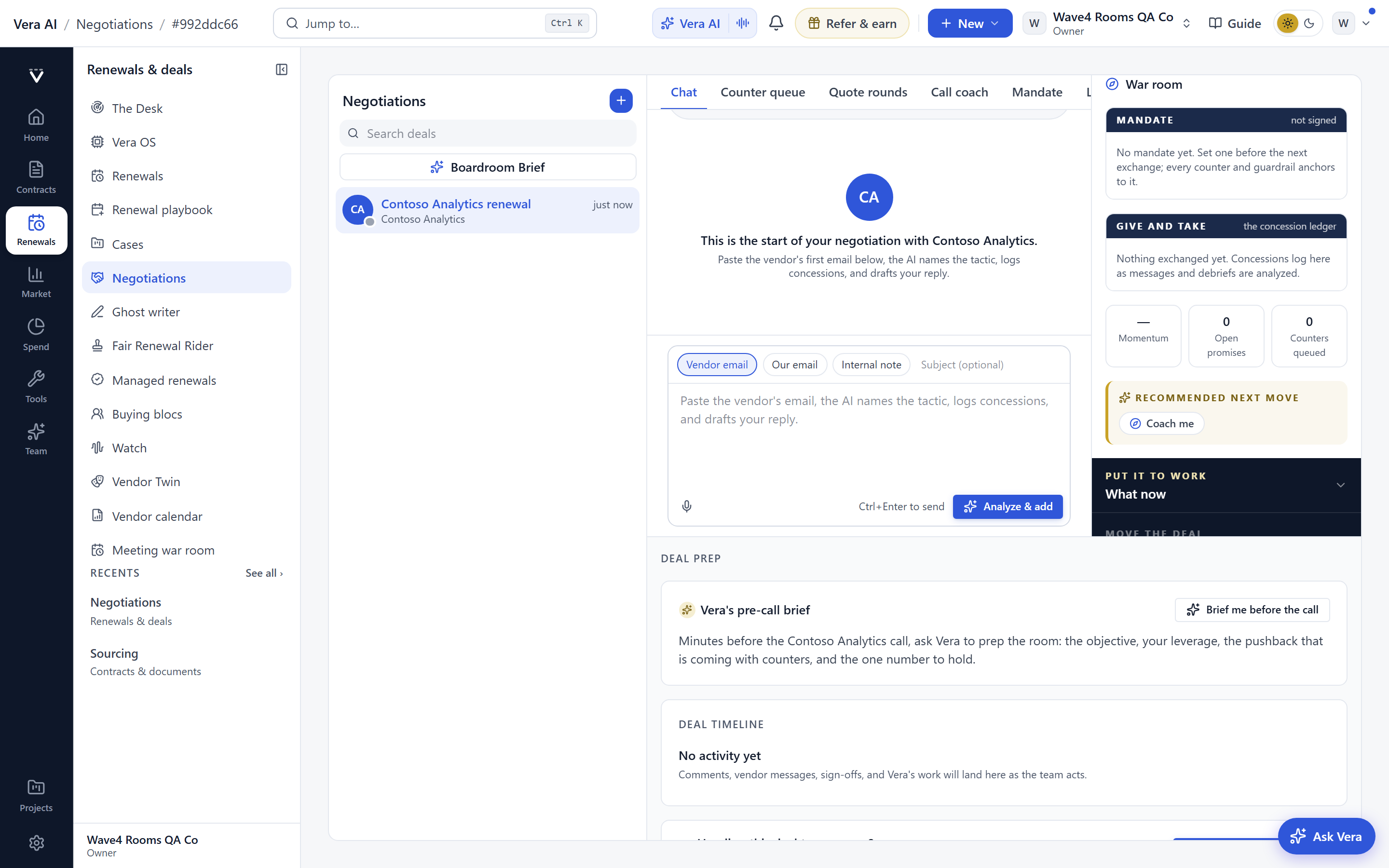
- Commitments — what the vendor promised, captured so it makes it into the contract.
- Competitive Quotes — the desk's Competitive Quotes button opens autonomous multi-vendor quote runs (below).
How to use it
- Open the hub and work the rooms in deadline order: approve what should move, hold what should wait, and let every choice file to the deal log.
- Start a negotiation from a renewal or an opportunity, and set the mandate before you engage the vendor.
- Analyze a vendor email for tactics, and log every give and get in the ledger.
- Run a post-mortem when the deal closes.
Related: Renewals · Competitive Quotes · Vera AI - Ghost Writer
The call room
Since 26 August 2026 the room opens as its own Fluent window, the same dress the Benchmark Library and the decoder doors wear: the titlebar names the call and carries the light or dark switch and the maximize control, both themes read on the warm window palette, and Close returns to Home, or to the deal the call belongs to when you arrived through one. The microphone and the tab share run top level, with no frame around the room at all.
Vera on a live call, in one of two rooms, and the room asks which before anything else: two choices of the same size at the top of the window, Internal call and External call. Internal call is you and Vera on your own, one press: she says hi first, and the two of you talk on an open full-duplex line where interrupting her mid sentence is normal. She arrives knowing your workspace: how many agreements you track and the largest of them, what you have been asking her lately in chat, and the research library, so "what should I read before the Microsoft call" gets a named brief, not a shrug. External call puts her on your real vendor call: Zoom, Teams, Google Meet, Webex, WhatsApp, or a phone on speaker. She hears both sides, follows every word as it is said, and answers only you, in your headset. By default she is invisible: nothing of her appears in the participant list and the other side never hears her. You can also give her a seat, and then she joins the meeting as a participant named for her, says who she is out loud, and speaks again only when you release her. In both rooms she has no figures of her own. Every number she says is looked up from your own agreements, benchmarks, and spend in the moment, and when nothing on file covers the question she says so rather than estimating. Every call is recorded and saved to Your calls with its transcript and memo, so you can replay it, share it, or continue the conversation another day. When the call ends she writes the memo: the call in brief, every number heard and who said it, the commitments in both directions, the flags, and your next moves.
*In plain words: the analyst in your ear on the call, the call written up before you are back at your desk, and the whole thing kept so you can come back to it.*
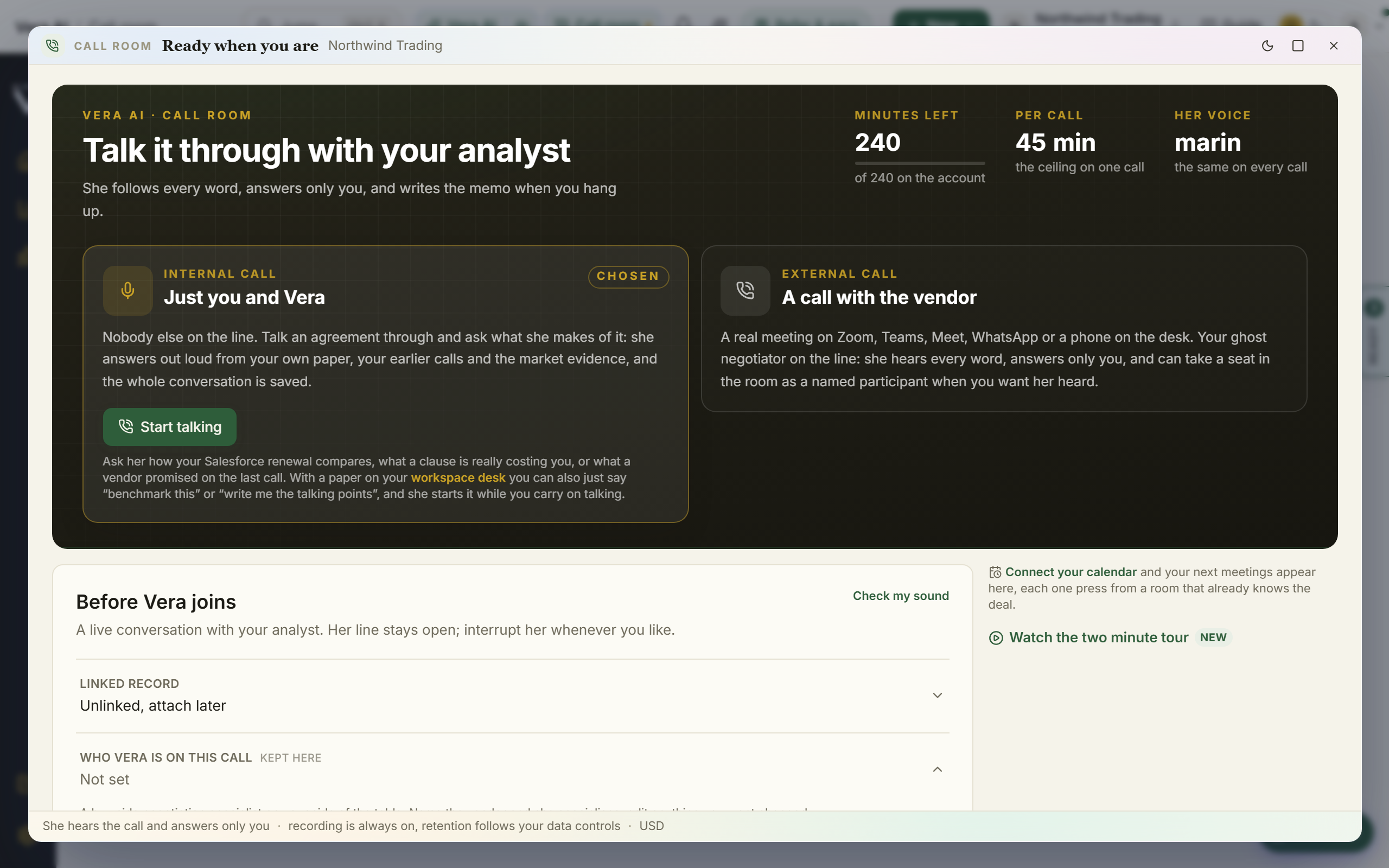
When to reach for this
- A vendor call is in ten minutes and you want the record, the paper, and the market in your ear rather than in seventeen tabs.
- Mid call, the rep quotes a number and you want it checked against your own paper before you respond.
- After any call, you want the memo without writing it: what was said on money, what was promised, what to do next.
- No call at all: you want to talk a deal through out loud on the way to a decision.
Before the call: the sheet
- Watch the two minute tour under the Talk to Vera panel: a narrated walk through what to press, what each part of the sheet does, and what is waiting when you hang up. It stays closed once you have seen it.
- The room opens as an app window over whatever you were doing, every time and from every door: the rail, the palette, a typed address, a calendar link, or the desktop companion.
- Pop it out beside the meeting. The arrow at the top right moves the room into a window of its own, narrow and tall, parked against the right of your screen: put Teams or Zoom on the other half and both are usable at once. That window is independent of the main one, so mid call you can open a contract, read a benchmark, or answer a message in the main window without touching the call. In the desktop app it is a real application window with its own taskbar entry. Pop back closes it. Popping out before you start is the tidy order; if a call is already running, the room says what closing would end rather than hanging up on you.
- The stage across the top states where you are and what you hold before you press anything: the room, the line it takes, and three readings on the right, which are how many minutes are left on the account, the ceiling on any one call, and the voice she answers in. The two ways to take a call sit on that stage, side by side.
- Pick the lane first, at the very top: Internal call and External call, two choices of the same size, and the one you pick carries its own way in. The sheet remembers your choice on this device. The chosen lane lifts and carries its own way in; the other stays quiet.
- The desk below the stage is two columns on a wide screen: the sheet you are filling in on the left, and a rail on the right with what is coming from your calendar, your saved calls, and the two minute tour. The rail scrolls on its own, so a long call history never pushes the sheet down the page. Below a wide screen the two columns become one, in the same order.
- Internal call then shows Start talking: one press and you are talking. No field is required first; she greets you, and everything on the sheet below (persona, goal, papers, talking points) simply makes her sharper when you fill it in. Under the button is what she is good for here: how a renewal compares, what a clause is costing you, what a vendor promised on the last call, what to read before the next one.
- Ask her to run something, out loud. With a paper staged and agreed on your workspace desk, saying "benchmark this", "write me the talking points" or "what are my options here" starts the real instrument, the same one the desk's own buttons run, against exactly the figures you checked. She says in a line that she is writing it and carries on talking; it lands on your desk a minute or two later while the call is still going. With nothing on the desk she says so rather than pretending, and she will never invent a figure to fill the gap.
- External call then shows Paste a meeting link, which drops the cursor straight in the invite box, and Set the call up, which takes you down to where the call and what she hears are chosen. If something is stopping the call from starting at all, the reason is printed right there at the button rather than at the foot of the sheet: AI not switched on for the account, the live voice not configured, an allowance we could not read, an allowance spent, or a microphone your browser is blocking for this site.
- The sheet is a list, not a form. Under the stage, Before Vera joins holds one row per thing she will know: the linked record, who she is on this call, who is on the call, which agreements it is about, your goal, anything for this call only, her talking points, how she hears it, and her stance. Each row states its own answer ("Salesforce · 13 papers loaded", "Unlinked, attach later", "the room microphone") and opens on a press when you want to change it. A row you have already answered stays closed; a row still empty opens itself.
- Nothing is an empty box. Goal, What else should she know, and Anything for this call only each offer ready answers under them ("Hold the uplift", "We are over-licensed", "Do not name a number"): one press fills the field, pressing again clears it, and every word stays editable.
- Your calls — the rail on the right of the desk, newest first, with a count in the heading. Every finished call is saved to your workspace: the recording, the transcript, and the memo. Each row says which vendor, when it was, how long it ran, whether it was recorded, and a summary of what was discussed taken from the write-up, so you can find the uplift conversation rather than scanning dates. One press on a row reopens it from any machine, and Continue this conversation starts a fresh call that opens knowing how the last one went. Calls kept only on this device are listed below the saved ones and say so.
- Forward or delete a row — hover a row, or reach it with the keyboard, and two actions appear on the right. Forward opens an email draft in your own mail client with the write-up already in it, so you read it before anybody else does, and when the call was recorded it also puts a listening link good for seven days on your clipboard. Delete removes that call's recording, transcript and memo together, after asking you once; it cannot be undone. Calls held only on this device can be forwarded but not deleted from the row.
- Which agreements this call is about — Choose the paper on the sheet opens your archive as folders by vendor, the same folders the archive itself shows. Take a whole vendor in one press ("Microsoft, 7 agreements") or tick the few you mean, name the set, and she reads exactly those before the call and answers from them on the line. Sets you name are saved for the workspace, so the next person taking a Microsoft call picks the same one rather than building it again, and choosing nothing simply gives her your estate in summary as before.
- Save the agent, use it again — once the sheet says who she is, which papers she has, how hard she pushes and what she does in the room, Save this agent keeps the whole arrangement under a name of your choosing. Twelve per workspace, shared with your colleagues, and one press restores every part of it. A saved agent whose set of papers has since been deleted says so on its chip rather than quietly opening with nothing.
- Pick up where you left off — above the sheet, the conversations already held about whatever this room has open, newest first, each with the vendor, the date, how long it ran and a line of what was discussed. One press starts a conversation that opens from those notes, so she refers to what was agreed or left open instead of asking you to explain the deal again. The list narrows to the subject: the set of papers, then the one agreement, then the deal, then that vendor by name, and it shows nothing rather than a call about somebody else. A colleague's conversation about the same paper appears too, marked as theirs, because the person who took the last call on an agreement is usually the one whose notes you need.
- Search what was said — the box on the Your calls heading searches inside your earlier calls, not just their titles: type a phrase and the calls that contain it come back with the passage that matched. Vera searches the same archive from the call itself, so "what did they say about the uplift last month" is a question she answers by looking rather than remembering.
- Coming up — with a calendar connected, the sheet opens on your next meetings, each matched against your own estate ("Snowflake · renewal in 47 days"). One press sets the whole sheet: platform, join link, dial-in, the matched deal, and the persona that follows it. Declined events and focus blocks never appear.
- Where the call is and the rest of the sheet apply to the lane you picked at the top; there is no second room switch further down.
- Where the call is (meetings): pick Zoom, Teams, Meet, Webex, WhatsApp, phone, or in the room. Each platform sets the right way for Vera to hear the call and says the one honest sentence about it. Paste the meeting invite and the platform sets itself, with the meeting one click away when it is time to dial.
- How Vera hears it (meetings): Headset and shared call audio is the one that delivers both sides cleanly (Chrome or Edge; you share the call's tab or screen and tick Share audio, and Vera takes the far side from the call itself). Inside the desktop app the same tile reads Both sides, no picker: the app captures the call's audio natively and there is nothing to share. Speakers and room mic works everywhere the call is audible. Headset only carries just your side.
- Who Vera is on this call: name the vendor and a full persona writes itself. Type any vendor at all, or pick from the list. Naming the vendor also loads our published research on them into the call, and the sheet lists those papers by title so you can see exactly what she has read (and open them in the library afterwards): up to ten documents on that vendor, drawn from every series the house writes. The negotiation toolkit and the terms benchmark lead (how they sell, what their sellers are paid to push, what good looks like on price, the concession stack, and which clauses in their paper decide the economics), then the prep brief, the intelligence report, the quarter's renewal outlook, the viability assessment, and whichever of the deep dives, commitment playbooks, audit manuals and five-year cost studies name that vendor. Three vendor-neutral craft documents ride every call on top of those: the mandate and who holds walk-away authority, the twelve month renewal clock, the deal team's lever ownership, the scripts for the five conversations that decide a renewal, and what the seller will say with the reply to each. Ninety three vendors carry the vendor-specific material, so on most calls she answers from it at once rather than searching while you wait. A vendor outside that set still gets a buy side specialist and the full craft, just without the vendor-specific paper. Pick World class negotiator when the call is about how to play rather than about one vendor: she takes the craft itself, will rehearse a conversation, and will take the other side in a role play if you ask. Edit every word or write your own. Attach a deal and she also reads that deal's saved brief and papers.
- The paper: drop the contract, the quote, or your strategy note, up to twelve documents, and she reads them before the call alongside our published research and can quote them on the line. Files are never stored; only the text she reads is kept.
- A paper sent from the chat: dropping a contract into the Vera Workspace chat and choosing Talk it through with Vera opens this room with that document already read. The room says so in a line at the very top, before the lanes: the document by name, roughly how many words she read, and See it on the sheet, which jumps to it in The paper above. If the document could not be read, the same line says which paper and why instead, and the room still opens so the call is never lost to a file that would not open.
- Talking points: one press and she writes the two minute run-through from everything on the sheet: how to open, the three to five points to land with the hardest first, the likely pushback and the reply, and the thing to keep back. Written the way a colleague would say it, kept on this device, and carried onto the call, so the voice in your ear and the plan on the sheet never disagree. Rewrite them after the sheet changes, or clear them and speak from your own.
- Stance: assertive, balanced, or supportive. It changes how hard she pushes, how readily she suggests a line in text, and you can change it mid call.
- Linked or unlinked: attaching a deal is a choice, not a gate. An unlinked call still gets minutes, everything you type is kept on this device, and the memo can be filed on a deal afterwards.
- Check my sound opens a live microphone meter and a device picker, so the first thing the call proves is not that your mic was dead.
- No microphone is fine. If this machine has none, or the browser is blocking it, or another app is holding it, the call still starts. The room says once which of those it was, and you type instead: the box at the bottom right of the private line takes your question and she answers out loud, so the spoken half you lose is only your own. Everything else is unchanged, including the notes she keeps and the memo at the end. Plug a microphone in and press start again whenever you want to talk.
- Telling the room: calls are recorded and transcribed, and recording consent law varies by country and by state. The notice at
/call-noticeis written to be sent to the other side before a call.
On the call
- Where this stands sits at the top of the rail and answers the question the room could not: a rep says "I could get you to 23" and this says whether 23 is any good. Type the discount they have offered and it places it against what comparable buyers of the same product are offered, in the standard three parts: the discount on the table, the range peers land in with its midpoint, and where this ranks in the five words (Poor, Below market, At market, Good, Top of the market). Move the lever to whatever they say next and the verdict moves with it. Tell it what the deal is worth over the term and the gap is priced in money as well as points, with the cap on the annual increase priced beside it. Say this next gives you the line in your own words, with the reason under it and one press to copy; Vera never speaks it on a vendor call. The range comes from the vendor's own reference set, so a vendor we publish no set for says exactly that rather than inventing a market, and a set with too few comparable deals to be a market says that too.
- Simple and Expert, at the top right of the call. Expert is the room as it has always been, every panel it has, and stays the default. Simple keeps the conversation, your private line and where the deal stands, and puts the second order panels away. It is a density over the same live call, not a different room, so it is one press either way and switching mid call loses nothing.
- Talking to Vera reads as a chat: her answers arrive as real prose with paragraphs, bullets, and links where she recommends something, never a wall of text, and a pin on every bubble keeps the good line. Under the conversation, Try chips offer premade openers ("Where do I stand on my biggest renewal?", "What research do you have on this vendor?"), one press to ask aloud.
- Asking for research works by name or by topic: she searches the research library and the video library and recommends the best match with a link that opens it. For the deeper question, she hands it to the full analyst, who answers in the persona set on your sheet.
- The transcript (meetings) runs down the left: what everyone on the call could hear, with money and percentages set off so a scanning eye catches them. Click any line to pin it to your notes. If you scroll up to reread, a Jump to live pill takes you back.
- Your private line runs down the right: hold the space bar (or the button) to open your line and ask her anything; a quick tap latches it open, another closes it. Your asides and her answers read as a thread, and a typed ask box at the foot of the rail is for the question you cannot say out loud.
- The ledger: the moment she hears either side give something, a draft entry appears in the rail. One tap keeps it for the record, one discards it.
- She suggests: when the vendor asks you something, pushes a number, or a claim deserves an answer, a suggested line appears on your private feed, marked as suggested and never spoken: one or two sentences you can say out loud as your own. She suggests only when the moment needs it, more readily on assertive and rarely on supportive, and the switch on the Notes tab turns suggestions off entirely.
- Her notes on a talk: when it is just the two of you, the right rail is her notebook rather than a private line, and it fills as you speak: what you covered in order, every figure and date as you said it, what you decided, what you ruled out and why, and the questions left open. It keeps itself current and feeds the memo at the end.
- Meeting notes: the Notes tab on the rail holds the plan from the sheet and the running notes she keeps as the call goes: what happened in order, every number and commitment with who said it, rewritten clean as the call moves so it always reads as one set of notes. A dot on the tab says they changed. They are held on this device like the transcript, and the memo at the end is the polished version.
- Her seat in the meeting — with a Zoom, Teams, Meet, or Webex link on the sheet, the foot of your private rail offers Send Vera in. If the pre-meeting window already sent her ahead of you, the room finds her and takes her over rather than offering to send a second, and everything she heard before you arrived is replayed into the transcript. A participant named Vera joins the meeting, waits in the lobby until you admit her like any guest, and introduces herself the moment she is in; her tile shows a named card, not a blank square. From then on the transcript carries each speaker's name, which no other way of listening can give you, and the room follows the call even when you are dialled in from your phone with nothing shared from this machine.
- She is in the meeting for real. Ask her something, usually by name, and she answers out loud in her own voice, in the flow of the conversation. The seat role on the sheet decides how forward she is: taking notes, she stays silent unless the room speaks to her or you release her; answering, she fields what the room puts to her and leaves the rest alone; negotiating, she argues your side, pushes back, and puts the ask, working from the goal and talking points on your sheet and the house's research on that vendor. The release box on the rail feeds her a line privately, and pressing it empty releases her to say the most useful thing she can ground. Mute her cuts her off mid sentence and holds her silent until you unmute; Walk her out removes her, and so does closing the room.
- She checks before she answers. Asked about a figure on your own deal, a product she does not recognise, or what the house has published on a vendor, she says one short line that she is checking and looks it up: your deal's own record, where it sits against the market, the research library, and public vendor facts newer than her briefing. Everything she can reach is read only, so nothing she does in a meeting changes a record, sends anything, or commits you. She does not know your targets or your walk away and no lookup returns them, so she cannot state them, and nothing said in the meeting can change how she behaves.
- The jotter sits under the transcript. Press J and jot three words; every jot is timestamped and folds into the memo.
- The clock shows elapsed and remaining, and turns amber in the last minute. End call ends a talk on one press; on a meeting it asks for a second press, because ending that one by accident costs a negotiation its analyst. E does the same from the keyboard; the card behind ? lists every key.
- The call is recorded and transcribed as it happens, saved to Your calls when it ends, and ends itself after three quiet minutes.
After the call: the memo and the recording
- The memo writes itself the moment the call ends: the call in brief, numbers and terms heard with who said them, commitments (theirs and yours), flags, and your next moves, grounded only in what was actually said and jotted.
- The recording sits above the memo with a player. Copy a listening link hands you a link anyone can open for 7 days, then it expires on its own; the mint is audited.
- Copy the memo, download it as a file with the transcript and your notes, or file it on a deal: filed, it becomes part of that deal's standing brief, so the next call's Vera opens already knowing how this one went.
- Send the notes by email: type the addresses and the memo arrives with your colleagues as an executive brief, with replies addressed to you. Tick Include a listening link to send the recording along; the transcript never rides along.
- Continue this conversation under What next starts a fresh talk call that opens on last time's notes: she picks the thread back up in a sentence and follows you from there.
- Your calls on the sheet holds every saved call; deleting one from the close screen removes the audio and the record together. An owner can also set a retention window under Settings, Data controls: call recordings older than it are removed nightly, audio and transcript together. Left unset, calls are kept until you delete them.
- She remembers the last one. Your next call opens knowing how the previous one with that vendor ended, whether or not you filed its memo on a deal.
- A tab that dies mid call loses the audio but nothing written: the transcript and your notes are held on this device, and the room offers to write the memo when you come back.
Getting there faster
- The desktop companion notices when a Zoom or Teams call starts on this machine and offers the room with the platform already set, then offers the write-up when the call ends. Its pre-meeting window appears one minute before calendar meetings.
- The auto-open rule — on the Coming up rail: Off, Matched vendors, or Every meeting. With a rule set, the companion opens the room armed at the meeting's start, with everything on the sheet already filled in. Pressing Start is still yours: a rule never starts a call by itself.
- A link can carry the meeting:
/call?invite=opens the room with the platform and join link in place, and&arm=1lands it armed. A link can also carry the subject:?agreement=names one agreement,?scope=names a saved set of papers, and?mode=talkopens the room as a conversation with her rather than a vendor meeting, so arriving from an agreement record lands you somewhere that already knows which paper is meant.
How to use it
- Open the call room and press Start talking. She says hi; ask her anything, or press a Try chip.
1a. To put her in the meeting itself: paste the meeting link, start the call, then press Send Vera in on your private rail and admit her from the lobby.
- For a vendor meeting instead: pick the platform, paste the invite, attach the deal, drop the paper, set the goal, and press Write my talking points for the two minute run-through.
- On a meeting, hold space to ask her anything; jot with J; tap the ledger chips as they appear; watch the Notes tab and her suggested lines on your private feed.
- When it ends, read the memo, replay or share the recording, file the memo on the deal, and take the next move it names.
- Any day later, reopen the call from Your calls and press Continue this conversation to pick it back up.
Related: Major renewals · Vera AI - Ghost Writer · Cases
Activity
Your own trail, on one page. This used to be the bottom half of the home screen; on 31 August 2026 the home screen gave that space to the feed, which is about the market, and this is where the three panels about *you* went. Nothing was dropped in the move.
*In plain words: what your workspace did lately, what you left half finished, and what you promised somebody.*
On the screen
- Recent activity — the signed ledger of the workspace's latest uploads and deliveries, newest first, with the actor named. The Everyone or Mine lens narrows it to your own work. Where a workspace buys in more than one spend category, each row names its category; the ledger itself is never filtered by category, because a feed that hid the others would show a colleague a dead desk on a quiet day. A row the platform cannot place carries no label rather than a guess.
- Pick up where you left off — the drafts you started and did not finish, and the rooms you were reading, each one press from resuming. Drafts save themselves as you type and only you can see them. Turn it off from Keep this room on my desk in any room's What now panel, which also clears what was saved.
- Standing commitments — the promises still open from the relationship ledger, with the date each was made. Tick one off or clear it from the row.
How to use it
- Open Activity from the left rail, or press Ctrl/⌘ K and type activity.
- To find something a colleague delivered, read Recent activity with the lens on Everyone.
- To get back into work you abandoned, press the row in Pick up where you left off; it reopens on the paper you left.
- To close a promise, tick it in Standing commitments.
Good to know
- The page is empty on a brand new workspace, and so is the home feed; a workspace with no contracts yet lands on its first light instead.
- The ledger reads the whole workspace, not just your category or your desk.
Specialists
Vera is one analyst with one head, and a vendor call is not one job. The person who knows how Oracle's fiscal year bends a quote is not the person who reads an indemnity, and neither of them is the person who keeps the plan and the dates. Specialists is the bench she works with: twenty prepared seats you can bring onto a live call, and since 31 August 2026 Vera's own seat at the head of it. Eight of them are vendor negotiators, one for each of the big families (Oracle, SAP, Microsoft, Salesforce, IBM, ServiceNow, Workday, and the hyperscalers), and each argues the way that vendor sells. Seven are craft seats: the closer, contract counsel, licensing and audit defence, FinOps, the renewal project manager, the value case, and security and data protection. Three carry the evidence and the outside view: the benchmark analyst, vendor intelligence, and the seat for the new AI meters. Two decide how the conversation itself goes: the executive sponsor for when the call goes up a level, and the vendor's chair, who plays their rep at full strength so the real call is the second time you have had it.
Every seat is a person rather than a mode. It has a method stated in its own words, five published works it reasons from, and a briefing pack of ten to sixteen documents, and each profile says plainly which of those briefs are written today and which are still being prepared. Vera still chairs every call, and the specialist argues its half.
Vera's own seat, first on the bench. The twenty each know one vendor or one discipline; Vera knows the platform, which is a subject none of them have. Take her seat when you cannot name the tool you want: say what you are trying to get done in your own words and she answers in one line and opens the room that does it, rather than explaining the platform at you. Her page carries the same parts as every other seat, including what she will not do, and she leads the bench on Home and the gallery under Your guide.
*In plain words: pick who comes with you, and they arrive having read your paper rather than being briefed on the call.*
Talk to a specialist from any page. You do not have to come here to reach one. A button sits at the bottom right of every screen in the app: press it and the whole bench opens in a small window over whatever you are reading. Search by name, vendor or skill, open a seat to see what it is for and the line it opens with, then press talk. The call runs inside that window, so the contract, the renewal or the benchmark that prompted the call stays on screen while you talk about it. A specialist opens like a person you are meeting: hello, who they are, how are you, and whether there is anything they can help with. They will not raise a vendor, a contract or a price until you do. Once you put something in front of them, everything they know is available. You do not need a microphone. If you have one, speak. If you do not, or you would rather not out loud in an open-plan office, type your question in the box at the bottom of the window and the specialist still answers aloud, with a running transcript of both sides above it. Each seat answers in its own voice rather than Vera's, which is the first thing you notice when Marcus picks up. The window shows who is on the line, how long you have been talking, how much time is left, and what they just said, with mute and end call underneath. Nothing opens until you press talk: no microphone, no call minutes.
The window itself. Since 31 August 2026 it is twice as wide and black, the one dark surface in the product, because a call in progress has to be findable over a page of cards, an app window and the taskbar. Under the name the voice is drawn as a waveform from the call's own audio, so a flat line means the line is quiet rather than the picture having stopped. Beside close sit two more controls: minimize drops the window to a chip that keeps the call running and hands you back the screen, and maximize opens it full height with the transcript grown to match.
Recording, and what happens to the file. A call is not recorded until you press Record, and that choice is made again on every call. The file is written on your own computer and never uploaded, so the platform holds no copy of it and there is no retention rule to read; the footer says so beside the button, and telling the other side you are recording is yours to do. When the call ends you get its length and two presses: Save the audio hands you the file, and Forward it opens a mail with the whole transcript in the body and a line saying the audio is on your machine. A recording that turns out to hold no sound is discarded rather than handed over, because a file of the right length with nothing in it looks correct everywhere except the ear.
The seat remembers you. Open a specialist you have called before and the card says how many times you have spoken and when the last one was. It is a tally and a date, kept in the browser you used, and never a word of what was said.
A quiet line closes itself, and the seat is offered back. Two minutes with nobody speaking on either side ends the call and says so, because at that point the call is over rather than paused and an open line is spending your talk time on nothing. Open the bench again and it names who you were with, how long it ran and whether it ended in silence, then offers Pick it up with them or Start a new call. The offer stands for a day, only in the browser you were using, and holds a name and a duration rather than anything that was said.
On the screen
- The masthead — how many seats are on the bench, your nearest renewal and how many days out it is, how many briefs are written across the twenty packs, and the four-seat ceiling for a single call.
- Staff the room — the three dials that decide who should be on your call: what kind of call it is (first negotiation, a renewal in flight, an audit, terms and redlines, an escalation, a rehearsal, or the internal approval), who is across the table, and how hard you have decided to push. The room redraws as each one moves, and the same three answers always draw the same room.
- The five benches — your guide, vendor negotiators, discipline specialists, market and evidence, and the room. Each group opens with what that bench is for. Since 31 August 2026 they are the window's rail, with the count of seats on each: press one to narrow the directory to that bench, Everyone to see them all, and Staff the room at the foot to open the staffing instrument on its own.
- A seat card — the portrait, the seat, one line of what it is for, its specialties, and how many briefs are prepared. A seat with a live renewal behind it leads its group and carries the vendor, the renewal date and the notice deadline along the top.
- A seat's profile — who they are, how they work, how they are in a room, the person underneath the job title, and roughly how they open once you make the introduction. Then what to bring them in for, what they do without being asked, and what they will not do.
- Twenty years on the vendor — the Microsoft, ServiceNow, Salesforce, Oracle, Workday and hyperscaler seats carry their vendor's negotiating practice: how that field is paid and when its pressure peaks, the licensing mechanics where the money hides, the plays they run in order, and the levers worth asking for. A seat whose vendor has no volume written says nothing rather than sounding experienced about it.
- The craft — not what the seat knows, what it does: the moves it runs in the moment, and the school it works in. A negotiator anchors where it has information, answers a hard demand with a question rather than a counter, trades instead of conceding, and stops talking after a number. Contract counsel reads the definitions before the clauses. The benchmark analyst answers in the fixed order and never leads with a percentile.
- The standing library — five published works per seat with the reason each one is there, and where the craft above comes from. The seat reasons the way they teach and never quotes them on a call.
- The briefing pack — the research this seat actually reads, shelf by shelf, every paper a link you can open, with a count of what is on the shelf beyond the ones listed. Below it, the rest of what the seat prepares from: your own paper, the benchmark data, a live market lookup, and the bench briefs still being written, which say In preparation and what they will hold. A shelf the library does not carry for this seat yet is named rather than hidden.
- Voice — the bench speaks in two voices rather than twenty. The women share the voice Vera speaks in and the men share the second, so a seat is recognisable on a line where nobody can see a face.
How to use it
- Open Specialists. If your workspace tracks agreements, the seats with a live renewal behind them are already leading.
- In Staff the room, pick the kind of call, the vendor, and how hard you want to push. Read the room it draws and the one line under each seat saying why it is there.
- Open a seat's profile and read How they work and In the room. That is the part that decides whether you want them on a live call.
- Check the briefing pack for what the seat actually holds today. Anything marked In preparation is on the bench roadmap and is not pretending otherwise.
- Press Bring them to a call. The seat is saved as a call setup for the whole workspace.
- Open the call room and pick that setup from your saved chips. Nobody joins anything until you start the call and send them in.
- On a meeting, send the seat in as you would send Vera. It introduces itself by name, answers on its own ground, and speaks in the seat's own voice. When the call ends, the debrief memo names who advised you.
Tips
- Four seats is the ceiling on one call. A fifth voice stops being a bench and starts being a crowd, and you are the one chairing it.
- Setting the stance to push adds the vendor's chair to the room rather than making another seat louder. Rehearse against their playbook before you use the hard version on a real call.
- A seat is not a licence to invent. Everything a vendor seat says about that vendor still comes from your documents, the tools, or the research library, and where it does not have something it says so and names what to ask for.
- The seat never loosens the rules of the room. It still speaks only when you release it, still looks up every figure before saying it out loud, and still does not know your walk-away. Where the seat and the room's rules disagree, the room wins.
- A call with no specialist behaves exactly as it always did.
Related: The call room · Major renewals · Research
The Deal File (preview)
The whole negotiation rendered as one case file, in the same voice as a Second Opinion: a dark stage, a white executive brief per page, and a Put it to work rail. Six pages, walked in order or jumped by tab, with the arrow keys paging when nothing else has focus. This preview runs on the anonymized sample renewal, so it opens straight into the worked Adobe file with nothing to upload; the panel links through to Second Opinion, where your own contract is the one that gets read.
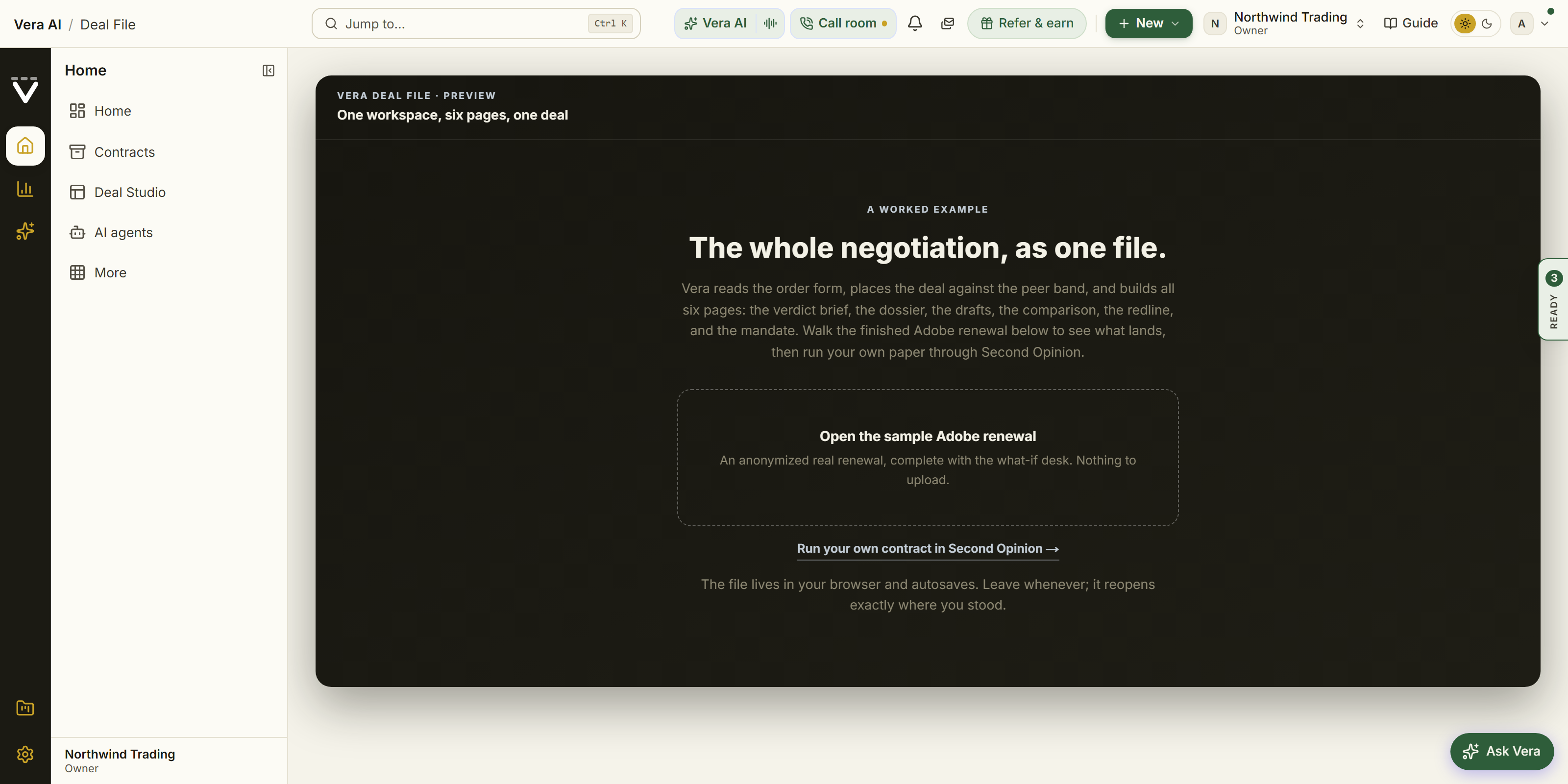
On the screen
- The file rail (left) — the six pages numbered in reading order with open and read markers, search across the file, and the seats at the table. Offer a seat brings a teammate into the same file on the same page.
- The paper (center) — one executive brief per page: the benchmark Brief, which opens on the discount you hold, the band comparable buyers land in, and where that ranks, the Research dossier where you tick your leverage directly in the table, the Drafts pack of five letters, the line by line Compare table with a strike button on every row, the Redline with adopt or hold on each clause, and the Mandate ready for sign-off.
- The what-if desk (right) — scope, term, and ambition dials plus three what-if pills. Every page reprices as you move it: the ask marker on the brief, the numbers in the letters, the mandate table.
- Put it to work (right, below the desk) — page-specific moves: the five drafts, copy the one line verdict, send the markup to legal, route the mandate for sign-off.
How to use it
- Open the file from the negotiation desk and read the brief; the gold marker is the ask the file argues for.
- Move the what-if desk until the target is one you would defend on a call, then tick your real leverage on page 2.
- Pick the opening email on page 3, copy it, and send it from your own inbox; nothing sends from the platform.
- Strike the indefensible lines on page 4, decide all six redlines on page 5, and route page 6 for sign-off.
The file autosaves in your browser: leave whenever, and it reopens on the same page with every number held.
Related: Major renewals · Second opinion · Vera AI - Ghost Writer
Vera AI - Ghost Writer
The correspondence desk for every vendor conversation you are running, in the shape of the mail client the work actually happens in. A drafting box is right for one email and wrong for the eight weeks after it, where the negotiation is a thread: what they sent, what you sent, what you nearly sent, and what to send now.
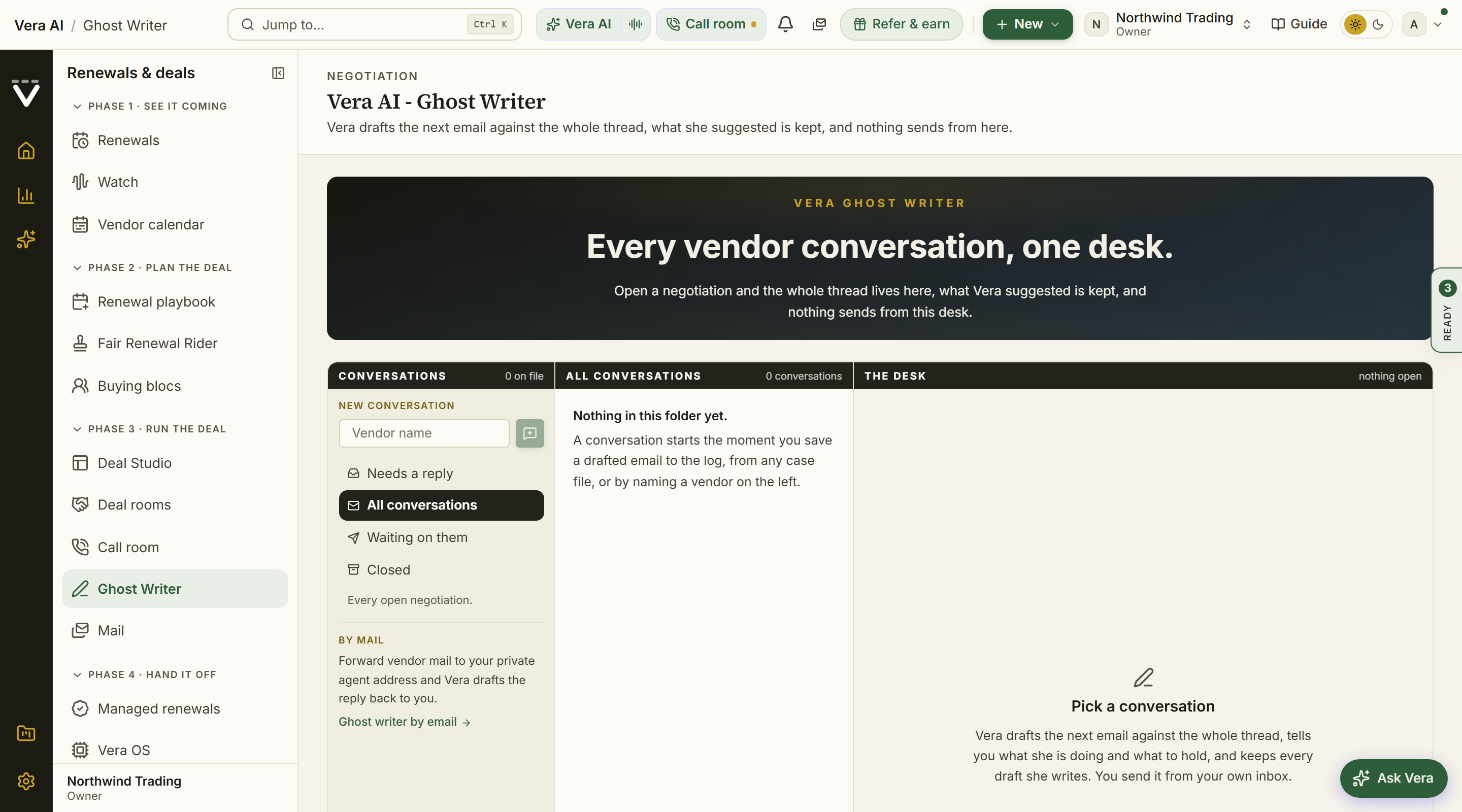
The three panes. Down the left are folders, worked out from the record rather than stored, so they can never disagree with the thread: Needs a reply (they spoke last), All conversations, Waiting on them (you spoke last), and Closed. Above them, type a vendor name to open a new conversation, or press one that already exists. The middle column lists the conversations, newest first, each showing the last thing said and a Needs a reply mark when the ball is with you. The right pane is the conversation itself: every message in order, yours and theirs, with Vera's read printed underneath each of their messages, the tactic named and the play she would run against it.
The composer. Underneath the thread. Paste what they sent adds their message to the conversation and reads it, against everything already said rather than on its own, so a number they are quietly repeating or a concession they are walking back is visible. Then pick an angle and Vera drafts: Hold the position (concede nothing, make them move next), Ask, do not bid (spend questions instead of money), Bring the alternative forward, The budget ceiling, Offer two packages (two shapes you value equally, so their choice reveals their constraint), or Close it out (narrow to what is open and collect the end-game asks).
The tone, on its own row under the angles, is a separate decision: the angle is what the email argues, the tone is how it sounds. Direct is the standard register, plain and businesslike. Warm is collegial, for a relationship you intend to keep; the warmth is in the wrapping only, so it concedes nothing a cold email would have held. Formal is measured and written to be read by people who were not in the conversation, for an email that will be forwarded, escalated, or attached to the file. Firm is cool and short, for a thread that has stalled: what is not working, what you need, and what happens if it does not arrive. Pressing one rewrites the draft in that register with the position unchanged, and the tone rides every rewrite and saves with the draft. She works out where the negotiation stands from the record itself, probe, anchor, trade, or converge, and writes to that phase, and every draft is written against what is known about how that particular publisher negotiates and where its fiscal year sits. What this draft is doing appears above the email, for your eyes only: what it concedes, what it refuses, and the one thing to hold. Ask Vera for a rewrite takes plain English ("shorter and firmer", "hold the number", "ask for their final paper") and rewrites what is on screen, so edits you made by hand survive.
Drafts are kept. Save the draft keeps it as edited, so leaving the desk does not lose it. Every draft Vera wrote lists the whole history for that conversation, each with the angle and tone it took, when it was written, and a sent mark on the one that actually went, and Put it back in the composer restores any of them, in the voice it was written in. I sent this records that you sent it from your own inbox: it joins the thread as an outbound message, and every later draft reads against it.
Nothing sends from here. The platform never mails a vendor from this desk. You copy the draft or open it in your own email app, and the desk records what left. If you would rather work the thread from your inbox entirely, Vera AI - Ghost Writer by email in the left rail sets up a private agent address you forward vendor mail to.
Related: Major renewals · The benchmark library · Workflow agents · Mail
Your own correspondence desk: every email the platform drafts for you, filed in one mailbox. Where the Ghost Writer holds one vendor negotiation as a thread the deal team can see, Mail is personal. It carries everything, the benchmark you are forwarding to your CFO, the note going back to a vendor, the reply you asked Vera to read first, wherever in the platform it started.
Mail opens as its own window: press it in the rail, the envelope in the top bar, or any link to it, and the desk arrives in one frame, folders, list and letter, with nothing loading behind it. The title bar carries Maximize, the sun and moon that flips the whole account between light and dark, and Close, and closing the window returns you to Home.
*In plain words: the mail client for everything Vera writes you, and it remembers.*
The three panes. Down the left are the folders: Inbox for mail you brought in, All correspondence, Sent, Drafts, To vendors and Internal split by who the reader is, and Trash. Under them, Renewal files lists the renewals you track, each showing how many chains you have filed into it. The middle column lists the mail, grouped Today, This week and Earlier, each row showing the reader, the subject, the first line, whether it is a draft or sent, an External mark when the reader is outside your company, and the document the draft was grounded on. The right pane is the letter itself, with everyone it went to, its attachments, and the actions along the bottom.
Writing one. New email offers the sources the desk can write from, then opens the composer: a reader rail on the left, the letter in the middle, and the figures behind it on the right. Pick who it is for and the angle and guardrails follow the reader; an email to a vendor keeps your internal targets and your walk-away out of the text. Add recipients in To, Cc and Bcc; anyone you have written to before completes as you type.
Your defaults, set once. The sliders in the composer's title bar hold the tone, the length, long, medium or short, your signature, and whether you write in plain text, rich text or html. Every new draft starts there, and the controls in the rail still change any single email without disturbing the default. The signature replaces the draft's sign off rather than stacking under it.
Attachments are real files. Attach takes anything from your computer up to 25 MB, or a contract, report or export from your workspace. You can also paste a screenshot straight into the letter. Files are stored privately and open through a link that expires after a minute, so an attachment is something the reader can actually open rather than a name on a list.
Reading their email first. Analyze a response takes an email you paste in, and Vera reads it before writing anything: the figures they put in writing, the dates they named, and the questions they asked, each with what it means for your position. Add a steer in your own words, "keep it short and firm", and the reply is written to it. The read stays beside the letter while you edit.
Filing it into a renewal. Save to a renewal puts a whole chain into a contract record, where the case and any negotiation on that renewal carry it as context. This is the one action that shares an email: your mailbox is otherwise yours alone, colleagues cannot read it, and a blind copy is never carried across when a chain is filed.
Sending it. Copy offers Copy for Outlook, which keeps your paragraphs, live links and inline screenshots when you paste, or plain text; Open in your mail app hands the draft to your own client. Nothing goes to a vendor from the platform without you sending it.
Related: Vera AI - Ghost Writer · Agreements · Renewals
Cases
Case Mode: every agent-run deal as one complete record, with the worklist sorted needs-you first and one rule throughout: a case holds at most one pending human decision at any moment.
*In plain words: Vera runs the negotiation; you approve the goal and decide every offer.*
When to reach for this
- The tail vendors nobody has time to negotiate: Automated mode runs them without a strategy review each.
- A deal that matters but not enough for your own calendar: Guided mode, with the strategy approved by you.
- Checking on a running case: the worklist is sorted so what needs you is at the top.
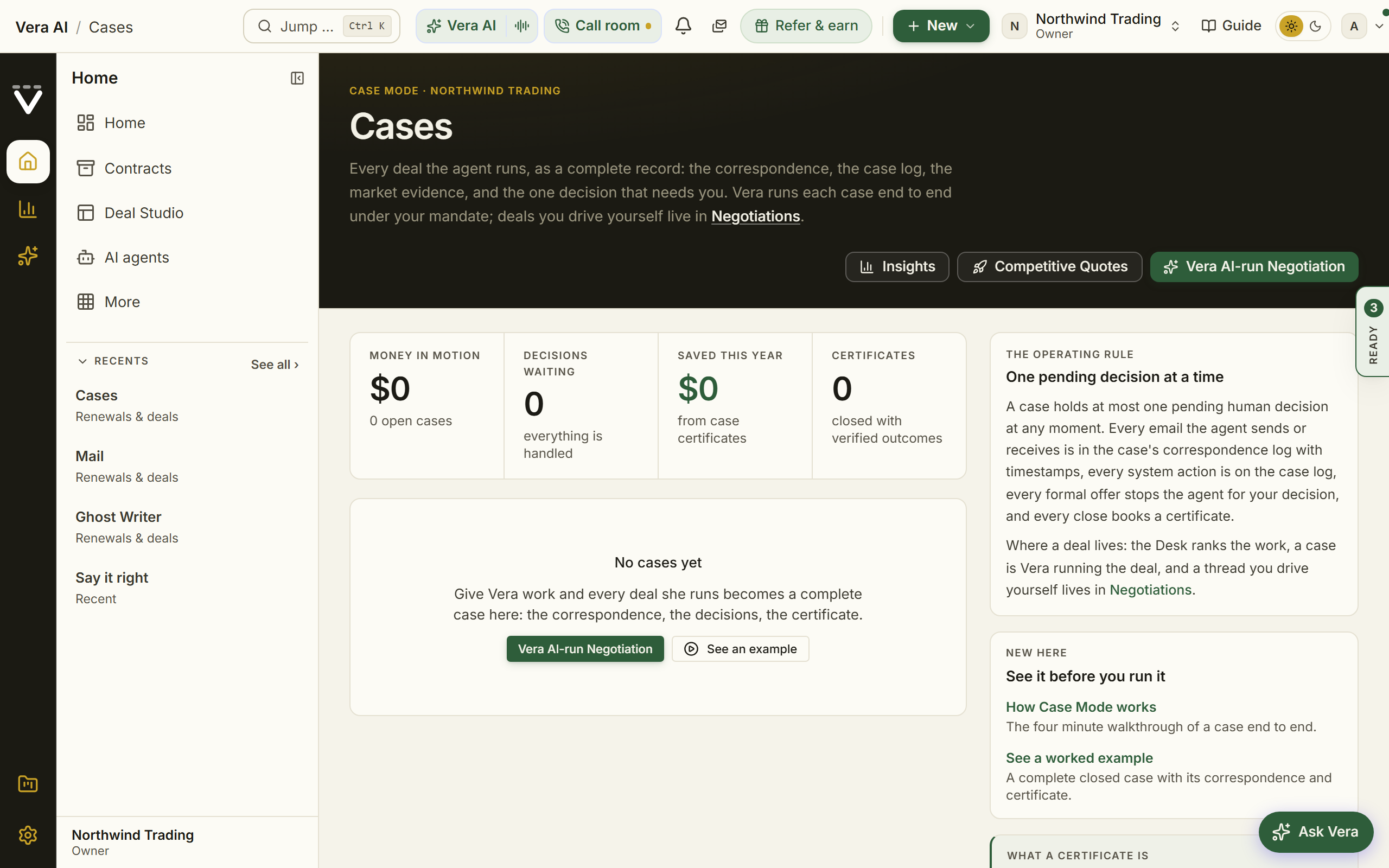
Your position sits in the masthead: money in motion, decisions waiting on you, saved this year from certificates, and certificates booked. The operating rule and the worked example sit in the column beside the worklist rather than under it.
On the screen
- The numbers: money in motion across open cases, decisions waiting, savings booked from case certificates, and certificates issued. Every number clicks through to the cases behind it.
- The worklist: every case with its annual value, stage (Your decision, You have the wheel, Agent negotiating, Setup, Closed), who the case is waiting on and for how long ("Vendor · 3d", "You · 2h"), the predicted close date with its basis, and the next action. Filter by stage with the chips above the table. When a vendor has been silent for 3 days or more, the row grows a Have Vera follow up button: one click and she sends a polite chase, you on CC. The worklist also states who owns each deal: a row where you took the wheel links straight to its Major renewals thread.
- The case record: a status path across the top (Setup, Agent negotiating, Your decision, Closed; gold "You have the wheel" when you take over), the metadata grid, then Your mandate: the one panel that answers "what exactly did I authorize?" with the opening ask, target, walk-away, and leverage, a plain-language "she may / she may never" split, how she signs, who rides CC, and the exact AI disclosure sentence the vendor reads. Below it the market evidence and the case file: every email and every system action merged into one chronology (filter to Emails or Case log), sent messages edged in blue and vendor replies edged in gold, each with its addressing, timestamp, complete body, and Vera's read.
- The decision panel: when an offer stops the agent, the money leads: three tiles showing what you pay now, what the vendor offers, and what you would save or pay more, plus the vendor's offer trend across rounds so you can see the floor forming. Then the one decision: accept and close, approve and send Vera's prepared counter, or reject it and tell her what to push for so she counters the vendor again. A negotiation runs as many rounds as it takes. Accepting can carry conditions: state them and Vera sends the vendor a written acceptance confirmation, subject to your conditions, before the case closes, so the terms live in the thread. When an offer lands you also get an email that leads with the same numbers. Nothing goes to the vendor until you choose.
- Take the wheel: step in on any live case and the agent stands down entirely; work the thread yourself, then hand control back to Vera whenever you are done. Both moves are on the case log.
- The certificate: closing books a verified outcome certificate with the baseline, the accepted figure, the savings, any acceptance conditions, and the evidence counts, and it rolls into the Saved this year number. A closed case ends with next moves (start the next vendor, open the report, see the insights), never a dead end. It also shows in realized savings on the Overview lens of Portfolio.
- This deal elsewhere: one line naming the other records this deal already lives on, so a single deal stops living in four places you have to remember. There are three possible surfaces, and it names only the ones that exist: Negotiation (you drive), Case (Vera drives), and Renewal record (the paper). The record you are standing on is never listed against itself, and the same line rides the negotiation case file.
Vera AI-run Negotiation (/cases/new)
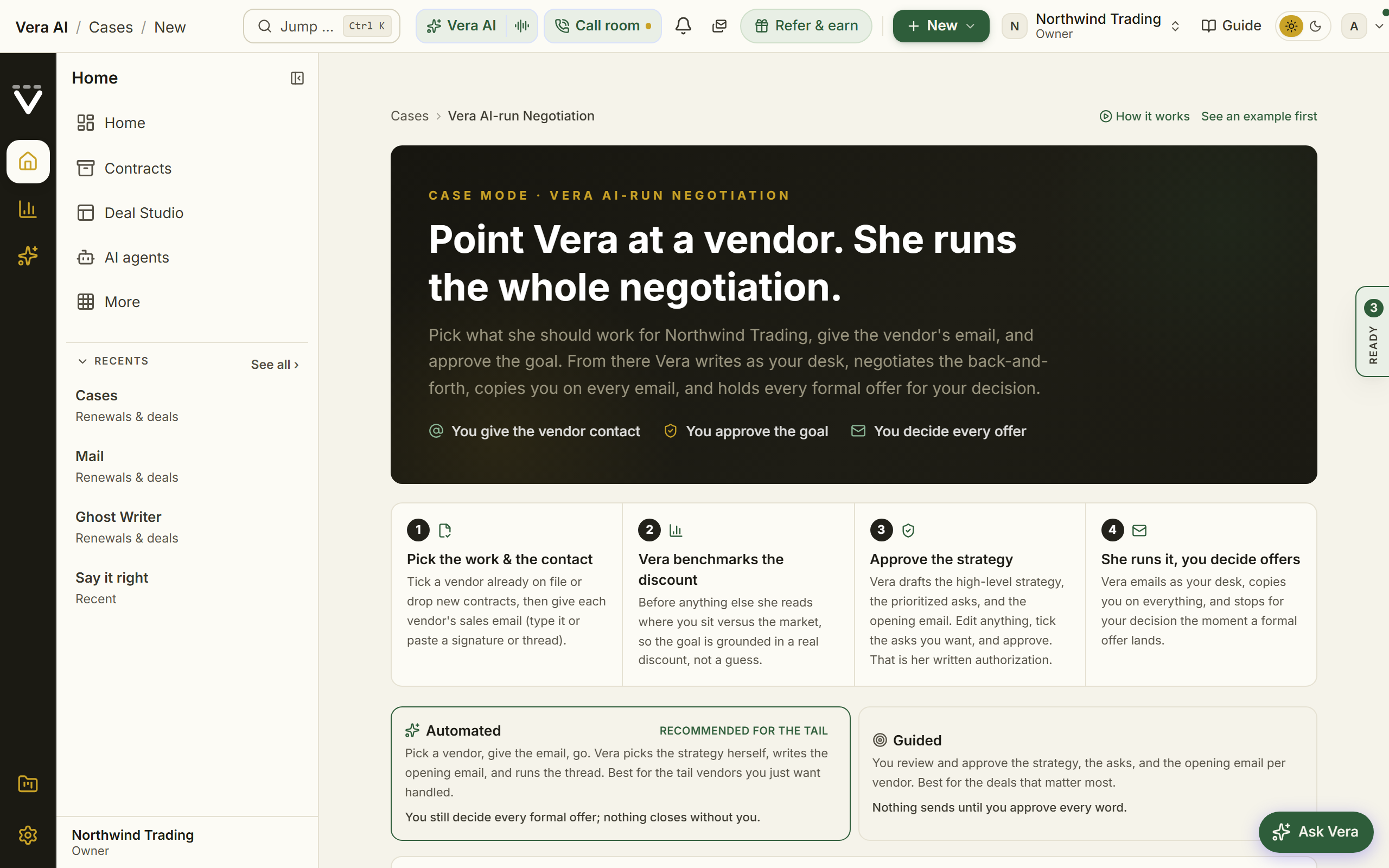
The one intake for Case Mode, with two modes at the top. Automated is the easy path for the tail (tier-3 and tier-4 vendors): pick the vendor, give the contact email, and launch, and Vera benchmarks the discount, writes the opening email, and runs the negotiation on her own with no strategy to review. Guided is for the deals that matter: you review and approve the strategy, the asks, and the opening email per vendor before anything sends. Both copy you on every email and stop for your decision on any formal offer.
The first visit plays the Case Mode introduction (/cases/intro): an eight-scene, full-screen walkthrough of how a case runs, from intake to the certificate, with the control model spelled out (you approve the goal, she negotiates, you decide every offer). The product screenshots carry each page; click any of them (or the Enlarge control) to view it near full screen, and press Escape to return. Replay it any time from How Case Mode works in the Cases header. Finish with "Do not show this again" ticked and it never interrupts again.
In either mode you tick a vendor already on file (each row carries a colored vendor monogram so long lists scan fast), add one by hand, or drop new contracts (single files or whole folders; the drop zone accounts for every file: added, failed, or skipped for type), and supply the vendor's sales or renewals email by typing it or by pasting a signature or email thread. The paste box shows what it found ("Found dana@vendor.com · Dana Reyes") before you commit it. As each row lands, Vera reads the market for that vendor and states it in dollars: the published discount band, and what your target percent is worth per year against your current spend ("At your 10% target that is $32,000 a year off the table"), with a nudge when your target sits below what buyers typically get. A summary line under the guardrails totals the whole launch. The screen also shows the exact AI disclosure sentence the vendor will read, word for word, and warns you if a CC address sits on the vendor's own domain. Up to 10 cases launch at once; the counter is on the screen. Your mode, guardrails, sender name, and CC list are remembered for the next launch, and once your org has launched its first case the big explainer folds away into a one-line header.
The launch is live. After you press launch, each case plays its opening on screen: benchmarked, strategy set, first email in the vendor's inbox, then the actual email that went out, readable in full, with the sender name the vendor sees. The headline states the target on the table in dollars across everything you launched. Failed rows list their reason with a Fix these and relaunch shortcut. In Guided mode you then press Prepare the strategy with Vera: she benchmarks where you sit versus the market (the discount read), drafts a high-level negotiation strategy that uses real competitive tension (naming credible alternatives so the vendor has to stay price competitive), sets the opening ask, the internal target, and the walk-away, lists the prioritized asks as tick boxes (defaults are pre-ticked; untick what you do not want), and writes the opening email. The plan also states how she will play the rounds: the concession plan (steps that shrink round over round so the vendor reads the floor), what she finds out from the vendor before conceding anything, and, when talks would fail, the credible alternative as a costed path (If talks fail). Review and edit any of it, including the email itself, then approve; the approved plan becomes the mandate every one of her emails is checked against. The owner's authorization launches every prepared selection at once. How the email works is spelled out on the screen: Vera sends through VendorBenchmark's secure relay so vendor replies route back to her, the vendor sees your sender name (not VendorBenchmark), and you are copied at your real inbox on every message.
How Vera negotiates. Before every strategy and every counter she reads the VendorBenchmark research for the moment at hand (the vendor's Negotiation Toolkit, the Negotiation Craft doctrine, Renewal Outlooks, audit defense manuals, exit runbooks), so a quarter-end squeeze or an audit-as-leverage play gets the researched counter. She computes the vendor's offer trend across rounds (shrinking moves mean the floor is near), recognizes the rep from your prior threads and the plays they favor, knows the vendor's fiscal year and quarter closes and deliberately slows her pace into them, and never gives without getting: every concession is paired with an ask, on the shrinking curve you approved. Before any email goes out unattended, a seller-side check reads the draft the way the vendor's account team would; anything exploitable is parked in your approval queue with the findings attached. And a negotiation that reaches ten vendor rounds without landing stops and asks you to converge or walk, with a prepared next move waiting.
Editing what Vera sends. You can edit any email before it goes out: the opening email in the prepare step, and every counter Vera drafts (open the case, use Edit on the prepared counter, then approve to send exactly what you see). The AI-agent disclosure is always kept on the opening email even if you remove it.
If the first email has not gone out. A case only reads as "Agent negotiating" once the opening email has actually been sent. If a case shows "Setup · not started" with the next action "First email not sent yet", open it and use Send the first email now; if delivery fails you will see exactly why.
Insights (/cases/insights)
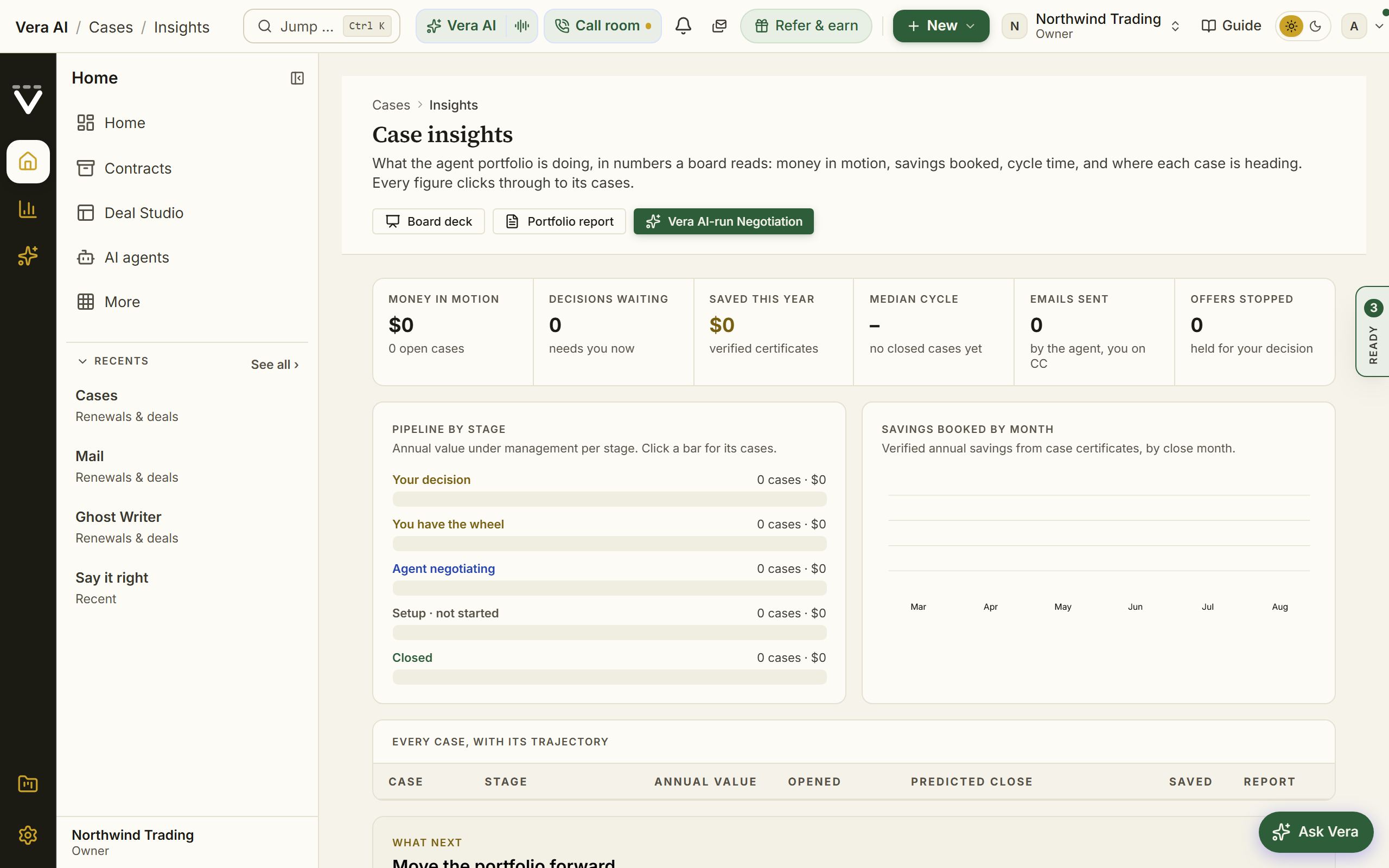
The management view leads with the number a leader repeats: verified savings a year across closed cases, on a navy banner. Below it: money in motion, decisions waiting, median cycle time, and the agent's email activity, with pipeline-by-stage and savings-by-month charts you can click into, and a table of every case with its predicted close date and basis. Board deck exports the whole portfolio as a three-slide PowerPoint in the executive-brief theme (the numbers, then every case), ready to drop into a board pack unedited; the portfolio report is one click away too.
Email that keeps you current. A weekly Your cases digest lands Monday morning when you have open cases: money in motion, decisions waiting, savings booked, and the worklist, decisions first. And the first time a vendor replies on a case you get a short note with the vendor's message, Vera's read, and her next step, so you never wonder whether the machine is working.
Reports
Every case has a report (/cases/[id]/report): the mandate, the full correspondence, Vera's reads, and the outcome, as an executive brief you can export and forward. The portfolio report (/cases/report) is everything Vera ran across every case in one brief.
How to use it
- Open Cases and work top down; the list already puts what needs you first.
- On a setup case, review the mandate table and approve it in place; that approval is the agent's written authorization.
- When a decision is waiting, read the correspondence log first, then send the counter or accept and close.
- To steer a live thread yourself, take the wheel on the case, work it, then hand it back to Vera.
- Use Full deal thread on any case to drop into the complete negotiation workspace with every tool.
Tips
- Cases are the same deals as Major renewals, read as records; anything you do in either place shows in both.
- The sender name and CC list you choose at launch apply to every email Vera sends on that case, not just the first.
Related: Major renewals · Competitive Quotes · Renewals
Competitive Quotes
Autonomous multi-vendor quote runs: hand Vera a set of vendors, the tier-4 tail is the sweet spot, and she runs every quote conversation herself, so the vendors effectively compete for your business in parallel.
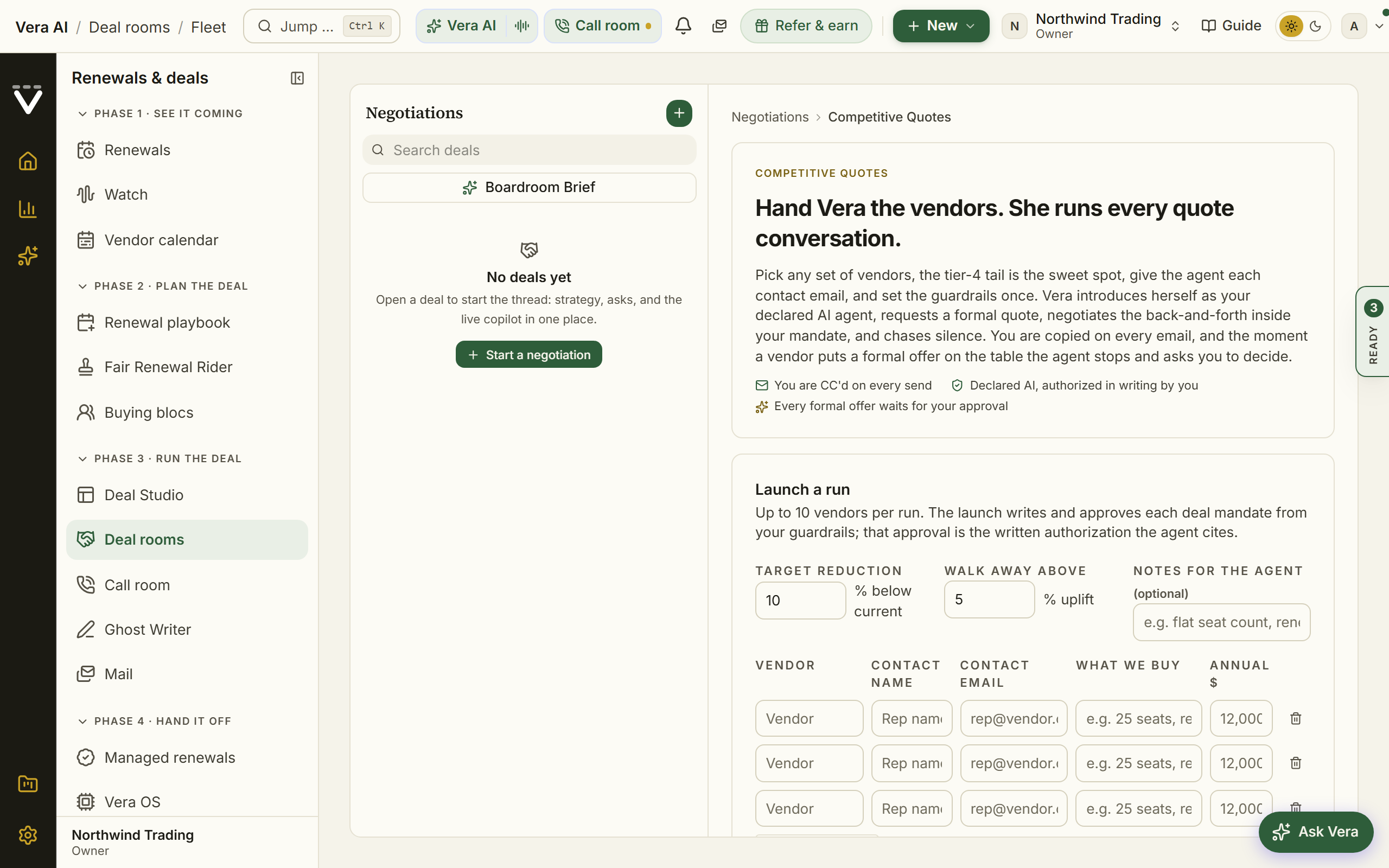
On the screen
- The launcher — up to 10 vendor rows, each with the vendor, the rep's contact email, a one-line scope ("25 seats, renews October"), and the current annual spend if you know it. Guardrails are set once for the run: the target reduction, the walk-away ceiling, and optional notes for the agent.
- The authorization — the launch checkbox is the written mandate approval the agent cites to vendors. Owners only, and the approved mandate is recorded per vendor in the audit log.
- What Vera does — introduces herself to each rep as your declared AI agent, requests a formal written quote, negotiates the back-and-forth inside the mandate, and politely chases silence. You are copied on every email she sends.
- The offer gate — the moment a vendor puts a formal offer on the table, the agent stops, notifies you, and waits. No offer is ever accepted without your explicit approval on the deal thread. A What next panel rides the moment: review the offer, escalate the run to a case, or ask Vera about the spread across the board.
- The board — every run with its state: quote requested, Vera negotiating, proposal awaiting your decision, paused, or closed, with sent and received counts and a link into each thread.
How to use it
- Open Competitive Quotes from the negotiation desk and add your tail vendors with their rep emails.
- Set the target reduction and the walk-away ceiling, tick the authorization, and launch.
- Watch the CC'd emails arrive, and act only when the board says a proposal needs your decision.
Tips
- Give each row a real scope line and the current spend; the agent's opening ask is built word for word from what you enter, never generated.
Related: Major renewals · Approvals
Buying blocs
Buyers with the same vendor and the same renewal window, negotiating on one term sheet. You stay anonymous until mutual opt-in.
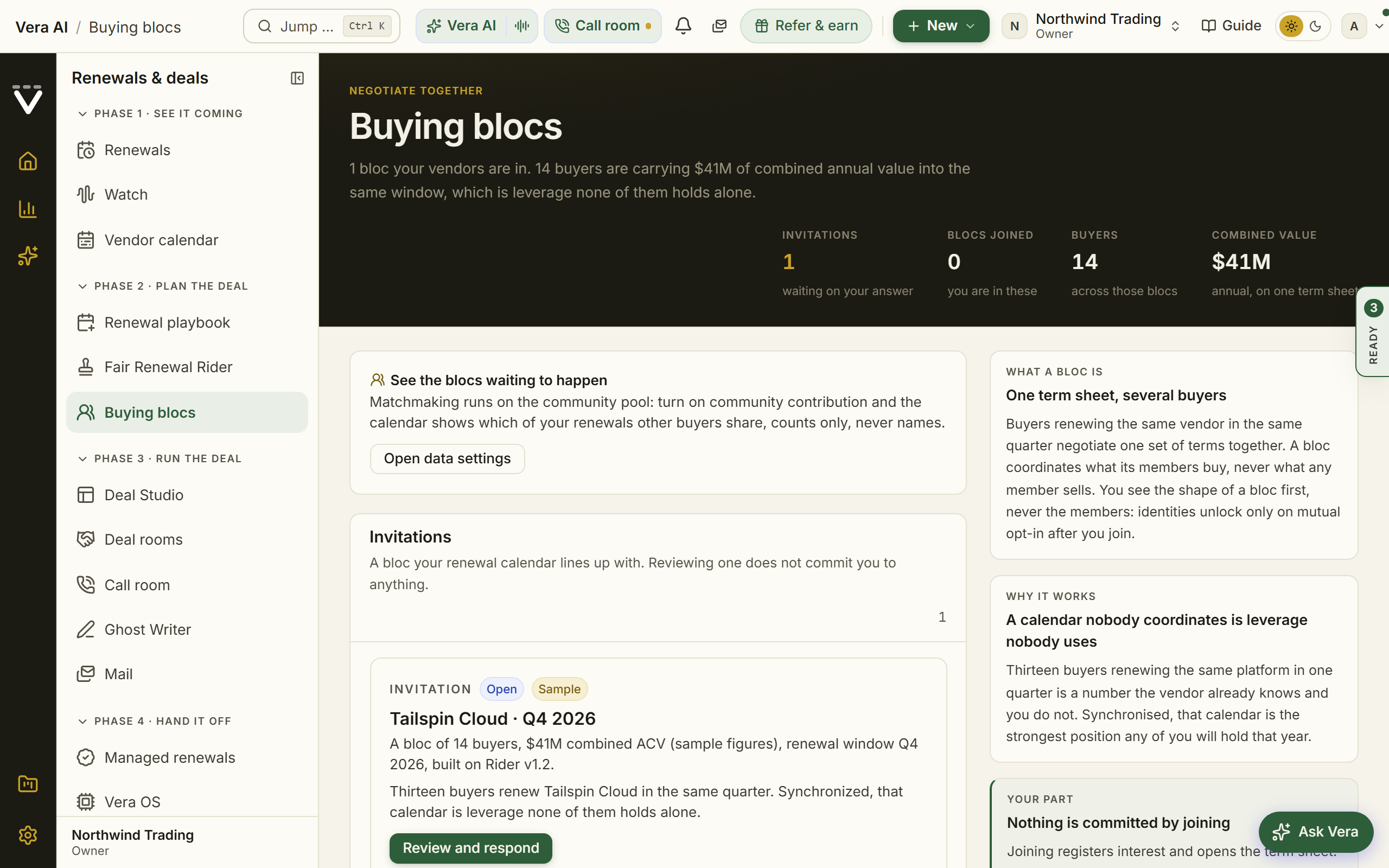
Your position sits in the masthead: invitations waiting on your answer, blocs you have joined, how many buyers are in them, and the combined annual value those buyers carry into the same window. That last figure is the whole argument for a bloc, so it leads.
On the screen
- Matchmaking strip — where your renewal calendar lines up with other buyers of the same vendor.
- Invitations — a bloc you have been invited to: you see the shape (buyers, combined ACV, window, term sheet version), never the members.
- Your blocs — blocs you have joined, with a room to coordinate the shared negotiation.
How to use it
- Review the matchmaking strip and your invitations.
- Open an invitation to read the bloc's shape and thesis.
- Join a bloc to enter its room; identities unlock only on mutual opt-in after you join.
Tips
- Blocs form around vendor families where several buyers renew in the same quarter, built on a shared Fair Renewal Rider term sheet.
Related: Fair Renewal Rider · Renewals
Clause library
Since August 2026 it opens as a Fluent window with its own menu: the rail inside lists the rest of Contracts & documents, so you move between them without going back out, and Escape closes the window.
Your organization's negotiation positions per clause, worked like a desk: the playbook rail on the left, the selected position as a one-page dossier in the center, and the live contract's verdict on the right. These positions feed the AI engines, so scans and drafts argue for your standard instead of a generic one.
This is the same playbook you see under Settings › Clause positions, viewed from the negotiating side, and each page now states its role and links the other: this workspace compares contracts and drafts redlines, while Settings › Clause positions holds the must-have template Coverage sweeps. Every workspace starts with the VendorBenchmark starter library already in place, so the page has positions to grade against from day one; edit them to match your own standard.
*In plain words: what your organization signs, written down once, argued for everywhere.*
When to reach for this
- Setting the standard, once, so every later review argues for your language instead of generic language.
- Before signature: compare the draft against your positions and see the deviations named.
- When the same clause fight keeps repeating: a recorded fallback ends the relitigating.
A worked example. Set an uplift cap position (preferred: 4 percent indexed; fallback: 5 percent; walk-away: no cap, no signature) and compare the sample Contoso Analytics quote against it: the quote names no cap at all, so the comparison flags the silence and drafts your pre-approved language as the redline. One position, recorded once, catches the same gap in every future contract.
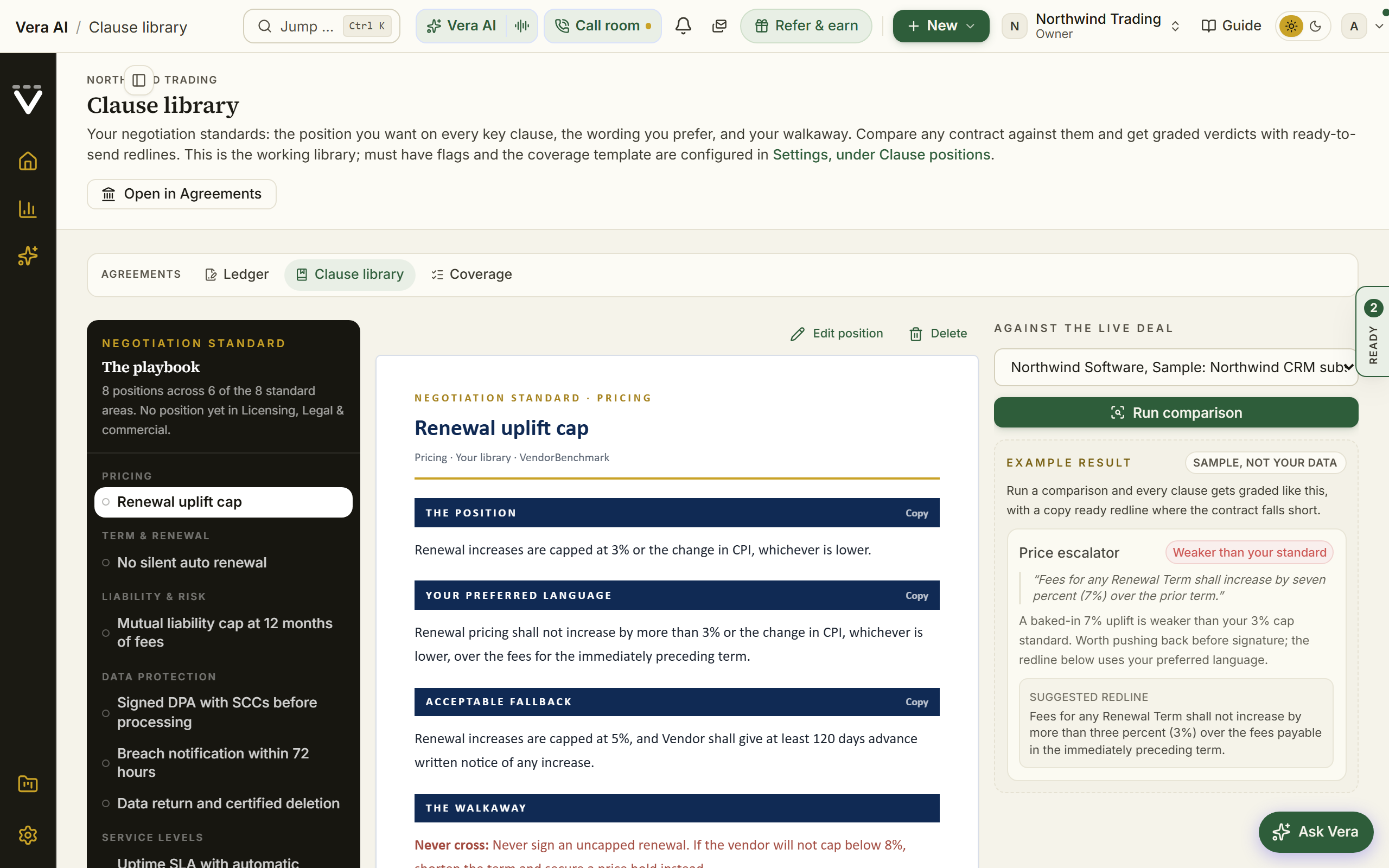
On the screen
- The playbook — the left rail lists every position grouped by area; its header states how many of the eight standard areas carry one, and names any area with no position, because a comparison cannot grade a clause you have taken no position on. Once a contract is compared, each clause carries its grade as a colored dot: green meets your standard, red weaker, gold missing, gray unclear.
- Draft the playbook from your paper — pick up to three indexed contracts and the agent drafts positions from the language those contracts actually achieved: category, title, preferred and fallback language, the walk-away, and a line naming exactly which contract each position is grounded in. Nothing enters the library on its own; you approve or dismiss each proposal one at a time, and the card counts your positions against the cap of 40. Contracts that are not indexed yet are named so you can index them first.
- The dossier — the selected position as a one-page brief: your position, your preferred language, the acceptable fallback, the walk-away, and why the position holds. Every section carries a copy action, so the wording is one press from a redline.
- Against the live deal — pick a contract on the right and run the comparison. The rail grades the selected clause, quotes the language the AI found in the document, and drafts the redline from your preferred language, with the deal scorecard beneath.
- What next — the sweep closes with its next moves: copy every drafted redline in one block for the negotiation thread, start the negotiation, open Vera Deal-Room, or ask Vera which redline to push hardest for.
How to use it
- Select a clause in the playbook rail and read its dossier. Add or edit positions from the rail; each carries a name, a category, your position in plain English, and optionally the precedent wording, the fallback, and the walk-away.
- If the rail header names an area with no position, add one before comparing.
- Pick a contract on the right and run the comparison, then click through the graded dots to read each clause's verdict and its redline.
- See position coverage across all contracts on Coverage.
Related: Coverage · Clause positions (Settings)
Rights register
*In plain words: both sides of every contract's obligations, harvested. The rights you hold, with their expiry windows watched, and the duties you owe, with their deadlines named.*
Since August 2026 it opens as a Fluent window with its own menu: the rail inside lists the rest of Contracts & documents, and Escape closes the window.
When to reach for this
- Before spending negotiating capital on something the paper already grants: true-downs, swap windows, price holds.
- Planning an exit: transition assistance and data-return rights are leverage you own (the sunset recipe).
- When a right is about to expire unused: the watchdog's alert is this page working.
- Before a payment deadline, a usage report, or a true-up notification falls due: the duties table names the date and the clause.
Everyone benchmarks the price; this page harvests the whole obligation picture. A quote-anchored pass reads each contract and records both sides: the rights you hold (true-downs, swap windows, price holds, SLA credits, benchmark and termination clauses) with their exercise windows, and the duties you owe (payment deadlines, usage reporting, true-up notifications, minimum commitments, insurance proofs) with their stated dates. The weekly watchdog alerts you when a right is about to expire unused; duties are marked Met or Missed on the register itself.
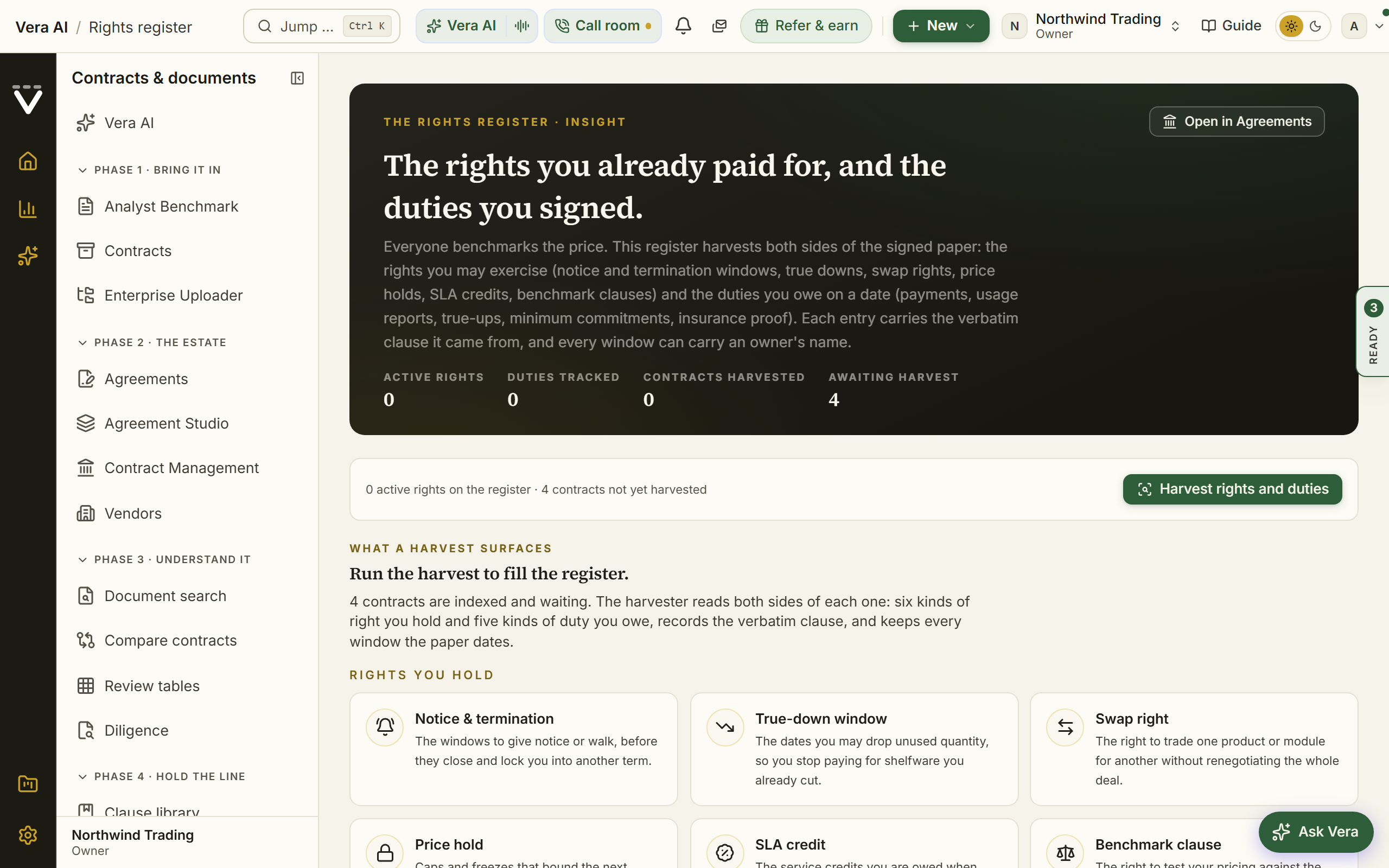
On the screen
- Rights you hold — every harvested right, its status, and the exact clause it was read from, so you can act with the contract in hand.
- Duties you owe — a dense table of your own obligations: the deadline, the stated amount where the paper prints one, and the clause each was read from. Duties falling due inside 90 days are counted at the top.
- Owner — every right and duty can carry an owner from your roster, so a window is somebody's window. Assigning is one select; viewers see the name.
- Harvest stats — active rights and duties, contracts scanned, and how many are still pending a harvest.
- Right families — before anything is harvested, the kinds of right and duty the harvester looks for, plus the one step that unlocks the register.
- What next — under the register, the next moves. The featured move is a pre-drafted, clause-quoting letter for the next closing window: an exercise letter for a right, a performance confirmation for a duty. The rest follow: open the clause behind the window, start the negotiation with that vendor, ask Vera which expiring right is worth most, or book the analyst to sequence the windows.
How to use it
- Upload contracts and index them on Document Agent, then harvest here.
- Work the rights with a near expiry so nothing you paid for lapses unused.
- Give every duty inside 90 days an owner; a deadline without a name is how a commitment gets missed.
Related: Document Agent · Clause library
Coverage
Since August 2026 it opens as a Fluent window with its own menu: the rail inside lists the rest of Contracts & documents, so you move between them without going back out, and Escape closes the window.
The board says when it is stale: contracts added since the last sweep, or a must-have template edited since, show as a badge on the stage with the run control beside it, and an outdated report tab offers its regenerate button. Nothing reruns without your press.
Your clause library's must-have template, swept across every contract: which agreements carry your required protections, and which do not.
*In plain words: your non-negotiables, checked against every contract at once.*
When to reach for this
- After setting the clause standard: the sweep is what turns positions into findings.
- Before a renewal: a red Missing cell on a renewing agreement is a negotiation item with a deadline.
- When leadership asks "are we protected?": the coverage report is the written answer.
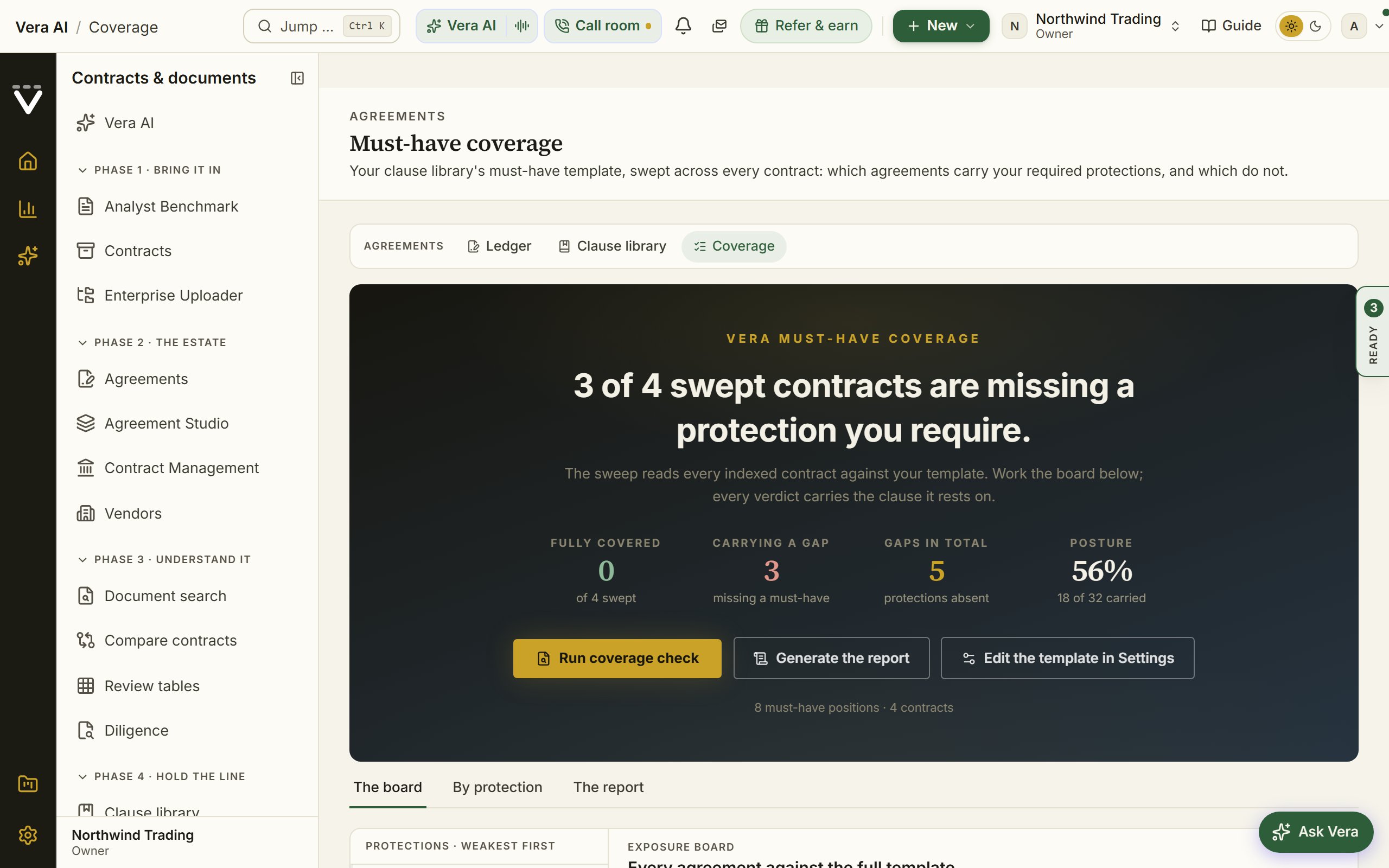
Before the first sweep, the stage does not draw an empty grid. It states what it is about to do, lists the protections your template requires below it, and offers one action: Run the first sweep. Nothing is graded until something has been read.
On the screen
- The verdict stage — the page opens on a navy stage, the same language as Second Opinion: one sentence on how many swept contracts are missing a protection you require, four figures counting up beneath it (fully covered, carrying a gap, gaps in total, and posture, the share of checked cells carried), and the page's actions: run the sweep, generate the report, edit the template. The template edit links say where they lead: Settings › Clause positions, where the must-have template lives.
- The sweep theatre — Run coverage check raises a fullscreen stage where the sweep plays live: position lines tick in as the portfolio is read, a gold arc tracks the real batches, and when the verdicts land the completion line types itself. Esc or the corner button lowers the stage at any time; the sweep keeps running behind it and the stage offers Watch the sweep live to return.
- The board tab — the protections rail on the left lists every must-have weakest first with a coverage bar; selecting one turns the ledger into that protection's story: one row per agreement with the finding the sweep recorded and its verdict pill, worst first. Expand a row for the evidence in full: the finding, the exact clause quoted from the document, and what your template requires. All protections shows every agreement with a verdict square per position (✓ present, ~ deviates, ✕ missing, ? unclear, · not checked) and a gap count; click any square to follow that protection. Verdict filter chips, a search box, and a worst first or vendor A to Z sort work the board.
- The By protection tab — the ranked read: the coverage ring, then every protection weakest first with its bar and counts. Opening a row shows the template language it grades against and the agreements missing it, each one press from its contract.
- The report tab — the white-paper read of where your protections are strong and where they are missing. If no report exists yet, this tab writes one; regenerating from the stage lands here.
- What next — when the sweep finds missing must-have protections, a What next panel targets the worst-exposed vendor: open its renewal, start a case on it, ask Vera about the exposure, or draft the redline from your clause library.
How to use it
- Run the sweep and watch it play, or lower the stage and keep working. Only contracts with indexed text can be read; the scope line says how many are waiting.
- Read the stage first, then the protections rail on the board: the top entry is the protection your portfolio is thinnest on.
- Select that protection and work the ledger from the top, expanding rows to read the clause each verdict rests on. Press the Missing chip to isolate the agreements with no responsive clause at all.
- Open the contract from any row to fix it, or generate the report for the narrative summary.
Tips
- The must-have template lives under Settings › Clause positions, so keep those positions current first; the Clause library workspace is where you compare contracts against them and draft redlines.
Related: Clause library
Fair Renewal Rider
The standard addendum buyers attach to every software renewal: an indexed uplift cap, benchmark repricing, audit conduct rules, no retroactive true-ups, co-termination, and change of control protection. Versioned, public, and free to send.
*In plain words: the standard protections, as one attachment, so you never negotiate them clause by clause.*
When to reach for this
- Every renewal, as a matter of habit: the rider rides along without spending negotiating capital.
- A contract with a structural gap: the sample Contoso quote carries no uplift cap, and the rider's indexed cap is the ready-made fix.
- Short on time: at two weeks out, one attachment carrying six protections beats six separate asks (the rescue play).
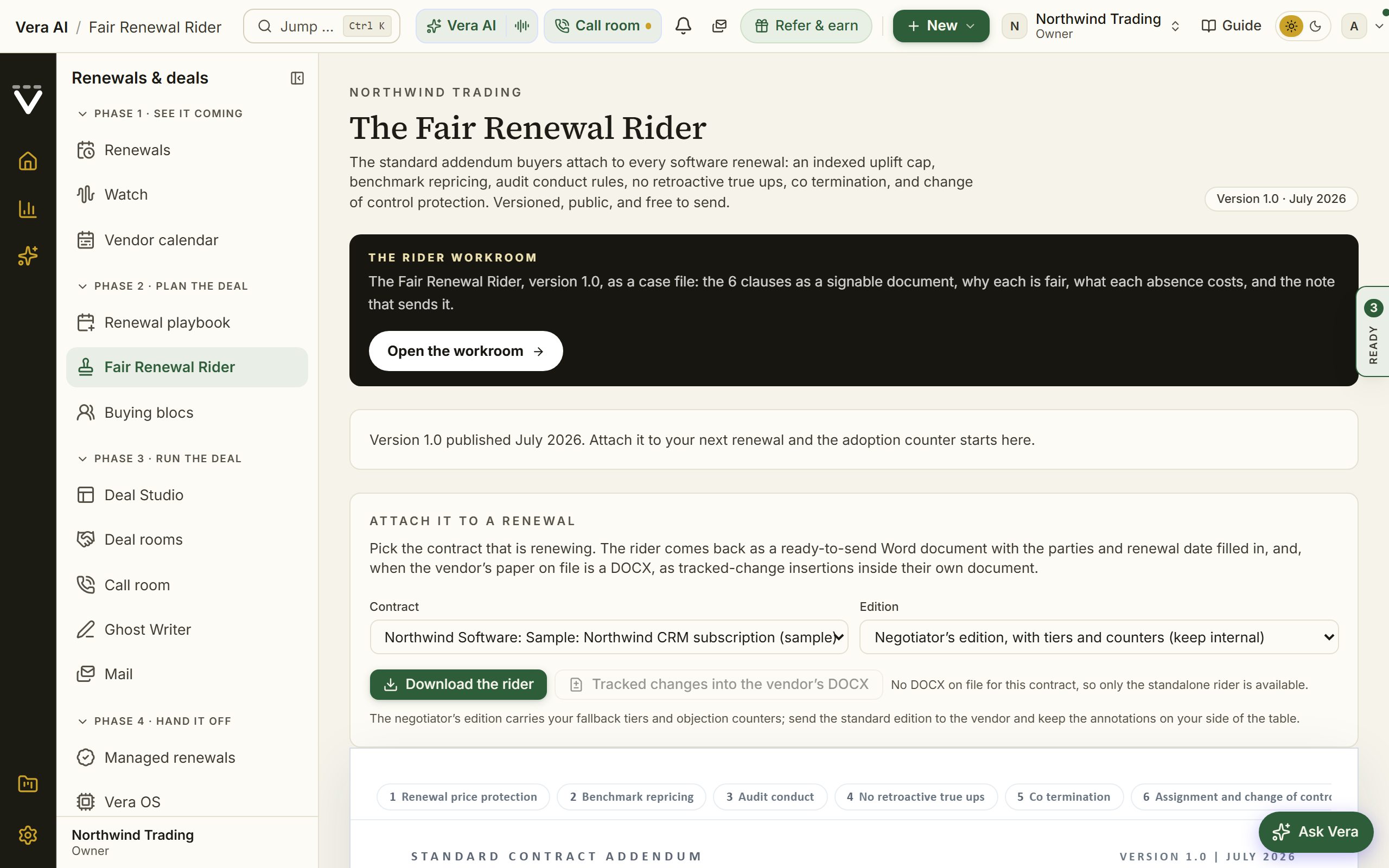
On the screen
- Adoption counter — how many real renewals carry the rider through VendorBenchmark. A standard works because everyone asks for the same thing.
- Open the workroom — the band above the adoption counter opens the rider as a six document workroom: the cover sheet, the operative language of all six clauses, the rationale brief in three clause families, a risk register pricing each missing protection in the rider's own words, the vendor facing send sheet, and a What now sheet. ⚡ What now drafts the cover note that transmits the rider, copies the full text, downloads either edition, and opens your renewals, the negotiation dossier, or the clause library. The standard edition is what goes to the vendor; the negotiator's edition, with the fallback ladders and the push backs already countered, stays on your side. ✦ Ask Vera answers from the rider's published text, including what you will hear on each clause and the counter to it.
- Generator — pick the contract that is renewing and the rider comes back as a ready-to-send Word document with the parties and renewal date filled in, or, when the vendor's paper on file is a DOCX, as tracked-change insertions inside their own document.
- Reading room — the rider itself, every clause annotated with why it is fair, the fallback tiers, and the vendor objection countered.
- Clause changelog — what changed in each version of the rider.
- What next — after you download the rider, a What next panel points to the renewal it attaches to and copies the send sheet cover note for your own mail.
How to use it
- Read the rider in the reading room to understand each clause.
- Pick the renewing contract in the generator and choose the edition.
- Download the Word document or the tracked-change redline and attach it to your renewal.
Related: Renewals · Buying blocs
Vault
Since August 2026 it opens as a Fluent window with its own menu: the rail inside lists the rest of Contracts & documents, so you move between them without going back out, and Escape closes the window.
A room is an access layer, not a second store: every document in one also sits in Contracts, and renewal terms stay on the agreement ledger.
One workspace over your governed document store, in the same voice as Second Opinion: a navy stage on every page. Projects group documents by matter, for example an acquisition review, and each project is org-wide or limited to named people; documents in a restricted project stay hidden from everyone else.
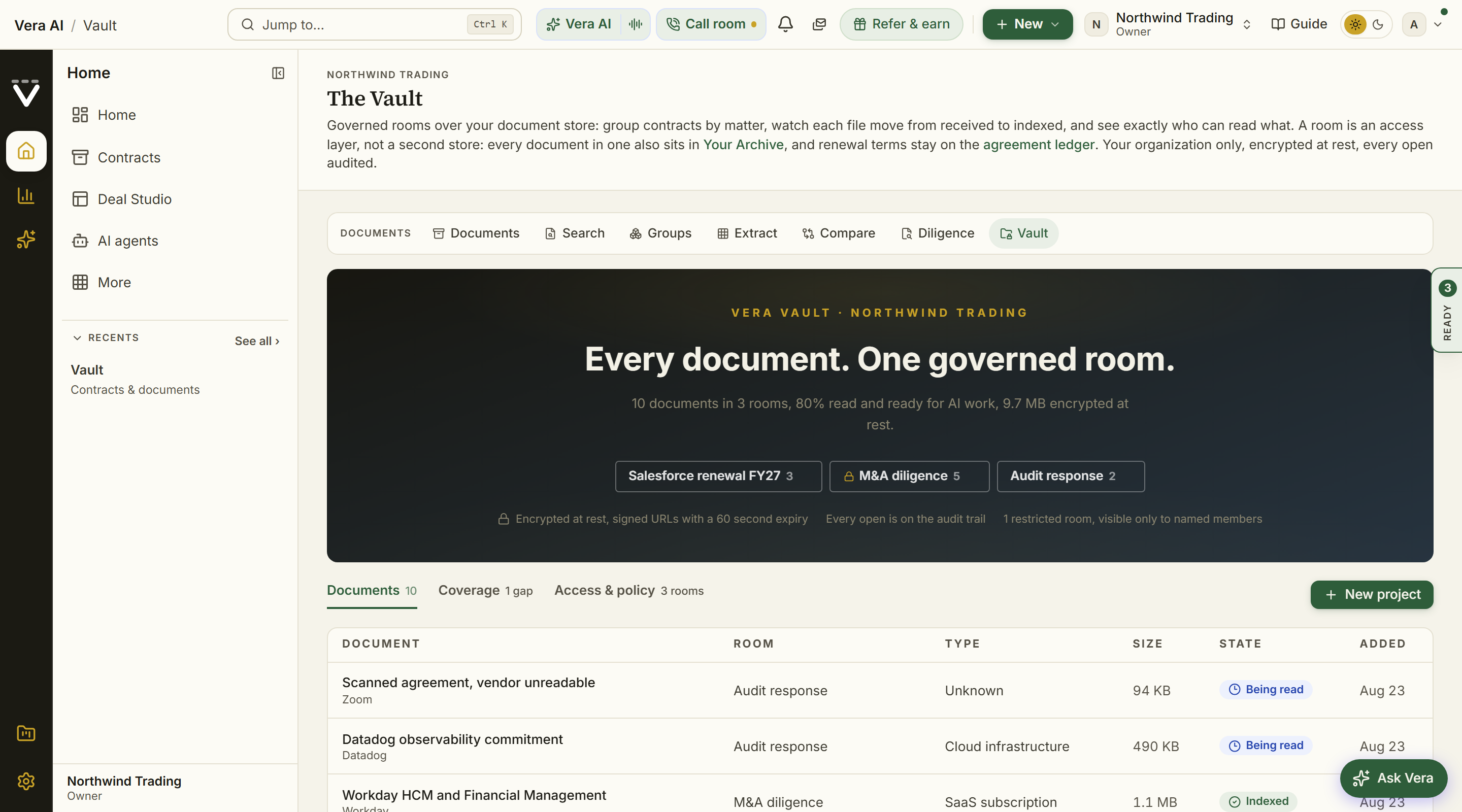
The front door opens on the stage: your estate in a sentence, documents, rooms, the share read and ready for AI work, encrypted megabytes on file, with a chip for every room. Each chip is a door into that room's own page; a lock marks a restricted room. Three estate-wide tabs sit under the stage: every document across the vault, the coverage matrix across rooms, and every room with its access level.
A room's own page carries its stage: the room's name, its figures, and the drop target. Drag documents or whole folders onto the stage and each file is validated by signature, malware scanned, deduplicated, and indexed automatically; the add existing and cloud import moves (Box, Google Drive, SharePoint) sit beside it as stage buttons. The same three tabs follow below, scoped to the room.
- Documents — the room's documents with type, size, state, and per row remove.
- Coverage — a vendor by document role matrix built from what the read stage has named: master agreements, order forms, amendments, statements of work. A vendor holding supporting paper with no governing agreement on file is flagged as a gap; papers not yet read for a role sit in the Untyped column rather than being guessed at. The read below the matrix turns the flags into sentences, starting with the missing agreements, which in diligence are usually the first document request.
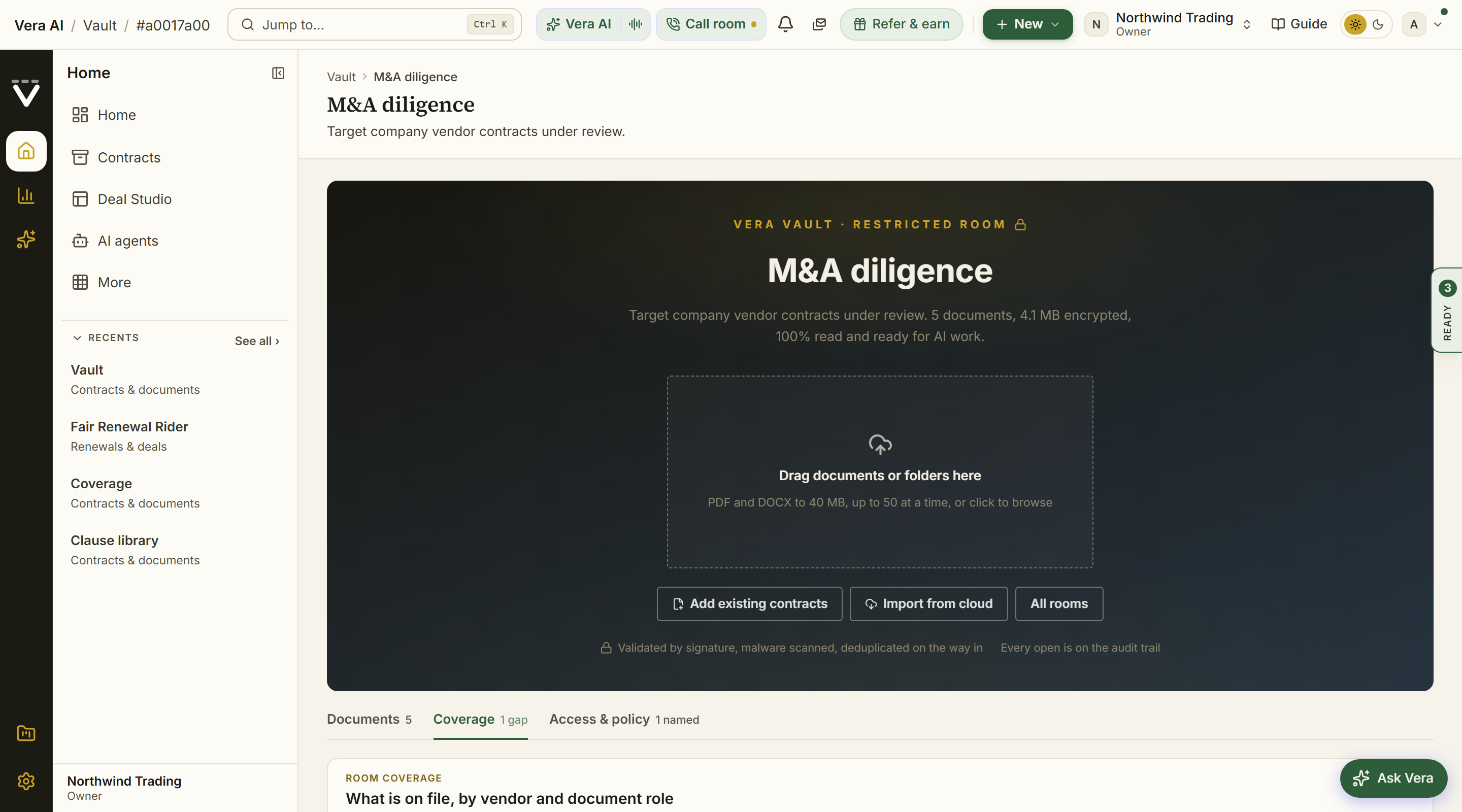
- Access & policy — who can see the room, straight from the database: on a restricted room, the creator and each named member with what their organization role lets them do; on an org-wide room, everyone by role. Under it, the handling policy in plain rows: intake checks, encryption, 60 second signed URL downloads, the audit trail, and the note that Redress analysts read rooms to produce your benchmarks, on the same audit trail.
- What next — the close at the foot of the page, running on this vault's own documents: the vendors holding supporting paper with no governing agreement behind it, named; anything stored but not yet read, so it cannot be searched or benchmarked; records on the ledger with no file behind them; and the moves that put the estate to work, a diligence run across every room, a new room for the next matter, an access review, or Vera with the vault loaded as the question.
How to use it
- Create a project and pick org-wide or restricted access.
- Open its chip and drop documents on the room's stage, in bulk if needed; each file moves from received to indexed on its own.
- Read the Coverage tab and request whatever the gap flags say is missing.
- Run diligence across a project when you want the deal-grade review.
Related: Diligence
Diligence
Since August 2026 it opens as a Fluent window with its own menu: the rail inside lists the rest of Contracts & documents, so you move between them without going back out, and Escape closes the window.
End-to-end document review for a deal: every contract in scope is read for change of control, assignment, exclusivity, termination, liability, and data terms, then assembled into a risk register and an analyst report.
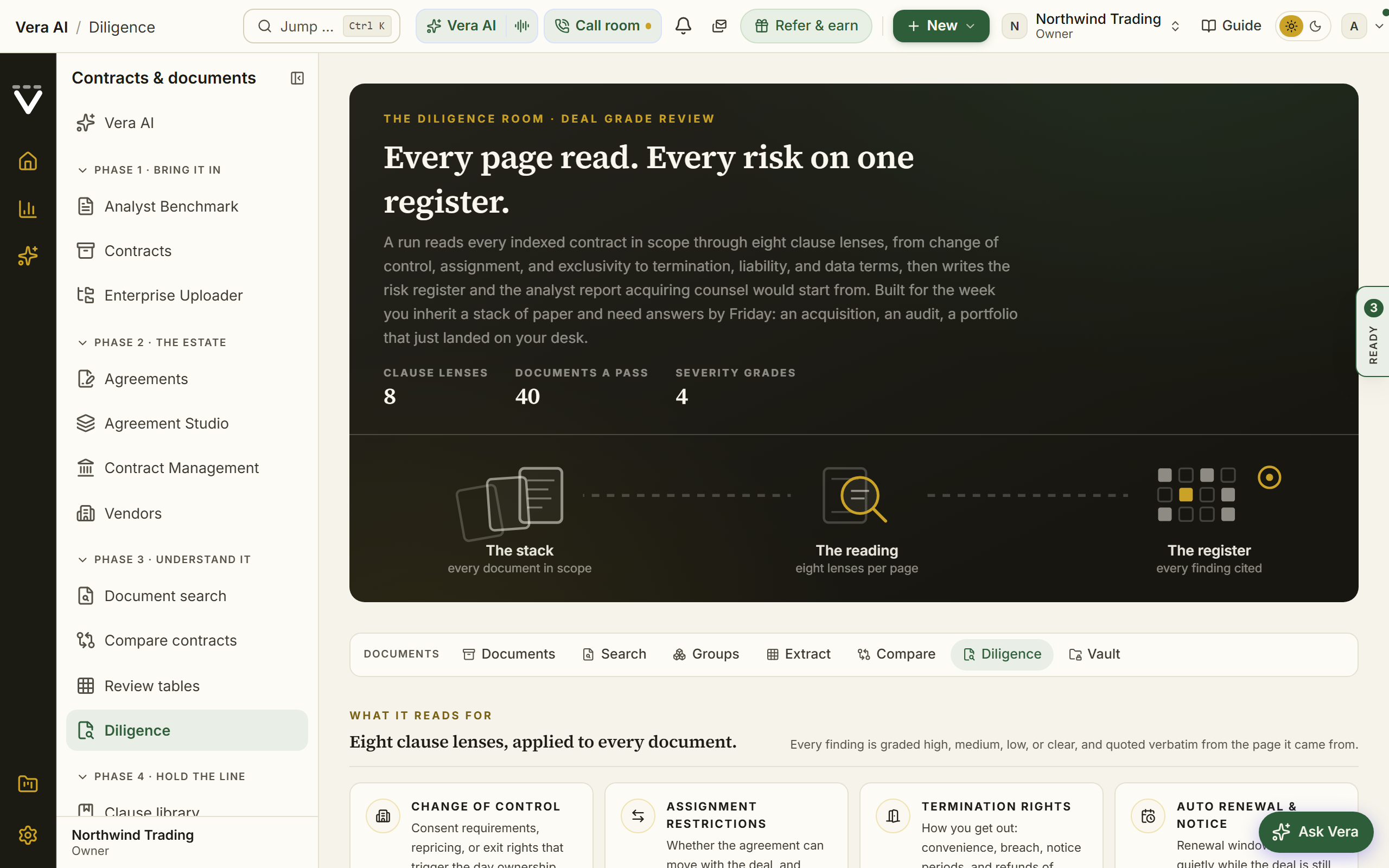
On the screen
- Scope picker — run the review across all contracts or limit it to one vault project.
- Risk register — every finding with its severity and the clause it rests on.
- Analyst report — the synthesized read: what needs consent or renegotiation before the deal, and what is clean.
- Open the workroom — once a review exists, a navy band above the report binds it into a numbered workroom: the cover sheet, the scope sheet, findings by area, a severity ranked risk atlas, the open questions sheet, and a What now paper. ⚡ What now drafts the internal deal owner briefing and a neutral counterparty information request from this review's own findings and open questions, copies the findings summary or the one line verdict, opens a Vera Deal-Room, and links back to the flagged records. ✦ Ask Vera is grounded on this review, so a question about what is still unresolved is answered from the review's own open items.
- What next — the review ends with a What next panel built around the top risk: open a case on that counterparty, draft the sends in the workroom, ask Vera about the worst flag, or copy the one line verdict.
How to use it
- Scope the documents into a vault project first, or run across all contracts.
- Run a diligence review.
- Work the risk register, starting with the highest-severity findings.
Related: Vault
Requests
One front door for new spend, and since August 2026 it is a room inside the sourcing desk rather than a page of its own: /requests and every old link land in the window on the intake room. Every request is read against what you already own, stamped with a verdict, and routed into sourcing, renewals, or approvals without leaving the desk.
*In plain words: everyone asks here, Vera checks what you already own, and nothing gets bought twice.*
When to reach for this
- Standing up the intake habit: one door, one triage, no side-channel purchases.
- A request arrived: the verdict (net-new, renewal, duplicate, over threshold) decides the route in seconds.
- Someone is about to buy what the estate already owns: the leak board is this room paying for itself.
In the room
- Raise a request — the form at the top of the room: what is being asked for, the vendor if known, the rough annual cost, and why. If your org shaped the intake form, its extra questions appear here too, required ones enforced. Vera triages it against the estate on arrival.
- The requester's receipts — filing a request sends the requester a receipt with a personal status link (no sign in needed), and a second email when the request is routed or reviewed. "Where is my request" stops being a conversation.
- The leak board — what was requested against what the estate already owns, priced, in the triage's own words.
- Verdicts and routing — each request carries its verdict pill and one press takes the recommended route: open a sourcing project, send it to the renewal desk, or send it to approval. Triage it again re-reads a request after the facts change. A request past the triage SLA turns its pill red, and the nightly watch tells the org's owners.
- The mail-in address — owners switch it on under Settings › Integrations and teammates email requests straight in, already stamped.
- Shape the intake form — owners add up to 12 questions of their own (free text or yes and no, optional or required); the answers travel into the triage and onto the request record.
How to use it
- Raise a request for the new spend, or let it arrive by mail.
- Read the verdict and the leak board.
- Take the recommended route, in place.
Related: Sourcing
Sourcing
Sourcing opens as the sourcing desk: one Fluent window with fifteen rooms over the whole pipeline, reading the same rows as the stage pages. Number keys 1 to 9 reach the first nine rooms, one search crosses projects, suppliers, bids and requests, and Escape closes the window. The pages beneath the desk wear the same glass: the project record and the deal desk each draw their own Fluent window with the desk rail as their menu, every entry opening that project's room, so no sourcing surface is a plain web page. The desk also keeps the record: every action lands on the project timeline, letters send from the emails room and are logged, and the award rides the approvals trail.
*In plain words: the buying pipeline, from the question to the award, one room per stage.*
When to reach for this
- A net-new purchase big enough to deserve a process (intake to award, the bake-off).
- Mid-process, when "what do I do next?" has a computed answer: every room closes with its real next moves.
- The evaluation endgame: the matrix, the pricing walk, and the target lever are what you walk into the decision with.
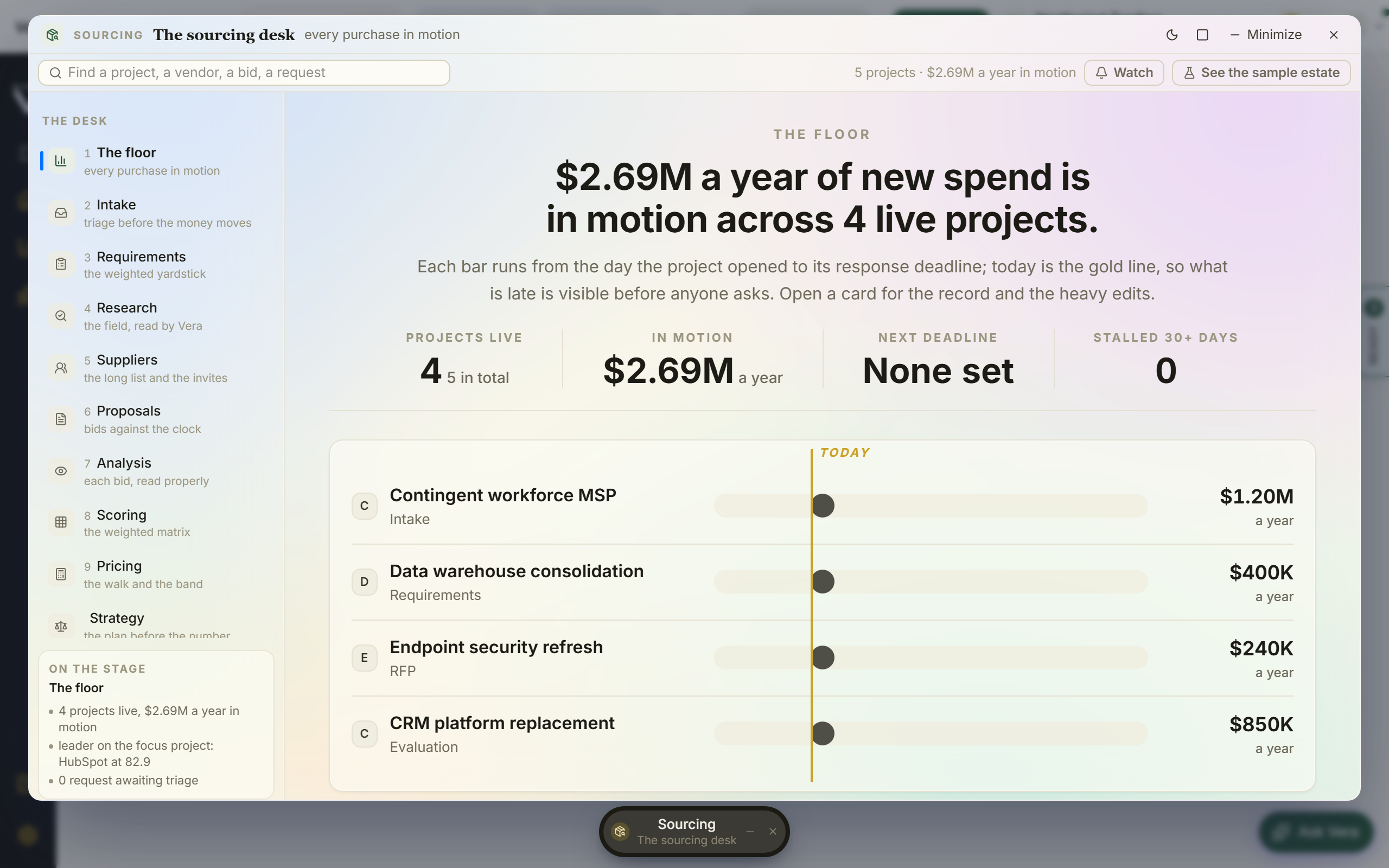
The rooms
- The floor — every project on one runway, from the day it opened to its response deadline, today as the gold line, with the budget riding each bar; the project cards lead with their computed next move, and the shared notes wall keeps the desk's memory underneath.
- Intake — one front door for new spend, inside the desk: raise a request or let it arrive by mail, the leak board prices what the estate already owns, and the recommended route is one press, all without leaving the room (see Requests). Every waiting request wears its clock against your triage SLA (24 hours unless your org sets otherwise), a request past it turns its pill red, and a request above your spend approval line says so on its meta line. Org owners can shape the intake form in place: up to 12 extra questions (free text or yes and no, optional or required) that appear on every raised request and travel into the triage.
- Requirements — the weighted categories with the mandatory gates marked, and the weight sliders as a what if: drag one and the scoring room re ranks live, without changing the signed set. The room also carries the sign-offs (named, dated records on the requirements and the RFP, and where the org's policy requires one, invitations refuse to send until it exists) and Upload a ready-made one: bring your own RFP, RFI or RFQ as a PDF or DOCX and the portal serves your paper verbatim to every bidder, with your standing protections still appended; drafting with Vera stays one press away, and either can replace the other at any time.
- Research, Suppliers, Proposals — the field Vera read with a fit against price map once bids are priced, the long list with who has responded and who is silent, and each bid as filed against the response clock. A supplier whose entry in the risk register is elevated or worse wears a risk chip on the long list. Beneath the long list sits the supplier register: the org level record behind each name (the same vendor across five events is one entry), showing how many events you have run with them, their qualification standing (send the baseline questionnaire from the row; they answer it once in the portal and it stands for a year across events; you approve or reject the answers), their document shelf (file certificates, insurance and tax forms with expiry dates; a lapsed critical document blocks award until renewed), their prior performance (score each quarter on delivery, quality, commercial conduct and relationship, and the average reads on every future event's register), their classifications (diversity and sustainability tags that roll up into the floor's reporting), and demos and bake-offs: schedule a session per supplier, capture what the room saw, and fold it into the panel's scores as evidence. The proposals room carries rounds and the window (open an RFI, RFP or best and final as a first class round with its own deadline, every bidder told at the same moment, bids stamped by round; seal the window and bid contents stay withheld from every reading surface until the deadline, when they unseal simultaneously and the deferred scoring runs, with a late bid on a sealed event refused outright), the structured price sheet (define the lines once and every bidder prices the same sheet in the portal, so the totals land side by side), self-declared positions (each bidder's comply, partial or no against every published requirement, with a declared no on a must-have flagged before anyone reads a page), and addenda: issue an RFP change as a numbered addendum, every live bidder is emailed the same words at the same moment, and each acknowledgment lands on the record so the trail shows everyone priced the same request.
- Analysis, Scoring, Pricing — each bid's read (summary, strengths, risks, what to clarify), the weighted matrix with gate misses struck at every weight, and the price walk from each paper's stated list to its committed annual against the budget and the incumbent. The scoring room also carries the evaluator panel: named teammates join after declaring any conflict of interest, score each bid blind per category (nobody sees another's individual numbers), and the consensus table shows the panel average, the spread, and the AI's read beside them as one voice among several. The pricing room reads round over round: what each supplier moved between rounds, in money.
- Strategy, Emails — the plan derived from the field (best and final for the leader, the walk away kept warm, the incumbent held), and the letters the project needs drafted from the record. The letters really send now: edit every word, press Send this letter, and it goes out on the platform's own mail rail and lands in the Sent from this desk log beside the drafts, on the record for good. The award and decline letters stay held until the decision is taken.
- Evaluation, Negotiation, Award — the decision memo on one page that rewrites itself as you move the levers, the finalist's asks with paste ready language and the target lever pricing the close, then the award scenarios and the savings walk. The decision itself is an arm and confirm press in the room, and it is gated three ways: an award at or above your org's approval threshold (100,000 dollars a year unless your org sets otherwise) asks for a spend approval on the approvals trail first, raised from the same strip, and only an approved request naming that supplier unlocks the confirm; a supplier whose critical document has lapsed on the register cannot be awarded until it is renewed; and where the policy requires it, the award memo takes a named sign-off first. An adopted split scenario records as a real split award: both members on the record with their shares, one agreement opened per member, the paper gate checked for each. The recorded award then opens the agreement in the estate so the renewals calendar holds the new term from day one, and it seeds the entitlement register from the awarded price sheet lines (marked needs review, so a person confirms before anything alerts). The awarded view links straight to the agreement and closes the books: sign off the savings against a typed baseline (the incumbent's annual or the approved budget) and the record lands on the org savings ledger the invoice reconciliation later proves, and save as a template keeps the requirement set and weights for the next event in the category. Once decided, each losing bidder's decline letter becomes a debrief drafted from their own scores only: their strongest category, their gap, and their own gate misses in their own quotes, never another bidder's data.
- The room — the project's collaboration surface: a comment thread on the project where mentions notify the person named, the project timeline (every action a person, an engine, or a supplier in the portal took, newest first, desk and portal merged), the shared notes wall, one press that drafts an email briefing a teammate on the project's real figures, and project roles: name teammates as owner, evaluator or viewer on this project, and editing narrows to its owners and evaluators (org owners always pass, so a misassigned wall can never lock the org out; a viewer reads without touching).
The floor also rolls up signed savings from this desk (the kept money across signed awards, on typed baselines, from the org ledger), counts the funnel honestly (invitations sent, responded, awards recorded, participation per supplier, and the classification rollup for diversity and sustainability reporting), and, for owners, carries the sourcing policy in full (the approval thresholds and triage SLA, the minimum invitations per event, whether the RFP and the award memo require sign-offs, the spend line above which projects open sealed, and the standing protections that travel on every RFP a bidder reads) plus webhooks: register an https endpoint with a signing secret and the typed project events (opened, staged, invited, bids, rounds, unsealing, awards, agreements) POST there as JSON, HMAC signed, the seam the PO handoff and ERP supplier sync build on. The policy is enforced at every gate, not remembered.
The proposals room's rounds panel can also run a price-improvement window on a best and final: switch it on and every bidder's portal shows the anonymous leading sheet total, a re-file must be lower than their own standing total, and a filing inside the last 15 minutes extends the window 15 minutes so nobody wins by the clock. A sealed window and a price-improvement window are opposite promises (one withholds every figure until the deadline, the other publishes the leading total live), so the desk offers one at a time and refuses the combination.
The command bar carries Watch beside the search: watch a project and every timeline entry reaches your notifications (the person who opens a project watches it from the start; press again to stop). It also carries See the sample estate: one press shows the whole desk fully worked on sample data, from any room, and one press brings your own desk back. An empty pipeline offers the same door from the floor, so the desk reads the same on day one as it does mid deal. The floor also reads cycle time from the trail: average days from open to award, the slowest stage and its dwell, derived from the project timeline's own stage moves. Once a project has finished, Start from a template on the floor opens the next event with the saved requirement set, weights and brief already in place.
Behind the desk, a nightly watch minds the estate: it refreshes the supplier risk register for every org with an open project and flags a worsening rating on the affected project's timeline; notifies org owners when an intake request waits past the triage SLA or a supplier document lapses or comes inside 30 days of expiry; flags a dated milestone that slipped and a project with nothing on its timeline for a fortnight; and when a scored bid carries open clarifications, it puts one line on the timeline pointing at the drafted best and final ask in the emails room. Every nudge fires once; nothing sends itself to a supplier.
The deal desk
One live deal at a time, with every move still open to you priced from the quotes you already hold.
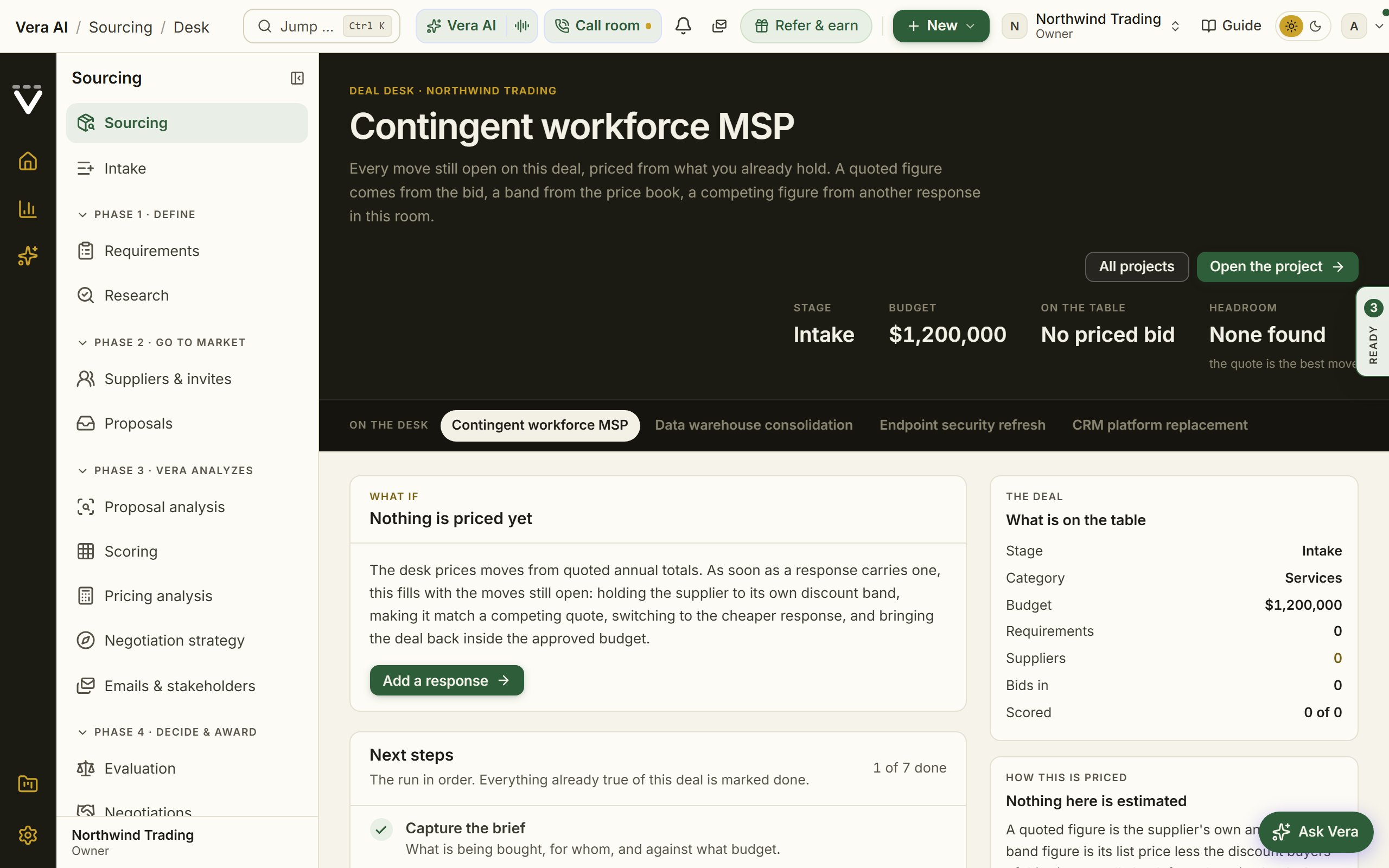
- What if — the moves, cheapest first, each with the annual cost, the difference against the quote on the table, the difference against the approved budget, and one line on what it takes: award as quoted, hold the supplier to the top of its own discount band, make it match a competing quote, switch to the cheaper response, or bring the deal back inside the approved budget. The move you are currently on track for is marked.
- Where each number comes from — every move carries its basis, and nothing is estimated. A quoted figure is the supplier's own annual total. A price book band figure is its list price less the discount buyers of your size actually land. A competing quote is another response in the same room. A move that cannot be traced to one of those is not shown at all.
- Headroom — the gap between the quote on the table and the best move still open, stated in money and as a share of the quote. It is the number to walk into the call with.
- The ask, drafted — each priced move drafts a vendor safe ask ready to copy: the target figure and its stated basis only, never your budget, your scores, or another bidder's name.
- The responses — what each supplier quoted, scored against your own weighted requirements, with list price, the discount that implies, and the expected band beside it. The leading response is highlighted.
- Next steps — the run in order, with everything already true of the deal marked done: the brief, the weighted requirements, the RFP, the shortlist, the bids, the scoring, and the award. A shortlist only counts as done from two suppliers, because one quote is a price and two is a negotiation.
- What next — the desk's close, under the checklist. The moves themselves rather than the run order: open the project room with its supplier, bid and requirement counts, go back to the sourcing pipeline, open the leading supplier's vendor room, start a negotiation against them, or ask Vera what to press them on before you award.
Deals sit on a switcher across the top of the desk, so you can move between them without going back to the list.
The project's What Next desk
Every project record opens with a What Next desk under the stage path: the computed next move as the headline, then the premade moves of the moment, so no step starts from a blank page.
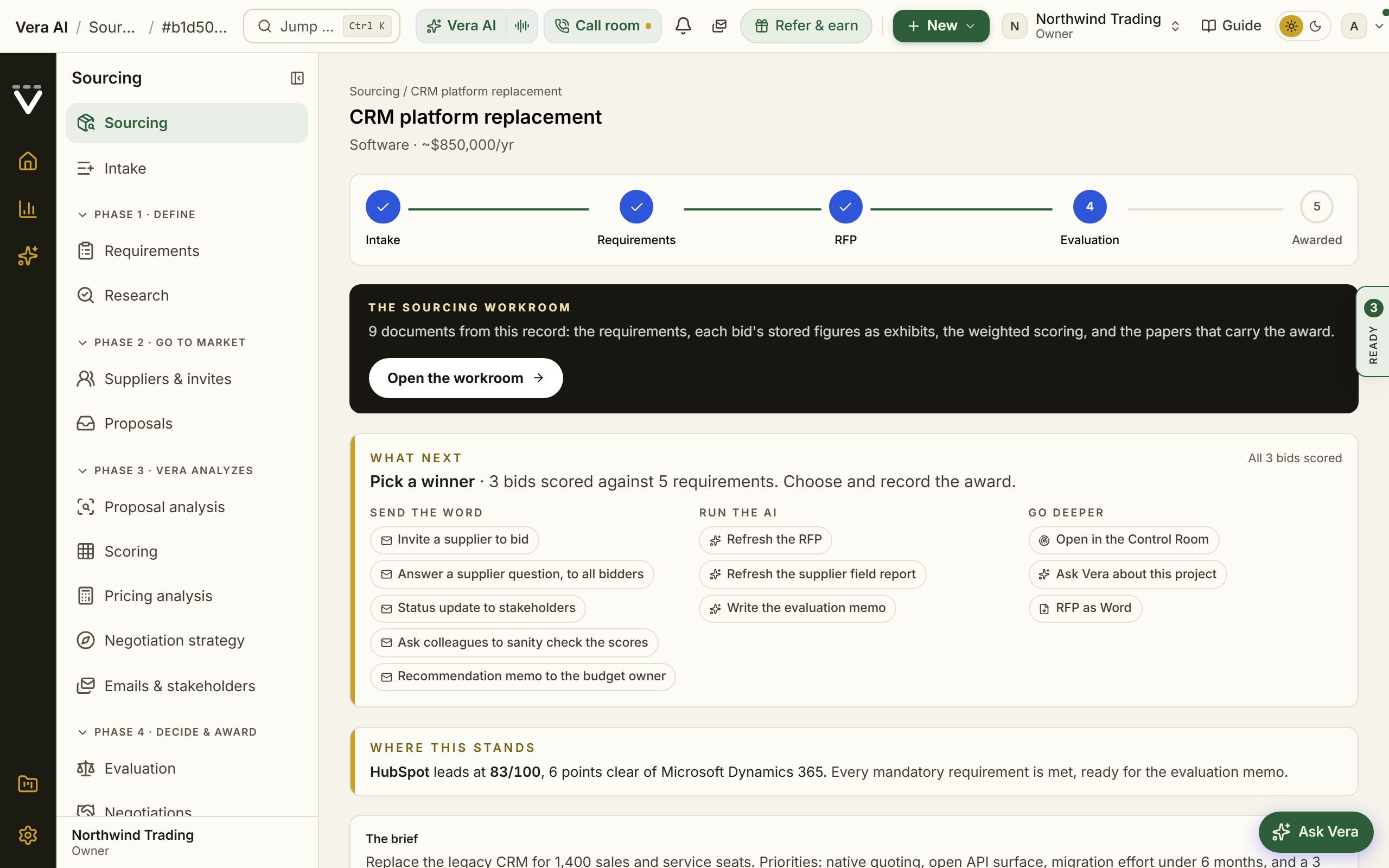
- Send the word — Vera drafts the email each stage actually needs, from the project's live numbers: the stakeholder kickoff, the requirements review request, the supplier invitation, the Q&A broadcast (one answer, every bidder, so the process stays defensible), the chase for quiet suppliers with their names already in it, the status update, the score sanity check, the recommendation memo to the budget owner, and after award the winner note, the decline notes, the legal handover, and the CFO outcome note. Drafts are yours to edit and copy; nothing sends itself.
- Run the AI — draft or refresh the RFP, find the best suppliers in the field, score every waiting bid against the weighted requirements in one click (each score carries a quote from the bid document that justifies it), and write the evaluation memo. Buttons show what has already run, for example "All 3 bids scored".
- Go deeper — the deal desk for this project, Ask Vera, the RFP and evaluation as Word, and the contract decoder once a winner is picked.
- The supplier field report — discovery now also renders on the Suppliers tab as a forwardable executive brief: the landscape summary, market context, fit bars across the field, and one honest section per candidate with strengths, gaps, price posture, and why the score, with the Send it on drafter beneath it.
- Open the workroom — once a project has a bid, a navy band under the status path opens it as a workroom: the requirements sheet, each bid's stored figures as lettered exhibits, then once two responses are scored a verdict brief that reads the whole field in one paper (the standing, the cross bid price check against bands and the price book, and a what to do first list that prices the band and list rate asks where the stored figures can), the weighted scoring atlas as one toned table, an award brief with a verify before award list, and a What now sheet. ⚡ What now drafts the best and final ask to each finalist (priced from the stored figures where the record can price it, in position language that never names the band or another bidder), the award notification, the courteous note to the other bidders (it carries no scores), and the stakeholder update, all from the stored record, then copies the project one liner or the bid table as text and scores the responses on the record. ✦ Ask Vera answers from this project's own requirements, bids, and scores.
Send invitations, and bids that file themselves
The RFP tab carries the send flow, so the document you drafted actually travels. Pick the shortlisted suppliers, confirm each contact email, set the response deadline, preview the email, and send. You stay in charge of every send; nothing mails itself.
- Each invitation renders in the document standard with your organization named as sender, summarizes the RFP, states the deadline, and carries its own private reply address.
- The supplier's portal page carries the RFP, the yes or no on bidding, the Q&A, the message line, the response upload, and, when the project has a structured price sheet, Price the sheet: the buyer's own lines with one unit price box per line and a live total. A filed sheet lands in the desk's proposals room beside the others, a resubmission before the deadline replaces the earlier one, and the filing is written to the project timeline. The portal also carries Declare against the requirements (comply, partial or no per published requirement, with a one line note on any gap), any addenda with an acknowledge button per bidder, and the buyer's qualification questionnaire when one was sent, answered once and standing for a year across that buyer's events. Publishing a Q&A answer emails every live bidder the same words at the same moment, each on their own portal link.
- When the supplier replies with the proposal attached (PDF or DOCX, 8 MB per attachment), the response files straight onto the project: the file is signature checked, its text extracted, and it is auto scored against your weighted requirements exactly as a manual upload would be. A scanned attachment files too: it is transcribed in the background under the same daily transcription budget the archive scan uses, and scored once the text is out. The invite flips to Responded, the notes wall gets the update, and the project owner is notified. A reply with no bid file, or an attachment that cannot be read even by transcription, is flagged on the wall for a human look instead.
- The RFQ watchdog (an agent in the Agent Center) minds the window daily: each quiet bidder gets exactly one reminder, three days before the deadline, and never without a deadline on record. When every invite has answered, or the window closes, it notes the tally on the project wall and nudges you toward evaluation.
- The supplier list on the tab shows each invite's state: Sent, Reminded, Responded, with dates.
Award scenarios
The Evaluation tab ends the guesswork about weights and split awards with a panel of pure math over your stored scores and extracted line items. No AI call is spent on any of it.
- What-if weights — drag a category's slider and the scored matrix re-ranks live, with each supplier's movement against the RFP ranking marked. One click resets to the RFP weights; the weights on record never change from here.
- Where the winner flips — one line per category stating the exact weight at which rank 1 changes hands, for example "Northline overtakes Meridian if Integration weight rises above 28 percent". No line means the ranking is weight robust.
- Single award vs split — where bids carry priced line items, the panel prices every single award against the best two way split by line item group: each contested group goes to the cheaper bidder, groups only one bidder priced stay with it, and every card shows total cost, the delta against the best single award, the combined weighted score (each requirement served by the stronger member), and mandatory coverage. The math states its own limits: up to 15 line items per bid, the first 8 bids, and no modeling of bundle discounts a vendor might withdraw on a partial award.
- Adopt a scenario — saves the chosen scenario on the project and posts the one line summary to the notes wall. For a single award scenario the regular Award button sits right beside it; the award itself stays a deliberate, separate step.
How to use it
- Walk in and read the marquee; it names the project that needs you first. Click that card.
- Make the move the focus console states, or run the engine it offers.
- Press N to leave what you learned on the wall, and U to log what you did.
- Before you step away, open the Shift log and compose the End of shift handoff for your team.
- Start a new project from the backstage toolbar, or turn a purchase request into one.
Related: Requests
The sourcing spine
Folded into the sourcing desk in August 2026: every stage that used to be its own page, Requirements through Award, is a room in the desk window now, and the old addresses (/sourcing/requirements, /sourcing/scoring, and the rest) land in the window on the right room with the active project carried along. The rooms carry the stages' engines in place: draft the RFP, run the research, add a vendor, upload a proposal, read and score the bids, write the memo, and take the award decision with a confirm press. The project record keeps the deep edits, the papers, and the exports.
The Negotiation Workflow
One deal walked from the number to the emails that close it: four acts, each named as the question you are actually asking, all dressed like the home page. The panel beside the rail lists all four in order under their act names, so where you are in the deal is the same on the panel as it is on the page. The workflow remembers the deal as you walk it: the deal meter at the top carries each act's answer and a check as the acts produce them, and from act 2 on a deal so far card follows you with your number, the verdict, and the play, each line linking back to the act that made it, with one press copying the position for your CFO. The left and right arrow keys walk the acts, and old step links land on the act that absorbed them.
The workflow never lets a click lose your place: any link that points outside the four acts, the model tool, a negotiation case, Ask Vera, a playbook, the vendor room, opens as an application window over the act you are on, so the workflow menu and the working deal stay exactly where you left them. The left panel also carries a Tools row with the Benchmark Library, opening the same way. Close the window and you are still mid act.
*In plain words: learn your number, pressure test the paper, plan the play, and say it right, in that order.*
Your number (workflow act 1)
Act 1 answers what you are being offered. It opens with the instant benchmark: no upload and no wait. Pick the vendor, the product, and the deal size, type the discount you are offered, and the three answers render immediately, your discount, the range comparable customers land in at your size, and where that ranks, priced per year when you add the deal value. The same inputs always place the same, because the placement is the curve guideline, not a model's guess.
Below it, the full read: the whole card is the target. Drop a quote, order form, renewal proposal, or signed contract, or browse for it, with an optional vendor hint to sharpen the cohort. The run theatre shows a real percentage over the pipeline's own beats, and you can leave at any point: the run follows you, and the finished deal desk room renders right on this act, the command band with the three answers, the six page case, and the share rail included. Continue to your benchmark simply moves you down the page to that room, and the room's What next rail leads with Negotiation strategies, one press into act 3.
Recent reviews underneath is the workspace's whole history, newest first, and each row says what the review actually was, not just a title: the customer named on the paper, the vendor, the product line, the discount held against the peer midpoint, and the verdict, plus what the later acts concluded, the pressure test verdict and the chosen play. Every deal desk room this workspace has run opens right here, and a check you set aside on this browser, even one that never produced a room, restores whole with one press of Resume, the figures, the verdict, and the play travelling back with it.
Starting over never loses work. The header carries Start a new review on every act the moment a deal is in progress, and the outgoing review is saved under Recent reviews first, whichever way the new one starts: the header button, a fresh drop, the entry question, or a vendor switch mid check. A new drop is a new deal: the working figures clear and the previous deal's room steps aside while the new paper reads, so nothing from the last deal wears the new one's name. A room you open yourself from Recent reviews is different: it renders even while a new paper reads, with the reading note above it, because every brief your workspace has run stays saved and openable at any time. Coming back to the workflow with a deal already in progress asks once whether to continue it or start a new review, and every saved brief, playbook, and report stays in your workspace either way. The stage never defaults to another vendor's room: it shows the working deal's own newest brief or nothing. Download PDF prints the brief alone; the instant benchmark, the drop lane, and Recent reviews all stay off the paper.
The paper itself travels with the deal: the dropped document files into your workspace under Contracts (when your organization keeps tool documents; the room's footnote states which happened), and the later acts reuse it, the pressure test in one press and the Vera door with the contract already attached, so the workflow never asks for the same file twice.
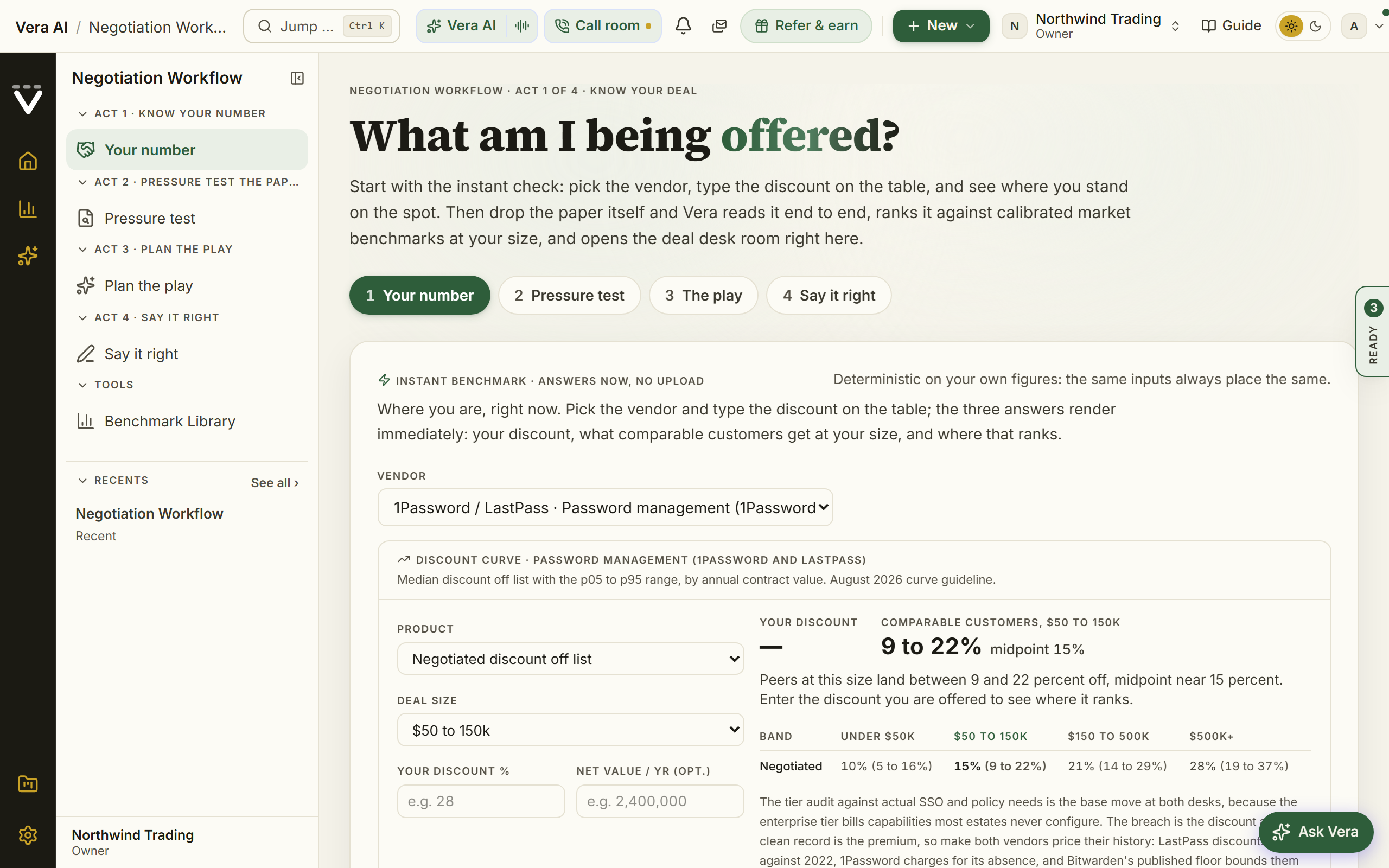
Pressure test (workflow act 2)
Act 2 answers what is wrong with this paper. The second opinion's verdict theatre reads the contract live and returns the four page verdict brief in about a minute: the verdict, what the paper gets wrong, what each problem costs, and what to ask for instead. When the working deal carries a paper from act 1, the stage shows two doors of equal size: Continue with your document on the left runs the filed paper with no re-upload, and the drag and drop zone on the right takes a different one. The continue door always points at a document the workspace actually holds, even when the record behind it was replaced since act 1. The sample Workday renewal runs free, so you can watch a pass before spending one on your own paper, and the verdict writes itself onto the deal meter.
On the idle act, the clause level pass leads under the drop stage: Contract Agent for the order form, the MSA Agent for the master terms, and the SOW Agent for the services paper, each reading your PDF or DOCX clause by clause with paste-ready asks. With a finished opinion on stage, its own Next moves carry the handoffs instead, so the tail of the page never says the same thing twice.
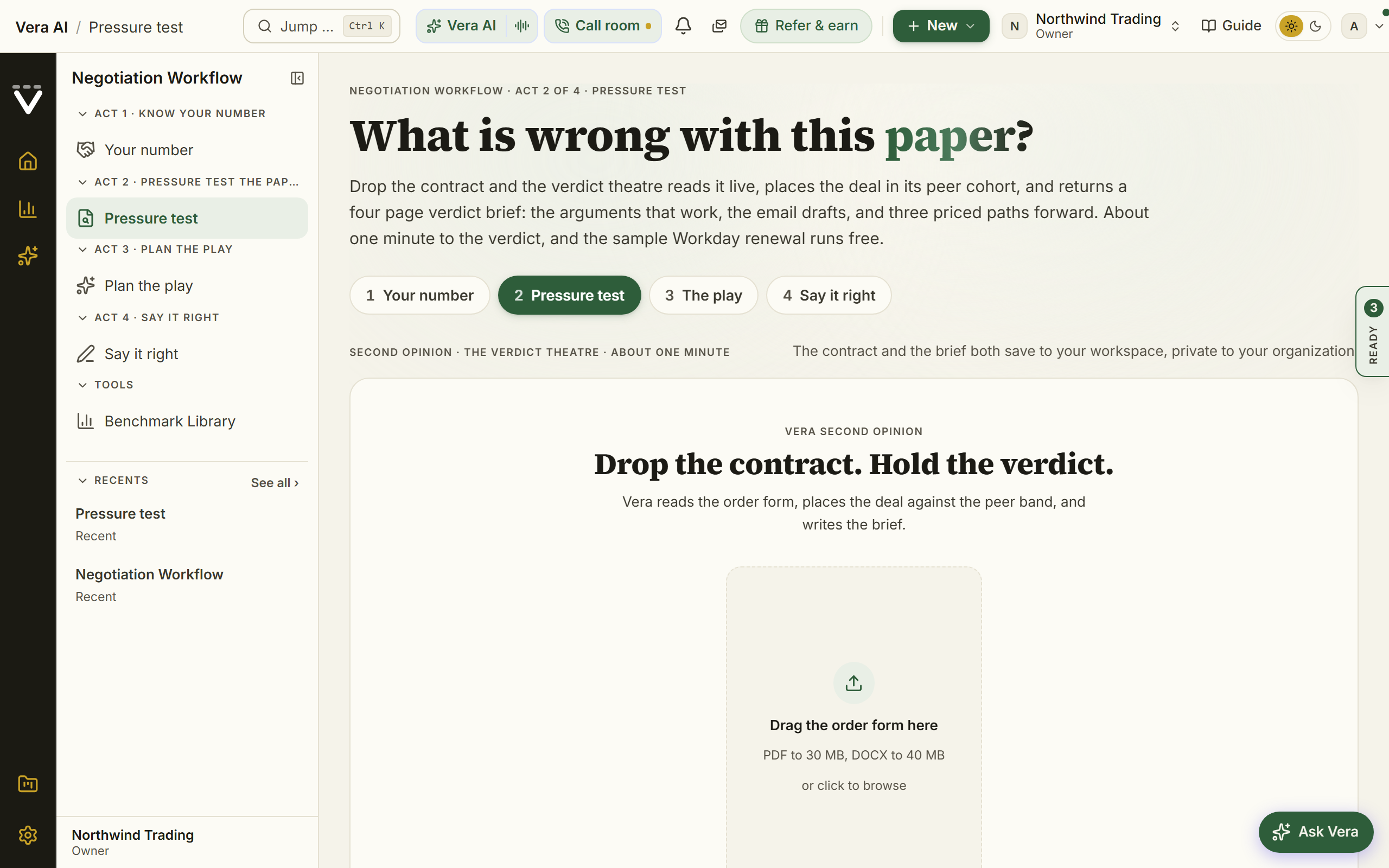
Plan the play (workflow act 3)
Act 3 answers what you trade. The Vera door writes any of the eleven reads, from the pricing benchmark to the final call plan, right on the act: the working deal's own paper arrives already attached when act 1 filed one, or drop another, choose the read or say what you want in your own words, and the finished brief renders in place, so planning the play never leaves the workflow. Your saved playbooks sit below, newest first, each grounded in your own paper, and the guided vendor playbooks carry the majors end to end with the typical finding stated on each card.
The research rail brings the market to the act: the vendor's fiscal quarter, the counterparty grade, and the latest wire stories, all read from the working deal's vendor, so the play is planned against what the vendor is living through this quarter.
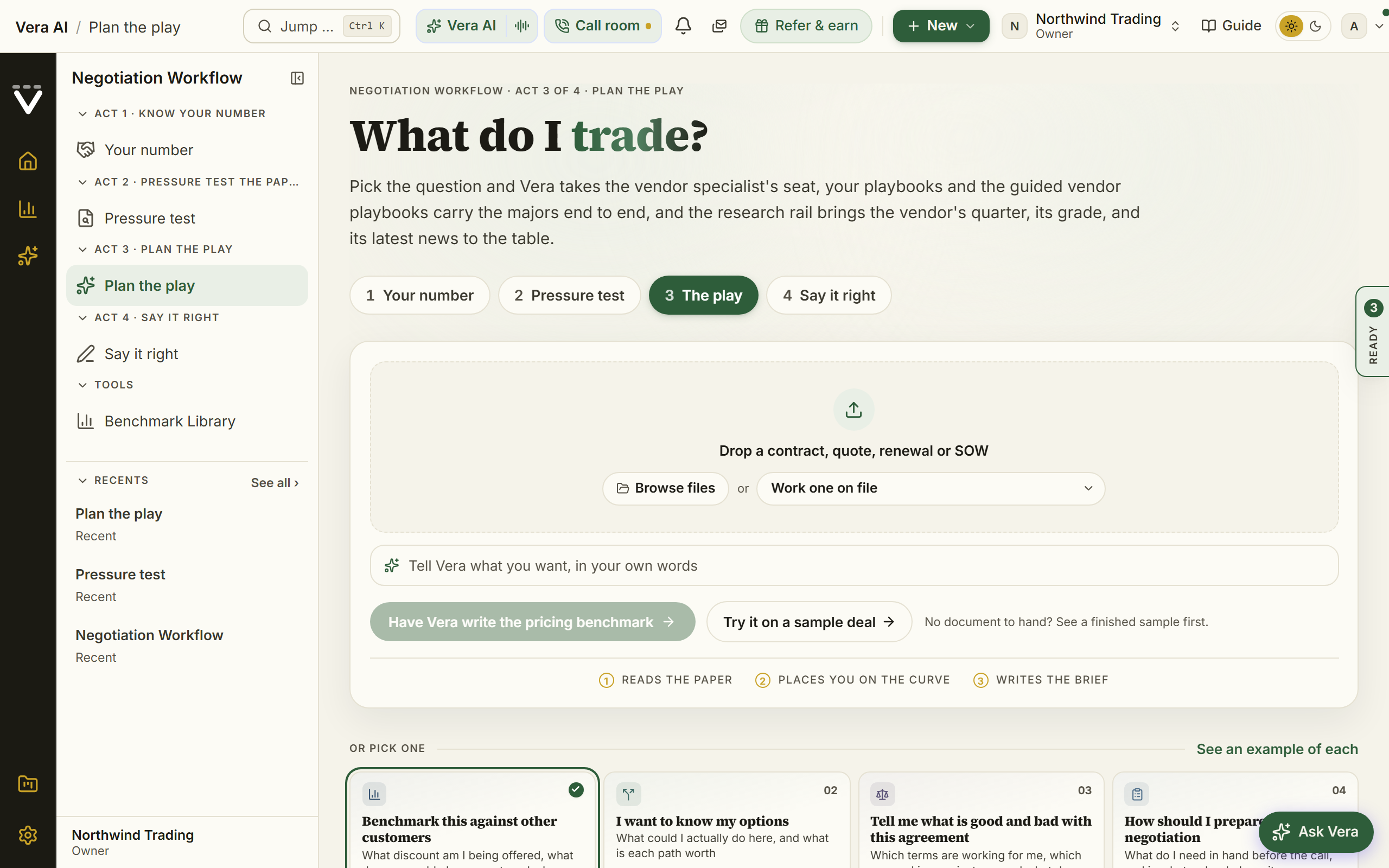
Say it right (workflow act 4)
Act 4 answers what you say. The ghost writer holds every vendor conversation as a thread and drafts the expert reply to each inbound email, grounded in your numbers, your benchmark, and the play you chose. You edit and send from your own inbox; nothing sends itself.
The research briefings play here too: the full analyst video gallery, searchable and filterable by vendor, opens on your deal's vendor so you watch the analyst's read before the words go out.
The finish opens the war room: the negotiation thread is created with your vendor attached, the playbook and the briefs one press away, and every email in one place, where Major renewals tracks the deal to signature.
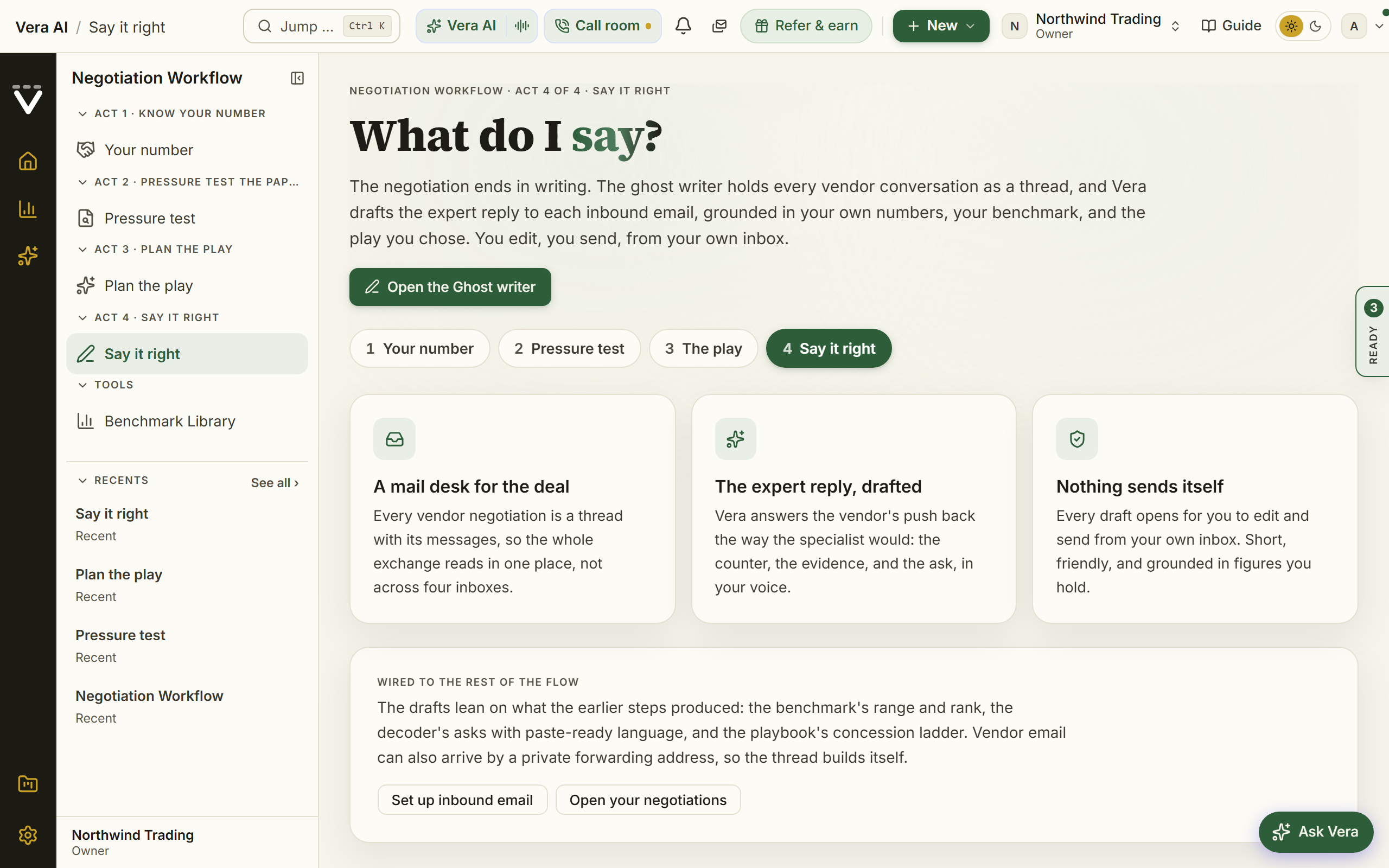
Negotiation Agent
One paper, eight rooms, and every room reading the same figures. The Negotiation Agent, until August 2026 the Deal AI Agent, opens straight into its window: pressing it anywhere opens the application itself, with nothing loading behind it, and closing the window returns you to Home. Move the ask on the curve in room 2 and the plan's ladder, the money and the talking points all follow it, because there is one set of figures behind all eight rooms rather than eight copies of them.
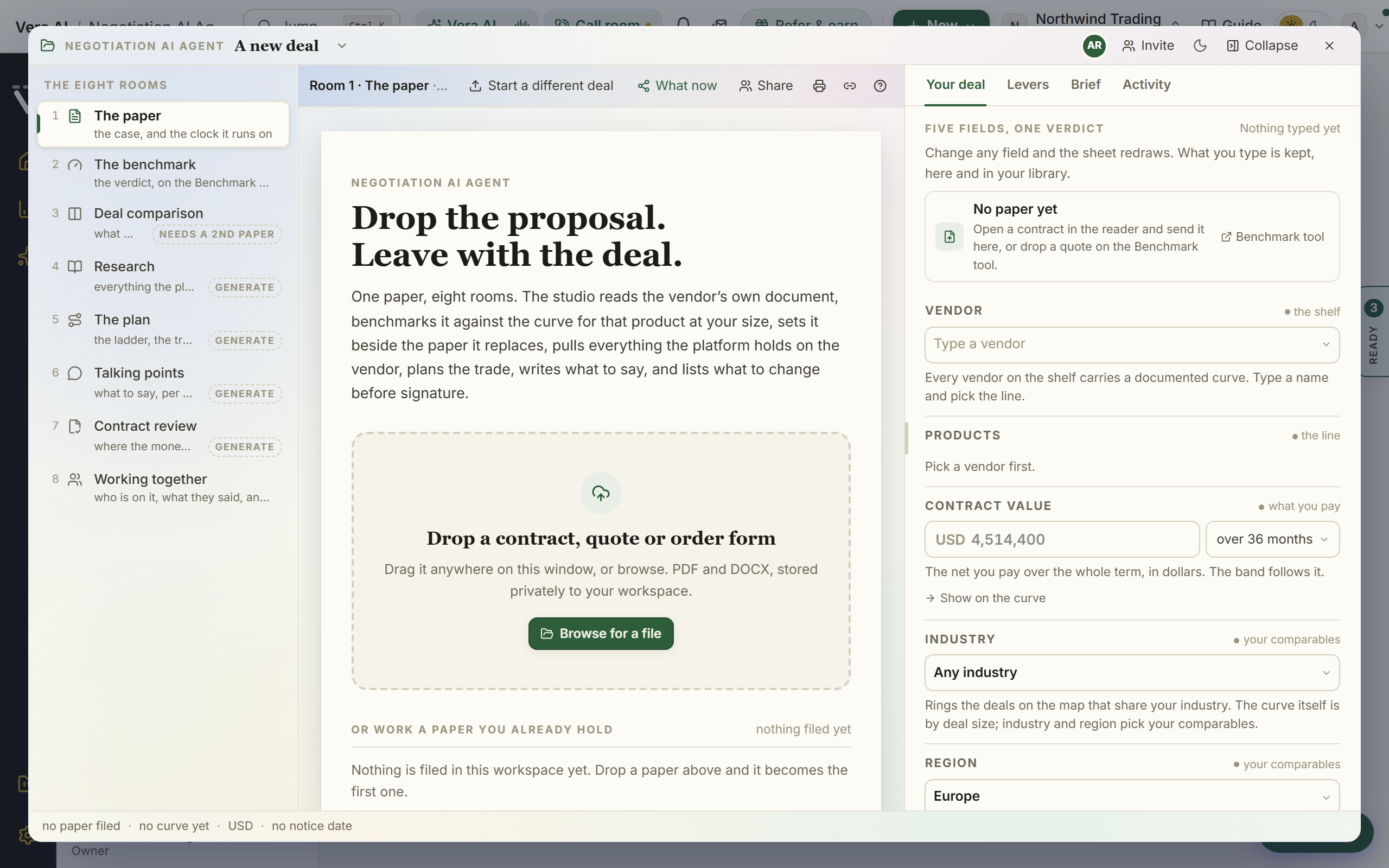
On the screen
- The room rail — the eight rooms down the left side, each with its number, its own line and its state chip: the benchmark shows your rank, the comparison says whether it has a second paper, and the four written rooms say Generate until you ask for them. Keys 1 to 8 switch rooms, the rail folds to its icons on a narrow window, and closing the window returns you to Home. At the rail's foot, the deal so far: the term figure, the vendor, the year price, the discount and your notice date, in view whichever room you are in.
- Day and night — the moon in the titlebar turns the desk dark and the sun turns it back. It is the account's own theme switch, the same one the top bar carries, so the choice follows you out of the window and onto every other screen.
- Room 1 without a paper — the front door. Drop a contract, quote or order form anywhere on the window, browse for one, or pick one this workspace already holds. Dropping onto an open studio files it into the studio rather than asking which tool you meant. The paper is then read: the vendor, the products, the user count, the list, the net and the term are lifted off the document and fill the five fields on the right, the first of them within about half a minute and the rest as the benchmark behind it finishes. A paper you pick out of the workspace is read the same way rather than taken from its filing record. The read runs outside the window, so closing the studio does not stop it.
- Room 1 · The paper — once a paper is read, the case: what the vendor wants over the term and each year, the discount the paper states, and what the paper is silent on, named rather than counted. Only what the document actually carries is filled in. Where it is silent the field stays empty and the silence is named, and the term says whether the paper stated the length or the studio is standing on a working figure you can change. Underneath, the clock: your notice deadline, the end of the term and the vendor's own quarter closes on one line, with the fortnight to sign in bracketed. When the vendor's deepest window falls outside your term the clock says so and points at the close that does not.
- Room 2 · The benchmark — the Benchmark Library's own sheet, unchanged: your discount, the peer range at your size, the supported ask and what is on the table, then the discount curve you can drag, the market map, comparable deals ranked with you in them, and what every figure rests on. It is the same code the Library runs, so the two can never disagree.
- Room 3 · Deal comparison — a comparison needs two papers, so the room opens on a picker of the papers your workspace already holds. Attach one and every term is set beside its opposite number and priced over the term, with a dumbbell chart showing which way each one moved and a ledger of what each paper actually says. Replace the comparison paper when a fresh quote lands and the whole room re-runs against it.
- Room 4 · Research — everything the platform holds on this vendor as a gallery: posters for the films, covers for the papers, briefings, the curve document and the price watch. Generate writes the vendor file above it, ranks every item for this paper, and puts one line under each card saying what it changes here.
- Room 5 · The plan — the ladder (where to open, where to land, where to stop, each priced on the curve rather than rounded), the trade in two columns, and the run of moves against the same clock room 1 draws, each with an owner and a date.
- Room 6 · Talking points — say what the call is, who is on it and what you want out of it, and the room writes the beats for that call: how the minutes are spent, what to say, the evidence under each point, and the answer to what they will say back. Six common calls are one press away as a starting point.
- Room 7 · Contract review — every clause worth changing, ranked by what it costs over the term rather than by clause number, with the paper's own words beside the language to ask for. Risks that carry no price are drawn as outlines, never given an invented number.
- Room 8 · Working together — who is on the deal and what each of them is there for, the notes written on it, the five ways to send it on that the contract reader carries, and the sign off chain that has to clear before anyone signs. Nothing on that page reaches the vendor.
- The inspector — the five fields and the offer on the right, the same panel the Benchmark Library carries. Change any figure and every room redraws. Drag the edge to resize it, or collapse it from the titlebar.
How to use it
- Open the Negotiation Agent. With no paper in it, room 1 is the drop lane: drag a renewal onto the window, browse, or pick one you already hold. The read starts on the drop and the fields fill in as it goes, so you can watch room 1 fill or move on and come back. You can also type the five fields on the right and skip the document.
- Press 2 for the benchmark and drag your deal up or down the curve to test an ask. The rank, the money and the supported ask follow the dot.
- Press 5 and Generate the plan. The room shows what it is reading while it runs, and opens on a ladder priced against the ask you just tested.
- Press 6, write what the next call is for in your own words, and generate the talking points for that particular conversation.
- Press 3 and attach the paper this renewal replaces, or the quote they sent back, to see what moved and what it is worth.
- Close on room 8: invite whoever has to approve the mandate, and check the chain before anyone signs.
Tips
- Nothing typed is lost. Close the window, come back tomorrow, and every room is where you left it, including anything the four written rooms produced.
- A read in progress is not lost either. Close the studio while a paper is being read and the read carries on, with its progress in the corner of whatever screen you move to.
- Regenerate sits on every written room. A failed run writes nothing, so nothing is lost by trying again.
- A room that says Generate is not loading. It is empty because nobody has asked for it yet, which is deliberate: a plan written before the paper was read looks like an answer.
Related: The Negotiation Workflow · Benchmark Library · Major renewals
Next: Chapter 02 · Benchmarks & research
Was this page helpful?
Thank you. Your note goes straight to the team that writes this manual.