04 · Insight
The intelligence layer over everything you have uploaded. It turns your proposals, agreements, and invoices into spend and concentration analytics, ranks the savings still on the table, proves negotiated savings against the invoices that followed, reads your documents for search and grouping, and connects you to an anonymous community of other verified buyers. Where a screen leans on AI, it is marked below and needs an AI plan.
Your organization
The whole estate on one page: what your organization actually spends per year, vendor by vendor, with every agreement consolidated. This is the page you forward to finance, so it is open to every member rather than owners only.
*In plain words: the one-page answer to "what do we hold and what does it cost."*
When to reach for this
- Finance asks for the estate: this page is built to be forwarded, and every member can see it.
- Sanity-checking the consolidation: agreements rolled up per vendor, one line each.
The number it leads with is what you pay per year under the agreements in force today. Not a contract total, and not anything whose term has ended. A vendor you have renewed three times counts once, because three sequential three year deals are nine years of paper and one live agreement.
On the screen
- Open the workroom — the band at the top opens the estate as a workroom. Up to six documents: the cover sheet, the vendor ledger, the flagged overlap atlas, the renewal horizon, a consolidation sheet with three options per overlap (the overlap papers appear only when two live agreements overlap by more than 180 days), and a What now sheet. ⚡ What now drafts the estate report for a stakeholder, copies the estate summary, and opens renewals or your biggest agreements. Only live annual figures are counted, and an overlap is flagged rather than silently merged, so the number is the estate's own. ✦ Ask Vera answers from your estate's own vendors, years, and renewals. Several pages in this chapter open the same way; each section says what its workroom holds.
- Annual spend, live — the headline. Underneath it, what adding every contract on file would have claimed instead, so the difference is explained before anyone asks.
- Why this is lower than your spreadsheet — the gap in money, and the reason for it.
- Renewal windows — what comes up this year, next year, and the year after, by the annual value at stake, with the largest vendor in each named.
- Spend per year — each agreement spread across the years its term actually covers, so a three year deal is a steady line rather than a spike in one year. Agreements with no dates are left out of the chart rather than guessed into a year.
- Vendors by annual spend — one row per company, consolidated across every agreement and legal entity you hold with them. Different spellings of the same vendor (Salesforce, Inc., Salesforce UK Limited, SFDC Ireland Limited) merge into one row, and the merged entities are listed under the name so nothing is hidden. Vendor aliases your organization has confirmed are applied first. A vendor with earlier renewals says so. Two live agreements overlapping by more than six months under the same recorded name are flagged as overlapping terms; a company holding paper through two entities at once is normal contracting and is not flagged.
- The move on a flag — a flag now settles itself rather than just warning you. An overlapping terms flag links the two agreements open side by side in the comparison view, worst overlap first, so one look tells you whether it is two real products or the same contract loaded twice. An uplift ahead flag drafts the objection: the percentage, the years it steps between, your current annual spend with that vendor, and a request for the calculation in writing before the new pricing takes effect. Copy it, or open it in your own mail client. Nothing sends from the platform. The uplift marker reads the signed fee schedule, meaning a rise the contract already prices, rather than an uplift-cap clause.
- Show history — the ended agreements and what they were worth, visible on request and never added into the live figure.
- Your five biggest agreements — the largest live agreements, one per vendor, with one button to send them all for a benchmarked second opinion.
- Second opinions — every verdict the organization has run, with its status, linking to the full report.
- What to do next — a note to your CFO, a board report, a renewal project, a Vera Deal Room, market research on your vendors, and the renewal watchdogs.
- What now — four moves, and each one does something. Write the brief builds the executive brief. Diarise the notice dates writes every dated deadline in the answer into the renewal calendar as an obligation carrying the clause it was read from, so it becomes a date somebody owns. Draft from this clause writes a notice of non-renewal or a request to amend, built from your own clause language, and tells you what to check before it is sent. Compare two clauses puts any two of the cited papers side by side and says whether their numbers agree.
- Read it again — where the finding says a page could not be read, the block carries a button that sends that document back through the reader with the image reader switched on. If more text comes out, ask the question again and the answer changes with it.
- Ask next — the chips under a finding are questions that answer raised, named in its own terms rather than a standing list, and pressing one carries the answer with it. "Which of those can we still exit before December" resolves "those" against what you just read instead of starting cold.
- Export the search log — in the Library, organisation owners can download every question asked of these documents as a CSV, with who asked, when, and how many clauses came back. Every search was always on the audit log; this is how it comes out.
- Watch this question — beside the follow-ups. The question is re-run on its own each week, the cited clauses and their figures are compared with the last run, and you hear about it only when one actually moves: a notice period that changed, a paper newly cited, a paper that dropped out. A reworded answer is not a change and will not disturb you. The note tells you what moved and opens the question again.
- Share this finding — a read only link for someone with no seat: outside counsel, a colleague in another workspace. It carries the verdict, the figures, the ledger and the clauses quoted, and it reaches nothing else in your estate. It expires after fourteen days, every view is counted, and creating it is on your audit log.
- Against your playbook — under the clause in the evidence pane, where your clause library has a position on that paper. It names the position, whether this paper meets it, falls short of it or does not cover it at all, and what you said you would accept and where you would walk. These are your own positions from Settings, checked against this document. It is not a comparison with other buyers, and it does not claim to be.
How to use it
- Read the headline, then the line explaining the difference from your own spreadsheet. Take that difference to whoever owns the spreadsheet.
- Check the three renewal windows. The one with the most money in it is where your next quarter goes.
- Scan the vendor table for overlapping terms. Each one is either a product nobody told procurement about or the same contract twice, and both are worth ten minutes. Press Open the two terms side by side on a flagged row to settle it in one look.
- Press Analyse these 5 to get a benchmarked verdict on your largest agreements. Results appear on this page as they finish.
- Pick a next move from the bottom of the page.
Tips
- Two live agreements from one vendor are counted, not merged, until you say otherwise. We will not quietly halve your spend on a guess.
- A renewal signed a few months before the old term ends is normal and is never flagged as an overlap.
- Contracts still inside a migration that has not gone live do not appear here at all.
Related: Portfolio · Enterprise Uploader
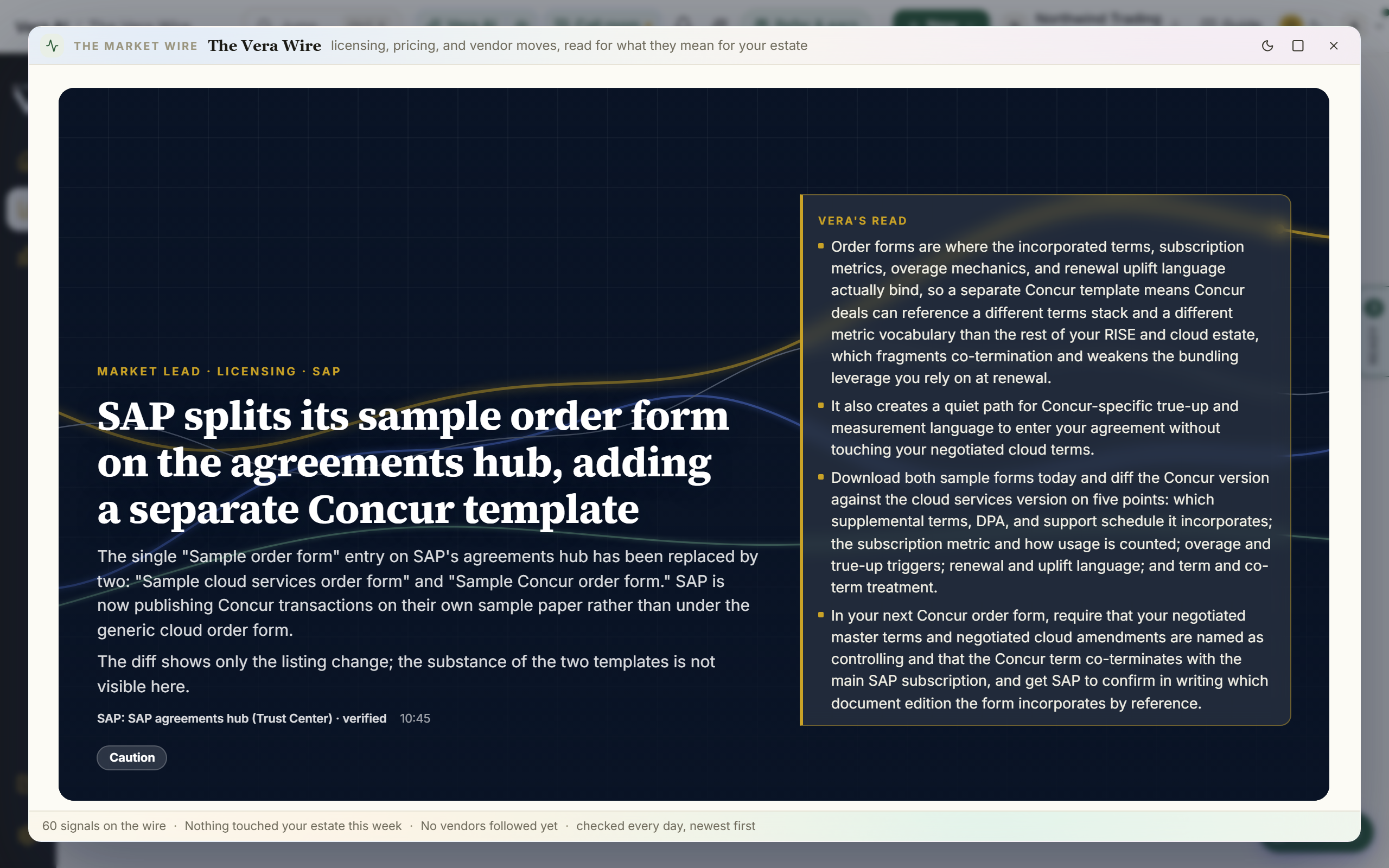
The Vera Wire
The always-on market news desk. Every licensing, pricing, and vendor move the platform tracks lands here in one feed, newest first, each item read for what it means for your estate. It writes itself: the wire aggregates Terms Watch price changes, the Price Index, newly published research, the weekly vendor report, and the Vendor Changes agent's document changes every day, so it stays current without anyone curating it. A condensed strip also rides on your dashboard under the Ask bar and on the welcome screen. Pressing the wire starts the app: it opens as its own window with nothing behind it, and Esc or Close returns you to Home.
On the screen
- The cover — the lead story of the day, with Vera's read on what to do about it and a chip counting the items that touch vendors you hold.
- Lenses — one tap filters the wire to Licensing, Pricing, Vendor news, or Research.
- My vendors only — a toggle that narrows the feed to vendors you hold a contract with.
- The feed — a dated timeline of every signal; a colored dot marks the category, a pill carries the verdict, Favorable, Caution, or Risk, and a chip marks your vendors.
- Vera's read — tap any item to expand Vera's read, set as short points rather than a paragraph: what changed, why it matters, and the move to make, grounded in your numbers.
- Your move — an item touching a vendor you hold ends with a Your move line: the vendor room, that vendor's benchmark, and Ask Vera seeded with the headline.
- The rail — price movers, Terms Watch changes, and newly published research, each linking to the source.
How to use it
- Read the cover story and Vera's read for the headline move of the day.
- Tap a lens to focus on Licensing, Pricing, Vendor news, or Research.
- Turn on My vendors only to narrow the wire to your own estate.
- Tap any item to expand Vera's read, then follow the source link for the detail.
Tips
- The strip on your dashboard and welcome screen shows the same lead and the next signals, so the headlines meet you before you open the full wire.
Related: Research Agent · Research · AI Agents - Vendor Changes
AI Agents - Vendor Changes
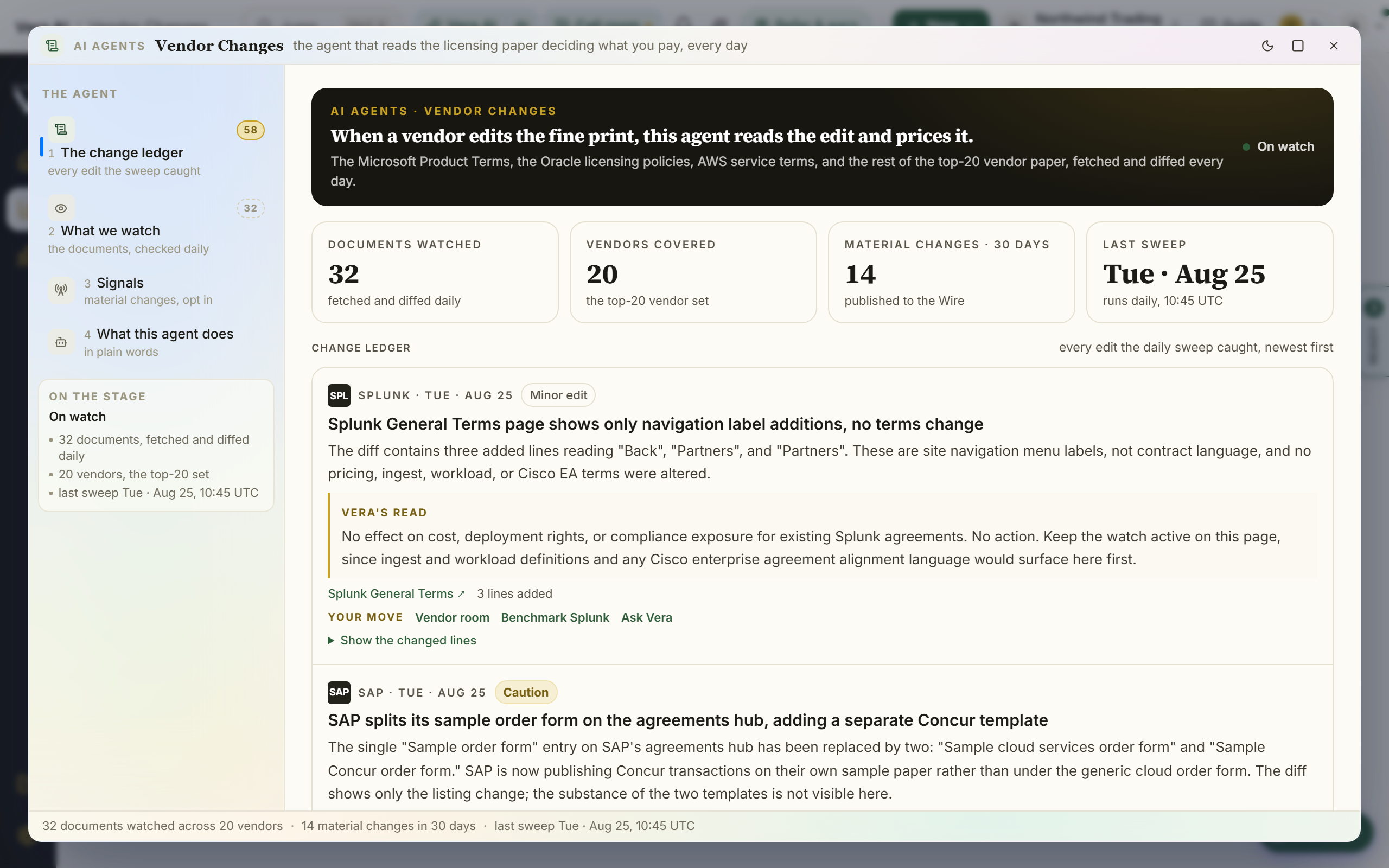
Vendors reprice you through their documents, not just their price lists. The Vendor Changes agent fetches the public licensing and cloud policy documents of the top-20 vendor set every day, 32 documents in all, and diffs each one against yesterday's copy: the Microsoft Product Terms and Universal License Terms, the Oracle partitioning, cloud licensing, support, and Java SE policies, AWS service terms, the Google Cloud terms, and the standing agreements of SAP, Salesforce, IBM, Adobe, ServiceNow, Workday, and their peers. Vendors publish on their own rhythm, Microsoft monthly on the first business day, AWS continuously, but the sweep runs daily because vendors do not always keep to their own calendar. When the fine print changes, the change is logged with the exact lines that moved and Vera's read on what it means, and material changes publish to The Vera Wire under the Licensing lens.
What you see
- The four rooms — the rail on the left walks the agent: The change ledger, What we watch, Signals, and What this agent does in plain words. On a phone the rail becomes a strip under the title bar.
- Vitals — documents watched, vendors covered, material changes in the last 30 days, and when the last daily sweep ran, at the top of the ledger room.
- Signals — the subscription panel, its own room (see below).
- Change ledger — every caught change, newest first: the headline, what changed in the document, a verdict pill, Favorable, Caution, or Risk, and Vera's read on why it matters and the move to make. Minor wording edits are kept in the ledger but marked and never sent to the Wire. Each change row ends with the same Your move trio the Wire carries, scoped to the change: the vendor room, that vendor's benchmark, and Ask Vera seeded with it.
- Show the changed lines — expand any change to see the exact lines added and removed, the evidence behind the read.
- What we watch — the full registry by vendor: each document with its type, why it matters to buyers, its known publication rhythm, when it was last checked, and a link to the live document at the vendor's site.
Signals: alerts per vendor or all
- Follow every tracked vendor with one switch, or pick vendors one by one with their bells.
- Choose your channels independently: Email me sends one exec brief email per sweep with the changes on your vendors and a one click unsubscribe that touches nothing else; Notify my dashboard lands each material change on your notification bell, tunable like every other alert kind in settings.
- Both channels are opt in and off by default, carry material changes only, and share one vendor list. Minor wording edits never alert.
How to use it
- Read the change ledger newest first; the vitals tell you in seconds whether anything moved since your last visit.
- On a change, read Vera's read, then expand Show the changed lines for the primary evidence, for example before raising it with your vendor rep.
- Follow your vendors with their bells and turn on the channel you want in Signals; from then on the fine print comes to you.
Tips
- Material changes also land on The Vera Wire, so you do not need to visit this page daily; with a subscription on, you do not need to visit it at all.
- A document shown as unreachable means the vendor moved or blocked the page on the last check; the platform keeps checking and the history stays intact.
Related: The Vera Wire · Watch · Research
Portfolio
*In plain words: the whole money story on one floor: position, spend, opportunities, the map, and the plan.*
When to reach for this
- The quarter's "where should effort go" question, answered by position rather than noise.
- Before leadership conversations: the masthead and the Estate map lens are the picture they want.
- Budget season: the Spend lens carries the trend, the forecast, and every finance export.
- Choosing the quarter's targets by money: the Opportunities lens ranks them.
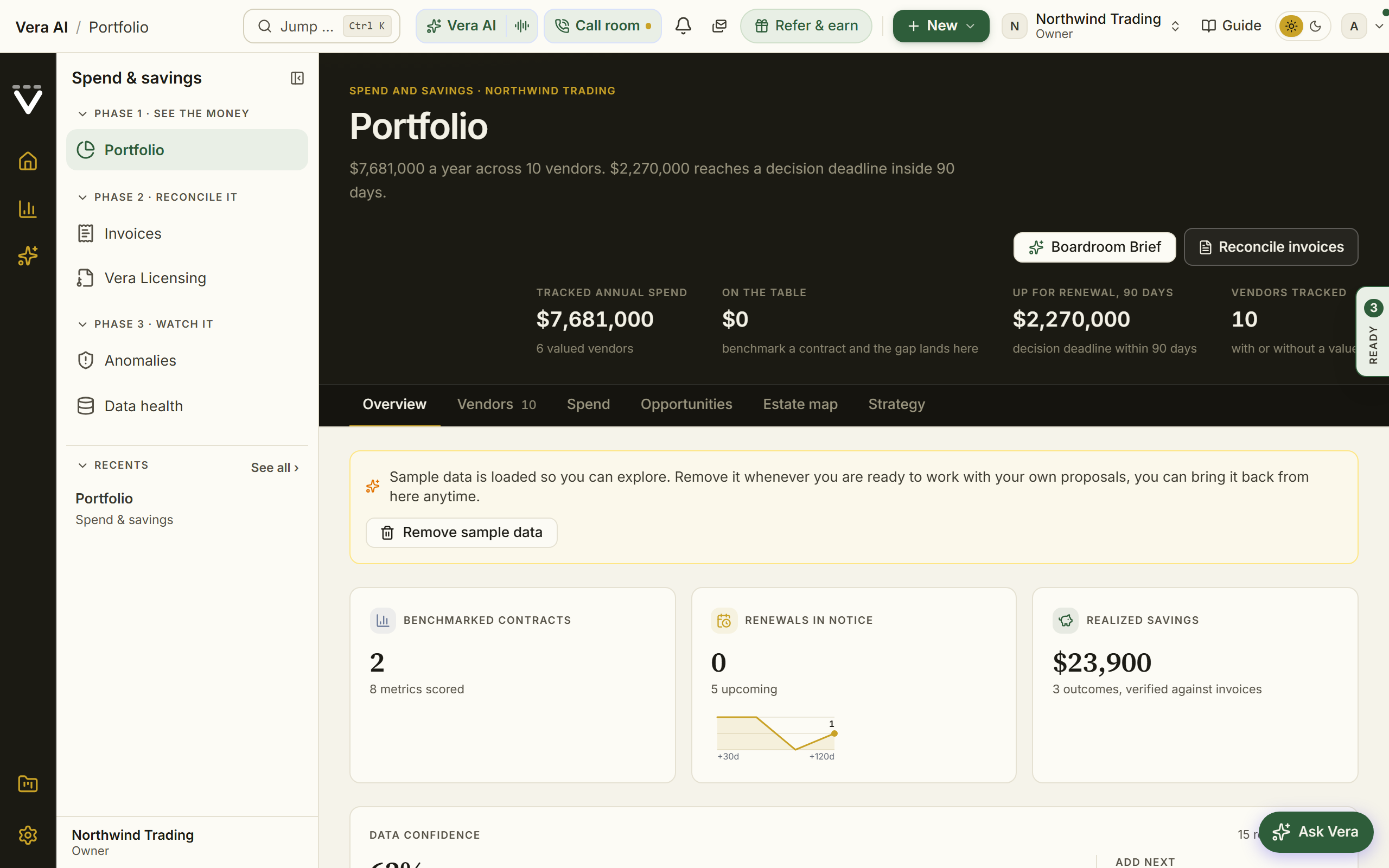
One page now carries what used to be five. Portfolio, Spend, Opportunities, the Estate map, and Strategy live here as lenses over one ledger: the navy masthead states the estate in figures, a tab rail switches the lens, and every chart lives on exactly one lens. Old links and bookmarks land on the matching lens automatically.
On the screen
- The masthead — tracked annual spend, the twelve month change, what is on the table, stated as the money and the vendors paying above market (or, when every benchmarked contract is already at or above market, saying so rather than showing a blank), renewal exposure in the next ninety days, and realized savings, with the lens rail beneath.
- Overview — the estate read: vendor concentration with the top three share, market position across your scored metrics, the data confidence meter naming the three highest impact fields to add next, upcoming renewal windows, and realized savings verified against invoices.
- The what-if instrument — on the Overview lens, on every plan: two levers, the annual uplift you hold vendors to and the discount you win, over the agreements reaching a decision inside ninety days. Drag either and the kept-over-three-years figure moves with it, computed on your own figures, so the same inputs always draw the same result. The page closes with a What next module: the opportunity queue, the renewal calendar, or recording a saving.
- Vendors — every vendor on one ledger: annual value, share of estate, market position, contracts held, and the money on the table per vendor. Rows open the vendor's own page.
- Spend — the finance lens: tracked spend over time, spend by category, the twelve month budget forecast with renewal months priced in, paid versus contracted from your invoices, and every estate export (Excel, PDF, and the raw CSVs) in one card.
- Opportunities — the ranked savings queue with its reasoning, the live tier for deadlines inside thirty days, cross vendor leverage windows, and the utilization radar for seats nobody uses.
- Estate map — the whole estate as one canvas, sized by spend and colored by market position, with the verdict chips and the slide export for the board deck.
- Strategy — the board ready annual read: state of the stack, category strategies with lock-in, and the sequenced plan, exportable as a Word brief or a board deck.
How to use it
- Read the masthead, then the Overview lens: the concentration and position instruments say where effort should go.
- Work the Vendors ledger top down; the on the table column is the queue in dollar order.
- Before a budget conversation, open Spend for the forecast and the exports; before a board conversation, export the Estate map slide and the Strategy brief.
- Turn an opportunity into a tracked negotiation from the Opportunities lens while its window is open.
Tips
- The richer your annual values, the sharper every lens. The data confidence meter names exactly what to add next.
- Old bookmarks to Spend, Opportunities, the Estate map, and Strategy redirect here, onto the matching lens.
Related: Invoices · Agreements · Renewals
Monthly briefing
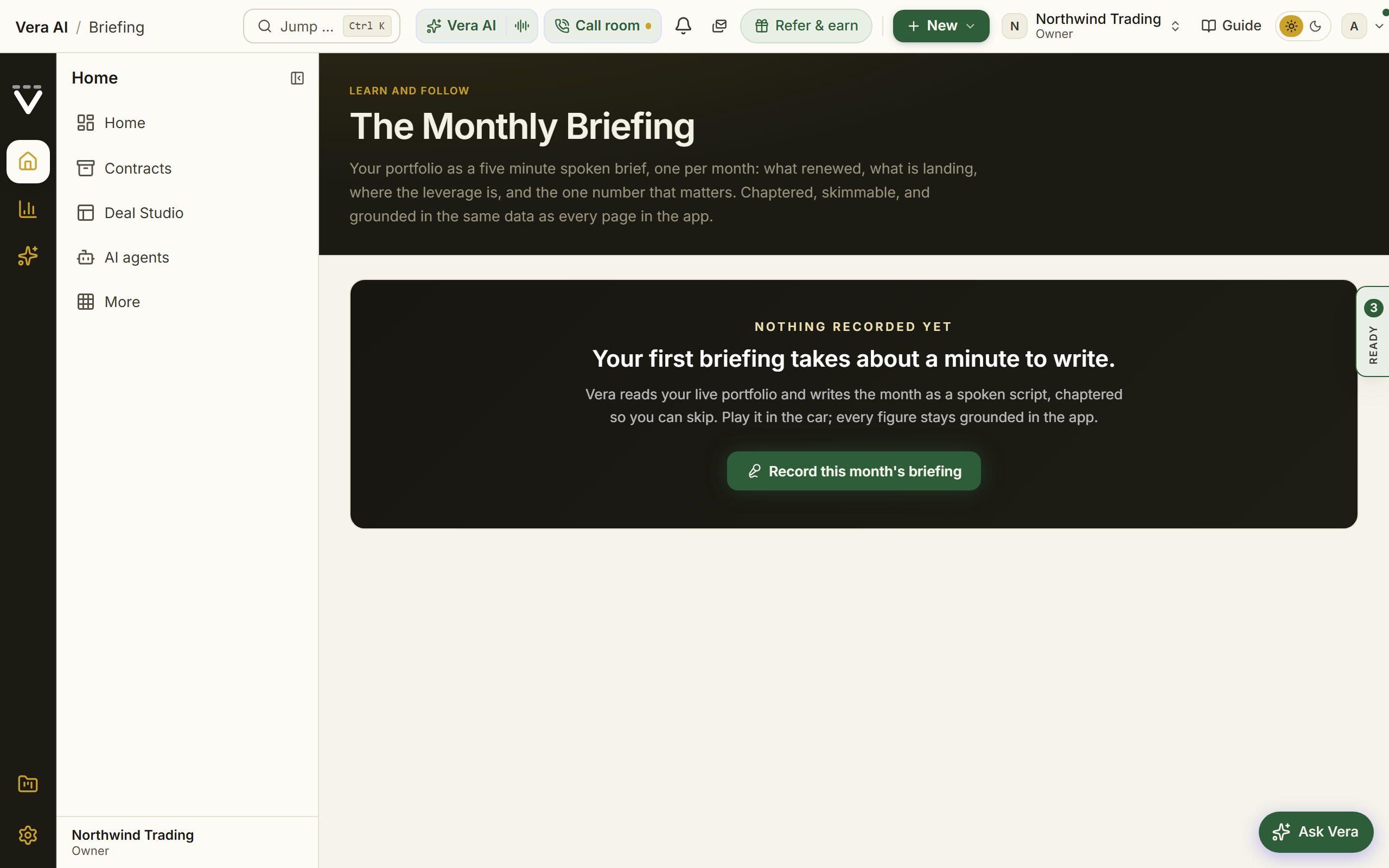
Your portfolio as a five minute spoken brief, one per month: what renewed, what is landing, where the leverage is, and the one number that matters. Chaptered, skimmable, and grounded in the same data as every page in the app. Restored in August 2026: the agent records on the 2nd of each month, and the page holds the latest recording.
*In plain words: the month, spoken, in five minutes.*
When to reach for this
- The commute, the treadmill, the five minutes before the leadership call.
- The monthly cadence between quarterly board packs.
On the screen
- Player — the current month's brief, split into chapters so you can jump to the part you want.
- Open the workroom — a band above the player lays the current briefing out as a five paper workroom: the month at a glance, every chapter as a timed ledger, the full script verbatim, a provenance sheet, and a What now sheet. ⚡ What now plays the recording, re-records it with today's numbers when AI is enabled, forwards the briefing to a colleague as a drafted note, copies a chat ready summary or the full transcript, and follows where the script points into your renewals, the market wire, or your dashboard. ✦ Ask Vera answers from the briefing's own script.
- Generate — builds this month's briefing from your live portfolio when one is not already waiting. Before the first recording exists the page says so plainly and offers the one press that writes it, which takes about a minute.
- Transcript — the full script under the player, set at a reading line length rather than the width of the window, so you can read the month instead of listening to it.
How to use it
- Open the Monthly briefing from the Agent Center's wire and press play, or generate the current month if the player is empty.
- Skip between chapters to reach renewals, spend, or leverage directly.
Related: Portfolio · Your AI agents
Anomalies
You no longer wait a week for your first findings: Run the scan on the page scans your portfolio now. Every finding can also be closed out: Resolve files an optional recovered annual amount, moves the finding to a Resolved section, and closes any linked task, and the verdict band totals recovered dollars against dollars at risk. Billed-above-contract, unused-seat, and no-uplift-cap findings also offer Draft the fix, a copy-only letter built from the finding's stored facts; nothing sends from the platform.
What the watchdog found while scanning your portfolio: unusual uplifts, missed notice windows about to bite, duplicated spend, and other things worth a look. It runs itself every week, and you can run it here whenever you like.
*In plain words: the sweep's findings: what looks wrong in your portfolio, worth a human look.*
When to reach for this
- The weekly glance: findings arrive scored, not alphabetized.
- Straight after an upload: run the scan and see what the new paper changes, rather than waiting for Monday.
- An uplift breach like the sample Northwind case (a 14 percent ask against a 7 percent cap) is exactly what lands here.
- Before renewing anything: check whether the watchdog already flagged the vendor.
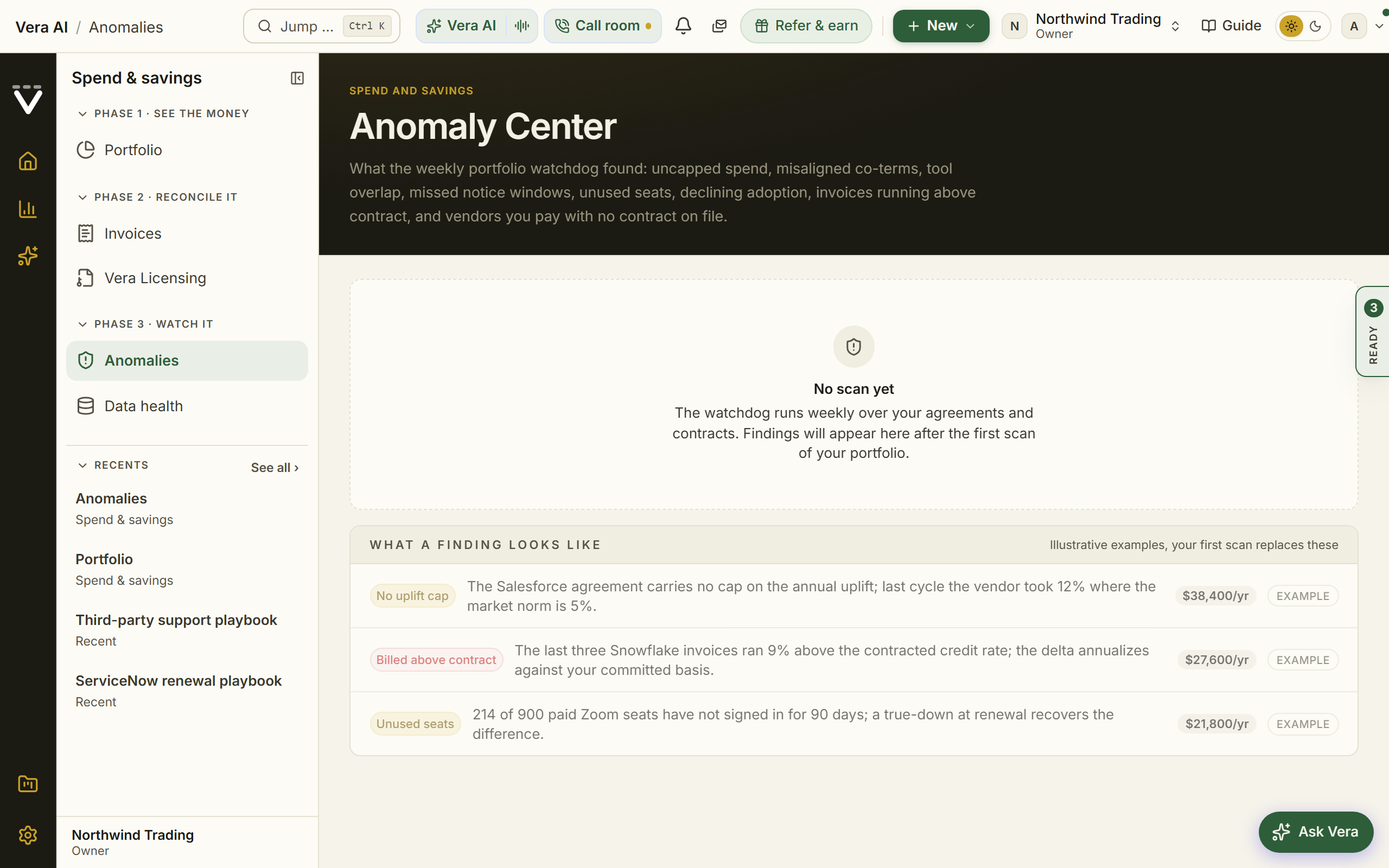
On the screen
- Vitals — what the open findings put at risk each year, how many are open, and how many carry an AI verification.
- Run the scan — runs the watchdog over your portfolio now. It is the primary action on the empty state before your first scan, and a quiet control beside the verdict band once findings exist. It is the same scan the weekly pass runs, the same feeds and the same AI triage against your own clauses and billing evidence, so it never returns a thinner answer than waiting would have. Owners and analysts can run it; approver and viewer seats see the findings without the control.
- Findings list — each anomaly with its severity and the evidence behind it.
- What a finding looks like — before your first scan, three worked examples of the kinds of finding the watchdog raises, marked as illustrative. Your first scan replaces them.
- Triage controls — mark a finding resolved or not relevant; the watchdog will not raise it again.
How to use it
- Press Run the scan now if the page is empty or you have added paper since the last pass.
- Open a finding and check the evidence.
- Act on it, then resolve or dismiss findings you have handled.
Tips
- Running the scan yourself emails nobody and pings nobody. You are looking at the findings already, and anything it turns up is still raised to whoever asked to be told on the next weekly pass, so pressing the button costs your team nothing it would otherwise have heard.
- The scan is limited to four runs an hour per organization. With no agreements or contracts on file yet, the page points you at the uploader instead: there is nothing to read until there is paper.
Related: Billing watch · Invoices
Vera Licensing
The area your license reports land in. A license management tool pushes a report over the API, a connected SAM source syncs or imports one, or you upload a CSV export by hand; every arrival files into the ledger with its rows and a computed summary, updates your live license position, and can be read by Vera as an exec brief.
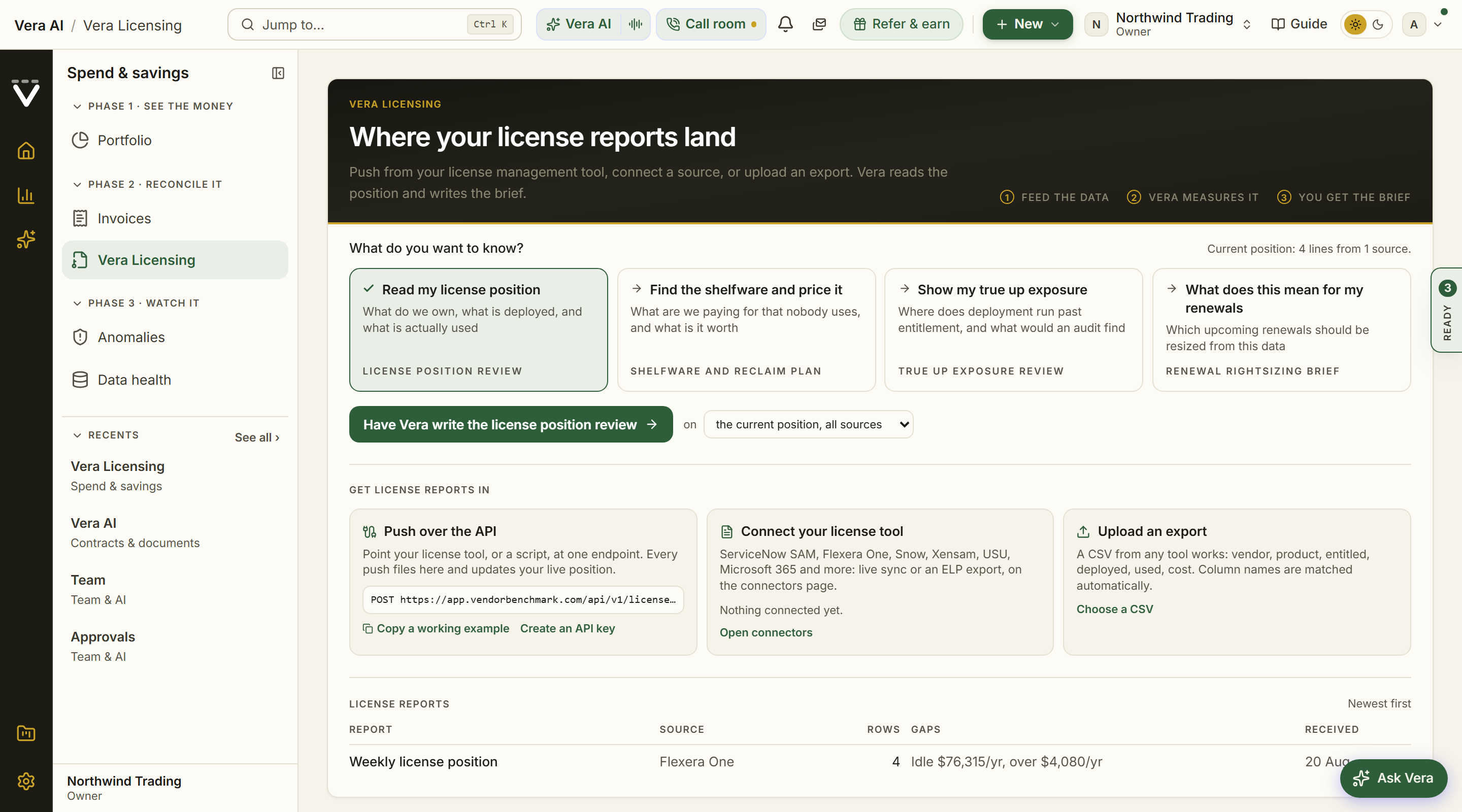
On the screen
- The reads — four requests in buyer words: Read my license position (what you own, what is deployed, what is used, vendor by vendor), Find the shelfware and price it (a reclaim ladder ordered by money), Show my true up exposure (every line deployed past entitlement, priced, with the fix for each), and What does this mean for my renewals (real usage joined to your tracked contracts, with the resize ask per upcoming renewal). Pick a read, choose the scope, press run; the brief takes a few minutes and opens by itself, and you can leave the page while it writes.
- The scope picker — a read runs on the current position (every source combined) or on exactly one report's snapshot, chosen next to the run button.
- Push over the API — the endpoint your license tool posts to, with a working example to copy. Keys are created by an owner at Settings › API access; pushes are limited to 12 per hour per key and 5,000 rows per report.
- Connect your license tool — opens the connectors page: ServiceNow SAM, Flexera One, Snow, Xensam, USU, Microsoft 365, Oracle LMS worksheets, cloud billing and more, as a live sync or a file import. Connector syncs and imports file into this ledger automatically.
- Upload an export — a CSV from any tool works: vendor, product, entitled, deployed, used, cost. Column names are matched automatically, commas or semicolons, up to 5,000 rows and 5 MB.
- License reports — the ledger, newest first: the report, its source, its row count, the idle and over-entitlement gaps (in USD per year where the source stated unit costs, in license counts where it did not), and when it arrived. Open a report to see every row with a position pill per line (Idle, Over by N, or Balanced), run the four reads on that exact snapshot, or delete it. Deleting a report removes the snapshot only; the live license position keeps its current state. Finished licensing briefs file into your reports like every other Vera read.
How to use it
- Feed it once: upload a CSV export from your license tool, or connect the tool on the connectors page, or hand the API card to whoever runs your SAM platform.
- Open the report when it lands and scan the position pills: brick rows are deployment past entitlement, the audit side; gold rows are licenses bought and idle, the savings side.
- Run Read my license position first. It states the whole estate in one document and tells you which of the other reads matters most.
- Before a renewal, run What does this mean for my renewals: it joins the usage numbers to your tracked contracts and writes the resize ask per vendor.
- Schedule the push from your tool weekly. Every push updates the live position, so shelfware analysis, audit exposure, and vendor pages stay current without anyone exporting anything.
Every figure in a licensing brief is computed from the rows your source sent, converted to USD at the current rate; where the source priced nothing, the brief says so and names what to ask your tool for rather than inventing a rate. A pushed report also raises the license_report.received webhook event for your connected channels.
Related: Integrations · API · Portfolio · Data health
Invoices
Invoice line-item intelligence: what the vendor actually billed, reconciled line by line against what you contracted. Every line gets a verdict with the dollars at stake.
*In plain words: every invoice line checked against the contract, with the overbilling priced.*
When to reach for this
- Standing hygiene: set the forward-in address once and every invoice checks itself (the dispute recipe).
- A bill feels wrong: the line verdicts replace the feeling with a figure.
- After a price-list move: whether your invoices already reflect it is a fact, not a worry.
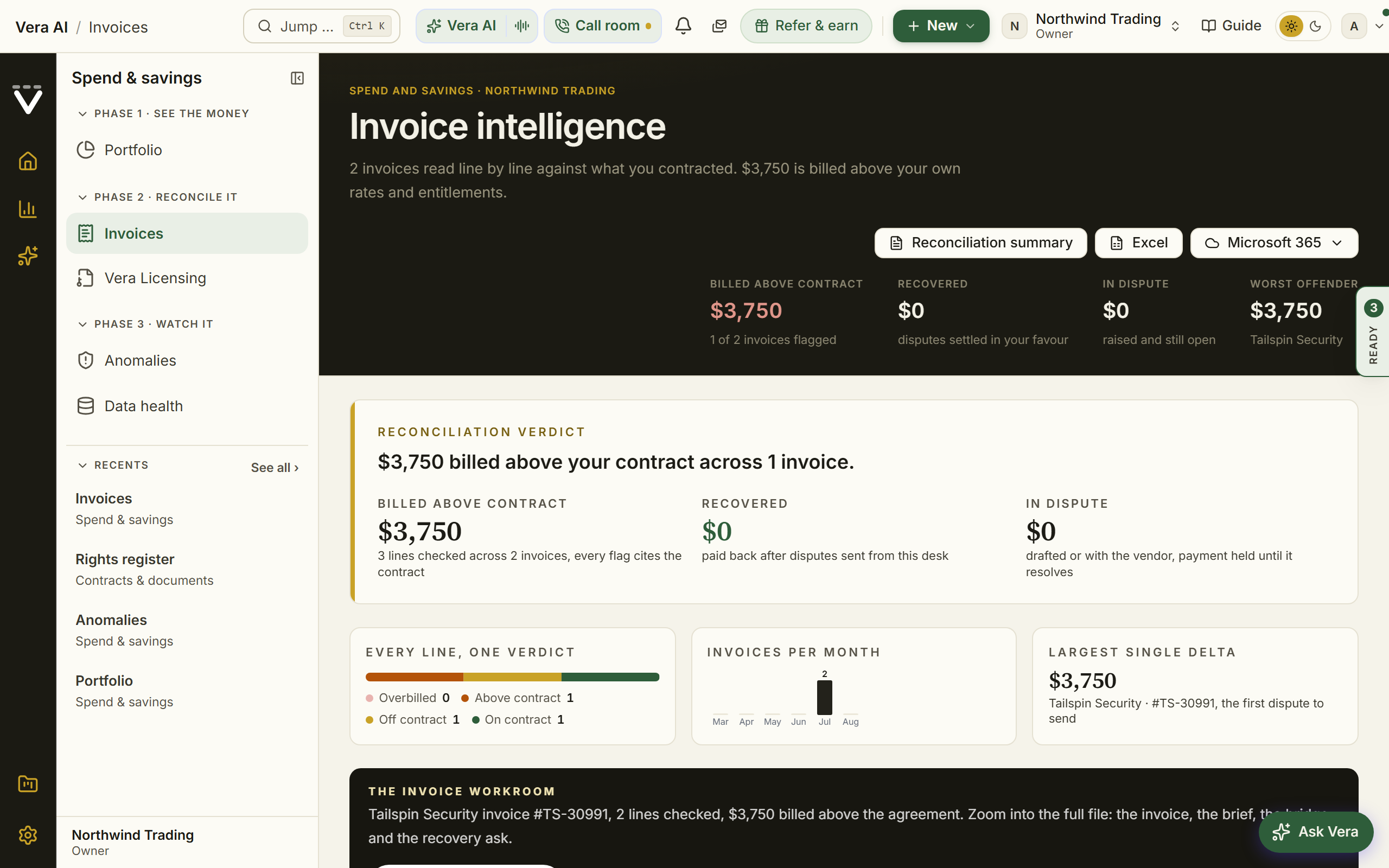
On the screen
- Vitals — what has been billed above contract, what you have recovered, what is in dispute, and the worst offender by dollars.
- Line verdicts — per line: ok, price above contract, billed over entitlement, off-contract item, uplift-cap breach, or above MSA rate card (a consulting line billed higher than the rate on your saved MSA rate card; see Rate Card Benchmark).
- Open the workroom — once findings exist, a band above the invoice list opens the analyzed invoice with the most at stake as a six document workroom: the parsed invoice with every flag marked, an overbilling brief, the recovery bridge, the itemized recovery sheet, and a What now sheet. ⚡ What now drafts the vendor dispute letter and the AP payment hold note from the invoice's own lines, files the dispute on this page's own desk in one click (reporting the real outcome rather than a generic line), copies the dispute summary, opens the agreement the invoice bills against, and opens a negotiation dossier. ✦ Ask Vera answers from this invoice's own line items and the contract terms they should have matched. Every figure is read from the stored invoice lines.
- File as verified saving — on a dispute resolved with money recovered, one press writes the recovered amount to your savings record with the invoice number in the note; the recovery counts into Portfolio's realized savings. It is counted once, as a one-time recovery, never multiplied across a term, so a recovery does not inflate your annual savings figure. The card then reads On the savings ledger.
- Forward-in address — connect the invoice rail to get a private email address; invoices forwarded there are processed automatically.
How to use it
- Upload an invoice, or set up email-in so they process automatically.
- Work the lines flagged above contract or over entitlement, dollars first.
- When a dispute is resolved with money back, file it as a verified saving so the recovery joins the proof ledger.
Tips
- Setting up the forward-in address is an owner action under Settings › Integrations.
Related: Billing watch · Anomalies
Vendor calendar
The timing desk, as its own application window: the fiscal year ends and quarter closes of the top 40 software vendors, read against your own notice deadlines. A vendor's quarter close is the one date their side cannot move, so this is when to time your asks. It opens over whatever you were doing, and Close returns you to Home.
*In plain words: when each vendor's quarter closes, so your ask lands when their discount authority peaks.*
When to reach for this
- Booking the vendor conversation: their calendar, not yours, decides the good weeks.
- The annual plan (the strategy recipe): quarter ends layered against your notice windows.
- A stalled deal: sometimes the fix is waiting three weeks for their quarter to squeeze them.
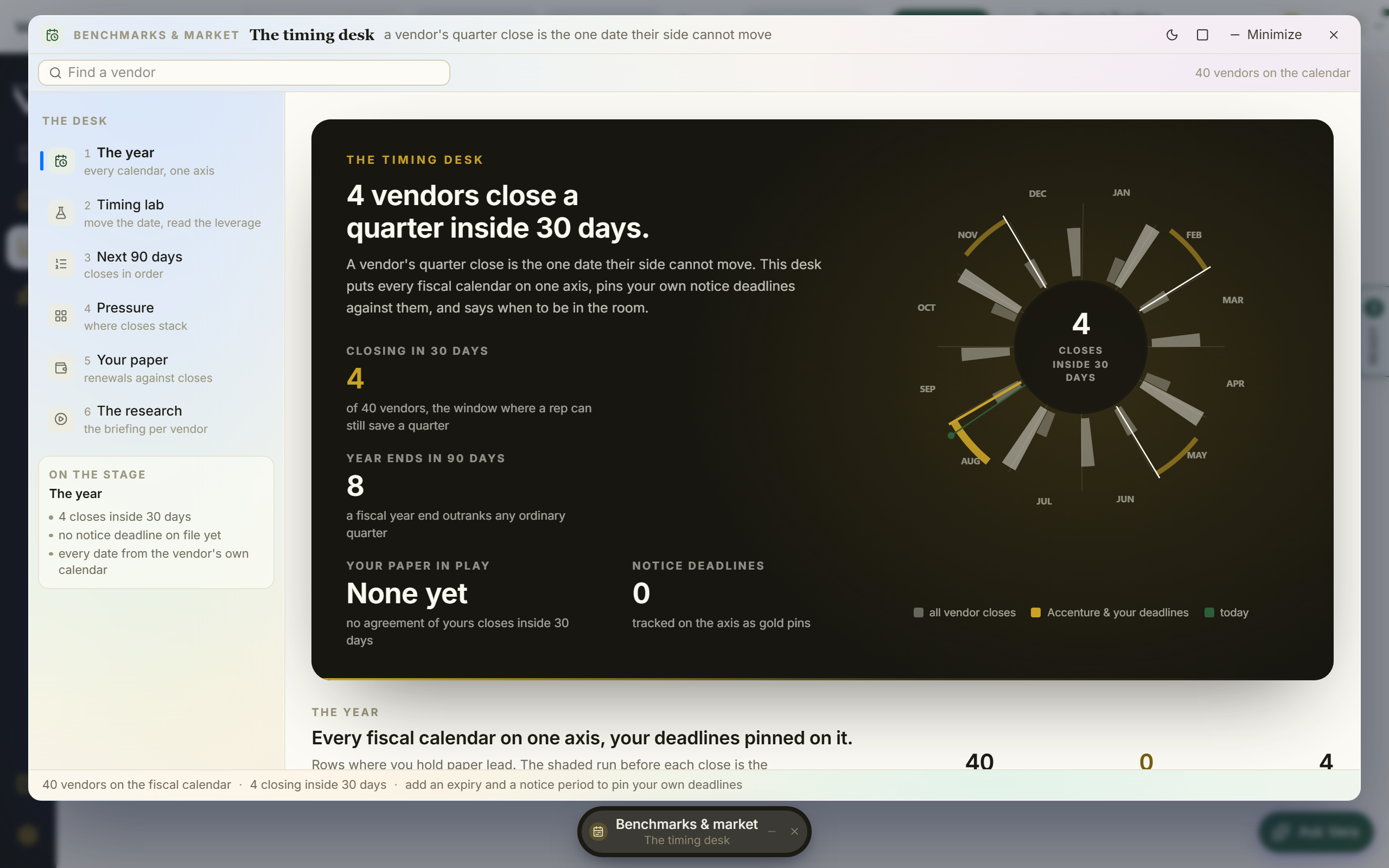
On the screen
- The rooms rail — six rooms, and the number beside a room is its keyboard shortcut: The year, Timing lab, Next 90 days, Pressure, Your paper, and The research. Search in the command bar finds a vendor from any room.
- The stage and the year wheel — how many vendors close a quarter inside 30 days, how many fiscal year ends fall inside 90, what your own paper with those vendors is worth a year, and how many of your notice deadlines are tracked. The wheel beside it is the calendar year as a ring: every vendor's closes as a radial histogram, the selected vendor's own closes and their leverage runs in gold, your deadlines as pins, and a hand on today.
- The year — every fiscal calendar on one axis, vendors you hold paper with leading. The shaded run before each close is the leverage window, the three weeks when a quarter still has room to be saved. Click any vendor row and their dossier opens above the axis.
- The vendor dossier — their fiscal profile, what closes next and in how many days, your annual value with them, and the analyst briefing we publish on that vendor, played in place with its chapter marks. Click a chapter and the film seeks to it.
- Timing lab — move your signature date and the reading moves with it: which close you land before, how many days out, and the point band that timing is usually worth. Where you hold paper with that vendor, the band is priced against your own annual value. Four buttons jump to the windows of their year, and a strip reads the same date across every vendor you hold paper with, because one date rarely suits everything.
- Next 90 days — every close in the window on one ribbon, year ends and your own vendors picked out, then each close in order with what to do about it and its briefing offered inline.
- Pressure — the twelve months ahead as stacked bars with your notice deadlines counted per month, then every vendor against every month as a grid, ordered by fiscal year end so the quarterly cascade falls as a diagonal.
- Your paper — the alignment chart: each renewal's notice deadline against that vendor's own closes on one shared twelve month axis, with the gap between them drawn and coloured by whether it lands inside a window. Under it, what better timing would be worth on the value not already aligned, and the shortest moves that would buy the most.
- The research — every analyst briefing whose vendor is on your calendar, ordered by whose quarter closes first.
How to use it
- Read the stage: it says how many vendors are inside a window right now.
- Open Your paper to see which of your renewals are well timed and which sit on no clock of theirs.
- Take a renewal into the Timing lab, move the date toward the shaded run before a close, and read what the timing is worth on your own value.
- Watch that vendor's briefing before the call: it is in their dossier and in The research.
A note on the figures. Every date comes from the vendor's own published fiscal calendar. The point bands are what buyers report from closing inside a window, applied to a figure of yours; they are a size, not a quote, and the panel says so.
Related: Renewals · Agreements
Document Agent
The document search application: ask a question in plain language across every contract and document you have stored, and the answer comes back as a finding. The verdict is one sentence you could forward, under it a ledger with one row per paper, and beside it the clause that row rests on. Any answer becomes a short executive brief and sends to a colleague from the same window.
*In plain words: ask your documents a question, get a verdict and a table with the clauses attached, send the finding as a brief.*
When to reach for this
- "What did we agree about termination with this vendor?" answered by the paper itself.
- A dispute needs the exact language: the clause, quoted and cited, beats a recollection.
- One question answered per contract in a grid belongs in Review tables instead.
It opens as its own application. However you reach it, a rail door, More, the palette, a bookmark, a typed address or a link a colleague sent you, Document Agent draws its own Mica window and nothing loads behind it, exactly as the Negotiation and Contract Readers do. Closing the window returns you to Home. Three rooms sit on keys 1 to 3: Search, Library, and The brief.
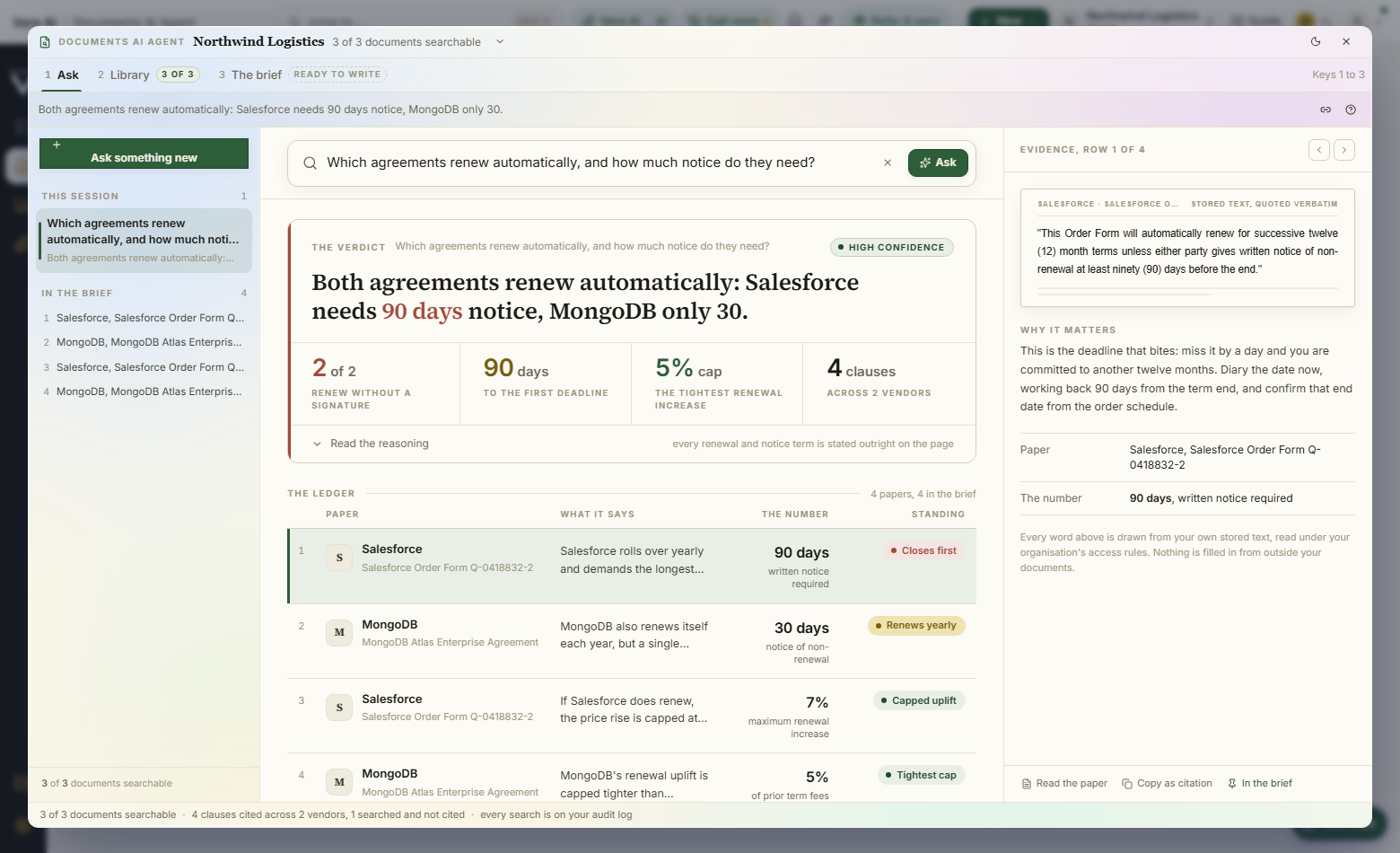
On the screen
- The titlebar — the workspace name, how much of the estate is searchable, your recent questions behind the chevron, and the light or dark switch for the window.
- Ask, room 1 — the question box takes plain language and stays above the answer; press / anywhere to focus it. While the finding is written the room holds nothing but the wait: your question set at reading size in the middle of it, the three stages lighting in order as each one starts, and a bar that measures the ten seconds, so waiting is measured rather than mute.
- When nothing is searchable yet — the room says which of the two reasons it is, rather than drawing an empty ledger. With no documents at all it offers upload your first contract; with documents on file that have not been read, it says how many are waiting and offers read the waiting documents there and then, about eight a round. Either way it also offers show me a worked example. The example is a finding over five sample papers held only in your browser: nothing is uploaded, nothing is written to your workspace, and every door that would write (diarise, draft, watch, share, the brief) says so and refuses. Everything you can read works, so you can press a row, drag the deadline line and compare two clauses before you own a single document.
- How a clause gets found — two passes run over your documents at once: one on the words you typed and one on what you meant, so asking to walk away early reaches termination for convenience even though the paper never uses those words. The two sets of results are merged by rank rather than one being appended to the other, so a clause both passes found comes above one only a single pass liked. That is what stops a wordy recital repeating your words from outranking the clause that actually answers. A last pass then reads the shortlist again with your question in hand, which is what separates two clauses that both discuss termination when only one of them carries the notice period you asked about.
- The session rail — on the left: Ask something new, this session's questions each with its verdict beneath it, one press to run any again, and the clauses currently kept for the brief, one press to jump to the row. The foot counts the index and opens the Library when documents are waiting.
- The verdict — one sentence at the top, the size of a headline, with the figure or date in it picked out. Under it a row of figures: how many papers renew without a signature, how long until the first deadline, how many clauses the answer rests on, and what is still exitable. Those figures are what a paragraph used to carry, and they read in a second. A confidence chip says how far to trust it and why, for example partial because one paper's termination section is cut off, and the reasoning itself sits under Read the reasoning for when you want it.
- The ledger — one row per paper: what it says in plain words, the one number that matters, and whether the clause is fine, needs a diary entry, costs money, or could not be read in full. Press a row and the clause appears in the pane on the right. In or Left out chooses which clauses the brief will carry.
- The clause, beside the claim — the pane on the right sets the selected clause as a piece of the paper it came from, with its running header and the note that the text is your own, quoted verbatim. Why it matters sits directly beneath the clipping, and the paper's facts beneath that. At the foot: Read the paper opens the document in the Reader, Copy as citation takes the quote with its source.
- When two of your papers disagree — if an order form and its master set different terms for the same thing, the finding says so in its own block, names which one governs, and states what that changes for you.
- What we could not confirm — when a clause is cut off or a page could not be read, the finding names it rather than passing over it, so silence is never mistaken for a clean answer.
- The deadline line — when the answer finds agreements that renew without a signature, their deadlines sit along a date line in order. Drag the day you would realistically decide and each paper is checked against the notice period in its own clause, counted back from the term end on your contract: the ones behind the handle strike through, and the count above drops with the money they were worth.
- Searched and not cited — every searchable document this answer does not rest on, by name, so you can see the reach of the search rather than take it on trust.
- Library, room 2 — every PDF and Word file on one shelf with how well it was read: Read whole, Read thin when almost no text came out of the file, which is what a scan with no text layer looks like, or Waiting for its read with a one-press Read the waiting documents now. A thin document answers quietly rather than not at all, so it is worth opening by eye before you rely on it.
- The brief, room 3 — the latest answer written up to the house report standard on one editorial sheet: the masthead and standfirst, four figures across the top (clauses cited, vendors, documents searched, recommendations), the sections, the clauses quoted, what to do about it, and the bottom line. Write the brief is a press, about twenty seconds, and every line is grounded in the quoted clauses.
- Send the brief — a colleague's email and an optional line for the top. They receive the executive brief email, the question, the answer and the clauses quoted, with a link that reruns the search here; the link needs a VendorBenchmark login with access to this workspace, and the quoted evidence travels in the email itself. Every send lands on the org audit log, and the sheet's pill turns from Draft to Sent.
- The window's memory — the question, the answer, the chosen clauses and the brief hold in the window's memory. Closing and coming back finds the work where it stood, and a return visit is asked once whether to continue or start new.
How to use it
- Ask a question like which agreements renew automatically, or press a Try chip and let it run.
- Read the verdict, then walk the ledger with j and k: the clause behind each row appears on the right as you go.
- Where the answer finds a renewal deadline, drag the deadline line to the day you would decide and watch which exits close.
- Leave out any clause the brief should not carry with Left out, then press Write the brief.
- Read the sheet in room 3, then send it: a colleague's email, an optional line for the top, Send the brief.
- Press 2 for the Library when anything is waiting for its read, or when a document came back thin.
Keys: 1 2 3 the rooms, / the question box, j and k down and up the ledger, Enter the paper behind the selected row, c copy the clause as a citation, p keep it in the brief or leave it out, ? the full list.
Related: Document clusters · Rights register
Document clusters
The survey bench now says when the map is stale: documents added since the last grouping show as a badge with the count, and the newer documents are named as not yet in any group, with the Re-group control beside it. Nothing regroups without your press.
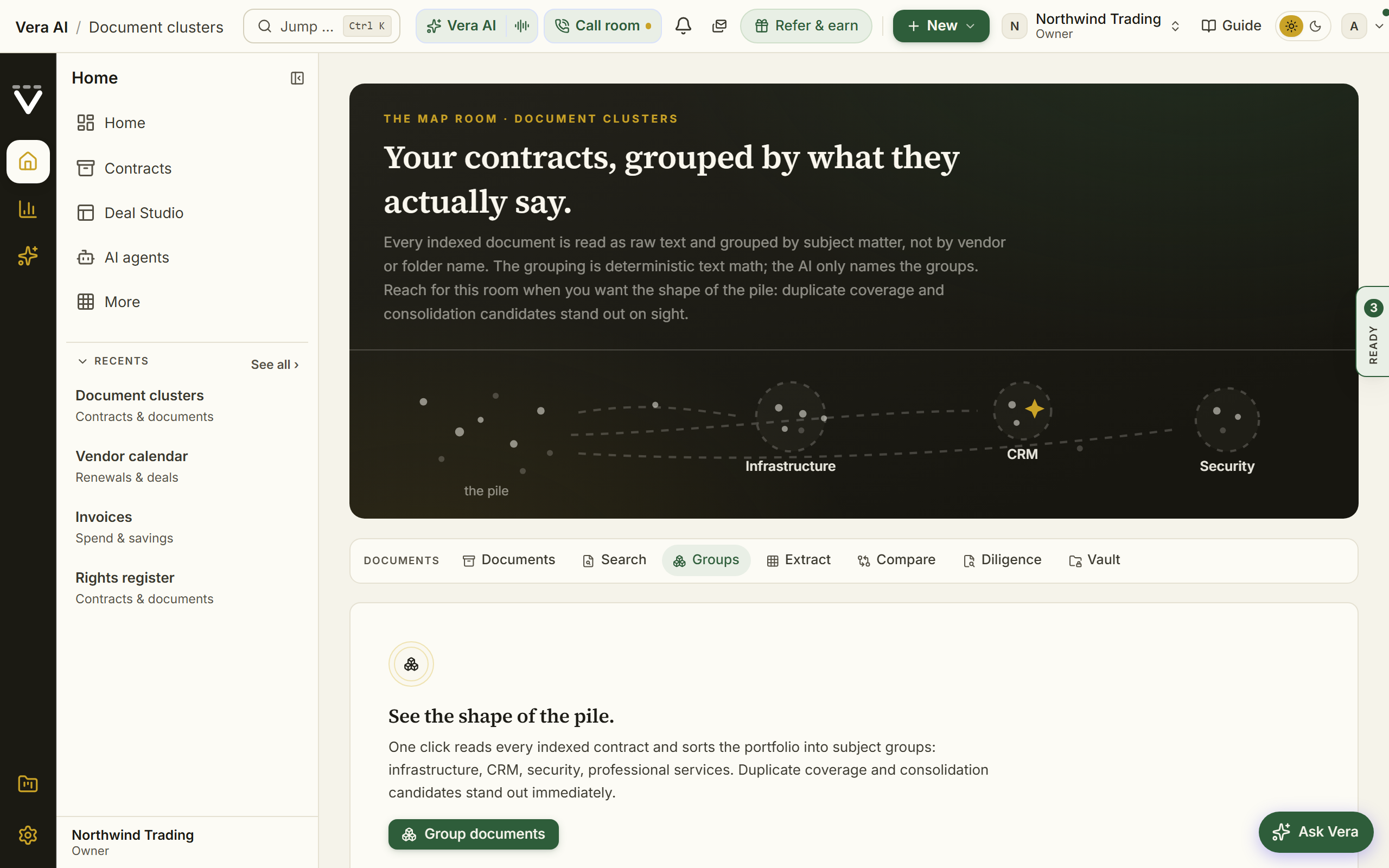
Your contracts grouped automatically by what the documents actually say, subject matter rather than folder names. The grouping is deterministic text math; the AI only names the groups.
On the screen
- Cluster cards — each group with its AI-written name and the documents inside it.
- What next — under the map, the next moves: price the overlap in the IT spend optimizer, open the ranked opportunities, or ask Vera where the biggest cluster can collapse first.
How to use it
- Run or refresh the clustering.
- Open a document from its group.
Related: Document Agent
Review tables
Ask the same questions across many contracts at once. Each column is one question (termination notice, renewal cap, liability cap) and the AI fills in a quote-backed answer for every document.
*In plain words: one question per column, a quote-backed answer per contract, exportable.*
When to reach for this
- The estate-wide questions ("who has an uplift cap?", "what are our notice periods?") that would otherwise take a week of rereading.
- Diligence and audits: the answer grid is the evidence table, to Excel in one click.
- Anything the Coverage sweep does not already ask; coverage is your standard, this is your bespoke question.
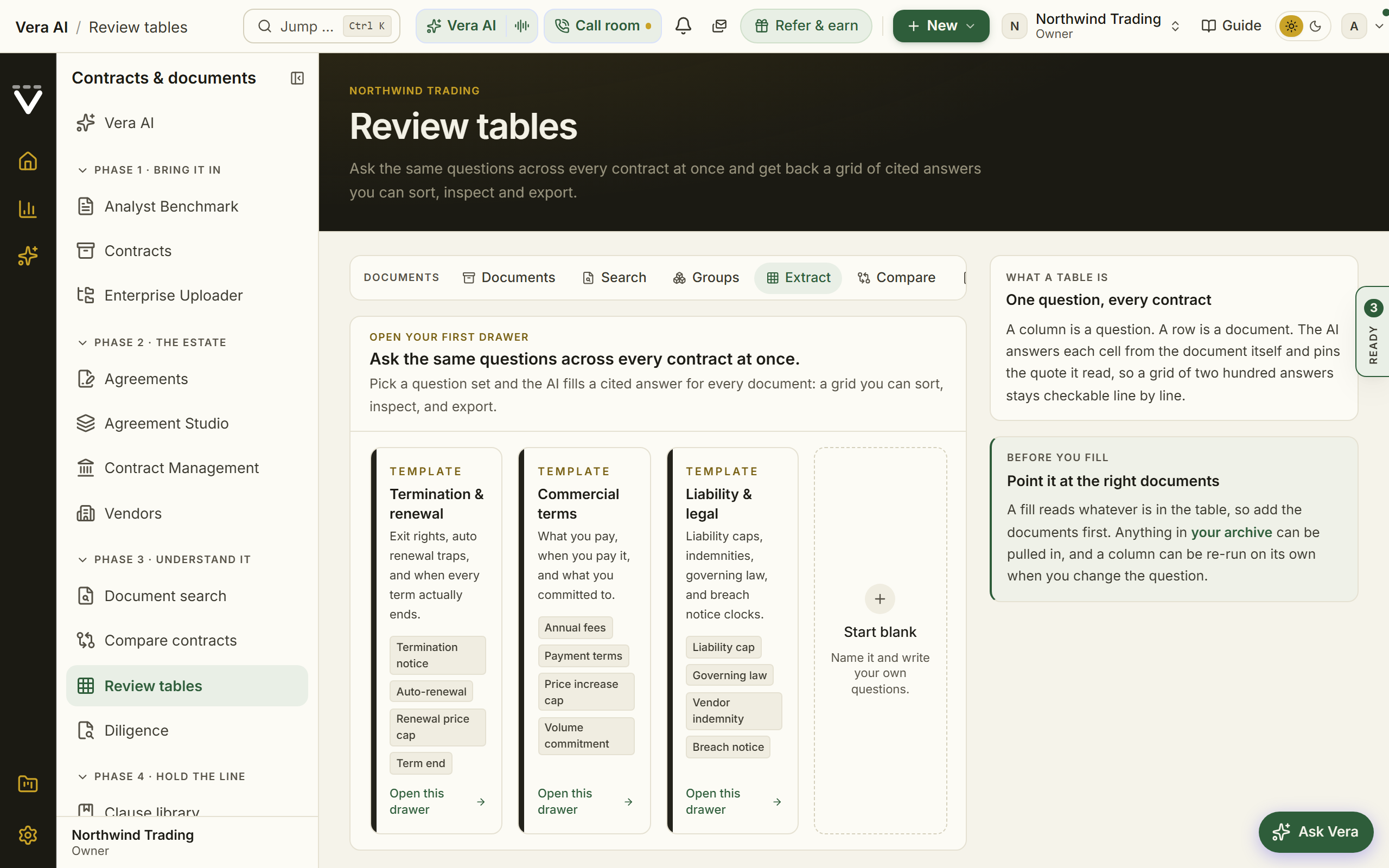
On the screen
- The drawer — the masthead states how many tables you hold, how many documents they cover, how many answers are extracted, and what share of every cell is filled.
- In the drawer — each table as a card with a live mini grid of its answers and a fill ring, opened with one click.
- Columns — your questions. Start from a template or add your own, up to twelve.
- Fill table — extracts every missing answer, a few documents at a time, with the supporting clause behind each cell.
- Export — the whole grid as an Excel workbook, quotes included.
- What next — once answers land, the grid ends with its next moves: export it for the deal file, fix a weak answer with preferred language from the clause library, start a negotiation, or ask Vera which answers should worry you most.
How to use it
- Create a table from the Termination & renewal template, or add your own columns.
- Fill the table, then click a filled cell to see the exact clause it came from.
Related: Document Agent · Clause library
Data health
What the platform cannot see for your organization and what filling each gap unlocks. The scan runs on every load; a prioritized plan tells you which gap to close first.
*In plain words: what the platform cannot see yet, ranked by what seeing it would unlock.*
When to reach for this
- The migration finish line (Chapter 18): "done" is a score here, not a feeling.
- Before an audit: the exposure estimate says how defensible the entitlement picture is today.
- Monthly: one closed gap a month compounds faster than any single feature.
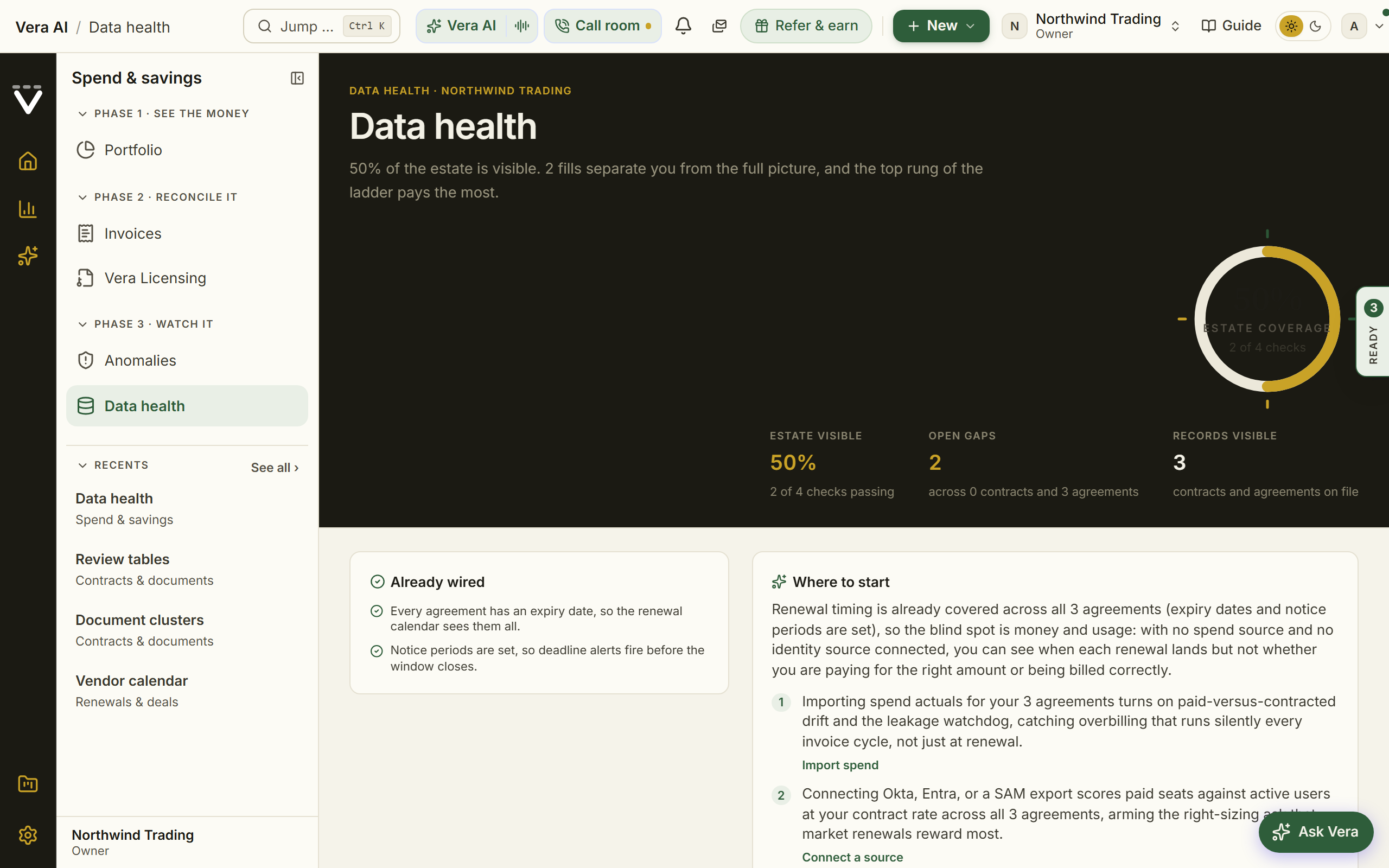
On the screen
- Vitals — how much of your estate the platform can see, how many gaps are open, how many records are visible, and your audit exposure.
- Completeness score — the share of data checks you have covered. Each open gap names the feature it would unlock.
- Audit exposure — an estimate of your license compliance exposure, built from the entitlement data connected so far.
- AI plan — the gaps ranked by value, refreshed whenever the underlying gaps change.
How to use it
- Close the highest-value gap first.
- Connect a data source to fill the entitlement gaps (an owner action under Settings › Integrations).
Related: Integrations
Next: Chapter 05 · Team, AI & assistant
Was this page helpful?
Thank you. Your note goes straight to the team that writes this manual.