05 · Team, AI & assistant
This chapter covers the shared-work queues where your team hands work back and forth (tasks, approvals, and team coverage), Vera the AI analyst grounded in your own portfolio and documents, the automations and deliverables built on top of her, and the ways your team talks to each other and to our analysts. Everything here is about getting work assigned, answered, and moving.
The Team & AI desk
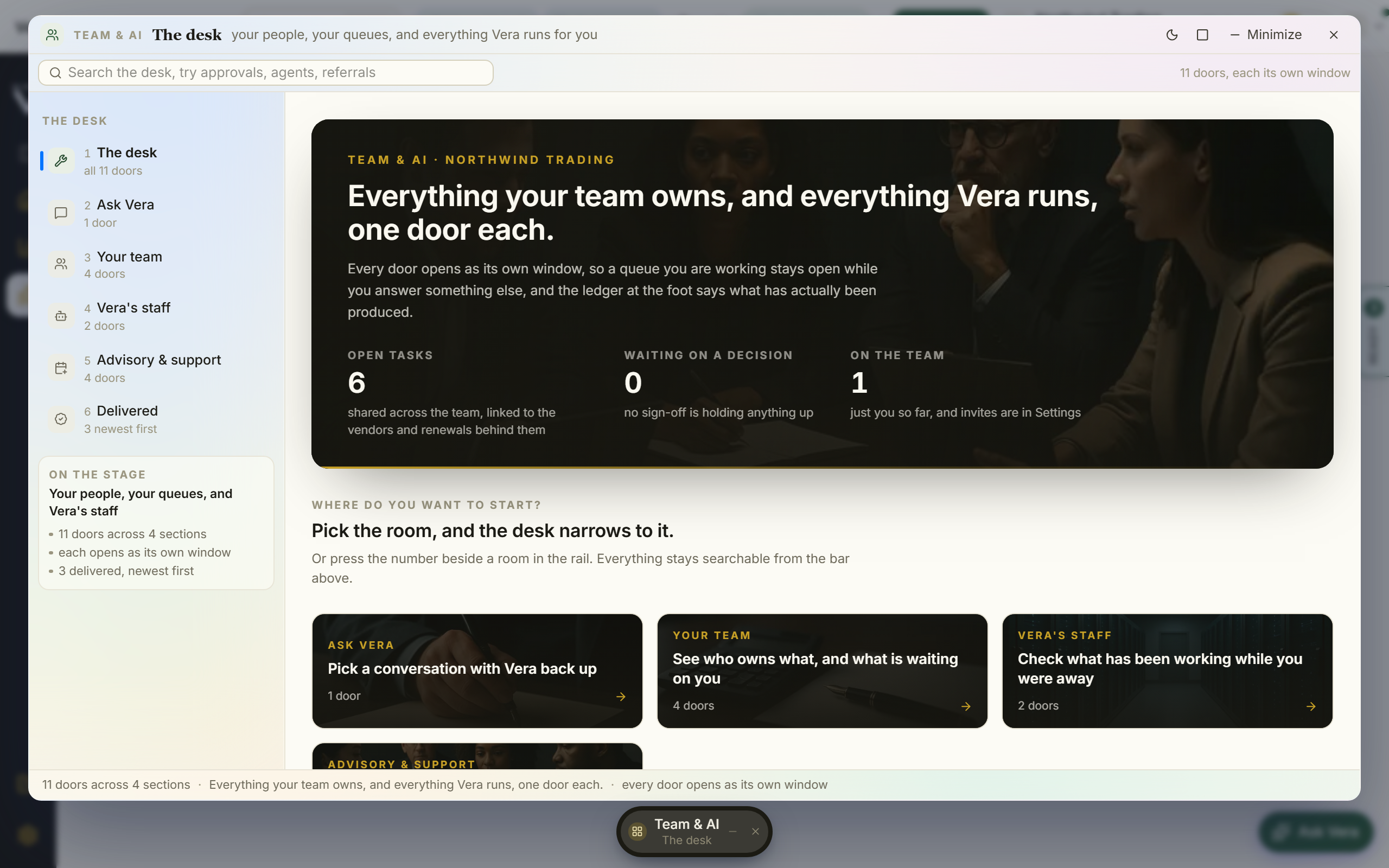
Every door in this chapter, as its own application window. It opens over whatever you were doing, the way the Benchmark Library and the instrument wall do, and Close returns you to Home.
On the screen
- The title bar: the window name, the light or dark switch, and the window controls. Escape closes, the square maximizes, and the minus parks the window on the taskbar to pick up later.
- The command bar: one search box across every room, over each door's name, its description and what it is for. Typing referral finds Referrals wherever it lives.
- The rooms rail: the desk, then one room per section (Ask Vera, Your team, Vera's staff, Advisory & support), then Delivered. The number beside a room is its keyboard shortcut, so 1 returns to the desk and 6 opens Delivered.
- The stage: what is actually waiting on you rather than a count of tiles. Open tasks that are not finished, sign-offs sitting in the approvals queue, and how many people hold a seat in this workspace. Where you have live deal rooms and negotiations, the headline says how many are in motion.
- Where do you want to start?: four doors, one per section, each carrying its own count. Clicking a door opens that room.
- Door cards: one card per destination, each with a photograph of the work it does, its name, and the sentence saying what it is for. Every card opens its destination as its own window.
- Delivered: every report you and Vera have produced, newest first, with who asked for it and when. Your own work is marked so you can find yourself in the column without reading it.
- What next: the three doors the desk usually leads to when you know what is waiting.
How to use it
- Read the stage first: it says what is waiting on you before you open anything.
- Pick the room for the job, from the rail or from the four doors.
- Search from the command bar when you know the name of the door you want.
- Open Delivered to see what Vera produced while you were away.
Tasks
Since August 2026 it opens as a Fluent window with its own menu: the rail inside lists the rest of Team & AI, so you move between them without going back out, and the entry you are standing on is marked. Escape closes the window.
Shared to-dos for your team as one runway with four views: follow-ups on renewals, negotiation actions, and anything else worth not forgetting.
*In plain words: the team's shared to-do list, attached to the work it belongs to.*
When to reach for this
- Splitting a renewal's actions across people, with owners and dates.
- Handing work over cleanly: reassign the open items when someone leaves or a portfolio changes hands.
- Your own queue lives on My work; this page is the team-wide view.
On the screen
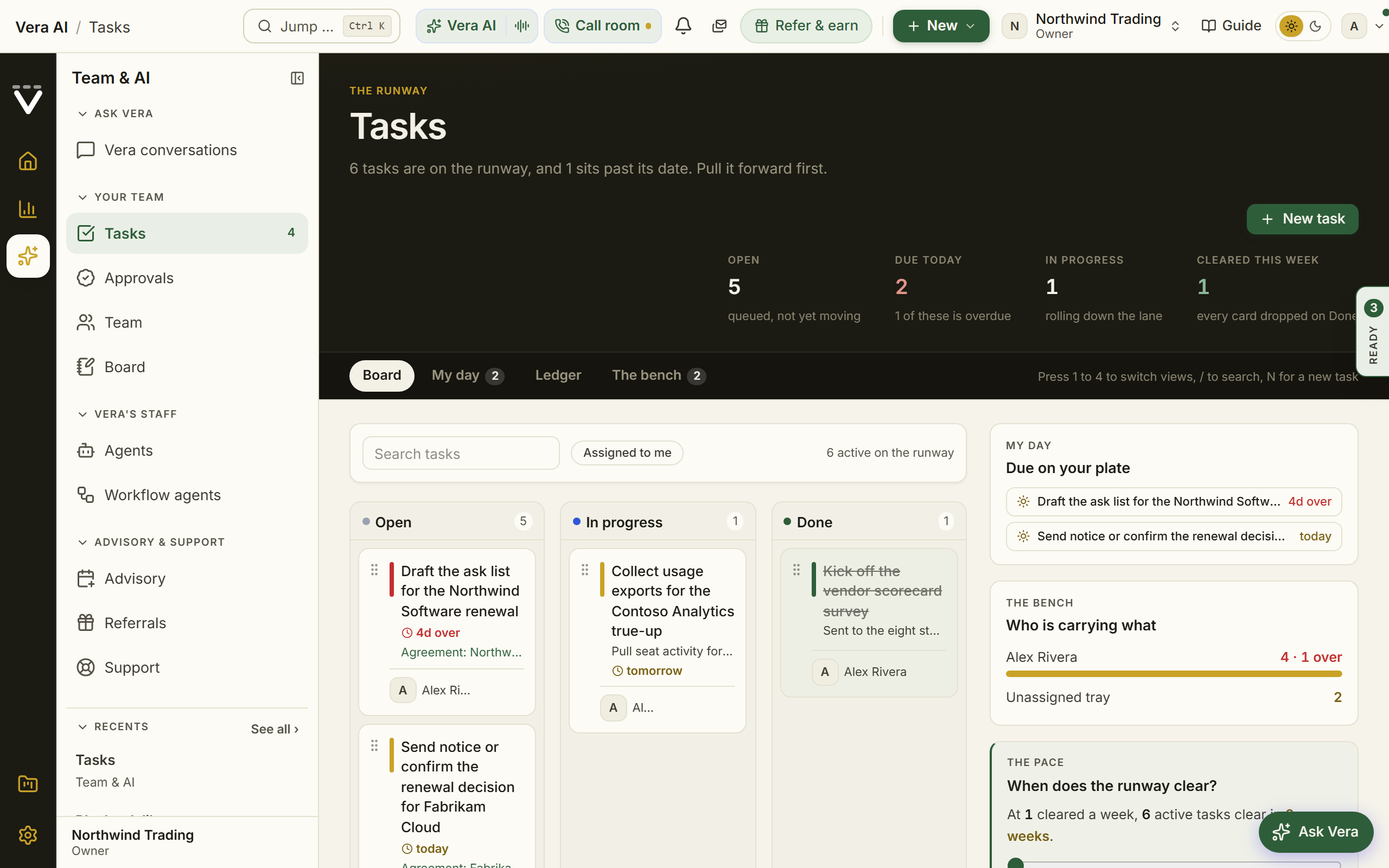
- The runway masthead — states where the work stands: open, due today with the overdue count called out, in progress, and cleared this week. These four move as you work, so the figures are always the board you are looking at. The New task action lives here too.
- Four views, one board — the band under the masthead switches views: Board (the drag and drop lanes), My day (every active task in landing order, grouped past their date, due today, tomorrow, this week, further out, and no date), Ledger (the whole runway as a dense table, with a toggle to include Done), and The bench (who is carrying what, with a load bar per teammate and their next due task). Press 1 to 4 to switch, / to search, N for a new task.
- The task file — click any task in any view to open its file, a right hand panel where the status, due date, owner, and notes all edit in place. The file is in the page address, so a forwarded link opens straight on that task.
- The pick up tray — the bench view leads with tasks that have no owner. Take it assigns one to you with a click; unowned work is how a date gets missed.
- One click complete and defer — in My day, the circle at the left of a row marks it done, and the Today and +1w moves push its date without opening anything.
- The pace instrument — the rail answers when the runway clears: drag the slider to test a weekly clearing pace against the active count.
- Delegate to Vera — every open task carries a sparkle control (on the card, the row, and inside the file). Delegating hands the task to Vera, the AI teammate: she reads the task and its linked record, writes the finished work product into the task notes, moves it to Done, and notifies you. Requires an AI plan.
- What next — the runway ends with a What next block built from the board's own numbers, including handing the most overdue task to Vera.
How to use it
- Create a task with N or the New task button, assign it to the teammate who owns it, link it to the vendor or renewal it belongs to, and set a due date.
- Run the week from My day: work the list top to bottom, complete with the circle, and push dates with the defer moves when the plan changes.
- Once a week, open The bench: empty the pick up tray and balance the load bars before anything slips.
- To see just the items assigned to you rather than the whole team, use the Assigned to me filter or open My work.
Approvals
Since August 2026 it opens as a Fluent window with its own menu: the rail inside lists the rest of Team & AI, so you move between them without going back out, and the entry you are standing on is marked. Escape closes the window.
Sign-offs your team routes through the platform, for example a negotiation mandate waiting for a budget owner. The page is a four tab workspace: the queue leads, the setup sits behind its own tabs.
*In plain words: the sign-offs waiting on people, and the chain they run through.*
When to reach for this
- You are an approver: the queue is where deals wait on you.
- A deal needs its documented sign-off before signature; the chain itself is configured by owners under Deal approvals.
On the screen
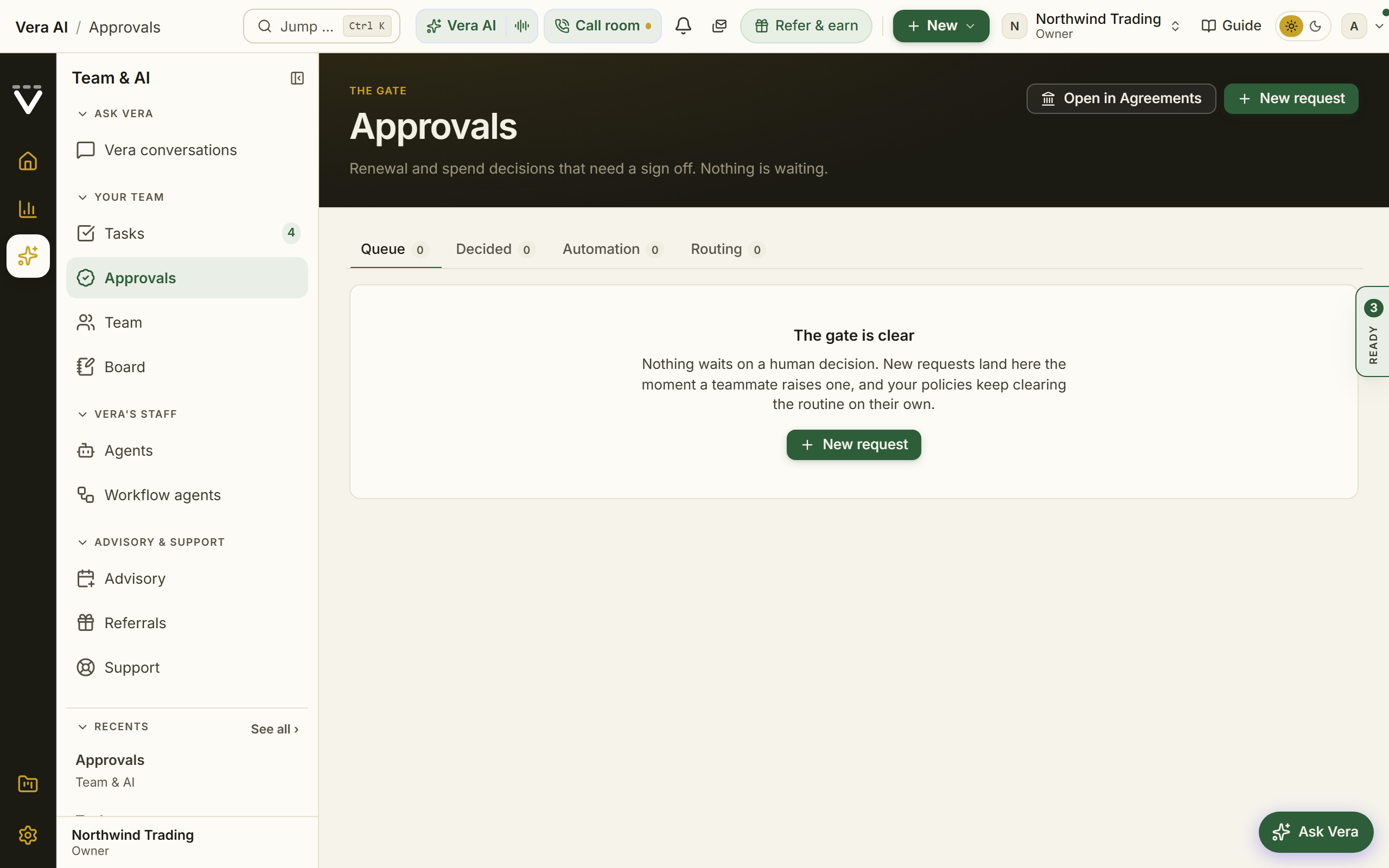
- The gate — the masthead states what waits and what it is worth: requests needing a human decision, the combined annual value on the line, how many have run past their SLA, and the median time from request to decision over the last 90 days.
- Auto-cleared — under the masthead, the share of the last 90 days' decided requests that your policies cleared before anyone read them. The rest reached a person because a rule said they should.
- Queue — every request waiting on a human, oldest wait first. Each row shows the wait or SLA chip, who it is routed to, and the AI risk summary; approvers decide right on the row. Each pending request also carries a Vera's read line: the ask, the vendor's delivered benchmark position, and the routing rule that queued it. The tab count turns red when a request is past its SLA.
- Decided — the decision ledger: cycle time analytics (median days from request to decision, decisions per month), plus a search box and an outcome filter (approved, rejected, auto approved, human decided).
- Automation — your auto approve policies and the rule proposals learned from your own decision record. Every auto approval lists the guards it passed.
- Vera's review — on a deal sign-off request, Vera reviews the snapshot before the chain votes: the latest quote against the mandate target, the concession balance, and the price movement. Her Flagged or Clear verdict, the checks behind it, and a short analyst note render beside the approval panel. She advises the chain and never casts a vote.
- Routing — the authority matrix (which type and amount band routes to whom, with optional second steps and SLAs) beside the approval threshold.
- New request — the button on the masthead opens a side sheet to raise a renewal or spend item for sign off.
- The record behind the ask — every row links the thing being approved, named for what it is: open the contract, the negotiation, the case, the renewal, the sourcing project. It is there on pending rows, so you can read the record before you decide rather than after, and it is offered again the moment you approve or reject.
- What next — the page ends with a What next block built from the queue's own numbers.
How to use it
- Open the Queue tab, open the record behind anything you are not sure about, then approve or reject each item. A rejection asks for a reason; it becomes the audit trail.
- To raise something for sign off, use New request on the masthead; routing rules pick the decider.
- Track past sign offs and your approval cycle time on the Decided tab.
Related: Deal approvals setup · My work
Team
Since August 2026 it opens as a Fluent window with its own menu: the rail inside lists the rest of Team & AI, so you move between them without going back out, and the entry you are standing on is marked. Escape closes the window.
Who owns what across your organization, and more importantly what nobody owns: renewals without an owner, open tasks, and assigned findings.
*In plain words: the ownership map, with the unowned things surfaced first.*
When to reach for this
- The weekly "is anything falling between people?" check: an unowned renewal inside its window is the finding that matters.
- Rebalancing load when someone is drowning or departing.
On the screen
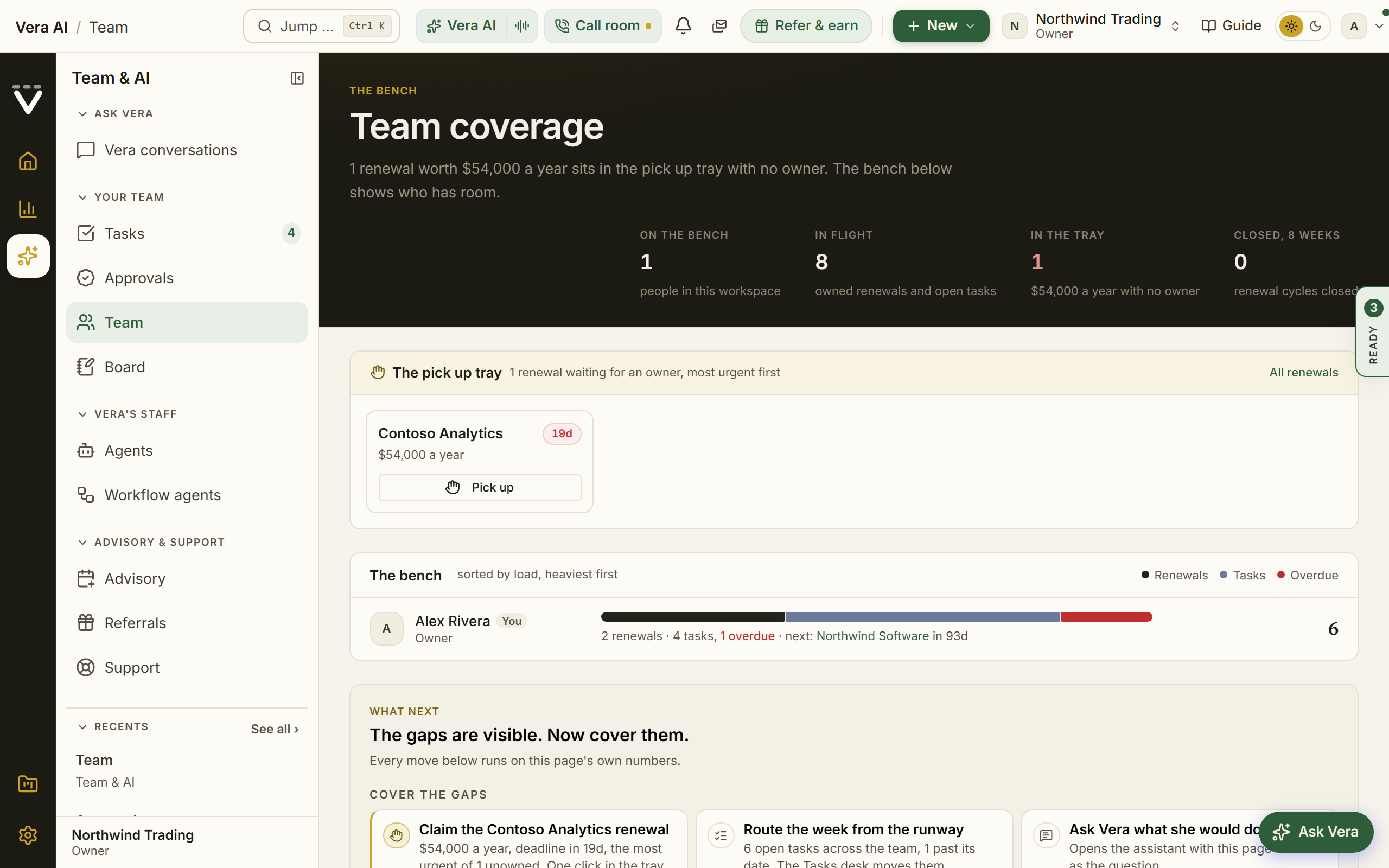
- The bench — the masthead states the coverage verdict: people in the workspace, owned renewals and open tasks in flight, what sits in the pick up tray with no owner and what that is worth a year, and the renewal cycles closed in the last eight weeks.
- Team pulse — renewal cycles closed per week over the last eight weeks, once anything has closed.
- Member rows — each teammate with the renewals, tasks, and findings on their plate.
- Unowned renewals — agreements with no renewal owner. Assign these before a notice window gets missed.
- What next — the page ends with a What next block built from the bench's own numbers, the unowned work leading.
How to use it
- Scan the unowned renewals first and assign an owner to each one.
- Use the member rows to balance who is carrying what.
Tips
- Owners can invite a teammate from here when there is more work than people to cover it.
Board
Since August 2026 it opens as a Fluent window with its own menu: the rail inside lists the rest of Team & AI, so you move between them without going back out, and the entry you are standing on is marked. Escape closes the window.
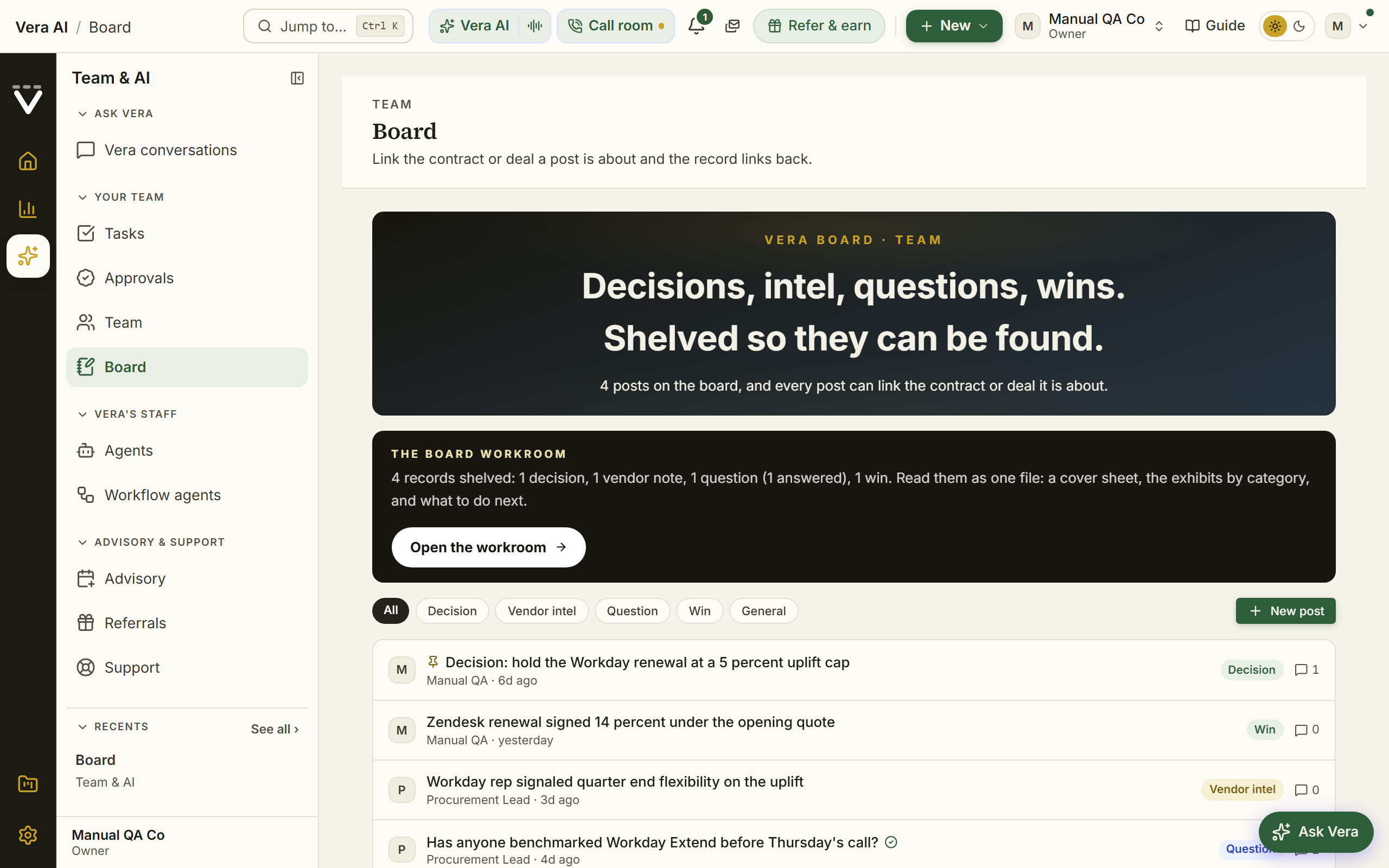
The team's durable forum beside the chat stream: decisions, vendor intel, questions, and wins, shelved so they can be found again months later.
On the screen
- Category tabs — Decision, Vendor intel, Question, Win, and General, with pinned posts leading every list.
- Posts — a title, the write-up, and threaded replies. Record links in a post render as grounded cards (the same cards chat shows), and @mentions notify the teammate.
- Link a record — the composer's control for inserting a proposal, renewal, deal, or vendor reference; the record's page lists the post under Discussed in.
- Templates — the composer's Start from pills prefill the three shapes teams shelve most: a Decision memo, a Vendor review, and a Renewal retro.
- Accepted answers — on a question, the author (or an owner) marks the reply that settled it; the list shows a check so nobody re-litigates.
- Pins — owners pin the posts the whole team should keep seeing.
- Open the workroom — on the unfiltered view, once a post exists, a navy band opens the board as a workroom. It carries a cover sheet with live counts, an exhibit per category, the question docket, and a What now sheet. ⚡ What now drafts the board digest for circulation, emails it to your team, copies the digest or the one line summary, proves the wins as savings, opens the estate the records govern, shelves the next record, and opens the newest one. ✦ Ask Vera answers from the records themselves rather than from a summary of them. It reads live from your newest posts; nothing is generated or stored, and nothing sends from a workroom.
How to use it
- When a decision lands (walking away from an uplift, standardizing on a vendor), write it up as a Decision post and link the deal it came from.
- Ask the team with a Question post; accept the reply that answers it.
- File what a rep told you as Vendor intel so the next negotiator starts warmer.
Tips
- Chat is for the conversation; the Board is for what should outlive it. When a thread reaches a conclusion, shelve the conclusion here.
Related: Chat · Tasks · Record pages
AI agents
Since August 2026 it opens as a Fluent window with its own menu: the rail inside lists the rest of Team & AI, so you move between them without going back out, and the entry you are standing on is marked. Escape closes the window.
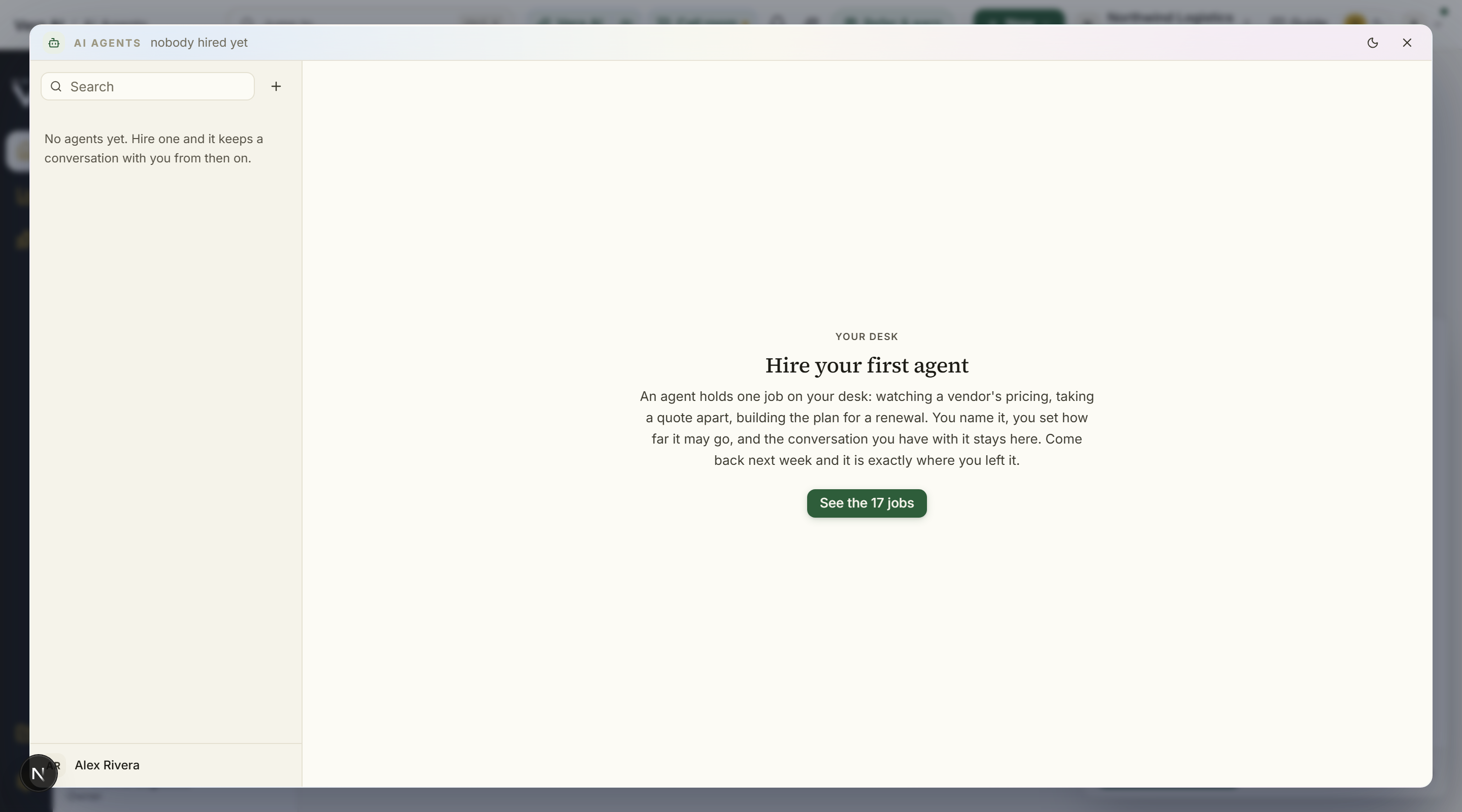
Your desk of agents, in a window of its own. Since August 2026 pressing AI agents opens the window directly, with nothing loading behind it: the roster down the left, one conversation on the right, the sun and moon in the titlebar for light or dark, and a close button that returns you to Home. Each agent holds a single job, wears the name you gave it, and keeps a conversation with you that never ends: come back next week and it is exactly where you left it. Seventeen jobs to hire from, covering the arc of a negotiation, a standing watch on your vendors, and the moves that hold the line when a vendor pushes.
*In plain words: staff you hire, name, and talk to.*
On the screen
- The roster — every agent you hired, down the left, most recently active first. Each row carries the agent's face in its own colour, the name you gave it, when it last spoke, and the last thing it actually said. An agent that spoke or worked since you last looked shows a green dot until you open it. The search box filters by name, job and vendor instantly, and a beat later searches what was actually said, so typing the uplift cap finds the agent that discussed it, under a Said in a conversation heading.
- Stood down — the drawer at the foot of the roster holds every agent you have stood down, read only. Open one and its whole conversation is still there; Rehire puts it back on the desk and its chain back to work, inside the same 24 agent ceiling as hiring.
- The plus above the roster — opens the catalogue of seventeen jobs, grouped by what the agent is for: working a deal, standing watch, holding the line. Pick one and its dossier opens beside it, saying what it reads, what it does, where its work lands, and how far it is allowed to go.
- The conversation — one thread per agent, and it is the whole record: what you asked, what it answered, every time its job or its leash changed, and every run it did, whatever set the run off. The weekly reads and upload triggered runs land here too, not only the ones you started. Nothing is cleared when you close the tab, and anyone in your workspace can pick it up. Your own messages carry your name, and answers carry the same citation chips as the main Vera conversation, with copy and feedback under each.
- The folder — beside the paperclip, for a contract you already hold. Search Contract Management Portal by vendor or title, press the one you mean, and the real document goes onto this conversation and rides with every question after it. Only records carrying a PDF or Word file are listed, because a record you cannot attach is a dead entry in a list, and what you can see is what your own permissions already allow you to open.
- The paperclip — attach a PDF or DOCX to the conversation, or drop one straight on the composer. It rides with every question in that thread, so turn nine can still ask about clause 9, and each question shows which papers it carried. Four documents at a time, the same limit as the main conversation. A paper dropped anywhere on the page while an agent is open lands in that agent's conversation as well, so the document stays with the thread you are working in.
- What the agent itself remembers — its own finished runs, what each one wrote and whether it finished, so asking it about its work gets you the work rather than a fresh start. It will not claim a finding from a run that stopped early. When a conversation grows past what it can hold at once, the earlier part is folded into a running summary overnight, so a thread you have kept going for months still knows what was decided in week one.
- Hand to — under any answer or finished run, pass that piece of work to another agent on your roster. It arrives in their conversation as a starting point to build on rather than as a question to answer, and both threads record it, so neither has a hole. Agents never message each other on their own; a person always presses the button, which is what keeps two agents from answering each other unattended.
- The header — who you are talking to, the job in one line, the vendors in its care, and the pill saying how far it may go.
- The vendors in its care — the watch list, set when you hire the agent and changed under the gear. It decides two things: which papers the agent picks up, and which vendors its work is about. An agent watching Microsoft stays out of the way when a Salesforce contract is uploaded and leaves it to the agents that do watch Salesforce, and it reads through the legal name on the paper, so watching Microsoft catches Microsoft Ireland Operations Limited. Leave the list empty and the agent takes every upload, which is usually what you want from your first one.
- Set to work — tells the agent to do its job now, and first asks one optional question: anything specific this time? What you type steers that run only; the standing setup is untouched. The run is the same workflow run you see on the workflow desk and in the runs tray. A card appears in the thread and follows it live, counting the steps, then lists every document it wrote with a link to the real thing.
- The phone button — takes this agent into the call room. Its job, the vendors in its care, your goal and its standing brief arrive as the call persona, written out on the sheet for you to read and edit before you dial.
- From the library — the rail on the right lists the briefings to watch and the research to read for the vendors in the agent's care, or for the vendors the conversation itself names when it has none. Films open in place; papers open in the research reader. An uncovered vendor shows nothing.
- The gear — the panel where you change the agent: its name, its job, how far it may go, the vendors in its care, what you want out of it, and its standing brief. It also shows This month, counted: answers given, runs finished and documents written, counted from the record and never estimated. And What it remembers: once a conversation outgrows what the agent holds at once, the earlier part is folded into a running summary you can read here, and Clear when you want it to start fresh. The transcript itself always keeps everything.
How to use it
- Press the plus above the roster and pick the job you need. Start with Market Watch if you want something running quietly, or First Call if you have a contract in front of you.
- Give it a name. The job's own name is filled in, so pressing Hire without changing anything is fine.
- Type a message the way you would to a colleague. It answers from your own agreements, spend and the market evidence.
- When you want work rather than an answer, press Set to work and watch the card.
- When one agent's work is the next agent's starting point, press Hand to under it and pick who takes it.
- Come back whenever. The thread is where you left it, and the roster tells you which agent spoke last.
How far an agent may go
- Watch — it reads and it tells you. Nothing is written on your behalf. Every agent starts here.
- Draft — it writes the documents and the vendor-facing letters its job produces, and leaves them with you. You send them, or you do not.
- Act — it takes the in-platform moves its job allows, such as opening tasks and recording dates and obligations, each of them logged and reversible. Anything that leaves the platform still waits for a person.
Each job states its own ceiling, and the dial cannot be pushed past it: a job that only reads will not offer Act however you set it.
The standing brief
Under the gear, Standing brief is what you want from this agent in your own words: what to lead with, what to always include, how long to be. It steers how the agent writes. It cannot loosen the platform's grounding or confidentiality rules, and it is checked before it is saved.
Tips
- Changing an agent's job keeps the thread. An agent that watched the market in March and prepared the renewal in June is one agent with a history, not two.
- Stand down takes an agent off the roster and stops it running on its own. Everything it wrote and every run it finished stays exactly where it is.
- One job per agent works better than one agent doing everything. Two threads you can tell apart beat one you have to search.
- Name the vendors an agent watches when you want a quiet desk. Three agents each watching one vendor give you three clean threads; three agents watching nothing all wake up on the same upload.
- Handing work over beats copying it. The receiving agent is told which agent sent it and takes the finding as given, so it does its own part instead of repeating the analysis you already paid for.
Related: Workflow agents · Vera AI · The Agent Center
Vera AI
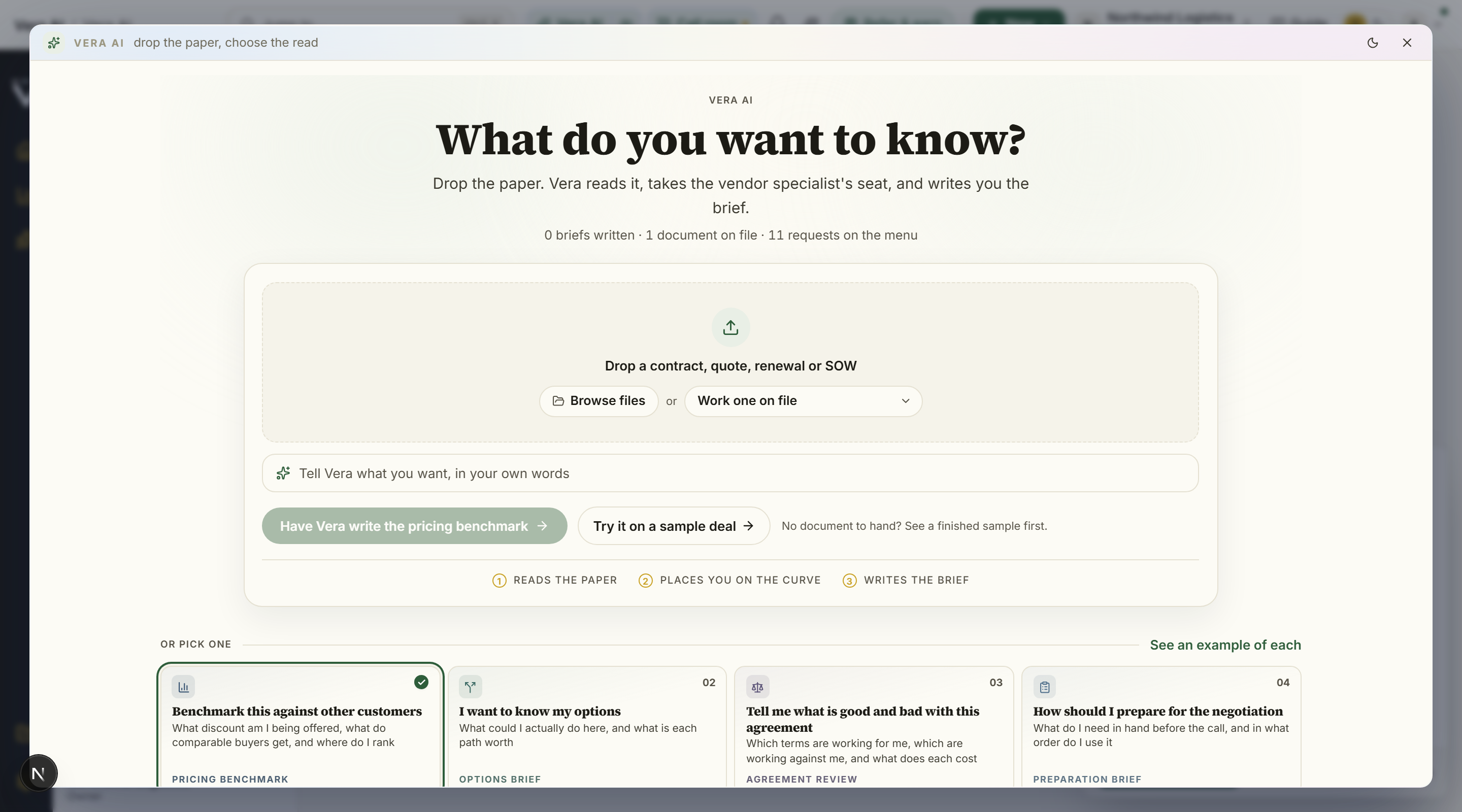
One window, one job. Vera AI opens straight into its own application window, like the other agent doors, with nothing loading behind it; the X at the top right closes it and returns you to Home. Drop a contract, quote, renewal or SOW on it, or browse, or pick one already on file. Then say what you want in your own words, or choose one of eleven requests. Vera reads the document as a specialist in that vendor and writes the brief that answers you. You do not need to know which tool does what: you say the outcome, Vera picks.
On the screen
- The window — Vera AI arrives as its own application window, the same Fluent dress as the other agent windows: frosted chrome over the window's own glow, sharp content on solid ground. The sun and moon in the titlebar flips the whole account between light and dark without leaving the door, and the X at the top right closes it and returns you to Home; in the desktop app the frame is the window itself.
- The headline — the question at the top, in the same light as the home page, with the door's vitals in one line beneath it: briefs written, documents on file, the eleven requests on the menu, and the date of your latest read. The finished briefs themselves stay filed in your reports, so the door carries the count, not a list.
- The composer card — one white card holds the whole run: the drop zone, the line in your own words, and the button, with the three steps of every run (reads the paper, places you on the curve, writes the brief) at its foot. Nothing you need to start a read sits below it.
- The drop zone — drag a PDF anywhere onto it, press Browse files to choose one, or press Work one on file to pick a document already in your workspace. Both ways in check the file straight away and tell you if it is not a PDF. Work one on file lists the documents in the workspace you are currently in; if you belong to more than one, switch workspace to reach the others.
- The document you arrived with — when you reach the door from a finished report, the drop zone is not a drop zone: it names the paper that report was written on, says which report carried it over, and the run uses that same document. Press the × beside the name to put it down and work something else.
- The one line — type what you want in plain words. Vera matches it to the nearest of the eleven requests and tells you which one it chose before anything starts, so a wrong guess costs you nothing. Press Pick a different one to override it. If you would rather choose the request yourself, pick a tile: what you typed stays where it is and travels with the run as your question.
- Or pick one — the eleven requests, each a colour tile with its own glyph: benchmark this against other customers; I want to know my options; tell me what is good and bad with this agreement; how should I prepare for the negotiation; make me a renewal plan; review the contract terms and pricing; create me a negotiation strategy; create talking points for my negotiation; benchmark this and arm me for the negotiation; review the terms clause by clause, pricing aside; plan my final negotiation call. Each names the question a buyer is really asking underneath it, hovering any of them explains what Vera does with the document and what the finished report contains, so you can pick the right read without a test run, and the tile you have chosen carries a ring and a check.
- The button — on the composer card, names what you are about to get, for example "Have Vera write the pricing benchmark".
- Try it on a sample deal — beside the button when you have not added a document. Opens a finished example of the read you have selected, written on an illustrative deal and rendered as the real document, so you can see what it produces with no wait and no run before dropping your own paper.
- See an example of each — beside the eleven requests. Opens the examples gallery, a finished example of every request written on an illustrative deal and rendered as the real document, so you can pick the request that fits before dropping your own paper.
How to use it
- Drop the PDF on the zone, press Browse files to choose one (up to 40 MB), or press Work one on file to pick a document already on file.
- Say what you want in your own words, or pick one of the eleven requests. Hover a tile first if you want to see what that read does and what the finished document contains.
- Press the button. It names the document you are about to get.
- Stay and watch the reading card, or leave the page: the run keeps going, and the finished brief opens itself when you are here or arrives as a notice when you are not.
- On the finished brief, use the rail on the right: download the PDF, email it to a colleague, or take the suggested next read, which opens the door still holding the same document.
While it runs the page stays put: the drop zone itself becomes the reading card, with your file named at the top and a live percentage beside it, and the rest of the page waits dimmed behind it. Inside the card a five step checklist reports the stage the run is actually on, each step ticking off as it completes: reading the paper, pulling the commercial facts, placing it against the market, writing the brief, filing it. These are the real steps, not a timer, so a slow stage looks slow. Under the checklist, a Read off the paper list fills in as the read establishes facts: the vendor, the product, the term, the commitment totals in US dollars and any stated discount, up to eight rows, each ticking in as the extraction lands. Every row comes straight from your document; a fact the paper does not state never appears. When the brief is ready the page opens it for you, and the card turns to Open the brief at the same moment, so the finished document is one press away whether or not the page has moved yet. A run takes a few minutes, and you do not have to wait on the page: leave it and a small marker in the corner tracks the brief, then a notice arrives bottom right with a link straight to it when it is ready. The brief lands in your reports either way, so a closed tab loses nothing.
What comes back is shaped to the request, in one consistent house style. The benchmark request returns the benchmark brief: four headline figures, the executive summary, the deal snapshot, the sensitivity if the baseline is wrong, the market evidence, the levers in the order to play them, the talking points, and the verdict. Peer figures are drawn from the reference set rather than written by the AI, so if there is no comparable cohort for your vendor the brief says so plainly and names what to ask the vendor for, instead of inventing a comparison.
The other ten requests each return a purpose built document. Tell me what is good and bad with this agreement prices every clause as an asset working for you or a liability working against you, shows them on one diverging ledger netted into a single position, records a right you never used at nil, and lists anything it cannot price yet as unpriceable with the reason. How should I prepare for the negotiation decomposes the proposal into a rate per unit per month for every line, prices each way the deal can be restructured, and lays out the information to demand in writing, the opening, target and walk away for each item, and the order to run the conversation. Make me a renewal plan works backward from the renewal date to a dated runway: the clauses to secure before you sign, the two windows where you can act on your own, the renewal cost under each scenario, and the gate at every milestone with the notice date marked as the one deadline that cannot be recovered. Create me a negotiation strategy reads your leverage honestly, ranks your objectives from must win to sacrificial, plots every ask on a trade matrix by what it costs the vendor against what it is worth to you, and sets out the currency to trade, the rounds, the plays, the closing sequence and a response to every predictable vendor move. Review the contract terms and pricing answers both questions at once: it reconciles every line to its actual unit rate and flags which prices were negotiated round rather than derived, reads the volume schedule, and works through each protection and the condition that removes its value at renewal, with a break-even curve wherever a conditional renewal cap has to be weighed against flexibility. I want to know my options sets out every real path open on the deal, from a like for like renewal to a re-mix of the licensing to a combined programme, prices each against the same baseline, ranks them by what they are worth against the weeks and the risk each carries, and plots them on a value against effort chart so the efficient paths stand apart from the ones that cost more time for less. Create talking points for my negotiation returns a script written to be spoken: the position said the same way by everyone on your side, the questions to ask in order and what each answer settles, the asks with the exact words and how to frame them, the objections with an answer to each, the phrases that lose money and what to say instead, and a pocket card to carry in. Benchmark this and arm me for the negotiation returns a three part pack: page one places your deal against the vendor's own discount curve where one exists or an illustrative peer trend otherwise, with your as proposed, target and stretch positions and the headroom between them; page two is ten tactics specific to that vendor, each with what to think about; page three is the arguments that move it, built on its own incentives and ranked by what they cost it to grant, closing with the one to lead with. Review the terms clause by clause, pricing aside returns a terms only assessment with pricing deliberately left out: every clause is graded against a fixed five value key (Protects, One sided, Ambiguous, Weak or Absent), each with the drafting change to seek beside it, the headline counts how many clauses protect you and how many protections are absent altogether, and it closes with the terms the order form does not address and the three fixes to make first in dependency order. Plan my final negotiation call returns a two page battle plan for the last session: every item forced into one of five statuses (Must win, Won, Open, At risk, Lost) with the conditions of signature first and the sunk items last, the session minute by minute with one hard rule per block, a concession ladder that releases each rung only against a stated precondition, the counterparty's best closing moves with the pre agreed answer to each, and win, loss and walk defined before the call so none is decided in the room. Every figure and date is computed from your document rather than written by the AI, and every report now argues in US dollars, converted from the contract's own currency at today's live exchange rate.
Forwarding and what next. Every finished report has a rail down the right side. Copy a link to send a colleague in your workspace, press Download PDF to take the document exactly as shown, or Email it to a colleague and Vera drafts the note for whichever reader you pick (a colleague, your CFO, your CIO or the vendor), ready to copy into your own mail client. Under the rail, what to do next: Vera suggests one or two of the other ten reads that follow naturally from the one in front of you, so a benchmark points you to a preparation brief and a strategy points you to talking points; or take the numbers into a negotiation.
The next read runs on the same document. Taking one of those suggestions, or Ask Vera something else, opens the front door holding the paper you have just been reading. There is no upload box: the document is named on the drop zone with a line saying which report it was carried over from, the request you picked is already chosen, and pressing the button runs it on that same paper. To work a different document instead, press the × beside the name and the drop zone comes back. A document you dropped is held for a day while you work on it; after that the door asks for the file again and tells you so rather than failing silently. A document already on file is held for as long as it is in your workspace.
Also on this deal. Above the rail on a finished report, and under the composer on the front door when a document is in hand, a strip lists the other reports written on the same deal, newest first, up to six, each with its document type and the date it landed. One press opens any of them, so you can step back to the renewal plan after asking for the negotiation strategy. The strip groups by the document the reports were written from, and by the vendor for reports written before Vera recorded that. It is not shown when there is nothing else on the deal.
Related: Vera conversations · Vera's seat and stance
Vera conversations
*In plain words: one chat, as many conversations as you need. Every thread lives in the rail on the left, each with its own full memory, and you pick any of them back up.*
When to reach for this
- A running conversation you want to continue, with everything Vera already knows about your estate still in context.
- One keystroke from anywhere: Ctrl/⌘ J opens Vera over whatever you are looking at.
- Asking well is a skill worth two minutes: the recipe covers it.
A worked example. Ask "am I overpaying for our CRM?" on the sample portfolio and the answer is grounded: the Northwind agreement's $142,800 a year and its delivered benchmark ($571 a seat against a $504 median) are cited inline, and the answer states the $28,650 in reach rather than gesturing at "potential savings". That is the standard to hold her to: numbers with sources, or a plain statement that the data is not on file.
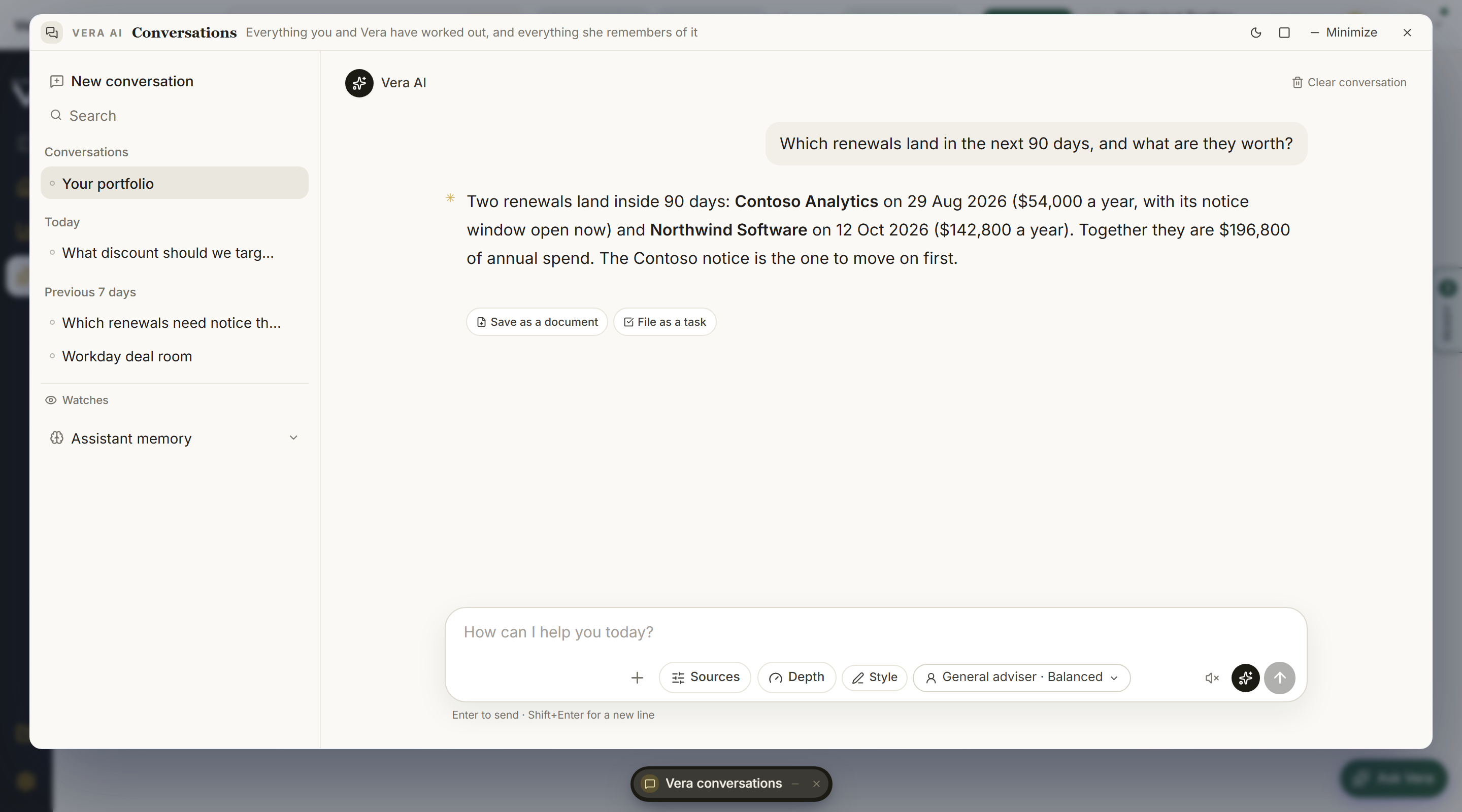
This is an app window rather than a page. It opens as one window exactly as tall as your screen, with no page behind it and nothing outside it that scrolls: the conversations rail down the left, the conversation filling the middle with its own scrollbar, and the composer docked at the foot. Arriving lands on the newest exchange with the composer ready. Sending a question rides it to the top of the view and the answer unfolds below it at your pace; the view never drags itself to the bottom while text streams, and whenever newer lines are out of sight a Jump to latest pill waits at the foot of the transcript. Every door into it opens the window itself, whether you come from Home, from a link inside an answer, or by typing the address; on Home the first character you type into the ask bar is itself a door, carrying your unfinished sentence, your attached papers, and your source choices into the composer here. To drop a document for a written brief, the front door is Vera AI at the top of this group; the playbook library holds the vendor playbooks, and specialist agents live in the Agent Center.
On the screen
- The window — the titlebar names the app and carries four controls on the right: light or dark, which is the same account setting the top bar carries so the choice follows you everywhere; minimize, which puts the conversation on the taskbar at the foot of the screen with everything you had typed still in it; maximize; and close, which returns you Home. Nothing loads behind the window, so closing it never drops you onto a half loaded page.
- The conversations rail — a search box at the top filters your conversations as you type and, a moment later, searches the full text of every exchange as well, showing the matching conversations with a snippet of the match; Escape clears it. Under it, every conversation grouped by when things happened: Pinned, Today, Yesterday, Previous 7 days, Older, with the main portfolio thread always at the top. Point at any row and its ⋯ menu manages it: Rename edits the name inline, Pin holds it above the list, Share with workspace opens it read only to your teammates with the link on your clipboard (and Stop sharing takes it private again immediately), and Delete removes it after a confirming second press. Conversations that began on a deal room or a report appear here too, and each row opens in place. On a phone the rail sits behind a Conversations disclosure above the chat, and picking a conversation closes the drawer.
- New conversation — starts a fresh thread with its own memory of what was said in it, opening on the greeting with your standing under it (your book, your next renewal); Ctrl/⌘ Shift O does the same from the keyboard. After the first exchange the conversation names itself, three to six words on the subject the way you would label a folder, and a name you set yourself is never overwritten.
- The conversation — the transcript keeps its own scrollbar, so the page never scrolls under you: the newest turn is in view when you arrive, your question rides to the top of the view when you send, and the answer unfolds below it without the view ever chasing the stream; Jump to latest waits at the foot whenever newer lines are out of sight. The reading is set at the app's own text size on a column that grows with the window, so a wide screen is used rather than left empty at the sides, and a narrow one still reads like a page rather than a wall. The working lives behind one small control at the answer's right corner, in every state and closed every time: while Vera is still working the corner's dot breathes, and pressing it shows what she is doing, how long it has taken, the lookups as they land and her own train of thought; leave it alone and the answer simply arrives with nothing narrating itself in the space the answer is about to fill. Once the answer settles the same corner holds what she checked, how long each lookup took, the thinking behind it, and the figure by figure verification, exactly as it looked while it streamed, today or on any later visit. A green dot on the corner means the figures verified against your data; a gold dot means review them before relying on the answer. Point at any answer and it shows the feedback thumbs, Copy, and a quiet ⋯ holding Ask again with its rephrasings, Regenerate, Watch this and Speak, on every answer in the transcript, not only the newest: a rating or a repair three turns back works exactly as it does on the latest. The closers, save as a document, file as a task, open the case, sit under the newest substantive answer only. When Vera opens a conversation herself after time away, her greeting appears as a quiet note from Vera card rather than a full answer. Site addresses in an answer render as named links you can press, and a long conversation opens on its newest turns, with Show the earlier conversation at the top when there is more.
- The composer — docked at the foot of the conversation, one rounded card with everything in it: your writing across the middle, and every control on the card's own foot, the + button (attach a document, up to four and up to 30 MB each, or open your documents and connected apps), then Sources, Depth, Style and the conversation's persona, with the microphone and send at the right. Papers you attach sit as chips along the card's top edge, above the text they will be read into. Enter sends, Shift+Enter makes a new line (the composer says so, once, the first time you focus it). Nothing floats above or below the box you type into: the greeting and the empty card are the whole invitation. While an answer streams, the send button becomes a working stop, and Escape does the same from the keyboard: the answer halts where it is, keeping what already arrived. A paste longer than a sentence or two becomes a named text attachment on the conversation instead of an oversized question, so a contract extract travels as the document it is. While a document is still attaching, the send waits: the question stays in the box until the paper lands, so an ask never goes up without the document you just handed over. What you have typed but not sent is kept per conversation, through reloads and thread switches.
- Dropping a paper on the conversation — the window is the target, all of it: drag a contract onto the transcript, onto the composer, onto the rail, anywhere inside the window, and the conversation catches it. Drop it on the conversation appears while the file is over the window, the paper uploads when you let go, and it lands on the composer as a chip. No chooser opens and no tool starts, because you are already in front of the box where you say what you want. A dropped folder works too, and a file the conversation cannot read is refused by name rather than opened. On a screen with no conversation on it, a drop still opens the chooser described in the Vera handbook.
- What you can attach — the + button, a paste, or a drop takes a PDF or Word contract, an Excel workbook, a CSV, plain text or Markdown, and images (PNG or JPEG), up to four at a time. A PDF or Word file can be up to 30 MB; everything else is capped at 8 MB. A spreadsheet is read cell by cell rather than summarized, every sheet of it, with a formula shown as the number it works out to, and Vera says plainly when part of a workbook was too large to read. An image is read directly, so a photographed rate card or a screenshot of a quote can be quoted from as printed instead of retyped, and its chip on the composer shows a thumbnail of the picture it holds. Clicking any chip opens the real file in a new tab, so what is on the conversation is never a mystery. Papers stay attached for the rest of the conversation, and they last: the first question that carries a document files a lasting copy with the conversation, so a reload, tomorrow morning, or another device all bring the chips back. Dropping a spreadsheet, an image or a text file on a screen with no conversation open now lands it straight on the conversation too, instead of being refused as not a contract.
- A long agreement is searched, not skimmed — a document under 8 MB is put in front of Vera whole. A larger one cannot be: there is a hard ceiling on how much can travel in a single question. Instead she indexes it once, searches it for the clause your question is about, and reads the pages that matter, which is a better read of a three hundred page master agreement than the whole file would have been. The chip on the document says searched when this is happening. Ask in contract language ("termination for convenience", "uplift cap") and she will find it; if a term genuinely is not in the paper she says so rather than answering around it.
- Where an answer came from — when an answer draws on a document you attached, Read from your documents appears under it. Open it for the exact passages the answer was built on, each with its page, so you can check a quoted figure against your own copy. The passages are recorded as the answer is written rather than reconstructed afterwards, and they stay on the answer in your history.
- Sources — on the composer's foot, the control that says where Vera may look before she answers this conversation's questions. Seven places, each on or off: Your contracts (the standing summary of your agreements that Vera carries into every answer, plus exact rows for spend, savings, saved scenarios and workspace activity), Document text (clause search across every contract you have uploaded, and the reports you have generated), Market benchmarks (peer discount ranges and where a deal ranks), The web (live search over public pricing and market pages, the mirrored vendor price catalogs, and any link you paste), Research library (the published toolkits, white papers and market notes), Past conversations, and Connected systems (what your integrations have synced: license usage positions from your identity and SAM systems, so "how many seats are actually active" is answerable, and procurement spend actuals, so "what did we actually pay" is too; where nothing is connected she says so instead of guessing). The control starts on Web only, live web search alone with nothing from your workspace read until you widen it, and it always says where it stands: the trigger names a one press choice when one is on (Web only, Your contracts), reads 3 of 7 sources when you have made a set of your own, and reads Sources when everything is on. Switching one off withholds it rather than filtering it afterwards, so Vera cannot quietly answer from a place you excluded, and when a question genuinely needed one of them she says which one in a single line rather than letting the answer read as though that place came back empty. Four one press choices sit above the chips. Web only, the default, searches the live web and nothing of yours. The other three each add to the previous: Your contracts (your own paper and what you and Vera have said about it), Contracts and research (that plus the market benchmarks and the research library), and Contracts, research and the web. Your own conversations stay on in those three, because they are your words rather than an outside lookup; Web only leaves them off, keeping its promise that nothing of yours is read. Everything and Nothing set all seven at once; with nothing selected nothing is looked up and no summary of your contracts is loaded either, so Vera answers from market expertise alone and opens by saying so. The choice is remembered per workspace. Papers you attach to the conversation are never affected: handing Vera a document is a direct instruction to read it, and no source setting overrules that.
- Depth — beside Sources, how deeply Vera thinks on this conversation's questions: Brief answers in one short paragraph, Standard is exactly what every answer was before the control existed, and Deep reasons longest, for the decisions that deserve it. Deep also lifts the working room: up to ten rounds of lookups instead of six and more than twice the clock, so a genuine research question, comparing several vendors' current pricing and building the table, fits in one answer. Deep now lengthens the answer as well as the thinking, roughly twice what the question would ordinarily draw, spent on the reasoning behind each finding, what a counterparty will say, and where the argument is weakest. The choice is remembered per workspace, and it shapes the answer without ever relaxing the grounding or the verification rules.
- Style — beside Depth, how the answers read. Write styles of your own, Board voice, Two lines max, and pick one for this conversation; the same panel holds your standing note, how Vera answers, always, which rides every answer in this workspace whether or not a style is picked, for example who you are and what to assume. Both are your words, applied to the shape and voice of the answers and never allowed to loosen the grounding or citation rules. The picked style is remembered per workspace, and no style at all is exactly the answers you had before the control existed.
- Deal — when this conversation belongs to a deal, the chip beside Style names it and its menu opens the deal, leaves the scope, or joins a different one. The scope is kept on the conversation itself: reopen it from the rail tomorrow and it still answers inside the same deal, which used to silently lapse with the link that first carried it.
- Files Vera builds for you — ask for a file by format and you get the file itself: a Word document, an Excel workbook, a PowerPoint deck, or a PDF, built in a sandboxed workspace with the same document machinery Claude uses on claude.ai and delivered as a download card on the answer, usually before the closing lines finish streaming. Say "make me an Excel workbook comparing our three cloud renewals" or "turn this into a PDF" and the card lands under the answer with the file's name and size; one press downloads it. Ask for a document, a strategy, a brief, a playbook, and the Word file arrives with it automatically: the document opens in the pane where you revise it, and the card under the answer carries the file you keep and forward, no second ask needed. Files are kept with the conversation, so the card is still there tomorrow and on any device, and deleting the conversation removes its files too. Everything is written to the firm's document standard and dress.
- Documents Vera opens beside the conversation — ask for something you will keep, forward or edit and it opens as a document rather than arriving as a long reply: in a wide window as its own pane to the right of the conversation, with its own scroll, a drag handle on its left edge to set the width (the chat remembers your choice), and a pin to keep it in view while newer documents arrive, a quiet line offering the newest when it is ready; in a narrower window, and on a phone, as a panel under the exchange exactly as before. A brief for the board, talking points, a note to the vendor. The panel names what it is and which version you are on, and the text fills as Vera writes it, so a long brief reads as work happening rather than a silent wait. Copy takes the whole document to your clipboard once it is finished; Versions in its header lists every draft it has carried, opens any of them read only, and can make an earlier one current again, saved as a new version so the history keeps the detour; Share beside it opens the document to your workspace, read only, and one more press takes it private again; Download saves the current version as a real Word document in the house dress, and it is a document Word treats as one: the masthead carries your workspace's name over the document type, the sections appear in Word's navigation pane and can build a table of contents, lists are real Word lists, money columns right align and item numbers center, classification words like REQUIRED and RISK carry their verdict colors, and the file's own properties name it so it never sits in your downloads as a blank; a PDF button beside it for the A4 file in the executive brief dress that renders identically wherever you send it, and a CSV button when the document carries tables, one section per table; Close puts it away and leaves it stored. Ask for a change and Vera revises that same document instead of writing a second one, so the paragraphs you did not mention stay exactly as they were and the version number moves to 2. The reply beside a document stays short on purpose: it says what was written and what she would change next, because the document itself is on your screen. Everything else stays in the conversation, a long answer included: the test is whether you will come back to it, not how many words it took.
- The shape of an answer follows the question — Vera reads what kind of question you asked and answers in the matching shape, rather than writing every reply to one template. A how it works question ("how do I exit a ULA", "what does a true up clause do") is taught: the mechanism, what decides the outcome, the sequence in the order it happens, and the traps, in headed sections at the length the subject needs. A question about your own position keeps the tight shape it always had, a two or three line read followed by the findings ranked by the money you can actually move, each with the ask it implies. A question with a real choice between options comes back as a comparison table with a verdict column. A quick follow up about something already established gets one or two sentences. Small talk gets a plain conversational reply with no analysis furniture. On a general question your own agreements appear at the close if they bear on it, never as the frame: asking how something works gets you the answer to that, not a report on your contract.
- What Vera knows about the publisher — name a vendor in a question and Vera brings her standing read of how that publisher negotiates: when real movement usually appears by quote round, where the flexibility actually hides when list price holds, the plays they reach for first, their fiscal calendar, the escalation that moves a deal and what typically stalls one. Twelve publishers are covered today, Oracle through its own deeper doctrine and Microsoft, SAP, Salesforce, ServiceNow, Workday, IBM, Adobe, Cisco, Google and Atlassian through the behavior library. It is curated advisory guidance rather than measured data, it says the month it was last reviewed, and where a fiscal date or a program name decides something Vera checks it rather than repeating it. For the vendors beyond those twelve, the same knowledge lives in the research library and she reaches for it there.
- What you have already decided — when a conversation settles something, that position is kept and carried into later conversations with the date it was settled, so Vera builds on it rather than putting the same choice back in front of you. If she thinks a settled position should change she says so and says what changed. Facts she remembers about you carry the date they were last confirmed, and anything she remembers that disagrees with your workspace data loses to the workspace: she states the current figure and tells you her note was out of date. Settled positions travel with the Past conversations source, so switching that off stands them down with everything else from earlier conversations.
- When a question needed a source you had switched off — Vera reads the web alone until you say otherwise, so a question about your own agreements, your spend, a renewal date or what a contract says has nothing of yours to read. The answer says which source was off, and under it sits one press that turns that source on and asks the same question again. It appears only when the question genuinely needed it: asking how a licensing model works, or how a vendor behaves, never nudges you, because those are answered from the market and are exactly what the default is for.
- What the sources switch covers — turning a source off withholds it everywhere, not only from the lookups. With Your contracts off, the standing summary of your agreements, the lookups, your unfinished work and Vera's own notes on your deals all stand down. With Past conversations off, earlier conversations and anything promised in them stand down too. What stays either way is what you have told Vera about yourself, how you like answers written, and your organization's stated posture, none of which is contract data.
- When Vera needs one more fact — a question that genuinely turns on something you have not said (your region, your seat count, your renewal date) is still answered first, on the most reasonable assumption and saying which assumption was made, with the one question that would sharpen it at the very end. You never get the question on its own, and never before the answer.
- Asking the same question a different way — the ⋯ menu on the newest answer carries Shorter, Go deeper, Different angle and Plain English beside Ask again. Each re-asks your question with one instruction attached, so an answer that was the wrong shape costs a press rather than a turn of arguing with it. What was asked stays visible in the thread, so a colleague scrolling back can see why two answers to the same question differ.
- Editing a question, and the versions of one — point at any question you asked and a pencil appears beside it. Change the wording and press Ask this instead: the conversation forks at that turn. Everything before it comes with you, the new wording is answered in its own version, and the question you first asked keeps the answer it earned rather than being buried under a correction. A small 1 of 2 control under the question moves between the versions, and each version appears in the rail under the conversation's own name so you can find it later. Regenerate, in an answer's ⋯ menu, takes a second run at the very same wording: a parallel version of the conversation answers it fresh, the same arrows move between the takes, and nothing is overwritten. Editing does not delete anything, which matters more often than it sounds: the first phrasing is frequently the better one and you only find out after reading both.
- Continuing an answer that ran out of room — a long answer can reach the length limit and stop mid sentence. It says so, and offers Continue it beside Ask again. Continuing picks the answer up at exactly the character it stopped on and writes the rest onto the end of it, so you keep your place in what you had already read; the two halves are saved as one answer, not two. Ask again is still there for the times the answer was going wrong anyway, but it spends the whole question again and comes back with different prose.
- Tables you can rank, blocks you can copy — press any column heading in an answer's table to rank by it. Money, percentages, dates and counts are read as figures rather than as text, so $1,240,000 sorts above $412,000 and a renewal in March sorts before one in November; a second press reverses it and a third puts Vera's own order back. Fenced blocks carry a Copy control for the clause or the draft you are about to paste somewhere else.
- Your clause against the market standard — when an answer compares your wording with the wording comparable deals carry, it is drawn rather than described: your version and the market version side by side, the words you would give up struck through, the words you would gain marked, and one line on what the difference costs. Where Vera does not have your exact text she says what a market standard clause looks like in prose instead of inventing a quotation.
- Open its page — in the header of a conversation that belongs to an artifact (a deal room, a report): one press back to the page it lives beside.
- A shared conversation, from the reader's side — a conversation a teammate shared opens as its own read only page: every question, answer and citation chip exactly as the owner sees them, with who shared it named at the top. Nothing on it is writable, no composer mounts, and nothing you do there can speak in the conversation or teach Vera anything. If the owner stops sharing, the link says so plainly instead of erroring.
- Clear conversation — deletes the conversation you are in and nothing else, and asks you to press it twice so a stray click never costs a transcript. A keyed thread is removed outright and the chat returns to the main one.
- Assistant memory — under the rail: the facts Vera holds about you, each with a forget button, and the audit log of everything learned or forgotten. Her memory of earlier conversations reaches back as far as your conversations do: every thread on file is distilled into memory, oldest included, so "what did we work out about this vendor months ago" finds the conversation rather than the last few days of them.
The command desk (/ask) remains its own surface, one press away, for working documents and specialists rather than chatting:
- The command bar — the desk switcher, the workspace vitals (records on file, how many renew inside 90 days and what they are worth a year, reports written), and Full chat. Every figure is read from your stored records before you type anything.
- The desk rail — the four desks, numbered, with the one you are on as a white pill. Under them: Pick back up, your recent conversations with the last question asked, Reports Vera has written, the newest four with a link to the full library, and the allowance meter showing the agent reports you have left this period.
- The start options — the conversation desk opens with your own choices, not a vendor Vera picked for you. Work a contract on file: pick any agreement and the Read a document desk opens with it already chosen. Drop a contract here: drag a PDF onto the tile (or press it to choose one) and it arrives on the reader already staged. Pick a conversation back up: your recent threads with the last question asked. Each option shows only when your workspace can honour it, so a fresh workspace simply gets the drop tile.
- Where you stand — the standing position lives in the dock, behind the crosshair icon. The headline names the renewal worth working and how many days out it is, with the money at the window and the time to decide under it, and one button into the wall those figures came from. Every figure is read from your stored records. A workspace with nothing on file gets the honest version instead: what Vera can answer today, and what one upload adds.
- The composer — docked at the foot of the conversation paper, caret already in it, so you can type without clicking anything. A scope chip says what the answer will be read from, Attach hands Vera a document to read, and Tools (or typing a forward slash in an empty box) opens the three generator desks. While an answer streams, the send button is a working stop: press it and the answer halts where it is, keeping what already arrived. Under it, a suggested question or three built from your own estate: they name your vendors, your contract count, and your nearest renewal rather than offering generic prompts.
- The conversation — your question is set behind a gold rule, Vera's answer behind her mark beside it, with the reasoning trail above and the verification line below. Asking a follow up adds to the thread rather than replacing the answer you are reading, and the thread scrolls under the docked composer. Follow up suggestions appear above the composer, read from the thread you are actually in. Every exchange saves to your Ask history.
- The What now dock — the lightning icon on the right edge, open by default on a wide screen. It reads your workspace and recommends the one move worth making first: with nothing on file it tells you to give Vera something to read, with agreements but no report it tells you to run your first one, and once a renewal comes inside 180 days it names that vendor as the one worth working now. Start here carries the first move with a gold edge; Take it to the vendor opens the vendor room, a negotiation, or the Deal-Room with those numbers; When a report is not enough books the analyst or hands a near renewal to the team. A move that names a desk opens it in place. Escape closes the drawer, and Escape on a generator desk returns to the conversation. Seeded sample agreements never count towards the figures or the advice.
- Read a document — its own desk, reached from the rail, Attach, or the tools menu. Pick where to start from (a contract you already have, a PDF you upload, or no contract at all), say in a line or two what you are trying to achieve, and press Analyze and build the report. You can also drag a PDF anywhere onto the panel. The file is read once for the analysis and then deleted.
- Watching the read, and where it lands — the read takes the whole screen while it runs, the same stage a contract decode plays on: your document sketched at the left with a sweep running down it, the percentage complete, and the passes named as they happen, from the pricing tables and the discount structure through liability and termination rights to scoring leverage on every finding. The percentage is an estimate against how long a read usually takes rather than a countdown, and while your file is still uploading the bar shows the real upload figure instead. When the analysis lands it opens as a room: full screen on the exec brief paper, with the document's own page underneath when you close it. The room is part of the address, so forwarding that link opens a colleague straight into the analysis, and Back closes the room onto the page. Closing the stage while it is still working only stops you watching it; the analysis keeps running and is waiting under Deliverables when it is done.
- Vendor playbook — its own desk: pick a major vendor and Vera writes a ready negotiation playbook with no document needed.
- Specialist agents — its own desk, the named specialists as compact rows, grouped into analysis specialists, negotiation deliverables, and your own team's agents, each showing what it delivers and whether it reads your PDF. The whole set fits in about one screen. Open one, choose the contract, and generate. The run keeps going if you switch back to the conversation.
- Chat — answers cite whether a figure comes from your contracts or from market experience. Your conversation is saved and private to you, and the assistant keeps a long-term memory of durable facts about you (reviewable and deletable under Assistant memory).
- Market questions without your figures — ask which vendors the platform covers and Vera reads the benchmark library itself: the total, the shape by category, and whether a specific vendor is in it. Ask what a good discount is on a vendor and she answers from that vendor's reference set: the typical (median) discount off list and what top-quartile buyers get, or for per-unit vendors the typical and best-quartile net fee. Once your own figures are on file she runs the exact standing on them instead.
- Current price questions — ask what something costs today and Vera answers from the price lists themselves. The platform holds a daily refreshed mirror of the cloud vendors' own catalogs (every Oracle Cloud part number on the Universal Credits price list, AWS on demand rates for the nine major services, and the Azure retail meter catalog), so a part number, an instance type, or a unit rate comes back instantly with its as of date; the trail shows Read the vendor's price catalog. For everything the vendors do not publish (a firewall with a three year support bundle, a landed price through an OEM partner) she checks the live web: the vendor's own price card first, then authorized resellers, and the answer leads with the printed figure, its unit, and the page it was read from as a link, then adds the discount comparable buyers achieve off that figure. The trail shows Checked current pricing on the web for those, and a looked up figure is kept for the day so the same question returns the same baseline to everyone on your team.
- A link you paste — give Vera the address of a vendor pricing page, a licensing change notice, an end of support announcement, or an analyst note, and she opens that page and reports what it says rather than searching for it again and answering from whatever came back. Figures are quoted with their unit and the date printed on the page, and a page that needs a login or has gone is reported as exactly that instead of described from memory. The trail shows Read the page you linked. It belongs to the web source, so it goes quiet when you switch the web off.
- How the answer gets built — Vera looks things up while she writes, not before. Each lookup appears in the working trail the moment she asks for it, with a spinner, and settles to a tick when it answers; anything that took more than a second and a half shows how long it took. She reads the question, reaches for whatever would genuinely sharpen the answer (your own figures, the text of a contract, the market standing, a price list, a page you linked), reads what came back, and reaches again if the first result changed what she needed to know. Open the corner at the answer's right edge and the trail shows each lookup as it happens, with the first line of what it returned; the answer begins as soon as she has something worth saying rather than waiting for every lookup to finish. Where a result comes back empty she says so rather than writing as though the thing does not exist, and where the clock runs short she writes from what she has and names what she could not check. A question about how something works or how a vendor behaves goes to the research library first, and to the web when the library does not hold it. Settled mechanics she knows cold are answered directly, because a lookup there buys you nothing, but anything that can have moved since she learned it is checked before she states it: a current price or list rate, an edition or program name, a support, licensing or audit policy, a certification procedure. A figure she remembers from an earlier conversation is re-derived from your live data before she repeats it, or dated if it cannot be, and before she contradicts something you were told before she checks that conversation and says what changed.
- The arithmetic — when an answer states a discount off list, a total over a term, what an uplift compounds to, or what closing a gap to a target is worth, Vera runs it through the same calculator the reports use rather than working it out as she writes. The trail shows Worked the numbers. An uplift is compounded rather than multiplied, so a three year term at 5 percent a year comes back as the real total with the walk printed year by year, and money is rounded the way a buyer says it aloud. Nothing is invented to fill a gap: a deal with no list price on file simply comes back without a discount line.
- Grounded figures — when an answer states a figure taken from your portfolio or from a live data query, that figure is grounded in your stored data. The prose itself stays clean of source tags; the provenance line under the answer records where the numbers came from, the same way generated reports list their sources below the document.
- Verification line — an answer that states figures is checked after it finishes streaming, by the same groundedness check that guards reports. A line under the answer says what was checked, for example 9 figures: 5 straight from your data, 1 straight from your document, 2 worked out from it, 1 market context, and opens into a row per figure. A figure quoted from a paper you attached is verified against the exact passage Vera read and its row says From your document, because a paper in your hand is not your stored data and the line never claims it is. Each row names the figure, where it came from, and the source chip it belongs to: a figure read straight out of a lookup shows the line it was read from, and a figure Vera worked out shows the arithmetic that produced it, for example your rate minus the cohort median. A figure the check could not place is marked and the answer says so rather than hiding it. No line means the answer had no figures to check.
- Staged changes — when you ask Vera to change something (for example move a renewal stage), she stages it as a card with Confirm and Reject buttons. Nothing runs until you confirm. The same cards appear in the Ctrl/⌘ J dialog, and deciding in either place applies everywhere.
- What the answer leaves as — an answer worth keeping ends with the moves that keep it, on the Vera desk and in full chat alike. Save as a document writes the question and the answer into your Deliverables as a formatted draft you can share, email, or print, carrying a note that its figures reflect the stored data at the moment it was written, so whoever you forward it to knows to re-ask before acting on a number that may have moved. File as a task opens a task titled *Follow up*, with the full answer in the notes and the conversation linked, unassigned so nobody is emailed. Open the case appears only when the answer names a vendor whose renewal falls inside 365 days, and it states the days remaining before it opens the case. The row shows on answers that state figures, or that run long; a one-line answer gets none of it.
- "Can I help you?": every Vera surface opens with the same question and the same six intents, phrased the way you would say them: I have a renewal coming up, I want to check if a price is fair, I need to review a contract, I want to cut our software spend, I am preparing for a vendor negotiation, show me what this platform can do. Answer in your own words, in a sentence or a paragraph, and Vera names the one tool that does it, links straight to it, and says what it will do and what it needs from you. If what you want could go two ways she asks the one question that decides it, then recommends. She routes from the platform's own registry of every screen, so the link always opens a real page, and if you are already on the right screen she tells you which control to press instead of sending you in a circle.
- Vera on every page: the button at the bottom right of every screen carries her name. Pressing it (or Ctrl/⌘ /) opens her with the same question, and the written guide for that screen sits underneath. Ctrl/⌘ J opens the same conversation as a dialog from anywhere.
- Ask Vera about this: every screen that produces something to read (a deal room, a generated report, a tool result, a benchmark) carries an Ask Vera box beside it. Vera reads the artifact itself, not just the page name: the figures it states, the section it argues, the asks it lists, and, on a deal room, which planned moves are still unticked. That is what makes "What should I do next?" answerable with your next actual move rather than general advice. The same reading reaches Ctrl/⌘ J, the floating panel, and the voice assistant while you stand on that page, so wherever you ask, Vera is looking at the same screen you are.
- A conversation per thing: each artifact keeps its own saved conversation. Ask four questions about your Salesforce deal room, come back next week, open the room, and Vera picks up exactly where you left off, with the room's current numbers in hand. The Ctrl/⌘ J header says which conversation you are in and carries a one click switch back to your main portfolio chat. Everything Vera has learned about you spans all of them; only the transcripts are separate.
- The popup's toolbar: on a wide screen the Ctrl/⌘ J popup carries a slim toolbar on its outer right edge with three options. Forward drafts an email from the conversation you are reading (pick the reader, edit it, copy it into your own mail) and copies a link to the page you are on. Collaborate invites a teammate into the workspace. What next lists good moves from the conversation: the full chat, the analyst walkthrough, the Deal-Room, and the tool finder. Each option opens as a panel docked to the right of the popup, outside the conversation, so nothing covers what Vera wrote. Escape closes the panel first, then the popup.
- Pick back up: the desk rail lists your most recent conversations, and the chat page lists every one you have open with Vera, newest first, with what you last asked and how many exchanges are saved. Opening one takes you back to the report it belongs to.
- Vera as a teammate — beyond answering questions, Vera holds a named seat on the team. You can delegate a task to her from Tasks and she does the work; she automatically reviews every deal sign-off request before the chain votes (see Approvals); on a negotiation she preps the room before a vendor call with a pre-call brief; and Competitive Quotes lets her negotiate with up to ten vendors at once. Everything she does is grounded in your stored deal data and appears on the record's timeline under her own name.
How to use it
- Start from the options on the desk: pick a contract to work, drop a PDF on the tile, or pick a conversation back up. Or ask about any vendor, price, or clause in plain language, or press one of the suggested questions.
- Not sure where to start? Open Where you stand in the dock (the crosshair icon), then take the first move in the What now dock, the one with the gold edge.
- To commission a document instead of an answer, switch desks: press Attach if you have the contract, or pick Read a document, Vendor playbook, or Specialist agents in the rail, the desk pills, or the tools menu (a forward slash in an empty composer opens it).
- To narrow an answer to one place, press Sources above the composer and switch off what you do not want read. Leaving only The web on and pasting a vendor's pricing link is the fastest way to ask what a published price means for your renewal.
- Keep asking. A follow up keeps the answer you are reading, and the suggestions above the composer are read from the thread you are in.
- Asked it badly? Point at the question, press the pencil, and reword it. The conversation forks, so you can read both answers and keep the better one.
- Finished reports land under Reports Vera has written in the desk rail; press All reports for the full library.
- Open Vera anywhere in the app with Ctrl/⌘ J, so you never have to leave the page you are on. On an ordinary page it is the same conversation as this one; standing on a report or a deal room it opens that artifact's own conversation instead, grounded in what is on screen, with the same verification and confirm cards. On a wide screen the popup carries its toolbar on the outer edge: Forward, Collaborate, and What next, each opening as a panel beside the conversation.
- On any report, use the Ask Vera box under it and start with What should I do next?; the answer names the specific move, ask, or clause from that document.
- Prefer talking? Spoken answers name their sources in words: "your contract shows" for figures read from your documents, "from market data" for market figures.
Tips
- Vera answers from your organization's own contracts, our market data, the mirrored vendor price catalogs, and, for current price questions the catalogs do not carry, the live web, and every figure is tagged with its source so you can tell a stored number from a market estimate or a published price.
- The floating Ask Vera button (bottom right on every screen, Ctrl/⌘ /) is the same Vera: it opens on her question with the screen's written guide underneath, and a question asked there continues here and in Ctrl/⌘ J, grounded in the screen you were on when you asked. The bottom right corner itself is shared: when the Talk to Vera panel, an upload progress chip, or a walkthrough is active, the widgets stack side by side instead of covering one another, with the help button stepping into its quiet round form.
- Vera's long-term memory is fully reviewable and deletable under Settings › Assistant memory.
Related: Assistant memory · Deliverables · Workflow agents · Vera's seat and stance
Vera's seat and stance
*In plain words: two dials that set who Vera is on this conversation and how hard she pushes. They change how she argues, never what she found.*
When to reach for this
- You are working one vendor and want the answer argued the way that vendor sells rather than in general terms.
- The reading is right but the delivery is wrong: you want the firm version to take into a negotiation, or the collaborative version for a relationship you are protecting.
The control sits on its own line directly above the writing box, under the tools bar, so the setting is in front of you while you type rather than filed away in settings. It states your current choice at all times: General adviser · Balanced until you change anything, Oracle specialist · Direct once you have. It carries the accent colour whenever a vendor seat is on, so a setting you have forgotten about is visible without opening the menu. Press it and the menu opens upward in three parts, taking as much height as the window has room for above the control and scrolling inside itself when that is less than the whole list.
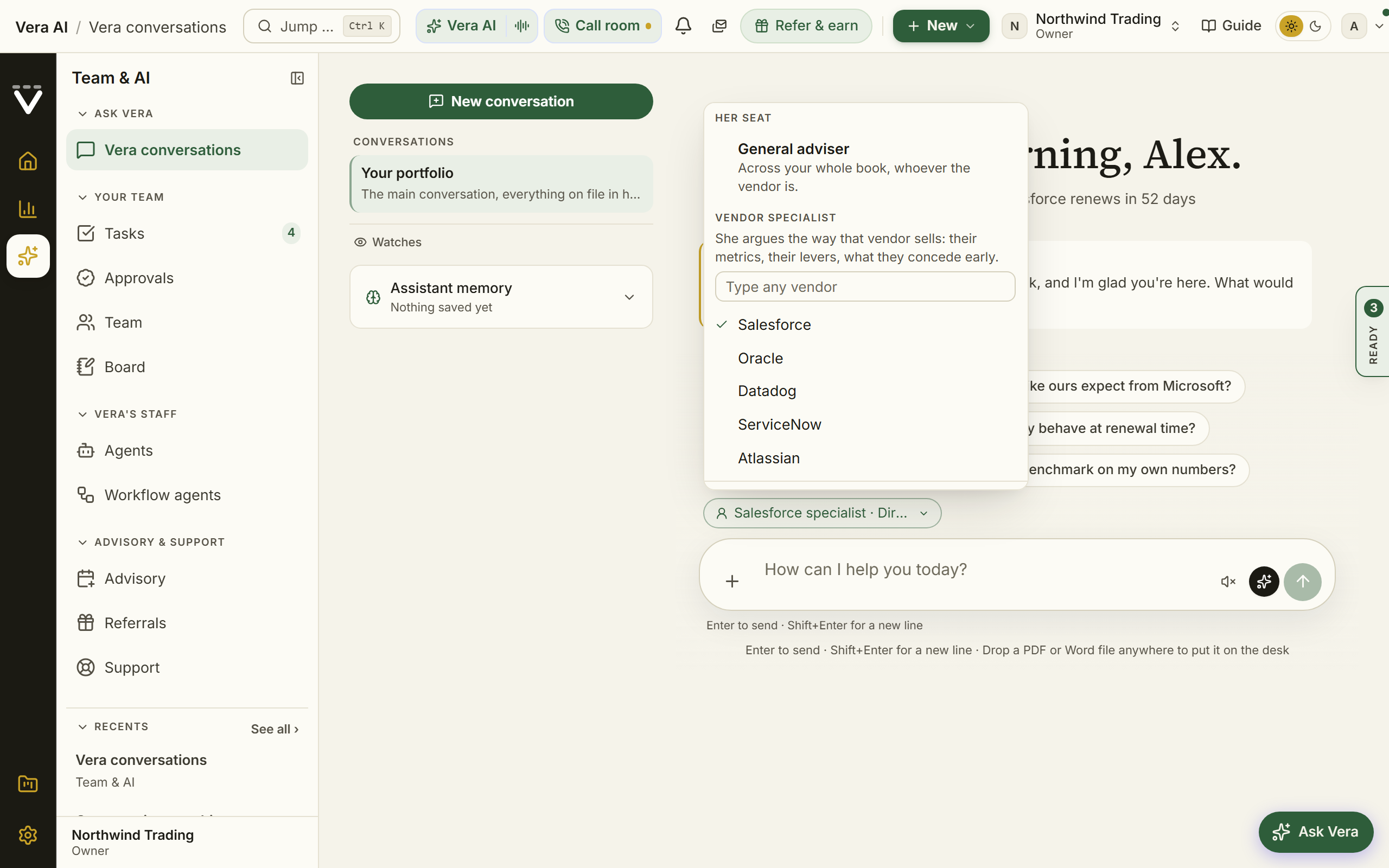
On the screen
- Her seat — General adviser is the default: she answers across your whole book, whoever the vendor is.
- Vendor specialist — the second seat, and the one worth setting before a renewal. She argues the way that vendor sells: their licence metrics and editions, the levers that actually move on their paper, the concessions they give early and the ones they hold, and where their fiscal calendar puts pressure. She uses their own terms of art where those are the clearest words for a thing.
- The vendor list — your own book first, up to eight names: the vendor on the paper currently on the desk, then the vendors whose agreements expire inside the next year, because the one you want is almost always one you already hold paper with. Sample agreements are left out, so an organisation running on the sample portfolio shows the empty list and asks you to type a name. Type any vendor covers everyone else: a name up to 60 characters, and that name is the only free text the control accepts.
- How she advises — three stances. Balanced is the default: the straight read and the one move it supports. Direct volunteers the harder read, names a concession as theatre when it is one, and puts every ask in its firm version. Careful prefers the collaborative framing and raises risk quietly and early rather than sharply and late.
- What it never changes — the line at the foot of the menu is the limit, and it is exact. The dials move emphasis, framing, and which move she leads with. They never move a figure, a verdict, or whether she says she does not know. Direct never overstates what the evidence supports in order to sound bolder, and Careful never softens a figure or buries a real risk in order to sound agreeable.
- Back to the default — at the foot of the menu: returns both dials to General adviser and Balanced in one press.
How to use it
- Open Vera conversations and press the control above the writing box. It reads General adviser · Balanced until you change it.
- To put her in a vendor's seat, pick a vendor from your own book or type the name and press it. The menu closes and the control names the seat.
- To set the stance, open the control again and pick Balanced, Direct, or Careful. The menu stays open, so you can read all three descriptions before you decide.
- Ask your question. The choice applies from the next question you send and stays set for every question after it, across conversations, until you change it.
- Press Back to the default when you have finished with that vendor, so the next conversation is not argued from a seat you have forgotten you set.
Tips
- A vendor seat is not a licence to invent. Everything she says about that vendor still comes from your own documents, the tools, or the research library, and where she does not have it she says so and names what to ask the vendor for. Ask a vendor-seat question about something else and she answers it plainly rather than bending it back to that vendor.
- The choice is saved to your profile rather than to the browser, so it follows you to another machine and survives a reload. It is yours alone and never changes what a colleague sees.
- The dials steer the conversation on the command desk. Vera on the other surfaces (Ctrl/⌘ J, the floating Ask Vera button, Vera AI) answers in the house voice whatever is set here.
- Two settings are two different questions to Vera, so the same question asked as General adviser and as a vendor specialist is answered twice rather than served the first answer again.
Related: Vera conversations · Vera AI
Workflow agents
Since August 2026 it opens as a Fluent window with its own menu: the rail inside lists the rest of Team & AI, so you move between them without going back out, and the entry you are standing on is marked. Escape closes the window.
An agent is a job you describe once and never do again: an AI analysis chained into an email or a task, running on a schedule, on every proposal upload, or when a renewal enters its notice window. The page is a workforce desk with four views on the masthead band.
*In plain words: the routine you keep doing by hand, chained once and run on a schedule.*
When to reach for this
- Anything you caught yourself doing weekly: the "Do this every week" control on record pages builds the entry for you.
- Routing platform output to where the team lives: an analysis into an email, a Slack post, a task.
- Supervising what you built: runs, failures, and pauses show in the Control room and the Agent Center.
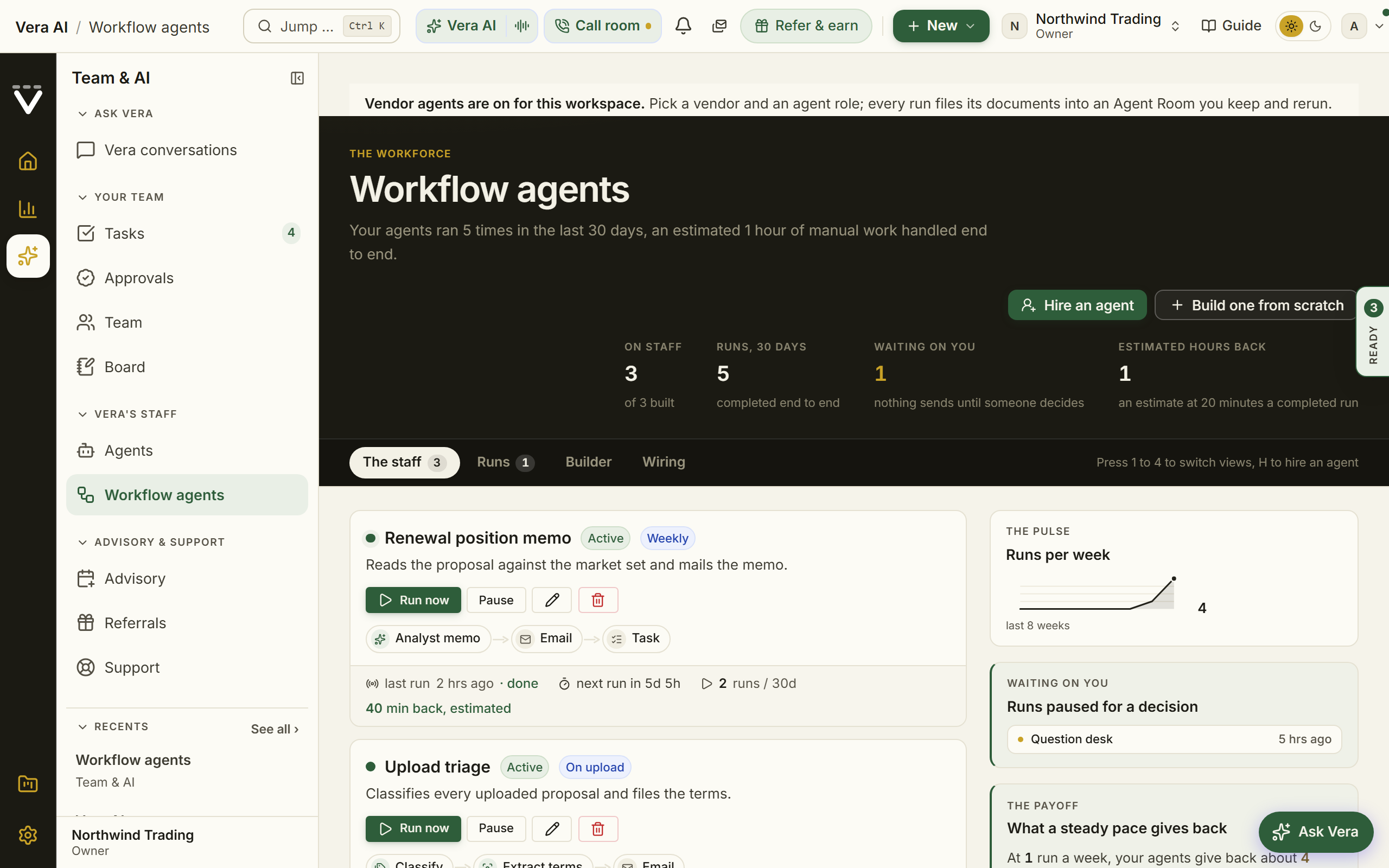
On the screen
- The masthead — how many agents are on staff of the number you have built, runs in the last 30 days, how many runs are paused waiting on someone, and last of all Estimated hours back, labeled as the estimate it is: 20 minutes of manual work a completed run, not a measured figure. Where real money is linked to the work, that money takes its place. The Hire an agent and Build one from scratch actions live here.
- The roster is the front door — with nothing on staff yet, the page opens straight onto the role gallery: the sixteen roles of the negotiation desk on big cards first (each stating what it watches, what it writes, and how many documents a run produces), the rest of the catalogue beneath. A search box and a "Everything they can do…" dropdown filter the cards by capability (research a vendor, read a contract like an expert, defend an audit, watch the market weekly, and so on). Picking a card opens the hire wizard already pointed at that role.
- Four views, one desk — the band switches views: The staff (every agent with its live heartbeat, its step chain drawn as a strip, and its Run now, Pause, edit, and delete controls), Runs (the console, with a badge on the tab the moment a run pauses for a decision), Builder (a standing bench: pick a trigger, then stack steps in order; details from whatever set the run off, the vendor, the agreement, the deadline, fill in by themselves), and Wiring (the agent inbox, the ghost writer, and a plain reference of every trigger). Press 1 to 4 to switch, H to hire an agent.
- The negotiation desk — the sixteen prebuilt roles cover the whole arc of a deal. The whole first-call file leads them: drop one contract and it writes the six documents a buyer actually asks for, the benchmark (your discount, what comparable buyers land, where this ranks), what to renegotiate with every term priced and the ask written out, the strategy with its concession ladder, the competitive scenario with the switching bill and three priced scenarios, the research brief on how this vendor negotiates and which analyst films to watch first, and the talking points for the call. Then: prepare a negotiation from a vendor name or from your uploaded contract, a call script aimed at a goal you state in your own words, the full deal check (the benchmark verdict on how good the deal is, the contract decoded clause by clause, then an independent second opinion that reads both, ending on the Deal Room question), the market monitor, the renewal war room, a quote teardown, a pre-signature red flag scan, audit defense, price increase pushback, the walk-away builder, rightsizing before renewal, the board and CFO approval pack, the first-call rehearsal, and the deal close handoff. Each role writes several full documents per run, every one its own model call, and a chain that ends in an email mails the whole pack.
- The rail — beside every view: the runs-per-week pulse over the last eight weeks, any run paused for a sign off with a link straight to it, and the payoff instrument: drag a runs-per-week pace and it states the hours given back a quarter, at 20 minutes of manual work saved a run.
- Editing an agent — the pencil on any staff card opens its draft on the Builder view; saving returns you to the staff.
- Runs — every run keeps a per-step record; open one to read the documents it produced. When the run was about a vendor the film library covers, the analyst films on that vendor sit under the documents and play in place, so the three the research brief told you to watch are already there.
- The run as a live desk — launching an agent opens the full-screen desk immediately: a gold progress ring fills step by step around a page writing itself, the narration line streams what the agent is doing right now, and every document in the left rail moves from queued to writing to filed, readable the moment it lands. Back to the app sits top left, your other recent runs and a Hire another agent button ride the left rail, and the Put it to work rail carries the real next moves: email me the pack, rerun with today's data, a chat-ready summary, three suggested next hires, and the schedule card. The agent is always saved automatically; the schedule card asks when it should run by itself (weekly, on every upload, on renewal windows, or only on demand), and the choice stays yours. Arrow keys page the filed documents, Esc closes. Behind the desk, the run page keeps the briefing-case cover, the document miniatures with Word exports, and the step by step run log.
- Turning the emails off — every email an agent sends closes with a link to Settings › Notifications, so turning them down or off is always one press away.
Hire an agent, the wizard
Four steps, and every one arrives already answered so you are correcting rather than composing.
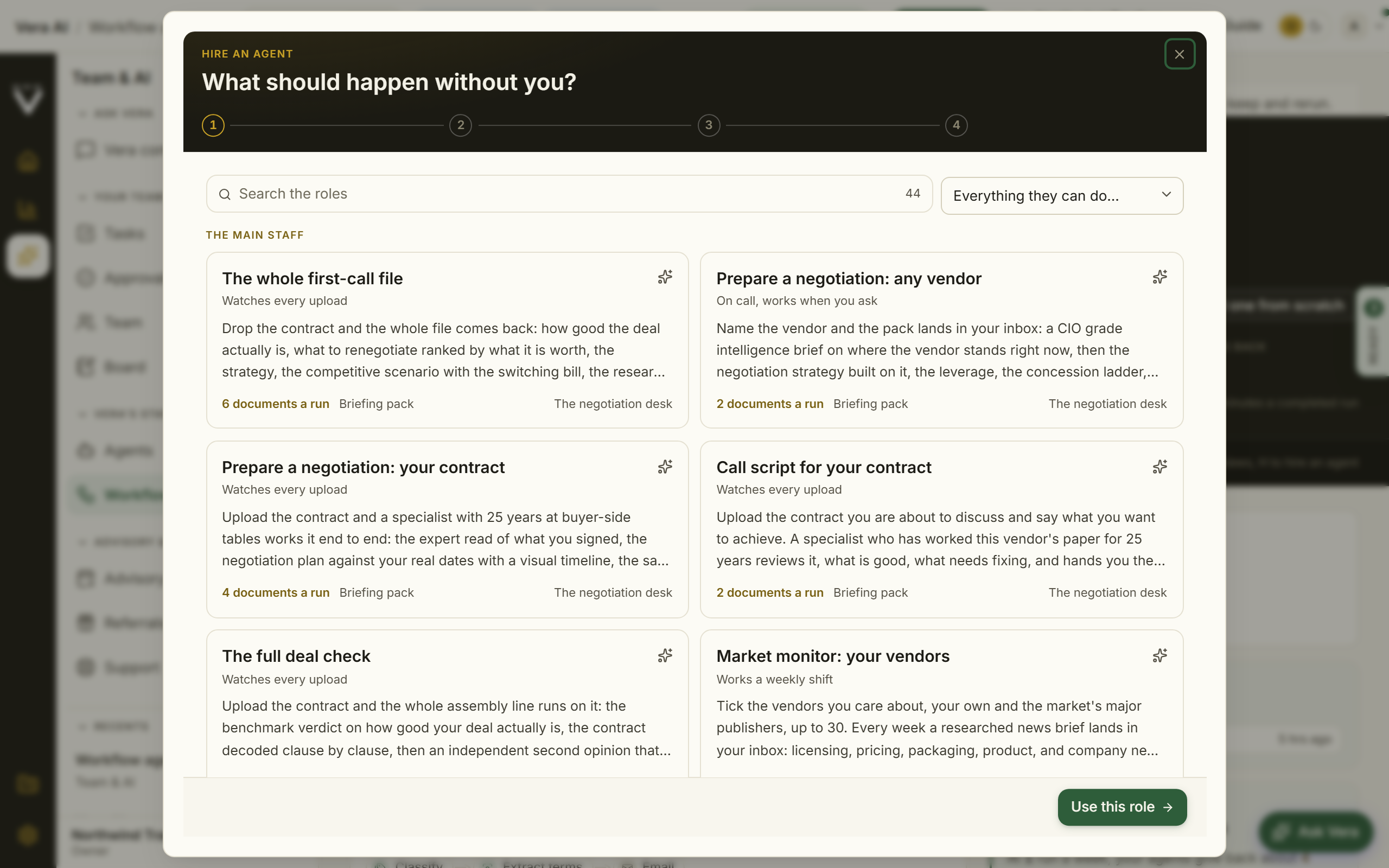
- What should happen without you? The full role gallery: the negotiation desk first, then every other role, with search and the capability dropdown. If you hold a renewal inside its notice window the renewal roles rise, and the page says why.
- Point it at your vendors. Pick one of your own vendors and the role fills in around it; the line under the picker rewrites itself with your real numbers as you choose. Vendor lists show one card per company, legal entities like Oracle America or SFDC Ireland are folded into one vendor with the yearly spend summed. The market monitor asks differently: tick up to 30 vendors to watch, from your own records and from the market's major publishers, and its weekly brief reports dated vendor news in plain English, with no advice attached. Roles that work toward an outcome (the contract prep and the call script) also ask what you want to achieve, in your own words, because an agent that knows the goal writes a sharper document.
- Here is the chain we built — the trigger, then every step in order with the document it writes. Nothing here has to be right the first time; the builder can change all of it later.
- Watch it run — the rehearsal. It runs the whole chain on your own records, and every email goes only to you, nothing is created for anyone else, and nobody else is notified. You read what it wrote before the agent is ever live.
How to use it
- Press Hire an agent (or pick a card on the landing roster), pick the vendor or tick the watch list, state the goal where the role asks, and run the rehearsal.
- Read what came back. If it is right, the agent is already saved and you turn it on; if it is not, open it in the builder and change the step that was wrong.
- Set a workflow to fire on every proposal upload when you want it to run itself; the market monitor mails its brief weekly on its own.
Related: Vera AI · Analyst Benchmark & upload
Vendor agents & Agent Rooms
One agent, one vendor, one room. Pick a vendor and an agent role, press Run the agent, and the agent writes its documents one at a time, every figure drawn from your stored records or labeled as the desk's market read, and files all of them into a single Agent Room you keep, reread, and rerun whenever your records change.
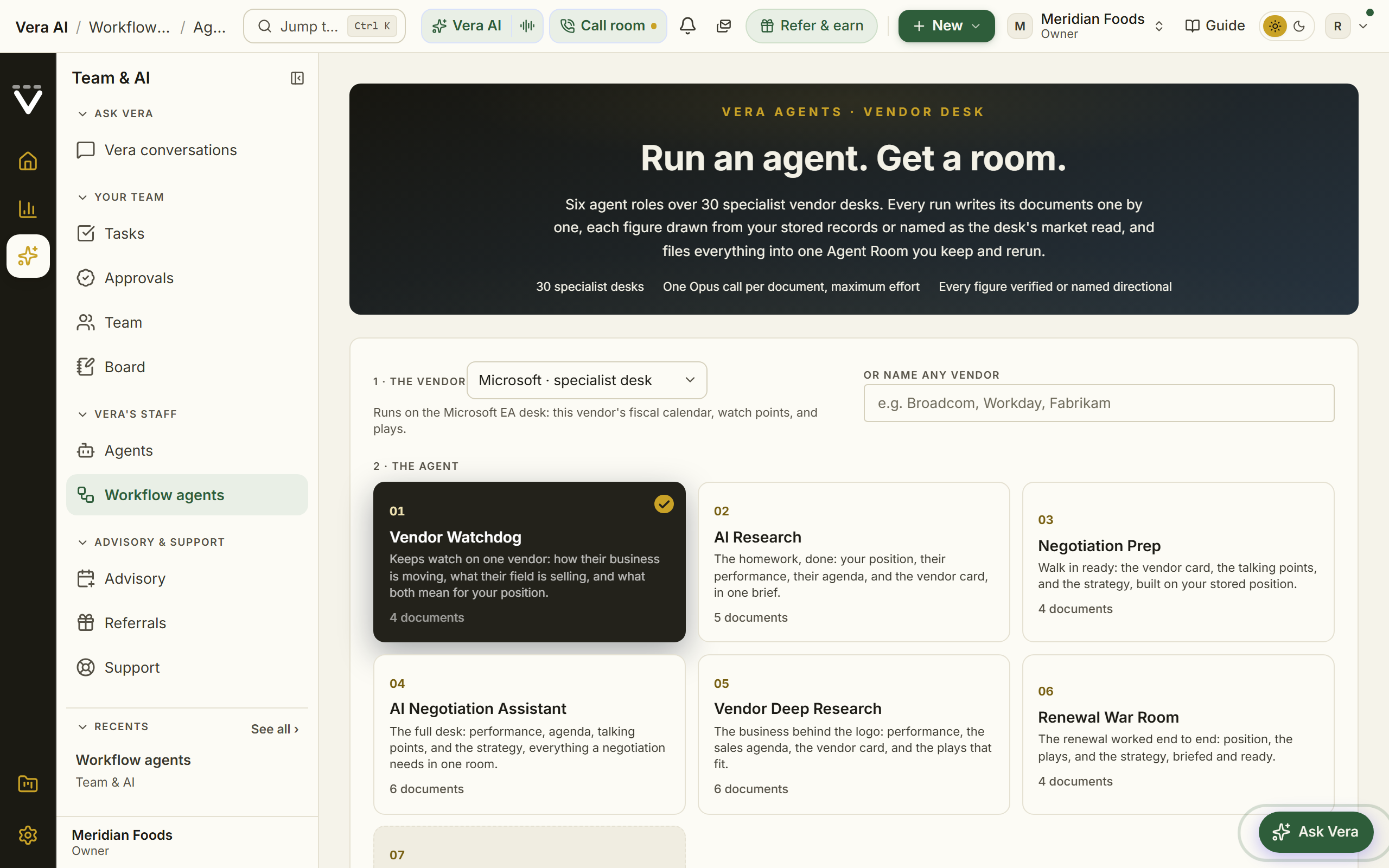
On the screen
- The vendor — two groups in one list. Your vendors comes from your stored agreements, largest first, with sample paper excluded, and names the specialist desk where one covers the vendor. The specialist desks lists all 30 desks, every one pickable even before you hold an agreement with that vendor; a desk holds the vendor's fiscal calendar, contract watch points, sales motion, and negotiation plays. Any other vendor can be typed in by name; the room then runs on your stored records alone, and the page says so plainly before anything starts.
- The agent — six roles plus Build your own, each card stating how many documents it writes; the selected card fills navy with a gold check. Vendor Watchdog reads how the vendor's business is moving and what their field is selling. AI Research is the homework in one brief. Negotiation Prep writes the vendor card, the talking points, and the strategy. AI Negotiation Assistant is the full desk in six documents. Vendor Deep Research is the business behind the logo, including the plays that fit. Renewal War Room works the renewal end to end.
- Build your own — the seventh card. Start from a situation (prepare for a vendor call, keep watch, work a renewal, do the homework, check before signing, brief the leadership, or the full desk) and the document chain pre-fills; then tick exactly the documents you want. The position page always opens the room, built from your stored records with no AI writing.
- What is this negotiation, and what do you want? — one box, your own words, required: "renewal due in March; the quote landed with an 8% uplift; we want the cap at 3% and a shorter term." Every document in the run is written toward what you wrote, in the voice of a specialist who has worked this vendor's agreements for 25 years, and the position page opens with your assignment quoted back. Anything the stored data cannot answer gets named as missing, never invented.
- The run — pressing Run the agent takes the whole screen instantly: a full-viewport opening stage where the position page writes itself while the room is prepared. The reader then opens on the position, your stored data on page one, the moment it is written; you read while the rest of the case file writes in the background. Pending documents sit in the rail with their live states (writing, queued), a quiet progress band shows what the agent is doing with an honest count that never claims a page before it lands, and each document becomes readable the moment it files. A document takes a few minutes; leaving the page pauses the run where it stands, and reopening the room resumes it from the last filed page. Nothing is lost to a closed laptop.
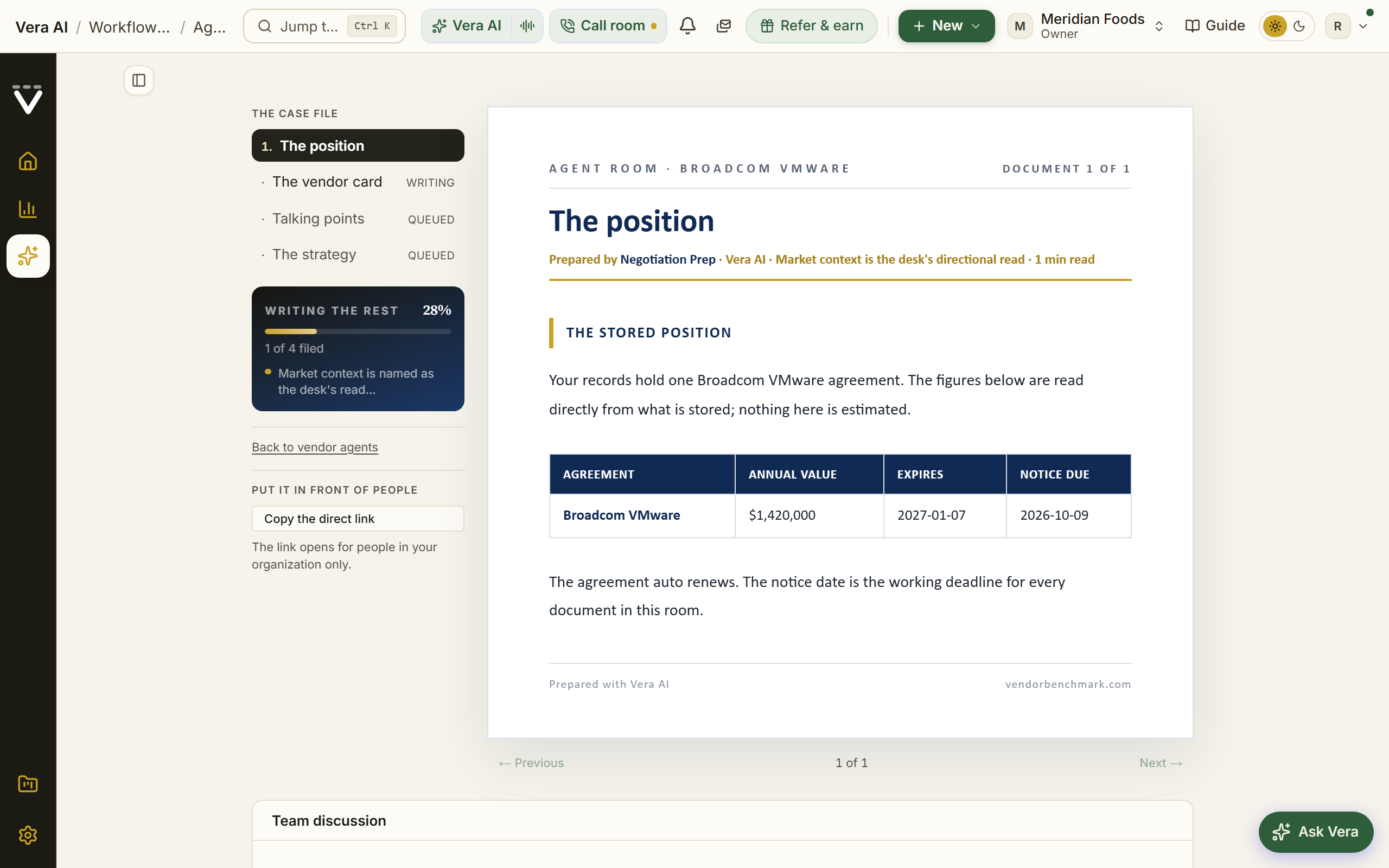
- The room — a finished run reads as a case file: the documents on a numbered rail, one page at a time on the report paper, with previous and next at the foot. The first page is always your position, built only from your stored agreements.
- The byline on every page — each document says where it stands: figures checked against your stored data, or exactly how many figures could not be verified and should be read as directional. Market context from the desk is always named as the desk's read, never presented as your data.
- Rerun with today's data — starts a fresh room for the same vendor and role against your current records. The old room stays on your list, so runs become a record of how your position moved.
- Put it in front of people — the rail's hand-off block. Copy the direct link copies the room's address; it opens for people in your organization only. Send to this teammate picks a colleague and puts a review task on their desk with a note in their inbox, so the room lands as work rather than a link. And on a complete room, Email me the case file (PDF) sends the whole room to your own inbox as one document: a cover page, then every document in reading order, each page carrying its own provenance line.
- Team discussion — a thread under the reader, the same discussion the rest of the platform uses. Type @ and a name to notify a teammate; replies, resolving, and edits work exactly as they do on a renewal or an approval.
- Your agent rooms — every room you have run, newest first, with its status. A room that hit an error keeps the documents it finished and offers to resume.
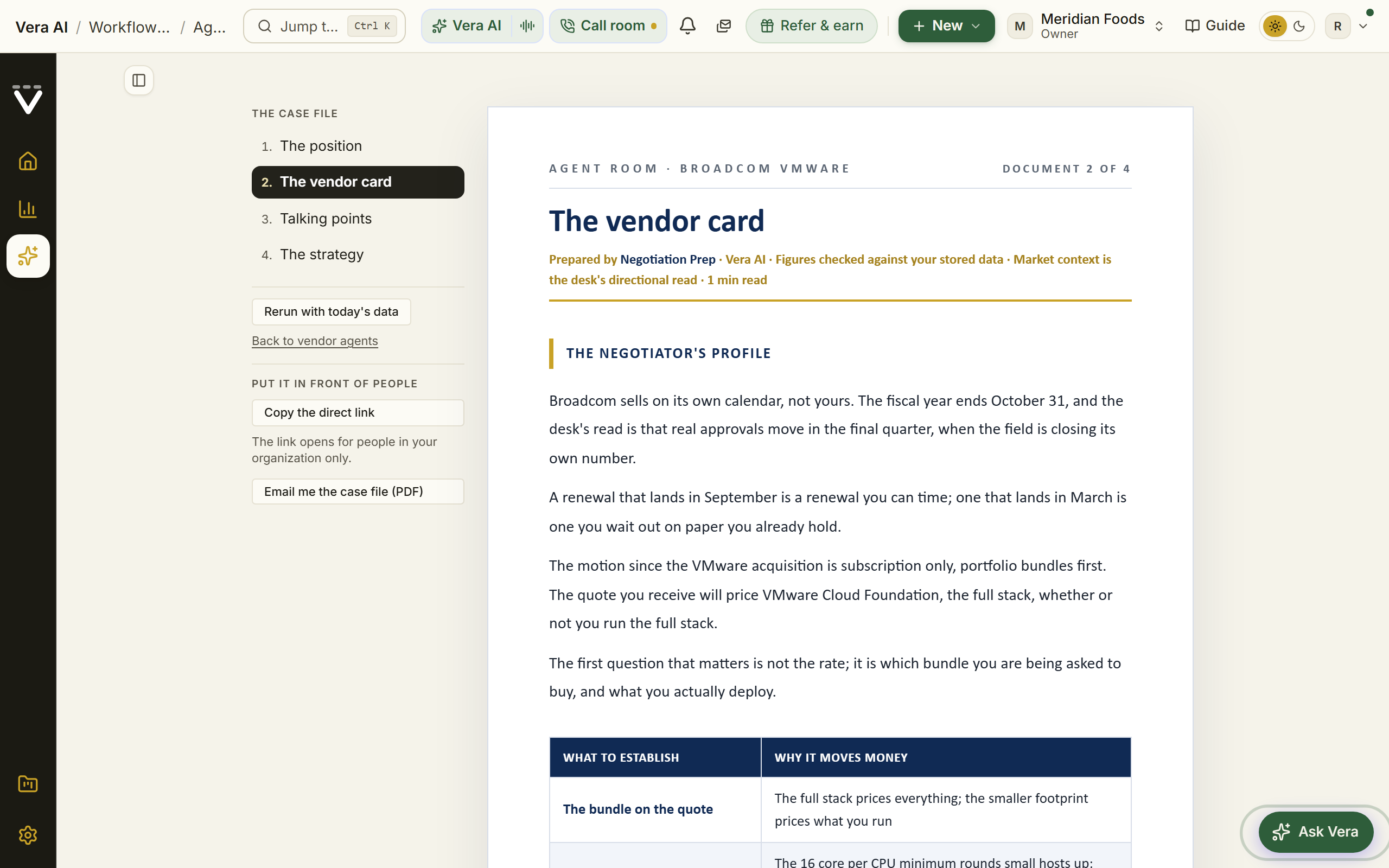
How to use it
- Open Workflow agents and press Run a vendor agent, or go to
/workflows/agentsdirectly. - Pick the vendor. If it carries a specialist desk the page names it; if not, the run still works from your stored records.
- Pick the role that matches the job in front of you, or Build your own and tick the documents. Then say what the negotiation is and what you want; the run does not start without it.
- Press Run the agent. Each document counts toward your AI allowance, and the page says so before you start.
- Watch the stage as the room fills, or come back later; the run resumes when you reopen it.
- When your records change, open the room and press Rerun with today's data.
Good to know
- The position page is deterministic: it is assembled from your stored agreements without any AI writing, so it is always exact.
- A vendor with no specialist desk still gets a room, built from your records alone, and every page says that is what it is.
- Rooms belong to your organization. A link to a room only opens for people in your org.
Related: Workflow agents · Vera AI · The Agent Center
Deliverables
Every delivered benchmark, AI brief, tool run, and draft in one place, laid out as an inbox: folders on the left, the list in the middle, the document on the right. Reading one never leaves the page.
Your position sits in the masthead: reports delivered with the latest date, how many are in production, and how many vendors they cover, on the same band as the Library, Generate, Drafts and Lessons tabs.
On the screen
- Folders — Inbox holds everything that is not archived and carries the unread count. Flagged holds the ones you marked to come back to. Delivered to you is the analyst team's work, Drafts your unfinished ones, and Archive everything you have filed away. In production underneath is not a folder but a count of the benchmarks still being written; they arrive in the inbox when they are published.
- Showing — above the folders, the lens on the whole library: Everyone lists every member's documents and is what the page opens on, Mine narrows it to the ones you asked for. It is a view and never a permission, so choosing Mine hides nothing from your colleagues. Your choice is remembered and carries to the Home activity ledger and the Reports shelf, and the folder counts follow it, so Inbox 4 under Mine means four of yours.
- The list — newest first, one row per document: the vendor or counterparty, the document title, and a line saying what kind of document it is. The end of that line names who the document belongs to: You in accent blue for your own, a colleague by name for theirs, Vera for anything the platform produced on its own. Under Mine the names come off, since every row would read the same. An unread document carries a blue dot and sits in bold; once you open it the row goes quiet. Search this folder filters what you are looking at.
- The reading pane — the document's type, title, vendor, and the day it landed, then Read it to open the full document, Word to download it where the type supports one, and Open the record to go to the contract or deal it belongs to.
- Triage — Flag marks a document to come back to, Unread puts the dot back so it stays on your list, and Archive takes it out of the inbox without deleting anything. Archived documents stay readable in the Archive folder and can be restored.
- Reads across the whole library — under the inbox, the AI narratives that read across every document rather than one: the board report and the weakest metrics card.
- Commission a deliverable — the full catalog of document types, folded away once your library has something in it and open by default when it does not.
How to use it
- Work the bold rows first. Those are the documents nobody on your side has opened.
- Select one to read it in the pane beside the list, then press Read it for the full document.
- Flag what you need to come back to, and archive the rest so the inbox stays the things that still need you.
- Create a new one from Vera AI, or open Commission a deliverable at the foot of the page.
Tips
- Read, flagged, and archived state is held in your own browser, so your unread count is yours and not your colleagues'. Clearing site data resets it, and nothing is ever deleted by archiving.
- A delivered analyst benchmark is signed with the person who sent the paper in, not with our analyst who wrote it: the useful question on that row is whose upload it answers.
Related: Vera AI · Deliverable exports, sharing & history
Deliverable exports, sharing & history
Every AI deliverable carries the same three companions wherever it renders: a download that matches the on-screen document, a public share link guarded by a confidentiality scan, and a version history you can diff and revert. As of August 2026 the flagship report views (benchmark narratives, the portfolio board report, the all-vendors benchmark, Reporting studio runs, and the scenario and comparison memos) assemble these through one shared toolbar, so exports, share, present, print, the Send it on drafter, and history sit in the same place on every report.
*In plain words: every document can leave the building safely: exported, shared, and versioned.*
When to reach for this
- Forwarding a brief outside the workspace: the share link's confidentiality scan is the safety net.
- "What changed since last month's edition?": the version history diffs it.
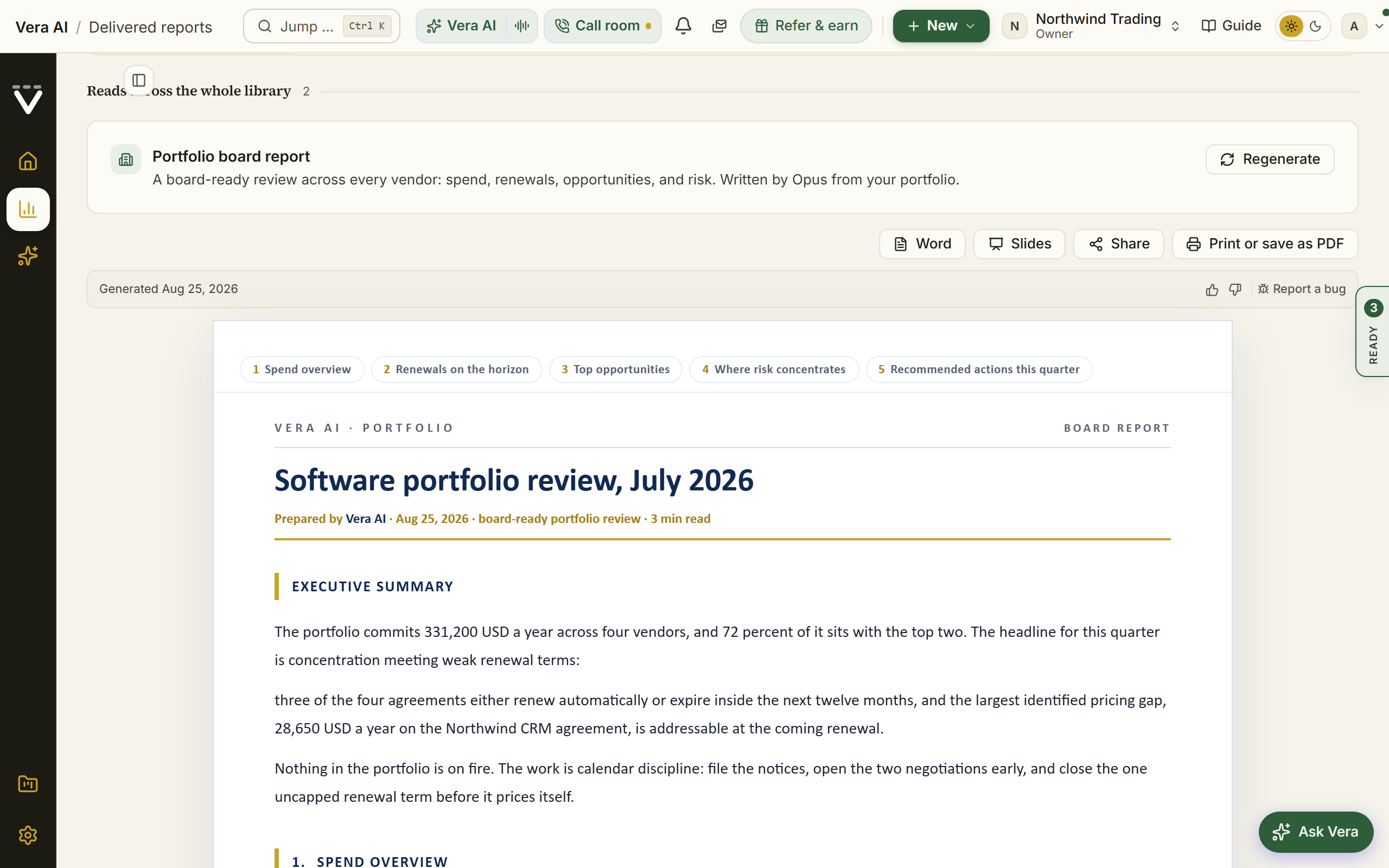
On the screen
- Download — exports the deliverable as Word (and, for the flagship reports, PowerPoint), rendered in the same executive-brief theme as the on-screen document. Most document types support it; the Formats column in Delivered reports › All documents shows which.
- Share — mints a public link and copies it to your clipboard, so a colleague without an account can read the document. Before the link exists, the deliverable is scanned for content your organization would not want external: named employees, walk-away numbers, internal targets, and internal notes.
- Check before you share — when the scan flags something, the findings render with quoted excerpts and no link is minted. Sharing anyway is an explicit, audited choice; overriding a walk-away number or internal target takes a typed confirmation, not one click.
- History — every regeneration is kept as a version. Open the history to see a word-level diff between any version and the current one, and revert to an earlier version when a regeneration went the wrong way.
How to use it
- Download the Word export when the document leaves the platform; it matches the on-screen brief exactly.
- Press Share to send a read-only link instead of an attachment. If the confidentiality check raises findings, read the excerpts before deciding.
- Regenerated a report and prefer the old one? Open History, compare the diff, and revert.
Tips
- A share link shows the document as it stands; revoking and reissuing is the way to cut off an old copy.
Related: Deliverables · Delivered reports
The commission rail
*In plain words: one-click orders for the brief this page is begging for, labeled with its own numbers.*
When to reach for this
- The page's verdict deserves to become a document someone else reads: the chip is the shortest path.
- You are not sure what to commission: the chips are already scoped to the page's own situation.
Two to four gold sparkle chips under a page's verdict, each a one-click order for an executive brief about the page you are on. The chips are labeled with the page's own numbers ("Renewal brief: Salesforce, 41 days out"), never generic, and the rail always ends with a blue question chip that opens Vera pre-filled with a question scoped to the page.
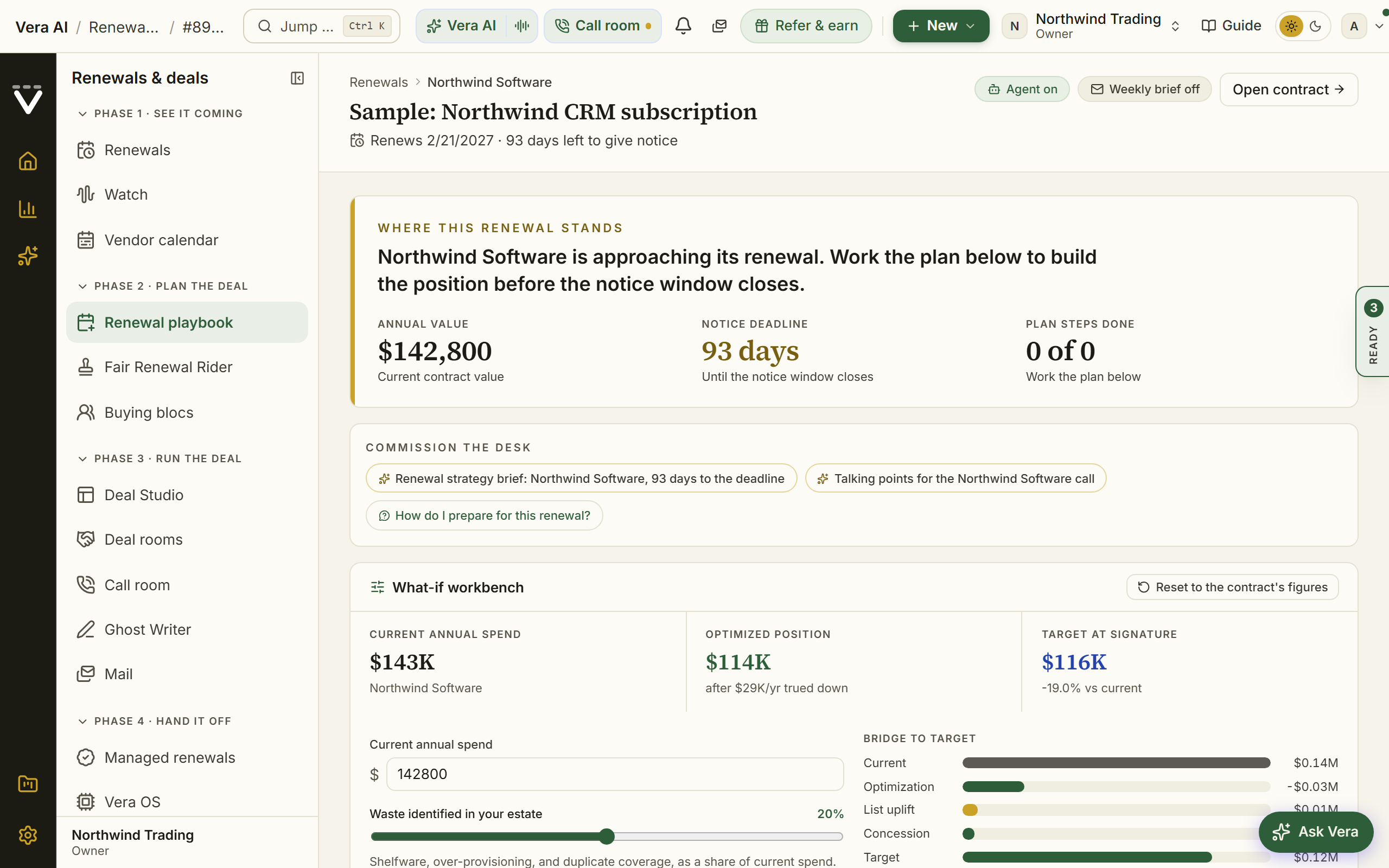
On the screen
- Gold chips — each one commissions a specific document: press it and the brief generates in a reading dialog with stage-by-stage narration.
- The finished brief — an executive summary, numbered sections, a bottom line, and a sources list; every figure is grounded in your stored data, traced in the sources list at the foot of the brief.
- The blue question chip — closes the rail: it opens Vera with a page-scoped question already typed, for when you want an answer rather than a document.
How to use it
- Press the chip whose label matches what you need; the document writes itself in the dialog.
- Read it there, or find it again later on the Deliverables shelf, where it lands automatically.
- Want a conversation instead of a brief? Press the blue chip and ask Vera.
Related: Deliverables · Vera AI
Advisory
Since August 2026 it opens as a Fluent window with its own menu: the rail inside lists the rest of Team & AI, so you move between them without going back out, and the entry you are standing on is marked. Escape closes the window.
Book time with a buyer-side analyst: a human expert who has negotiated with your vendor before, for the moments a report is not enough.
*In plain words: a human who has sat across from your vendor, bookable.*
When to reach for this
- The stakes outgrow self-serve: a large audit, a hostile renewal, a deal above your comfort line.
- Before signing something unusual: an hour of expert read on an odd structure is cheap.
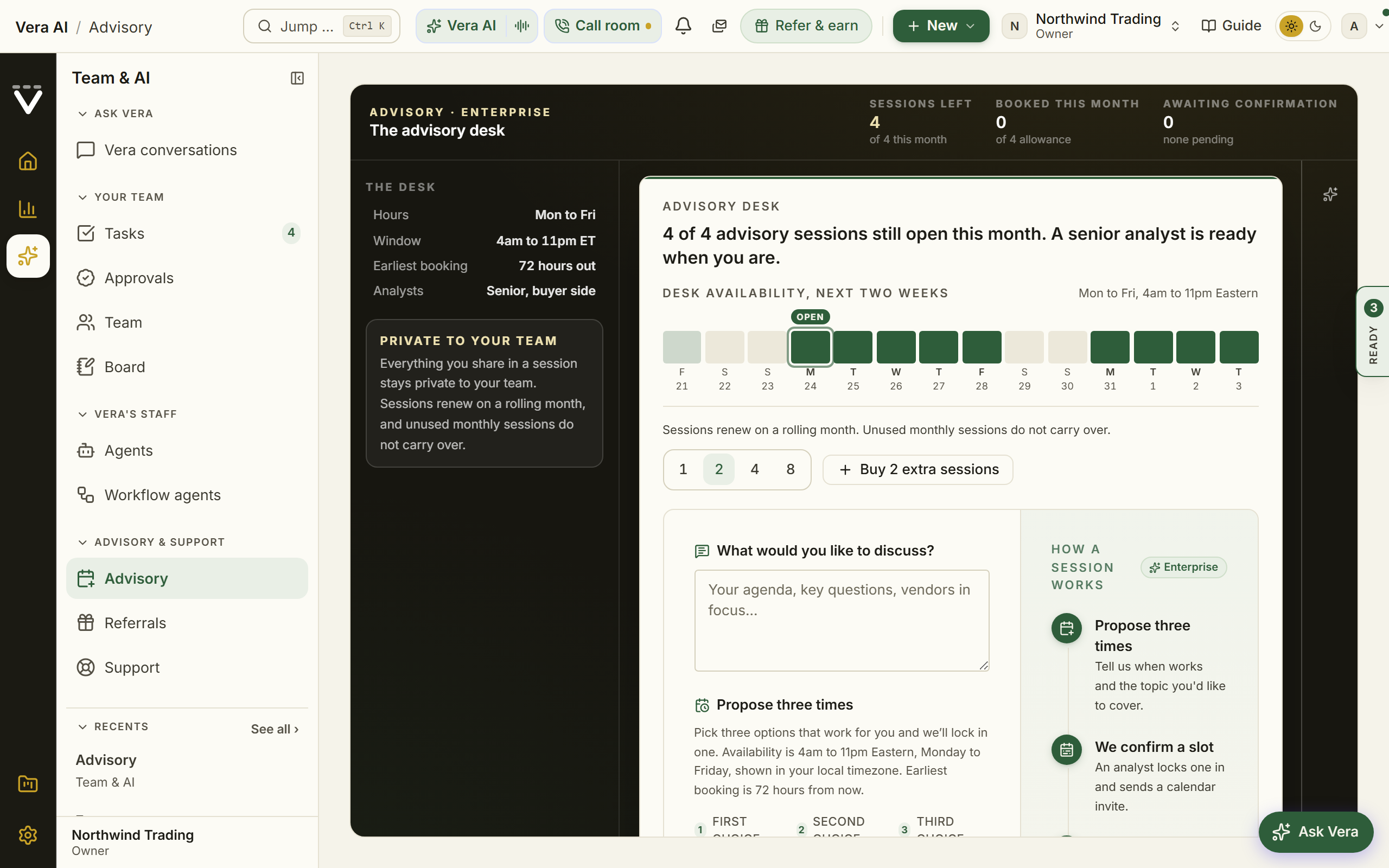
The desk is an application frame, the same command-desk grammar as Vera AI: a command bar with the live allowance, a dark rail with the desk facts and your bookings, the work on white papers in the middle, and a dock on the right edge.
On the screen
- The command bar — sessions left (monthly plus purchased), booked this month against your allowance, and bookings awaiting confirmation. Every figure is your stored usage.
- The desk rail — the desk facts, your bookings as one-line jumps, and the privacy note. The desk runs Monday to Friday, 4am to 11pm Eastern, shown in your local timezone, and the earliest booking is 72 hours out.
- The booking paper — the headline states how many sessions are still open, then the desk's availability for the next two weeks, the buy-extra buttons for when the month runs short, and the form: your agenda, then either three proposed times or, where instant booking is enabled, a direct calendar slot. The right side of the card explains the three steps of a session.
- Your bookings — every request as a ticket on its own paper: confirmed sessions carry the date stub and an Add to calendar link, pending ones list your proposed times, and each can be cancelled.
- Start from a topic — in the dock, behind the sparkle icon: four briefs. The first two are composed from your own two nearest notice-window renewals and name the vendor, the renewal date, and the annual value, so the agenda arrives written about a real deal; on an empty workspace they fall back to the standard renewal strategy and pricing benchmark briefs. The last two (vendor consolidation, contract terms) are always the standard ones. One press opens the desk with the agenda pre-filled and leaves you one field from a request.
- Present a session — every booking carries a Present button that runs the meeting full screen during the call: the ticket of record, your brief in your own words, the agenda point by point with a covered counter, then agreed actions you capture live. The printed leave-behind carries exactly the screens you walked.
How to use it
- Write your agenda, or open the dock's Start from a topic panel for a pre-filled brief.
- Propose three times that work for you; we confirm one and send a calendar invite. Where instant booking is on, pick a slot directly instead.
- Track the request in Your bookings; add a confirmed session to your calendar from its ticket.
- If it can wait, message the team instead and they will pick it up in Chat.
Related: Chat · Your engagements
Your engagements
Every advisory engagement we are running for your organization: where it stands, what happens next, and what we need from you. When your organization commissions consulting work (a Microsoft EA renewal run, a Salesforce SELA review, an audit defense), the engagement lives here as a workspace you share with our team.
On the screen
- Engagement cards — one per engagement: its status (Setup, Active, On hold, Closing, or Closed), the phases completed out of the total with a progress bar, and the next milestone by name.
- The engagement workspace — open a card for the full workspace, organized in tabs: Overview (the phase plan and its activities), Timeline, Team (who is on the engagement, both sides), Discussion (a comment thread on the engagement record), Documents, and Deliverables (published work products). EA and SELA renewal engagements open on a dedicated analysis workspace tab.
- Join card — if you have a seat on the engagement team but have not joined yet, a card at the top asks you to confirm your name and role.
- Data requests — activities our team marks as data requests appear in the plan; providing the data checks them off and keeps the phases moving.
How to use it
- Open the engagement and read the progress bar and next milestone; that is the one-line status.
- Answer anything waiting on you: join the team from the join card, provide open data requests, and reply in Discussion.
- Read published deliverables in the Deliverables tab as the team ships them.
- Anything urgent between milestones goes through Chat; the thread and the workspace reach the same team.
Tips
- Internal working activities on our side are not shown to you; the plan you see is the client-facing plan, and every view you take of the record is written to the audit trail like any other document access.
Related: Advisory · Chat · Managed renewals
Partner portal
Since August 2026 it opens as a Fluent window with its own menu: the rail inside lists the rest of Team & AI, so you move between them without going back out, and the entry you are standing on is marked. Escape closes the window.
Your client book. Every client organization linked to your firm on one table: their contract dates, their next renewal with its notice deadline, and how engaged the account is. Visibility is deliberately narrow, dates and activity only; each client's files, prices, benchmark results, and spend stay inside their own workspace.
The portal is an application frame, the same command-desk grammar as Vera AI: three desks as pills on one command bar (Client book, Prospect proposals, Marketing), the book's vitals beside them, a dark rail that jumps to any section of the desk you are on, the work on a white paper in the middle, and a dock on the right edge carrying What now (invite a client, build a proposal, import your list, send a note, the partner guide) and The boundary (the trust rule, one press away on every desk).
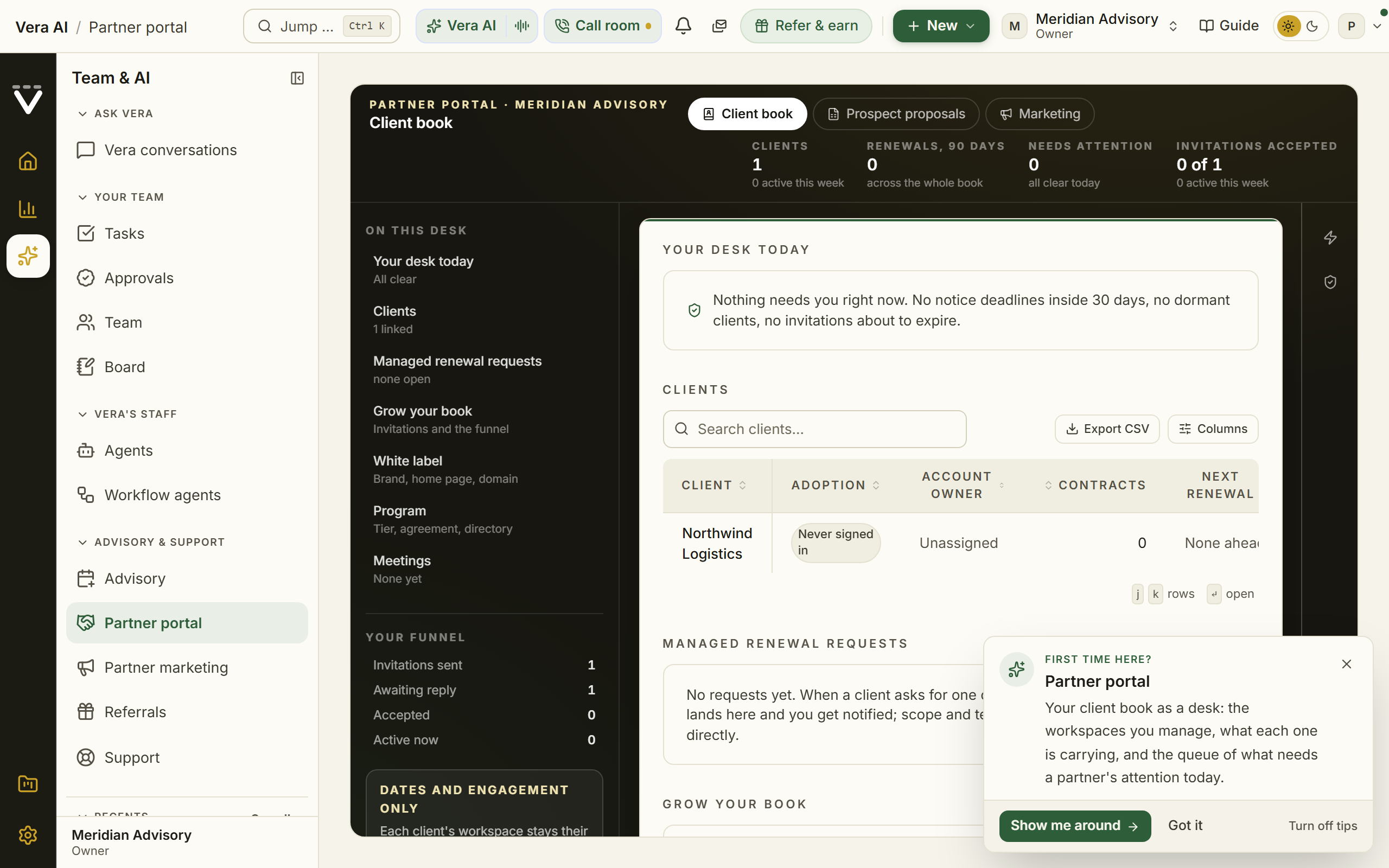
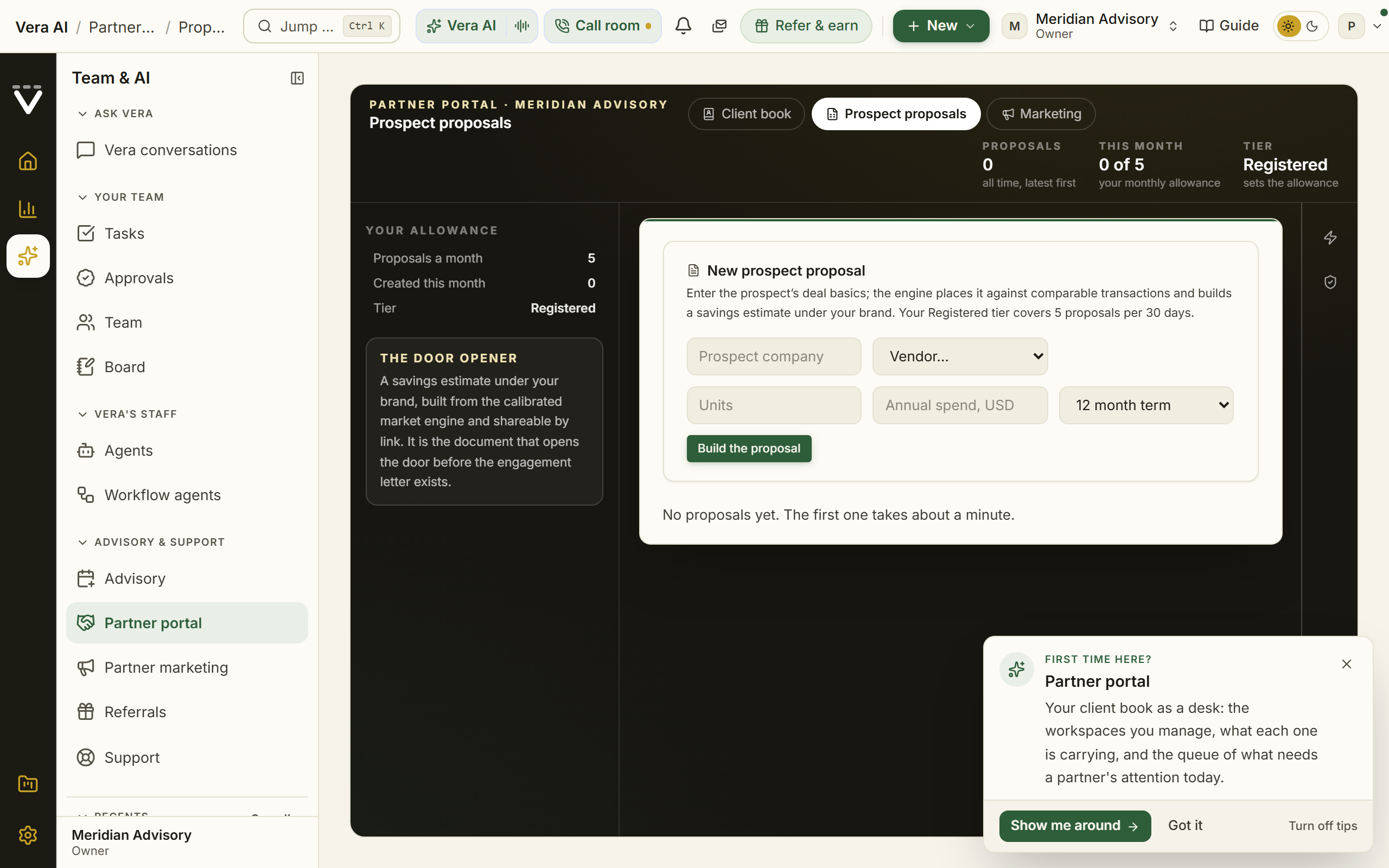
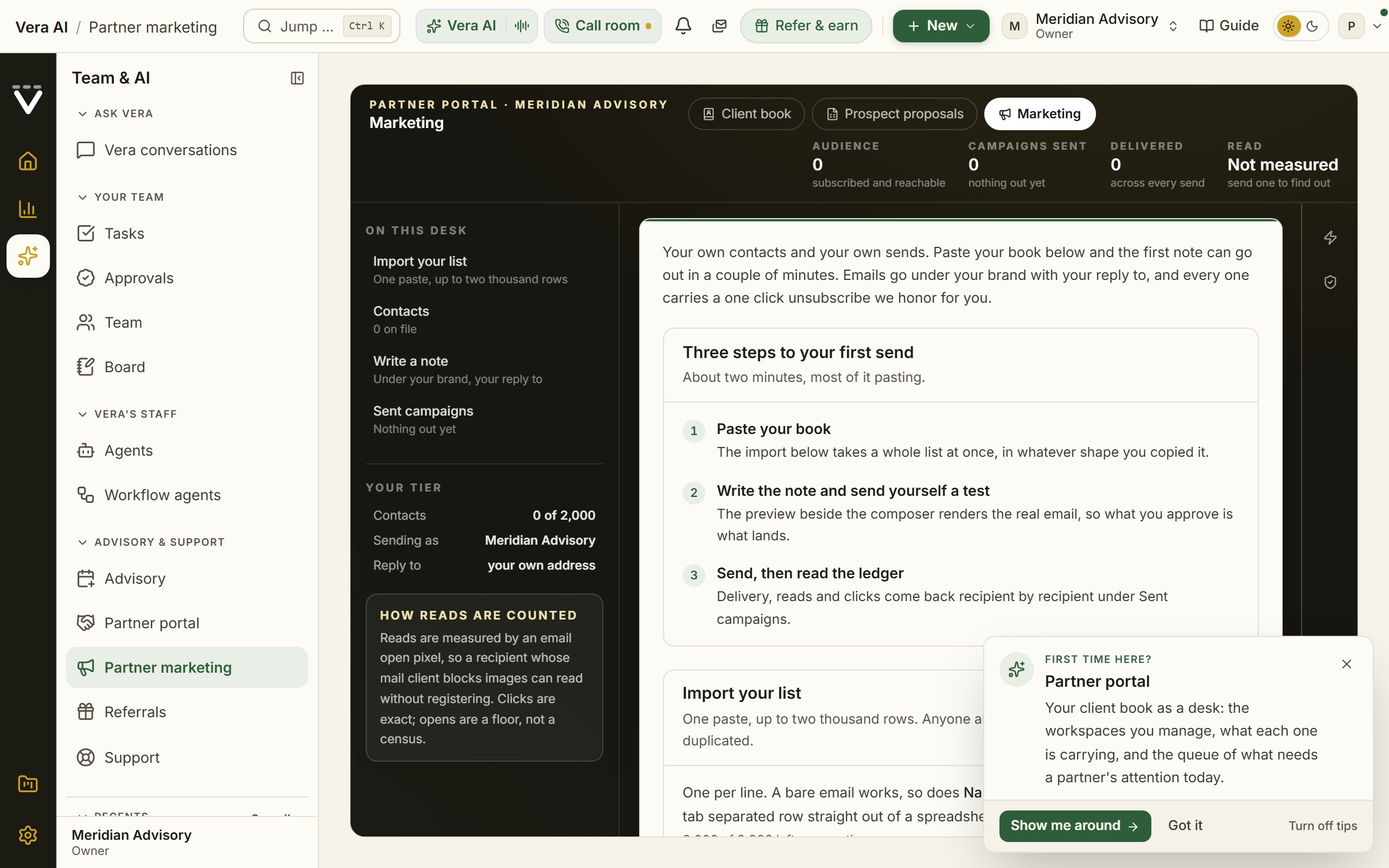
A client's page, and the quarterly business review it composes once that client has turned on outcome sharing:
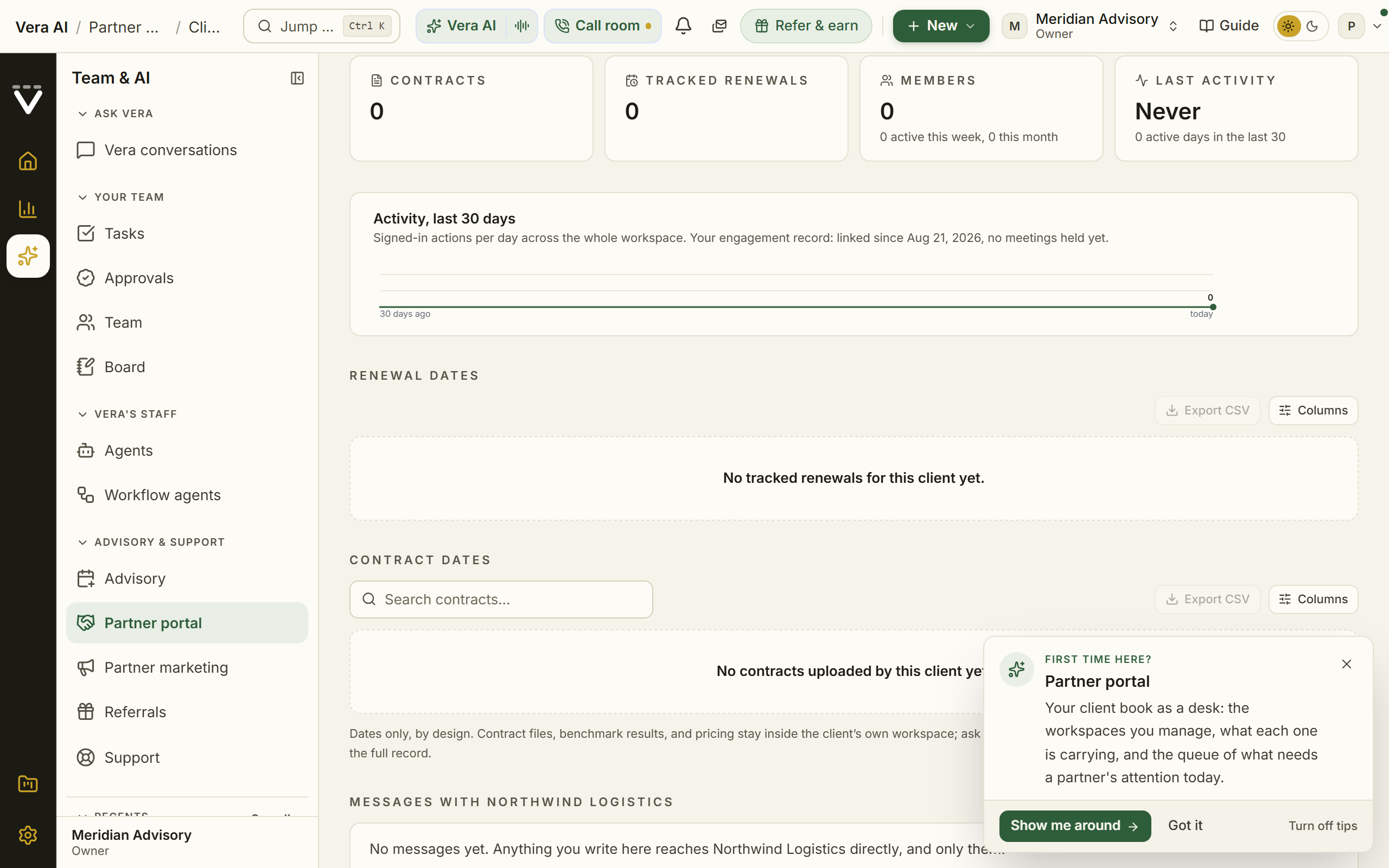
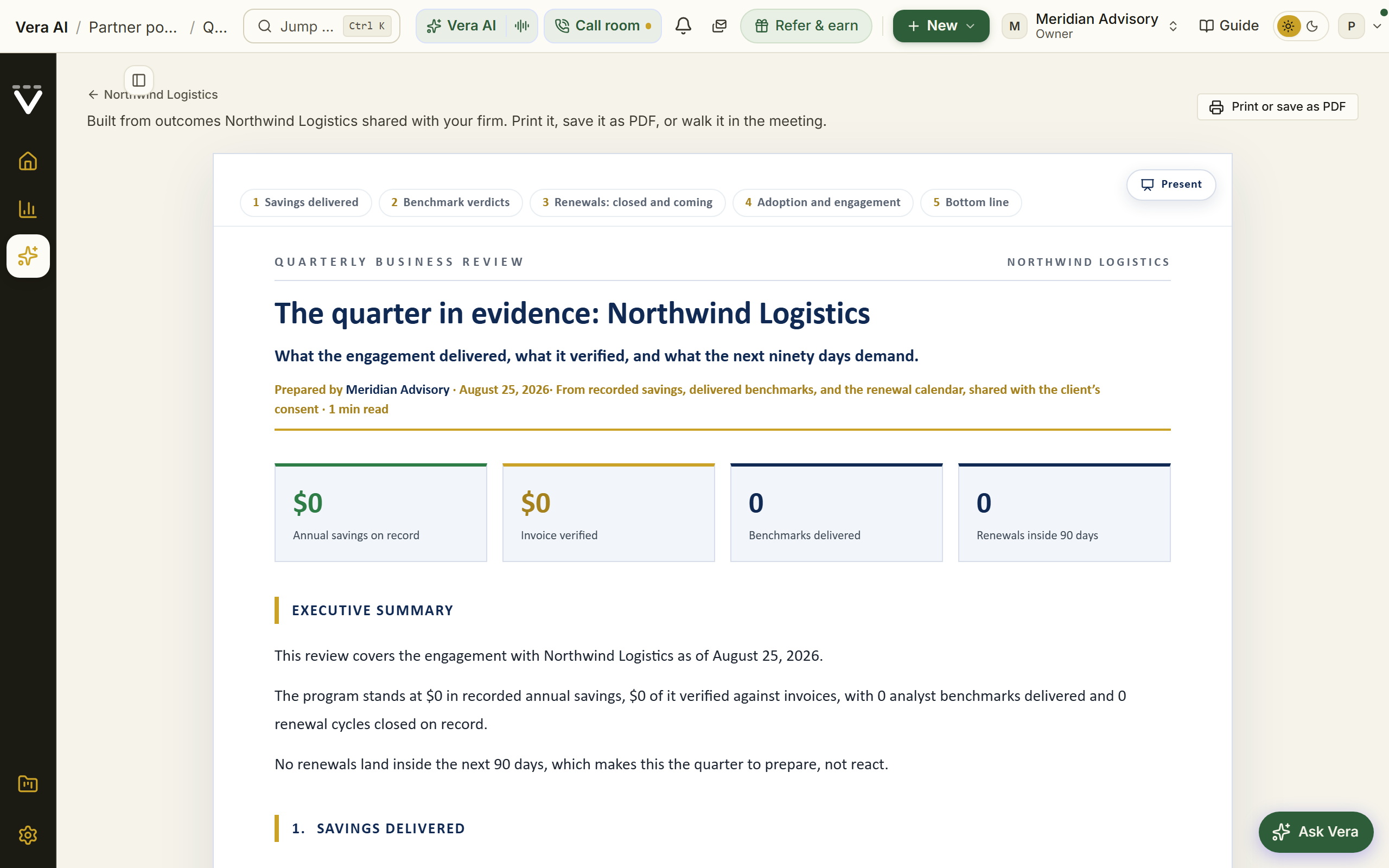
The public directory buyers browse, and the branded landing page an invited client sees:
On the screen
- The command bar — clients, renewals inside 90 days across the whole book, items needing attention today, and invitations accepted out of invitations sent.
- The desk rail — every section of the book one press away (Your desk today, Clients, Managed renewal requests, the horizon, Grow your book, White label, Program, Meetings), your invitation funnel as four figures, and the data-boundary note.
- Your desk today — a ranked attention queue: service requests, notice deadlines that passed or land inside 30 days, clients with no activity in 30 days, workspaces that never signed in, meeting proposals a week without an answer, and invitations about to expire. Each row links to the client or invitation it is about. When nothing qualifies, the queue says so.
- Draft it with Vera — a chip on every queue item except the expiring invitation. It writes the note from that item's own client, vendor, and dates: under 120 words, in your voice, addressed to a name you fill in, and never naming VendorBenchmark or Vera. Edit the subject and the body in place, press Redraft for another take, then Copy email. There is deliberately no send path. You send it from your own mail client, under your own name, so the client relationship stays yours and the platform never appears in it.
- Client book — one row per linked client: adoption stage, the account owner inside your firm, contracts, next renewal (vendor and date), renewals inside 90 days, active members this week, and last activity. The adoption stage reads Active, Getting started, Quiet, Dormant, or Never signed in, derived from real sign-in activity. Rows with a renewal inside 90 days are tinted. Assign the account owner from each client's page; the morning digest names them on items about their accounts.
- Outcomes on client pages — when a client's owner turns on outcome sharing (their switch lives on their Your advisory partner page, off by default and revocable), that client's page shows the results of the work: realized savings with their invoice-verified share, delivered benchmark verdict scores, and closed renewal outcomes. Files, prices, and the analyst narrative are never included, and every look you take is audit logged. With sharing on, Build the quarterly business review composes a client-ready executive brief under your brand, savings, verdicts, renewals closed and coming, adoption, and prioritized recommendations, ready to print to PDF.
- Managed renewal requests — when a client presses Get it managed on one of their renewals, the request lands here and at the top of Your desk today: client, vendor, renewal date, and their note, with Mark contacted and Close. The platform only tracks the state; scope, terms, and fees are agreed between your firms directly.
- Renewal horizon — the next twelve months of tracked renewals across your whole book, counted month by month.
- Grow your book — the invitation funnel (sent, awaiting reply, accepted, active now, with your conversion rate), then the invite form: client company, contact, email, and an optional personal note. The email and its landing page go out under your firm's brand. Open invitations show their expiry date with resend and revoke; accepted ones link to the client workspace they became and show how alive it is. Prospect proposals (
/partner/proposals), the second tab (pictured below): enter a prospect's vendor, unit count, spend, and term, and the calibrated market engine builds a one-page savings estimate under your brand, verdict, percentile, cohort range, and gap to median, shareable by an expiring link you can withdraw at any time. Your tier caps proposals per 30 days. - White label — your brand on the client experience: display name, brand color, and tagline, with a live preview. The logo comes from Settings › Branding. Only workspace owners can edit it. On the white-label tier (a Premier benefit, granted by VendorBenchmark), the section adds Your own sending domain: register a domain you control, publish the DNS records shown, press Check verification, and from then on invitations and campaigns send from advisor@your domain under your name alone, and your logo and name take over the rail lockup in the client workspaces you serve.
- Partner guide — the Program section header links to
/partner/guide, which is a document rather than a room and so stays off the tab row: the whole offering in one printable executive brief, from the tier ladder and the agreement to outcome sharing, white label, and the data boundary. Read it once, or hand it to a new hire on their first day. - Program — where the partnership itself lives. The tier card shows your rung (Registered, Select, or Premier), the caps it carries, and what the next rung unlocks. The agreement card carries the rate on record: offers from the VendorBenchmark team appear here with their terms, your workspace owner accepts in product, and the accepted version and rate stay visible from then on. The directory card drafts your public listing (one paragraph, focus areas, regions); firms on Select and above can switch the listing live in the public directory at
/partners, where buyers request introductions that land straight in your contacts. The morning digest switch is here too: weekday mornings, firm owners get the attention queue by email, and a clear desk sends nothing. - Your clients' home screen — curate what client workspaces open on: pick the apps that lead and add a one line headline under your brand, with a live preview of what clients see. The platform standard stays the default until you choose otherwise, the full catalog always stays one press away, and each client's own edits win. Owner only.
- Messages — every client page carries a direct message thread between your firm and that client. The client reads and replies on their Your advisory partner page, their owners get notified, and the thread is private to your two firms; partners cannot message anyone who is not their client. The client's side of that page also carries their outcome sharing switch, so what you can see is always their call.
- The boundary — in the dock, behind the shield icon on every partner desk: what you see (dates, renewal stages, org level activity, meetings) and what always stays the client's (files, prices, benchmark results, member identities). Show it to a hesitant client; it is the same list we show them.
- Meetings — every meeting between your firm and your clients, with its status.
How to use it
- Start with Your desk today; it is the call list, ranked. A passed notice deadline outranks everything else.
- Open a client row for the full picture: renewal dates with notice deadlines and stages, contract term dates, the 30 day activity chart, and your engagement record (linked since, meetings held).
- Watch the Adoption column: a Quiet or Dormant client two months before a renewal is the account to call first, and a Never signed in workspace needs a walkthrough, not a renewal pitch.
- Invite a new client from Grow your book. When they accept, their workspace opens on a free trial, already linked to your book, and it carries a "served by" mark for your firm. Invitations are single use, live 30 days, and can be revoked or re-sent with a fresh link; the funnel shows what each one became.
- Set your brand once under White label; every invitation and every client workspace mark uses it from then on.
- Propose a meeting from the client page: up to three times and an agenda. The client's workspace owners get a notification, confirm one time or decline, and both sides see the answer.
- Need the full record for an engagement? Ask the client to invite you into their workspace as a member; the portal never opens their files.
Clients join your book two ways: your own invitations, or a link made by the VendorBenchmark team after a client agrees in the engagement paperwork. If a client is missing, contact your partner manager.
Related: Partner marketing · Notifications · Members
Partner marketing
Your firm's own marketing desk: a contact list you build yourself, newsletter sends that go out under your white-label brand, and a read log showing who opened what. Nothing here comes from client workspaces; every contact was added by your own team.
On the screen
- The command bar — your audience (subscribed and reachable, with how many have unsubscribed), campaigns sent, emails delivered, and the share read.
- Three steps to your first send — while your list is empty, the page states the whole path: paste your book, write the note and test it, send and read the ledger. It disappears once you have contacts.
- Import your list — one paste, up to two thousand rows. A bare email works, so does the
Name <email>form every mail client copies, and so does a comma or tab separated row straight out of a spreadsheet. Anyone already on file is skipped rather than duplicated, so pasting the same list twice adds only the new names. - Contacts — add one at a time by email, name, company, and role. Unsubscribe or remove any contact; unsubscribed contacts never receive a send.
- Write a note — subject and body (blank lines start new paragraphs), a live preview of the branded email, a test send to your own inbox, and the real send to every subscribed contact. Emails go from our verified address under your brand's name, with your email as the reply-to.
- Sent campaigns — each send with delivered, opened, and clicked counts; expand one for the recipient-by-recipient log: clicked (and how many times), read (and when), delivered but unread, or not delivered.
- The desk rail — jumps to each section of the desk, what your tier allows (contacts against the cap, sending name, reply to), and how reads are counted. The boundary the portal runs on stands in the dock behind the shield: these contacts are yours, nothing is harvested from a client workspace, and no client's prices, documents, or benchmark narrative can be pulled into a marketing email.
How to use it
- Set your brand once on the Partner portal White label card; every send uses it.
- Paste your whole contact list into Import your list, or add people one at a time below it. The list is yours alone; clients' member lists are never visible to you.
- Write the send, or start from one of the three templates (a renewal season note, a quarterly market note, an introduction) and replace the bracketed slots. Press Send me a test, check your inbox, then send for real. The caps rise with your program tier, from 5 campaigns per day and 500 recipients per send on Registered up to 20 and 5,000 on Premier.
- Watch the read log. Opens are measured by an email pixel, so a recipient whose mail client blocks images can read without registering; treat opens as a floor. Links in the body are click tracked per recipient, and a click also counts the open, so the log distinguishes read from acted even when the pixel is blocked.
- Every email carries one-click unsubscribe. We honor it automatically and mark the contact unsubscribed for you.
Related: Partner portal · Notifications
Saved
A comparison spine shows a stale badge and a Compare again link in place of its saved date when either compared document has picked up a newer version.
Reports and research you bookmarked with the bookmark icon, plus every side-by-side comparison you ran, kept on shelves so you can find them again.
*In plain words: everything you bookmarked, in one place.*
When to reach for this
- Rebuilding context on a deal: the papers and reports you starred while working it.
- The bookmark is everywhere (cards, readers, report headers); this page is where they all land, and your home screen's Saved & shared panel shows the newest.
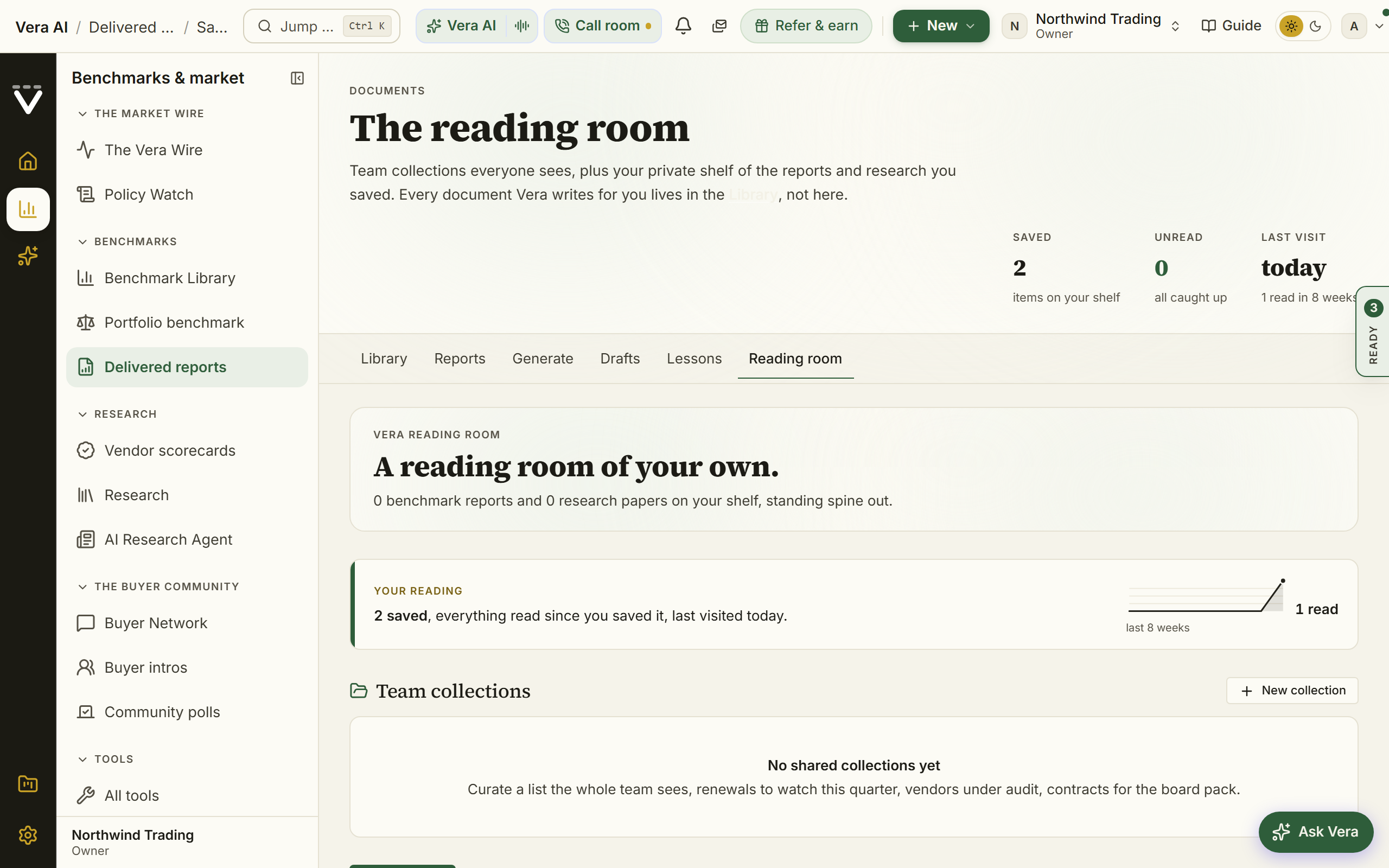
On the screen
- Saved items — everything you bookmarked, newest first.
- Comparisons — every side-by-side scan you ran on Compare contracts, saved to this shelf automatically, plus any a teammate added you to (marked Shared with you). A spine reopens the pair on the compare desk.
How to use it
- Open a saved report or paper straight from the list.
- Add to the list by clicking the bookmark icon on any report or research paper.
- Reopen a comparison from its spine. The X on a spine clears it from your shelf only; the analysis itself stays on both contract records.
Related: Delivered reports · Research · Compare contracts
Saved analyses
Negotiation playbooks the AI has written for you, kept in one list as the Drafts tab of Deliverables. When you ask Vera to analyze a document, the playbook she writes is saved here automatically, so you can revisit it, print it, or share a link with colleagues.
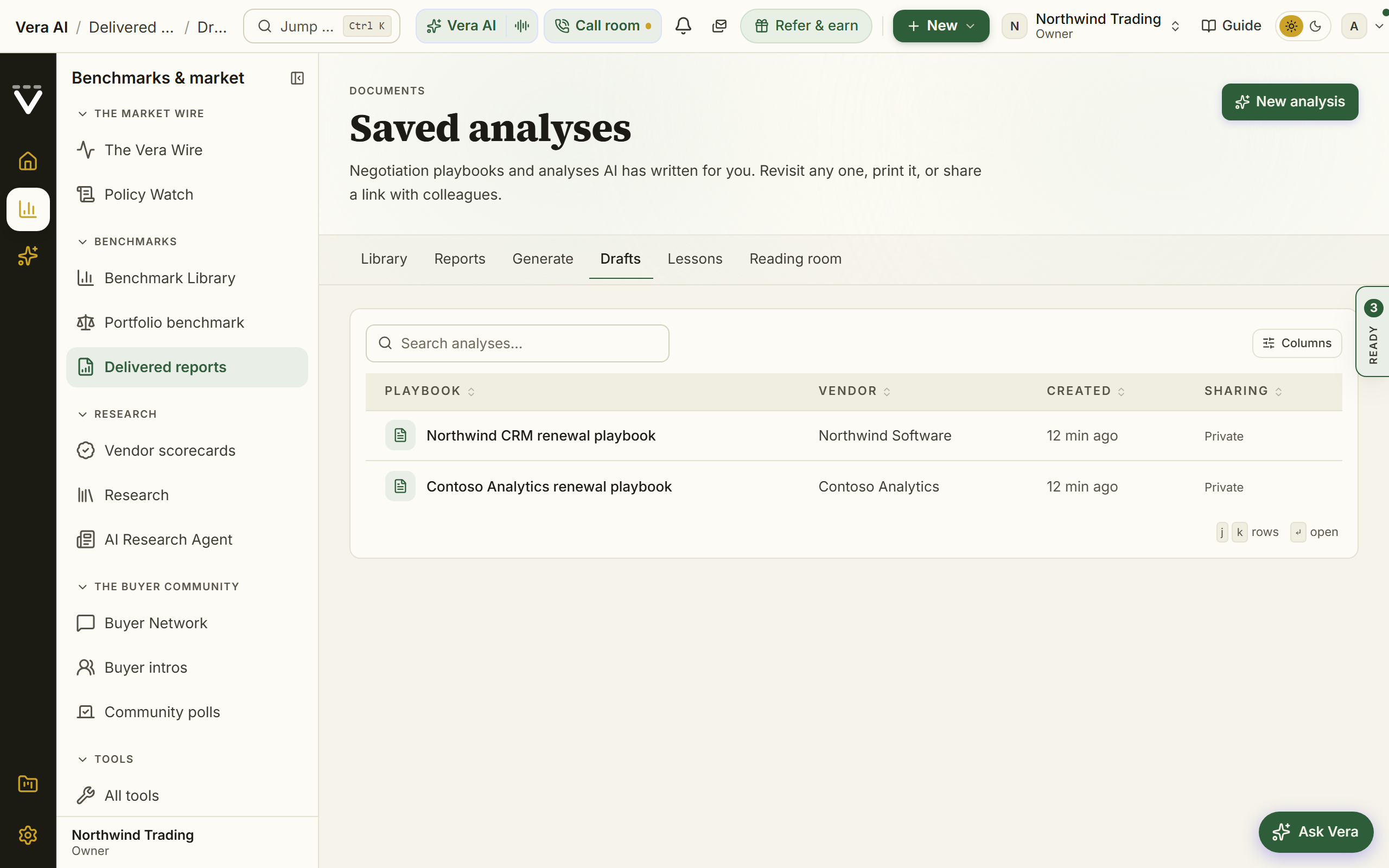
On the screen
- The list — every analysis with its playbook title, vendor, and creation date; search and sort across all of them.
- Sharing column — Link active means a share link exists for that draft (with its expiry date); Private means only your organization can see it.
- The draft page — opens the full playbook with a toolbar: Share link mints a public read-only URL and copies it, New link replaces it (the previously sent URL stops working), Email drafts a message carrying the link, Revoke kills the link, Print produces a clean paper copy, and Delete removes the draft for good.
How to use it
- Create one from Vera AI: choose "Ask Vera to analyze a document for you", and the result lands here.
- Open a draft to reread it before a call, or press Print for the meeting copy.
- Share it by minting a link; revoke the link when the conversation is over. A minted link expires on its own, and New link invalidates whatever you sent before.
Tips
- Your saved analyses also appear in the All documents library on Delivered reports, so there is never a second place to hunt.
Related: Vera AI · Deliverables
Playbook library
Every playbook the AI has written for you, shelved as one library. The move that makes it live: drop a contract onto any volume and the playbook reruns around your actual numbers, every figure and recommendation recomputed from the paper you dropped.
On the screen
- The shelf — one bound volume per playbook: the agent that wrote it, the title, the vendor, and the date. Open reads it; Run your contract picks a PDF or DOCX to rerun it against.
- Drop targets — drag a contract over the page and every volume lights up; drop it on one and a confirm bar stages the run.
- The run room — while the run tailors: the two stages (reading the commercial terms off your contract, then the rewrite), with your extracted numbers appearing as chips the moment they land.
- Your numbers band — the facts read off your contract: annual value, licensed quantity, term, renewal date, and uplift cap. Every figure in the tailored document stands on these.
- The tailored edition — the rewritten playbook, rendered as the same executive document, with Share and Open in the library. It joins the shelf next to its source.
How to use it
- Ask Vera for a playbook (or open one an agent already wrote); it lands on this shelf as a volume.
- Drag your contract over the shelf and drop it on the volume you want rerun, then press Run it.
- Watch your numbers land, then read the tailored edition; it is saved to the shelf and ready to share.
Tips
- The dropped contract is read once for its commercial terms and never stored; only the tailored playbook is saved.
- A run is grounded in what the document states. If the contract does not print a value or a quantity, the rewrite says so instead of inventing one.
Related: Vera AI · Saved analyses · Vera Deal-Room
Referrals
Since August 2026 it opens as a Fluent window with its own menu: the rail inside lists the rest of Team & AI, so you move between them without going back out, and the entry you are standing on is marked. Escape closes the window.
Your personal referral code. When a company you refer becomes a paying customer, you earn ten percent of their spend for their first twelve months. We email you when a referral signs up and again when they subscribe. The offer leads on the navy stage with your four figures at its foot: earned to date, accruing, waiting on signups, and what one referral is worth. Your code prints on the green ticket beneath it, and the earnings meter draws earned money in green and accruing money in blue. Opening the page from Home or the top bar keeps you in the Home group; it also stays listed under Team & AI.
On the screen
- Your code and link — on the green ticket; share these, and signups through them are credited to you automatically.
- How it works — the four steps up front: share, they sign up, they subscribe, you get paid, with the email you receive at each step.
- Referral status — who signed up, who is now paying, and what you have earned.
- Payout terms — payouts clear thirty days after we receive the customer's payment, and we contact you for your payout details once a referral starts earning.
How to use it
- Copy your referral link and share it with a company that would benefit.
- Watch the referral status list to see who signed up and what you have earned.
- Watch your inbox: when you first get your code we email you a short "how it works" explainer, then we email you again the moment a referral signs up and when they become a paying subscriber, with what the referral is worth and how the payout works.
Related: Refer & earn
Refer & earn (the invite dialog)
The fast way to act on your referral code: a dialog that emails up to five colleagues at other companies a personal invitation, each carrying your code so anyone who joins from it is tracked as your referral automatically. It opens as a full window, the offer and your code on the green half, the invites on the white half. This is deliberately not the team invite: no access to your workspace is granted, and your friends land on the public request-access page.
On the screen
- Your referral code — on the green panel with Copy invite link and Copy code buttons, and the terms in one line: when a company you invited becomes a customer, you earn 10% of what they spend for their first 12 months.
- Friends' emails — up to five addresses per send.
- Personal message — the note carried in the invitation email, up to 1,000 characters. It opens pre-filled with a ready-made note, and the dropdown beside the label offers five alternatives: quick and casual, before your next renewal, how it works, check a quote, and short and direct. Whatever you pick stays fully editable, and you can clear it to write your own.
How to use it
- Press the green Refer & earn pill in the top bar.
- Enter up to five email addresses. Keep the pre-filled note, pick one of the five templates from the dropdown, or write your own.
- Press Send invites. Track who signs up and what you have earned on Referrals.
Tips
- Inviting a teammate into your own workspace is a different action: that is Members, owner only, and it grants access. This dialog never does.
Chat
Your team's real-time chat: channels for the whole organization, a private support line to our analyst team, and the AI assistant on call in any channel. Chat lives inside the inbox bell: unread messages count into the bell's badge, and the pinned Team chat row at the top of the inbox panel opens this screen.
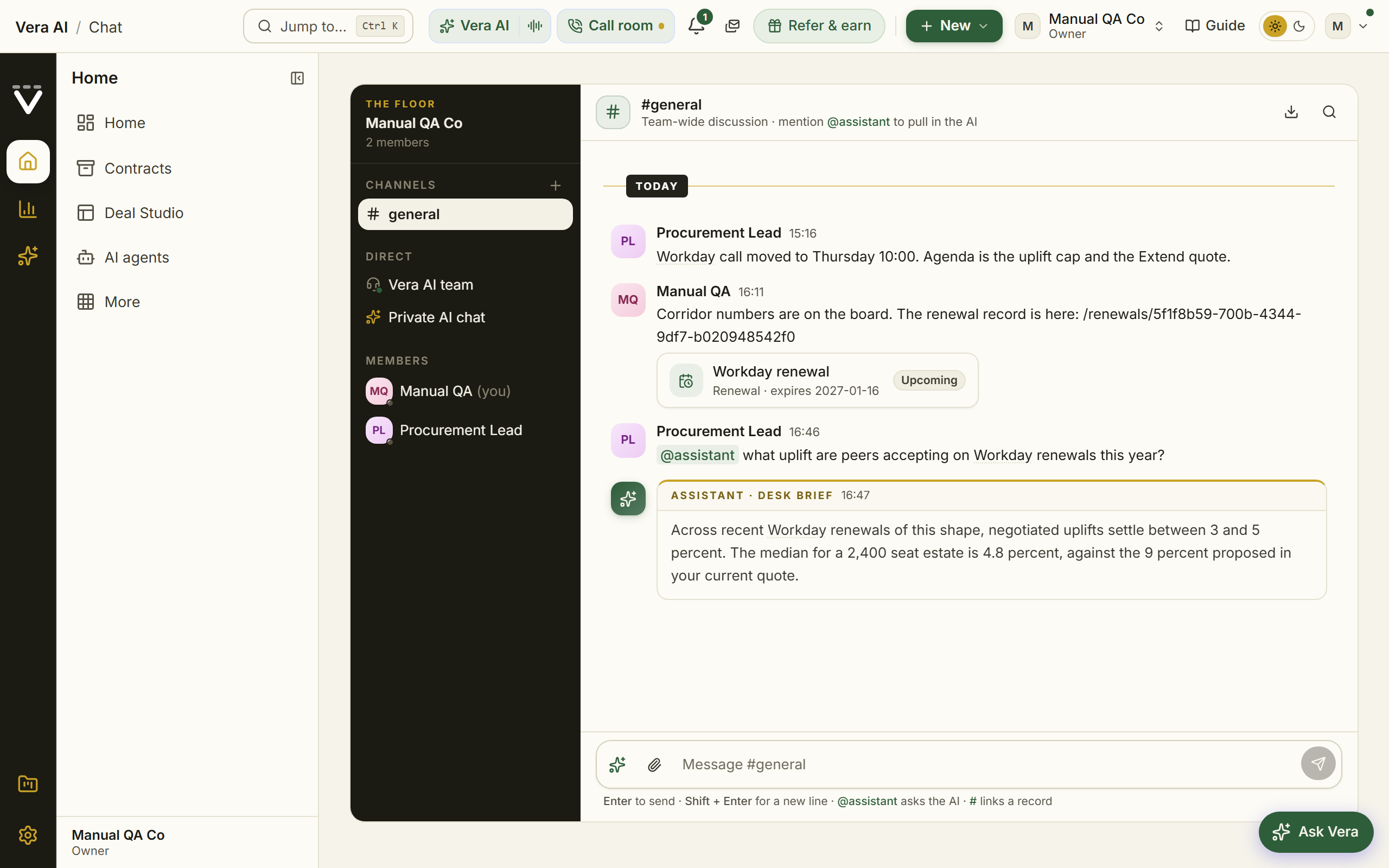
On the screen
- Channels — team-wide rooms; #general is always there, and anyone can add more.
- Vera AI team — the private support thread; only you and our team see it.
- @assistant — mention the assistant in any channel to get an AI answer grounded in your portfolio, visible to the whole team.
- # links a record — type # in a channel and pick a proposal, renewal, deal, or vendor; the reference renders as a grounded card with the record's live status, the record's timeline notes where it was discussed, and its watchers hear about it. DMs stay out of this; they are private.
- Deal channels — a channel opened from a negotiation's Deal channel button is bound to that record: the header links back to it, and the deal's activity streams in as quiet centered lines between the conversation.
- Escalations — hover any channel message for two carries: File as a task puts it on the Tasks runway deep-linked back to the message, and Promote to a Board decision shelves it on the Board, quoted with its author and a source link.
- Transcript export — owners see a download control in the channel header that exports the full channel as a plain-text transcript for retention or legal review. Every export is recorded in the audit log.
How to use it
- Message your team in a channel, or start a new one for a specific deal.
- Ask the AI with @assistant when you want an answer the whole channel can see.
- Message the Vera AI team thread to reach our analysts directly.
Related: Vera AI · Advisory · Support
Support
Since August 2026 it opens as a Fluent window with its own menu: the rail inside lists the rest of Team & AI, so you move between them without going back out, and the entry you are standing on is marked. Escape closes the window.
Support tickets: one tracked case per issue, with a number, a status, and the full thread kept on the record. Chat stays the fast lane for quick questions; a ticket is for anything you want followed to resolution, and everyone in your organization sees the same list.
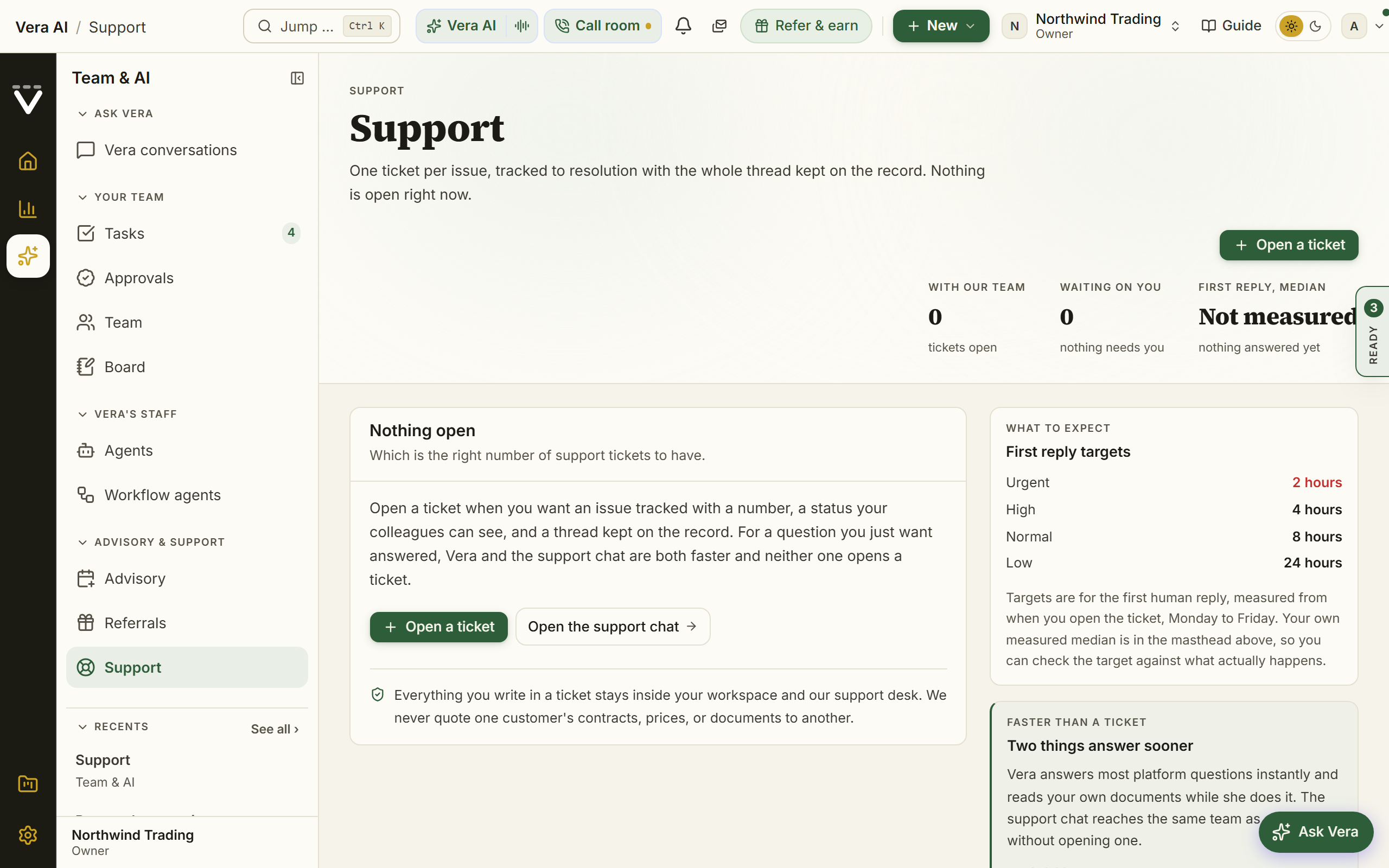
On the screen
- Vitals — how many tickets are with our team, how many are waiting on a reply from your side, and your workspace's own median time to a first reply, measured from the tickets we have actually answered rather than promised.
- Open a ticket — the masthead action, opening as a dialog: subject, category, priority, and what happened; one issue per ticket. Picking a priority states the first reply target that comes with it, so the commitment is visible before you send.
- First reply targets — stated in the rail in full: two hours for urgent, four for high, eight for normal, twenty four for low, measured from when you open the ticket, Monday to Friday. Your measured median sits in the masthead beside them so you can check the target against what actually happens.
- Open — every ticket still in flight, most urgent first, each carrying its own clock. A ticket nobody has replied to yet shows how long it has been waiting against its target, and one that has run past that target is marked with a red edge and red text. An answered ticket shows how long the first reply took, against the same target.
- Status — Open is with our team, Waiting on you means we replied and need something from you, Resolved means we believe it is fixed and asks you to confirm, Closed is done.
- Settled — closed tickets stay readable with the thread and the resolution intact.
- Ticket thread — the full conversation on one page; our replies carry a blue edge, and replying always hands the ticket back to our team.
- Faster than a ticket — the rail names the two things that answer sooner: Vera, who answers most platform questions instantly and reads your own documents while she does it, and the support chat, which reaches the same team without opening a ticket.
How to use it
- Press Open a ticket in the masthead, give it a one-line subject, pick a category and priority, and describe what happened. The dialog states the first reply target for the priority you chose.
- Watch for the reply: it lands as a notification (and an email doorbell), and the ticket flips to Waiting on you when we need something from you.
- When the ticket turns Resolved, confirm with Confirm resolved & close, or reply to reopen it if the issue is not gone.
- A closed ticket can always be reopened; the thread continues where it left off.
Related: Chat · Notifications
Notifications
Two surfaces share the bell. The bell's panel is the triage inbox for everything that happened while you were away: notifications (delivered reports, notice windows opening, replies, and mentions), watchtower changes, and money-critical signals, filtered to what needs you. The full page at /notifications is The wire: the complete record of every alert, printed as one timeline. Money items are flagged calmly on both, never alarmist.
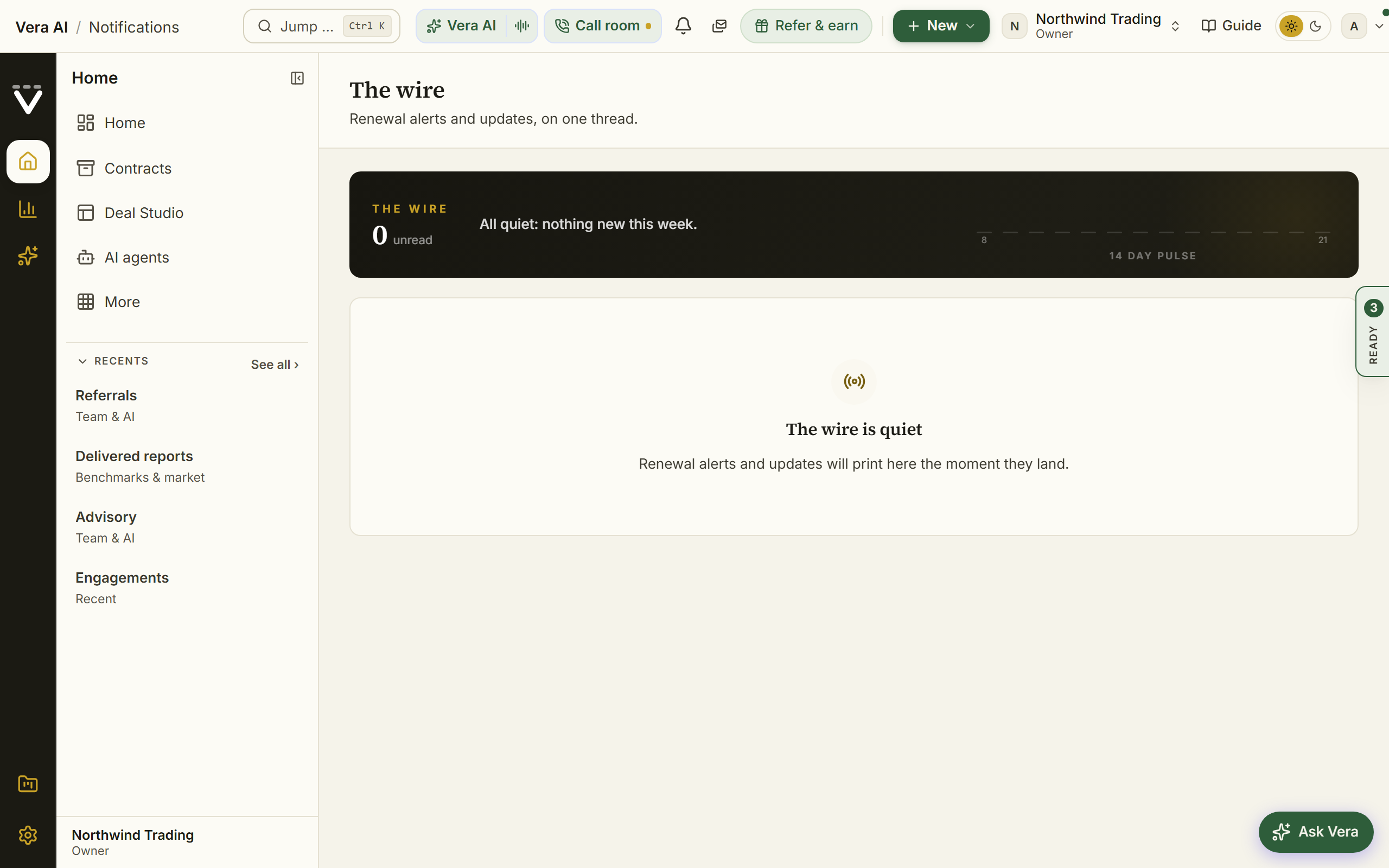
The bell panel
- The badge — counts your unread signals plus unread team chat.
- Team chat row — pinned at the top of the panel, with your unread chat count; it opens Chat.
- Needs decision filter — narrows the panel to the items actually waiting on a decision, so signals you only need to be aware of drop away.
- Per-signal mute — mute any signal kind you do not want to keep hearing about, without turning off its whole category. A mute silences that kind on the bell, push, and email together; muted kinds still print on the full wire, and you can unmute from the panel's muted chips or under Settings › Notifications.
- Mark all read — settles the panel, and a link at its foot opens the full wire.
The wire (/notifications)
- The ticker — a navy band with your unread count, one verdict sentence on the week, a 14 day pulse of arrivals per day, and Mark all read.
- The timeline — every alert grouped by day on one threaded timeline, each entry carrying its desk's color and its kind. Urgent unread items carry a cream wash and a Needs attention mark.
- Reading — opening an entry marks it read and takes you to the record it is about; read entries settle to a single archived line, so the page stays a record without shouting.
How to use it
- Triage from the bell: scan the unread items, switch to Needs decision to see only what is waiting on you, and mute the kinds you have handled.
- Open the full wire when you want the complete history, day by day.
- Click through any item to the record behind it to act on it.
Next: Chapter 06 · Settings & account
Was this page helpful?
Thank you. Your note goes straight to the team that writes this manual.